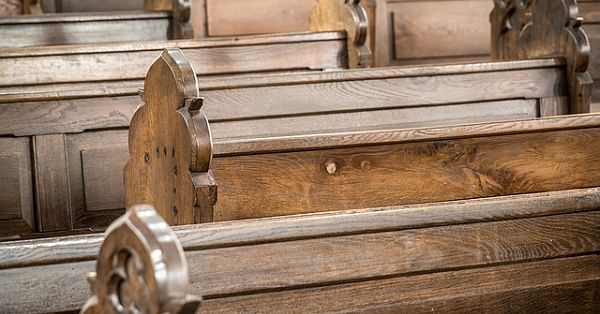
Lutheran writer and humorous church historian Luke T. Harrington writes about the history of church pews.
In Luther’s day and before, everyone stood or kneeled sometimes in church. The pews were invented first as private boxes that allowed the nobility to avoid mixing with the vulgar masses. Then they kept evolving.
Read what happened, including a cultural study of sitting, after the jump.
From Luke T. Harrington, The History of Pews Is Just as Terrible and Embarrassing as You’d Imagine – Christ and Pop Culture:
Is there anything more reassuring than a church pew?
Simple. Humble. Sturdy. Two rough-hewn planks, fastened with a handful of nails, permanently fixed to the floor—and open to all. Occasionally padded, often not; not comfortable, exactly, but comforting. An invitation to the weary traveler to sit and hear the Word of God proclaimed; a simple reminder that we follow a humble, crucified carpenter; the perfect symbol that all are equal at the foot of the cross. From the greatest king to the poorest pauper, from the holiest saint to the most desperate sinner, all have sat in these pews before us, pondering their failings and begging for mercy. Despite the advent of stadium-style seating and auditorium-like worship halls, the simple, ancient pew endures—and no wonder, because it is, and always has been, the perfect metaphor for the faith.
Seating in churches didn’t really become a thing until parishioners got bored enough to wish they were sitting down—that is, about the time of the Protestant Reformation.
Except—nothing I just said is even remotely true. In fact, it’s pretty much the exact opposite of all that. Would you like to know the true story of the pew? Okay, then—buckle up. (But not actually, though, because pews don’t have seatbelts.)
It turns out that there’s no evidence of churches having seating of any kind for at least the first 1,400 years or so of Christianity. In other words, Augustine, Athanasius, Jerome, Thomas Aquinas, Martin Luther, John Calvin—all those guys very likely lived their whole lives attending churches that were standing-room-only. During ancient Christian worship, parishioners could stand, kneel, or even mill about the nave if they so chose. There’s no record of whether they engaged in stage dives and crowd surfing, so we’re forced to assume they did.













 Ad-Free & Subscriber Log-In