

Sometimes I come across items that aren’t newsy or big ideas for discussion, but I still want to share them with you. For example, stand-alone quotations, intriguing websites, and opportunities you might appreciate. Let’s call them “Items of Interest.” This probably won’t be a regular feature of this blog, but maybe an occasional feature. So try these for our inaugural Items of Interest post:
A Psalm about AI. Martin Luther’s handwriting font–and more. And my book on George Herbert is on sale for half-price.
A Psalm about AI
The Civitas Institute, a conservative research center at the University of Texas at Austin, has published a post by Spencer Klavan reviewing a book about Jewish legends about inanimate objects that acquire human traits–as in the Golem tales–and how they apply to AI.
Martin Luther’s Handwriting Font–and More
You Cranachers who have followed this blog for a long time may remember way back in 2017 when a German typeographer named Harald Geisler approached us about his project of designing a computer font based on Martin Luther’s handwriting.
I have it on my computer and it enables me to type things like this:
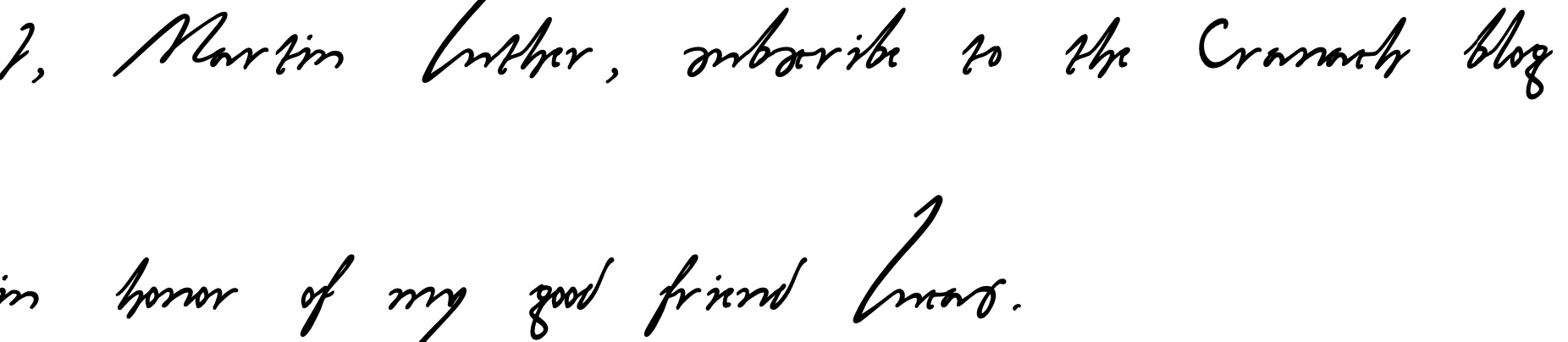
Now, eight years later, Herr Geisler has written us again, announcing both an update to the Luther font and a bigger project: a site that will be a library of fonts based on the handwriting of famous people.
He has already devised and made available fonts based on the handwriting of Albert Einstein, Sigmund Freud, Rosa Luxemberg, and Martin Luther King, in addition to our guy. These fonts, including Luther’s, will migrate to the new site and will only be available there after December 6.
Read the announcement here, which also contains various links you may want to check out. The new site is called The Digital Handwriting Font Library and is worth visiting just to see some fascinating examples of handwriting.
To help raise financial support, he is offering library memberships, with a free level giving you limited access to the fonts and higher levels of membership with more complete access, including the ability to download the fonts, starting at 2 euros per month ($2.32) per month.
Members will get to vote on who’s next to get their handwriting turned into digital fonts. Actually, members get two votes and can suggest other possibilities. The curent candidates are J. W. Goethe, Friedrich Schiller, Marie Curie, Ada Lovelace, Emily Brontë, C. J. Walker, and Thomas Jefferson.
We here at the Cranach blog have been lamenting the lost art of handwriting, so I think this is a worthy project.
My Book on George Herbert Is Half Price
I got word from Wipf & Stock that my book Reformation Spirituality: The Religion of George Herbert is on sale for half price, a $37 value for $18.50 for the paperback or $17 for the ebook.
In looking into the matter, I saw that I wasn’t being singled out but that ALL Wipf and Stock books are on sale for half price. The sale ends soon, though, on November 30. But if you buy a book before the end of the month from the W&S website and enter the code CONFSHIP at checkout, you can get it for half price.
The offerings include eight books by the Swedish theologian Gustaf Wingren, including the classic Luther on Vocation!
As for my book, this is what started it all for me. It is basically a revision of my doctoral dissertation, which launched me into my profession. And it got me started as a writer. Most importantly, the research I did for this book is what would lead me to Lutheranism. (By the time I published this book, originally with Bucknell University Press in 1985, I was already a Lutheran.)
George Herbert, I contend, is the greatest Christian lyric poet in the English language. A master of literary form–often using his poetic form in utterly original ways to underscore the meaning of his poems–he is also one of the greatest poets in the English language, period.
I have often blogged about Herbert. He was an Anglican priest writing at a time when the Church of England was heavily influenced by the Reformation. Instead of writing about ascending to God, as medieval writers like Dante did, Herbert writes about running away from God until God comes down to him. He does so in Christ, in His Word, in His sacraments. That is to say, Herbert writes about God’s grace, something I never heard about in my days in mainline liberal Protestantism.
And though he was not quite Lutheran, his emphasis on justification by grace through faith in the work of Christ and His use of the Bible that permeates all of his verse are combined with a sacramentalism and a liturgical worship that pointed me to Lutheranism.
Before my research, most Herbert scholars read his poems in terms of medieval Catholic meditation practices or 19th century Anglo-Catholic categories. I read him in terms of the Reformation. Today, with the help of some other scholars, that view has pretty much won out in Herbert scholarship.
Read Herbert’s poetry. And if you’d like a guide to lead you through it, read my book.
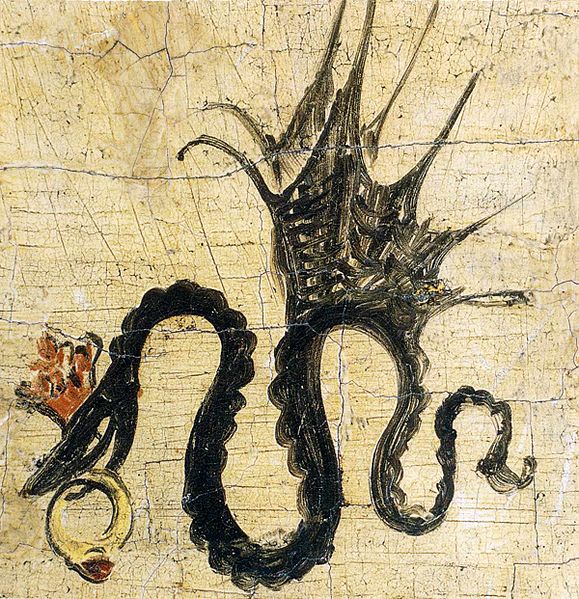
Illustration: Lucas Cranach’s seal, based on his coat of arms and used in various stylized forms to sign his paintings.














 Ad-Free & Subscriber Log-In