

At this blog, we have worried about the decline of Christianity, and we have also worried about the decline of liberalism (that is, liberal in the sense of “freedom,” plus individual rights, plus democratic self-government).
What if there is a connection between those two great traditions, one religious and the other political, both of which are being repudiated by thinkers and the general public from both the left and the right? Might the decline of Christianity be causing the decline of liberalism?
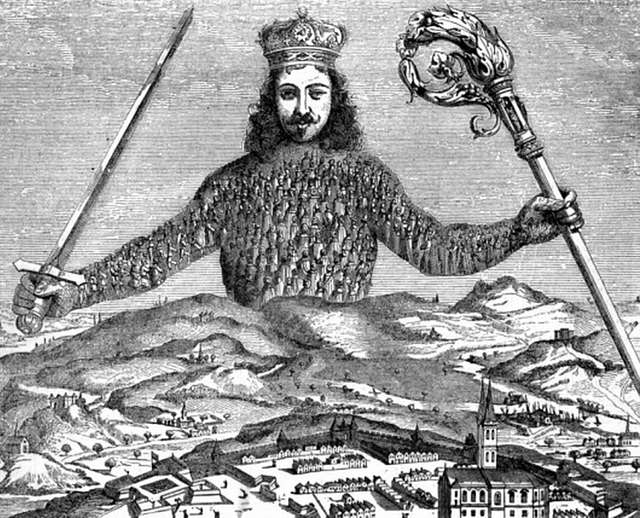
The prominent political thinker John Gray thinks so. He has written a new book entitled New Leviathans, subtitled “Thoughts after liberalism.” The title refers to the book Leviathan by his fellow English political theorist Thomas Hobbes. In contrast to the romantics who idealized the “state of nature” as a realm of peace and harmony, Hobbes believed the state of nature is a “war of all against all,” in which “the life of man” is “solitary, poor, nasty, brutish, and short.” What’s needed to prevent our lapsing into that state of anarchy, Hobbes argued, is a powerful monarchical government–a “leviathan”–to impose social order.
Grey worries that our current liberal leviathan is breaking down, heralding a reversion to the “war of all against all.” As Bonnie Kristian summarizes his conclusion, “a world after liberalism will be morally worse than the world before it.”
She has written a thoughtful review of Gray’s book for Christianity Today entitled Christianity Has Anchored Free Societies. What Happens as They Deconvert?, with the deck “Philosopher John Gray predicts we’re headed for an age of all-consuming moral warfare.”
All four of the defining ideas of liberal thought are continuations of Christian monotheism. The primacy of the individual is a secular translation of the belief that each human being is created by the Deity, which has an authority over them which transcends any worldly power. The egalitarian belief that human beings have the same moral status reproduces the idea that all human beings are equal in the sight of God. Liberal universalism—the belief that generically human attributes are more important than particular cultural identities—reflects the idea that humankind is created in God’s image. The belief that human institutions are indefinitely improvable replicates the theistic faith that history is a moral narrative of sin followed by redemption.
But what about today’s Christian illiberals? Well, the most prominent today are the Integralists, and they are Catholic, not holding to “the primacy of the individual.” The Seven Mountain Dominionists are Pentecostals, that is to say, “enthusiasts,” who worked for an earthly kingdom as early as the Reformation. The Reformed Dominionists don’t believe in universal atonement, so with their special role for the Elect would be weak in other kinds of universalism, and their tradition has a history of theocracy. But most American Christians–including most Catholics, Pentecostals, and Reformed–historically haven’t gone that far and have promoted this kind of “liberalism.”
“What happens, then, as the West deconverts?” Kristian asks. “Our culture’s post-Christianity and its post-liberalism go hand in hand, Gray suggests. Christendom is supplanted not by a reversion to paganism, as some conservatives think, but by a perversion of Puritanism, bloated with rules and bereft of redemption.”
“Christian values continue to be widely authoritative if not often practiced,” Gray observes. But “unmoored from their theological matrix, they become inordinate and extreme. Society descends into a state of moral warfare unrestrained by the Christian insight into human imperfection.”
This, Gray says, is the origin “of what has come to be called the woke movement” and its chaos-courting champions among the Western elite.
Having jettisoned liberalism’s individualism and universalism—along with Christianity’s bestowal of identity and community in Christ and the unchosen bonds of family and place—we’re left to define ourselves from scratch as chaos swells around us.
Wokeness, according to Gray as Kristian explains it, is “a lifestyle, worldview, and career path; morally stringent and tirelessly political; personal identity, public power, and ethical cleansing all wrapped up together.” And it is intrinsically elitist and a matter of social standing.
Envisioning a representative member of this intellectual elite, Gray charges him with “[r]ecycling the fashionable detritus that millions like him unthinkingly believe [while being] convinced of his independence of mind.” That false confidence risks his destruction—and ours. “He denounces society while never doubting its stability or his place in it. Gleefully conniving in the destruction of traditional morality, he is pitifully unprepared for the savagery that ensues when it breaks down.”
Illustration: Allegorical Figure of a Commonwealth, from Hobbes’ Leviathan via Picryl, Public Domain, http://commons.wikimedia.org/











 Ad-Free & Subscriber Log-In