

For All the Saints
First of all, I’d like to thank my most recent Patreon supporter, Michael Magee, and my other patrons! Mr. Magee joined this month with an extremely generous donation, and I’m still between jobs at the moment, so that was really encouraging.
Also, quick note. This post is another one with some substantial chunks that, while interesting, aren’t essential to understanding the text I’m commenting on from Revelation chapter 7. To save some space, I’ve put these less-necessary portions of the text in small type—if you aren’t interested, you shouldn’t miss anything crucial by skipping these.
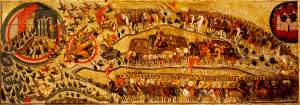
Ecclēsia Mīlitāns [“The Church at War”] (mid-
16th-c.), one of the largest ikons ever created
at 4’8″ high and nearly 13′ wide.
Today’s post is for Hallowmas, a.k.a. All Saints’ Day, a.k.a. All Hallows—a festival originally instituted (if memory serves) to honor those martyrs whose names we don’t know, and eventually extended to all the saints we don’t know about, and from there to all saints, period. It therefore felt like an especially fitting occasion on which to translate all three Mass readings, and it is also one on which I can do that, because the Lesson is from the Apocalypse and therefore in Greek! That does also mean we have a lot to get through, so I’ve split this one in two (and skipped Sunday’s readings). It also turned out I had much more to say about the Lesson than about either the Epistle or the Gospel—both of which, I had forgotten, I’ve translated here before!—so I’m dealing with the first by itself. And since I’m doing so …
New Covenant, Who Dis
It will come as no surprise that there is debate nowadays over who wrote Revelation; it may come as a surprise that this debate stretches far back in the history of the Church, possibly to the first century. In fact, it took this book a little longer than most of the rest of the New Testament to secure recognition as divinely inspired: it was among what are called the antilegomena, meaning “spoken against” or “disputed.”
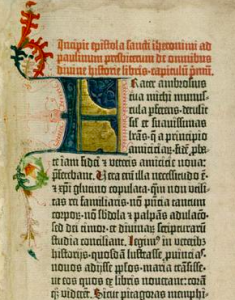
The antilegomena (sg. antilegomenon) were prospective members of the New Testament that were, for a while, considered debatable. All told, there were around a dozen: a gospel, several letters, a handful of apocalypses, a couple of other oddities. For example, in the Syriac tradition,1 the standard edition of the New Testament (known as the Peshitta or P’šitta2) originally included one letter each from SS. Peter, James, and John, but not the books of II Peter, II John, III John, Jude, or Revelation—these didn’t begin to be standard inclusions in the Syriac Bible until the sixth century. The list is roughly as follows—italicized names denote books whose rejection from the canon became final. (I’ve defined the list of what was considered for possible inclusion in the New Testament fairly generously: some works below, like I and II Clement, were only seen as possibly canonical in extremely niche circles, and there seems to be serious doubt whether the Acts of Paul and Shepherd of Hermas were ever seriously proposed as inspired.)
Evangel
- Gospel of the Hebrews (the only major antilegomenon that is now lost)
- Acts of Paul3
Letter
- II Peter
- Jude
- James
- II John
- III John
- Hebrews (often attributed to St. Paul in antiquity, though this was always disputed)
- Barnabas (forged)
- I Clement (by Pope St. Clement I)
- II Clement (mistakenly attributed to St. Clement; survives only incompletely)
Apocalypse
- Apocalypse of John (a.k.a. “Revelation”)
- Apocalypse of Peter (forged)
- Shepherd of Hermas
Catechism
- Teaching of the Twelve Apostles (a.k.a. “the Didache“)
Apocalypse Who
But about Revelation. If the St. John we usually mean when we say “St. John” didn’t write it, then who did? Or if he did, why have so many people throughout history thought he didn’t?
The answer to this is, first of all, stylistic; but when I say that the canonical Apocalypse differs stylistically from the rest of the Johannine corpus (i.e. John, I John, II John, and III John4), I need to be clear how extreme these differences are. A couple of weeks ago, I was saying I found it extremely silly to dispute the authorship of a book on grounds like He uses “faith” as the name of a virtue in his other letters, but in these ones he talks about “the faith” as something with settled doctrine; but this is not that. When I refer to the style of Revelation being extremely different from the other Johannines, what I’m talking about is things like The author flubs basic points of grammar here and there. And not just fiddly, complicated points like when to use παρά with the dative versus when to use it with the accusative; I mean that whoever wrote Revelation can’t always keep his tenses straight, even within the same sentence.
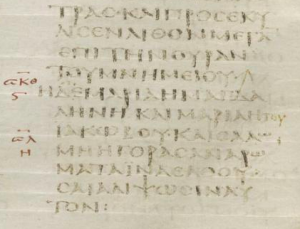
This is emphatically not what we would expect from the author of the Fourth Gospel! That work does have a very weird feel to it in Greek—I’d go as far as to say it obviously wasn’t written by a native speaker (though a native speaker might have been its amanuensis). But its weirdness is not a matter of clumsiness. Though its rhetoric doesn’t imitate Greek models, it’s an extremely elegant style, smooth for all its strangeness; the only thing I can think of to compare it to is something like this:
My father is lord of the province of Calavar and is one who has the right of standing on his feet in his shoes before the face of the Tisroc himself (may he live for ever). My mother (on whom be the peace of the gods) is dead and my father has married another wife. Now it came to pass that my father’s wife, my stepmother, hated me and the sun appeared dark in her eyes as long as I lived in my father’s house. And so she persuaded my father to promise me in marriage to Ahoshta Tarkaan. Now this Ahoshta is of base birth, though in these latter years he has won the favor of the Tisroc (may he live for ever) by flattery and evil counsels. Moreover he is at least sixty years old and has a hump on his back and his face resembles that of an ape. Nevertheless my father, because of the wealth and power of this Ahoshta, and being persuaded by his wife, sent messengers offering me in marriage, and the offer was favorably accepted. When this news was brought to me the sun appeared dark in my eyes and I laid myself on my bed and wept for a day.5
So the idea that the same person who wrote the Gospel and First Epistle of John also wrote something that is, in technical terms (whatever its merits), as bad as the Apocalypse … there’s a good reason it’s a hard sell?
John the Revelator
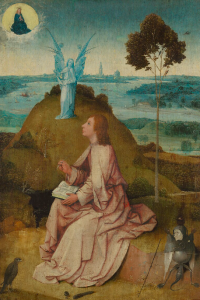
John on Patmos (ca. 1489), by Hieronymus Bosch.
That said, I actually do think St. John the Apostle wrote the Apocalypse. I’ve talked about my theory of the Johannines before, though at the time I didn’t mention Revelation; the short version of the theory is, I think St. John the Elder (a disciple from Ephesus mentioned by the second-century writer Papias) served as St. John the Apostle’s scribe, helping in particular with the composition of the Gospel and I John, and that he was himself the author of II and III John. On this theory, part of the reason for the flawed Greek of the Apocalypse is that St. John (likely a native speaker of Aramaic), being in exile on Patmos when he wrote it, accordingly lacked the assistance of his eloquent secretary; he was therefore obliged—since he was sending this to the Christian congregations he knew in the province of Asia, which was Greek-speaking—to write in Greek as best he could.
Still though, why attribute this to the St. John, especially since John was such a common name? Well, it was common—but not nearly as common in the New Testament as we might expect. The Baptist and the Beloved Disciple are the only figures of importance of this name in the Gospels or Acts; I’m not sure the name comes up even once in the epistles, including the Johannines themselves. So, while this is not a certainty, it sounds as if only one living man could have described himself as “I, John” (Rev. 1:9) without further explanation and be confident he’d be understood. That suggests that this was either by the Apostle or was forged by someone feigning to be him specifically.
But that alone would make a very flimsy case for its authenticity. There are other elements here that, in my opinion, point to St. John. As I said, the surface-level style is very inconsistent with John and I John; however, certain motifs and structural elements—the kind of things which can persist across divergent styles and even across divergent languages—are shared in common.
One of the more neglected elements of both the Apocalypse and the Gospel, in my opinion, is their templar character (as in, the adjective meaning “of or concerning the Temple”—nothing to do with the Knights Templar). People are typically so busy trying to decode who the seven heads and ten horns of the Dragon are that they don’t pay much attention to the setting the seer establishes for the majority of the book: the heavenly throne room, a familiar location in apocalyptic and Hekhaloth literature, hinted at carefully in the writings of the Merkavah mystics. Hebrews states explicitly, which was already an element in Judaic belief, that the heavenly throne room was the divine archetype of which the Temple in Jerusalem was the earthly ectype. I have no space here to go into detail about these strands of Judaic and primitive Christian theology (though I’ve touched on them in brief a few times before now, I recommned Dr. Justin Sledge’s video essay introducing Merkavah mysticism on his YouTube channel ESOTERICA); what I will do is highlight that this interest in the Temple is shared with the Fourth Gospel. Jesus visits Jerusalem and spends time in the Temple more frequently there than in any of the Synoptics (visits are explicitly indicated 2:13, 5:1, 7:2-14, 9:1-7, 10:22-23, and finally 12:12-15), and allusions to the Judaic liturgy—synagogal, but especially templar—are common in John, both in the narrative and in the imagery: the lamb, the wine, the water, the bread.
However, the most obvious of these shared traits between Revelation and the other Johannines is the recurrence of the number seven. The first half of the Fourth Gospel is structured on seven miracles performed by Christ: two at Cana, one at the pool of Bethesda in Jerusalem, one by the Sea of Galilee, one on that Sea, a second also in Jerusalem, and one at Bethany. Seven appears in other places as well: the seven days alluded to in the first two chapters (1:29, 35, 43 and 2:1), which, taken together with the allusion to creation in the prologue (1:1-18), suggest the inauguration of a new creation; or the seven Apostles mentioned by name, which are i. Andrew, ii. Simon Peter, iii. Philip, iv. Nathanael (Bartholomew), v. Thomas the Twin, vi. Judas Iscariot, and vii. Judas (Thaddæus). And turning to Revelation, not only is it literally impossible to go a chapter without encountering this number—seven spirits, seven stars, seven churches, seven seals, seven trumpets, seven thunders, etc.—but the vision concludes with a new heaven, a new earth, and a new Jerusalem, whose new Temple is the Lamb.
In any event, let us turn to the Lesson for All Saints’.
Revelation 7:2-4, 5-8, 9-14, RSV-CE
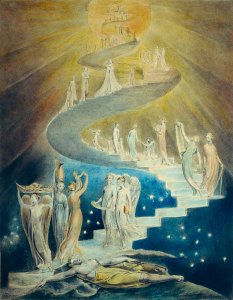
Jacob’s Dream (c. 1800), by William Blake.
Then I saw another angel ascend from the rising of the sun,a with the seal of the living God,b and he called with a loud voice to the four angels who had been given power to harmc earth and sea, saying, “Do not harm the earth or the sea or the trees, till we have sealed the servants of our God upon their foreheads.” And I heard the number of the sealed, a hundred and forty-four thousandd sealed, out of every tribe of the sons of Israel, twelve thousand sealed out of the tribe of Judah, twelve thousand of the tribe of Reuben, twelve thousand of the tribe of Gad, twelve thousand of the tribe of Asher, twelve thousand of the tribe of Naphtali, twelve thousand of the tribe of Manasseh, twelve thousand of the tribe of Simeon, twelve thousand of the tribe of Levi, twelve thousand of the tribe of Issachar, twelve thousand of the tribe of Zebulun, twelve thousand of the tribe of Joseph, twelve thousand sealed out of the tribe of Benjamin.e
After this I looked, and behold, a great multitude which no man could number, from every nation, from all tribes and peoples and tongues, standing before the throne and before the Lamb, clothed in white robes, with palm branchesf in their hands, and crying out with a loud voice, “Salvation belongs to our God who sits upon the throne, and to the Lamb!” And all the angels stood round the throne and round the eldersg and the four living creatures, and they fell on their faces before the throne and worshiped God, saying, “Amen! Blessing and glory and wisdom and thanksgiving and honor and power and might be to our God for ever and ever! Amen.”
Then one of the elders addressed me, saying, “Who are these, clothed in white robes, and whence have they come?” I said to him, “Sir, you know.” And he said to me, “These are they who have come out of the great tribulation;h they have washed their robes and made them white in the blood of the Lamb.
Revelation 7:2-4, 5-8, 9-14, my translation
And I saw another messenger coming from the rising of the sun,a who had a seal of living God,b and he cried out in a great voice to the four messengers to whom it was given to injurec the land and the sea, saying: “Do not injure the land, nor the sea, nor the trees, before we seal the slaves of God on their foreheads.”
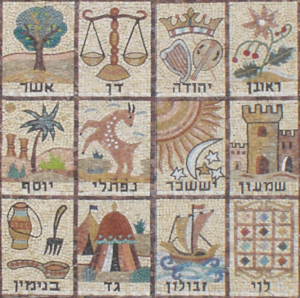
A mosaic (20th-c.) of the Twelve Patriarchs’
names and symbols from the Etz Yosef
synagogue in Jerusalem.6
And I heard the number of the sealed, a hundred forty-four thousand,d sealed from every tribe of sons of Israel:
…..from the tribe of Yehudah, twelve thousand sealed;
…..from the tribe of Ruven, twelve thousand;
…..from the tribe of Gad, twelve thousand;
…..from the tribe of Asher, twelve thousand;
…..from the tribe of Naftaly, twelve thousand;
…..from the tribe of Menassheh, twelve thousand;
…..from the tribe of Shimuoun, twelve thousand;
…..from the tribe of Lewy, twelve thousand;
…..from the tribe of Yššakhar, twelve thousand;
…..from the tribe of Zevulun, twelve thousand;
…..from the tribe of Yousef, twelve thousand;
…..from the tribe of Bin-yamyn, twelve thousand sealed.e
After these things I saw, and look—a large crowd, which no one is able to number, from every nation and tribe and people and tongue, standing before the face of the throne and before the face of the lamb, clothed in white gowns, and with palmsf in their hands. And they were crying with a great voice, saying, “Our salvation is to God, who is seated on the throne, and to the Lamb.” And all the messengers were stood in a circle around the throne and the eldersg and the four living things, and they fell before the throne on their faces and prostrated themselves to God, saying: “Amen: blessing and glory and wisdom and thanksgiving and honor and power and strength to our God, into ages of ages. Amen.”
And one of the elders responded, saying to me, “Who are these who are clothed in the white gowns, and where do they come from?”
And I answered him: “My lord, you know.”
And he said to me: “These are the ones coming out of the great distress,h and they washed their gowns and made them white in the Lamb’s blood.”
Textual Notes

Sunrise seen from a national park in New South
Wales, Australia. Photo by P. R. Fenelon, used
under a CC BY-SA 4.0 license (source).
a. the rising of the sun | ἀνατολῆς ἡλίου [anatolēs hēliou]: Ancient Greek had two sets of compass-directional terms, one based on the names of the winds and one based on celestial bodies. The expression ἀνατολῆ ἡλίου, “the ascendancy of the sun”—which is the origin of the name Anatolia—is from the second of these sets, aligning with terms like ἄρκτος [arktos] for north, hence Arctic. (The literal meaning of ἄρκτος is “bear”: it came to mean “north” by reference to the constellation Ursa Minor, “the Lesser Bear,” in which Polaris is located.)
b. the seal of the living God/a seal of living God | σφραγῖδα θεοῦ ζῶντος [sfragida theou zōntos]: Here we have an example of Revelation’s Greek being a tad rough! Normally Greek, like English, would use the definite article with θεός [theos] “God.”
c. harm/injure | ἀδικῆσαι [adikēsai]: I have used “injure” here on etymological grounds: that word originates in the Latin injūria, meaning “injustice, wrong, unlawfulness” (from a negation of jūs “right, law”). The structure of ἀδικῆσαι is almost exactly analogous to that of injūria, using the negating particle ἀ- with a verb formed from δίκη “justice, right”; the more concrete meaning “harm,” which is technically distinct from doing wrong to someone, most likely developed because doing wrong to someone nearly always means doing them harm.
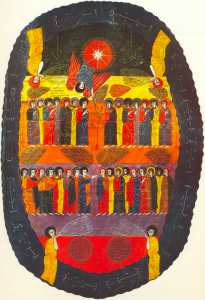
An illumination from the Facundus manuscript
(ca. 1050) of St. Beatus of Liébana’s commentary
on Revelation, depicting the sealing of the
hundred and forty-four thousand.
d. a hundred and forty-four thousand/a hundred forty-four thousand | ἑκατὸν τεσσεράκοντα τέσσαρες χιλιάδες [hekaton tesserakonta tessares chiliades]: Twelve, being the number of the Patriarchs (the sons of Jacob and thus the fathers of all Israelites), is a traditional numerological symbol of God’s chosen people. Multiplied by both itself and a thousand, we therefore have a number suggesting the whole immense mass of Israel. Interestingly, this seems to indicate only one part of the elect; the hundred and forty-four thousand are discussed here (twelve thousand from each of the twelve tribes), and then the “multitude no man can number” are introduced separately, after the hundred forty-four thousand are enumerated. This might indicate the distinction between the elect of the Mosaic Covenant versus the elect of the New; I’m not sure.
e. Judah … Reuben … Gad … Asher … Naphtali … Manasseh … Simeon … Levi … Issachar … Zebulun … Joseph … Benjamin/Yehudah … Ruven … Gad … Asher … Naftaly … Menassheh … Shimuoun … Lewy … Yššakhar … Zevulun … Yousef … Bin-yamyn | Ἰούδα … Ῥουβὴν … Γὰδ … Ἀσὴρ … Νεφθαλὶμ … Μανασσῆ … Συμεὼν … Λευὶ … Ἰσσαχὰρ … Ζαβουλὼν … Ἰωσὴφ … Βενιαμὶν [Iouda … Rhoubēn … Gad … Asēr … Nefthalim … Manassē … Sümeōn … Leui … Issachar … Zaboulōn … Iōsēf … Beniamin]: As I generally do, I’ve tried to give a more exact transliteration of the Hebrew names here, rather than sticking strictly to the Greek or being guided mainly by English precedent. (I’m the bolder to do this, on the grounds that the Greek was also produced by someone trying to record Hebrew, possibly modified by Aramaic, in Greek letters as best they could.)
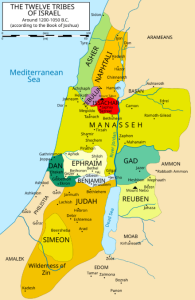
A modern map of the territories attributed to
the Twelve Tribes in the book of Joshua,
created by Wikimedia contributor Janz, used
under a CC BY-SA 3.0 license (source).
The list here in the Apocalypse differs slightly from the Torah’s list of the Patriarchs, in both order and content. In content, there are a couple curveballs.
- One name we would expect to find, Dan, is missing. That it should be him is a bit odd, since Dan was not one of the first tribes to become extinct in the male line; Reuben and Simeon appear to have dwindled first and fastest, vanishing from the records even before the Assyrian deportations (let alone the Exile).
- Two names we would not expect to find simultaneously are Joseph and Manasseh. We’d usually see either the two half-tribes of Joseph, i.e. Manasseh and Ephraim; or, find Joseph named singly, and still have Dan.
Subtracting Dan and treating the half-tribes as full tribes still gives us a total of Twelve, so the math still maths, but I’m not clear why this was done. It faintly echoes the perplexity of whom to count as “the Twelve Apostles” after Judas’s, uh, emphatic exit from the list: by one way of thinking, the twelfth apostle is obviously St. Paul, while according to another, it’s St. Matthias.
The list is also very much out of any order we would expect, at least in the first half. It’s no surprise that Judah, the honorary firstborn, appears first, nor inexplicable that Reuben, the natal firstborn, is next. In the third place, we’d expect to find either Simeon (next chronologically) or Levi (the tribe of the priesthood)—or failing them, probably Joseph. And we find … Gad. As the seventh of Israel’s sons, the first child of Leah’s maid Zilpah, and one of the three that took land on the eastern side of the Jordan, Gad doesn’t have a very clear significance? His only full brother, Asher, is right afterward, which kind of makes sense; next is Naphtali, who was older than either Gad or Asher.7 Then Manasseh, whose place also seems random. He is separated from the two related names here, Joseph and Benjamin, so his treatment isn’t like Asher’s.
The second half seems a tad more logical: its first four are all sons of Leah, listed in their birth order, while the last two are the sons of Rachel and also the two youngest (not counting Manasseh). In terms of hard facts about this listing of the Twelve Tribes, I’m now out; the rest of this textual note passes into the realm of hypothesis and guesswork.
Joshua Commanding the Sun to Stand Still
Upon Gibeon (1816), by John Martin.
I did eventually come up with a possible explanation for these oddities. It’s pretty out there—so much so that at first, I was reluctant even to mention it in anything more than a footnote. But the footnote kept getting longer and longer, until I started to think there really might be something in it. Even so, I want to stress: the following is extremely speculative!
With that caveat, I’d like to dig into the idea that this list of the Tribes corresponds with the Twelve Apostles. The idea doesn’t come completely out of a vacuum: Jesus does promise that “in the regeneration when the Son of man shall sit in the throne of his glory, ye also shall sit upon twelve thrones, judging the twelve tribes of Israel” (Matthew 19:28)—which obviously could be simply a generic form of symbolism, but it could carry this meaning too.
Now. There are four lists of the Apostles in the New Testament, with minor variations in order among them.8 Three are found in the Synoptic Gospels, in Matthew 10, Mark 3, and Luke 6; these lists include Judas, while the fourth, which lacks him (and can thus be viewed as in some sense the most correct of the four even though it only has the Eleven), appears in Acts 1. If we take the list of the Eleven from Acts, add in Paul as the new twelfth, and align that with the list of Patriarchs in Revelation 7, this would make the correspondences as follows:
Peter—Judah…………………………Bartholomew—Simeon
James the Greater—Reuben…..Matthew—Levi
John—Gad…………………………….James the Less—Issachar
Andrew—Asher……………………..Simon—Zebulun
Philip—Naphtali……………………..Thaddæus—Joseph
Thomas—Manasseh………………Paul—Benjamin
This does produce several correlations. Some are a bit of a stretch, though there are a few I find striking.
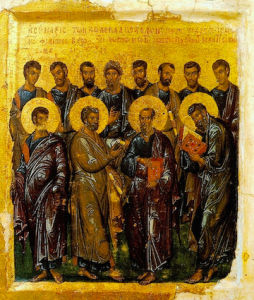
14th-c. Russian ikon of the Synaxis of
the Twelve Apostles.
- St. James the Greater was the elder of the two sons of Zebedee, as Reuben was the eldest of the Patriarchs.
- SS. James the Greater and John were called “the sons of thunder” by Christ in Mark, while the Reubenites and Gadites (who both had land in Gilead) were noted in I Chronicles as hardened warriors.
- St. Thomas’s name means “twin,” and Manasseh was a twin—though the other twin, Ephraim, doesn’t appear in the Apocalypse’s list.
- St. Matthew is believed to be the same as the Levi of Mark 2 and Luke 5.
- St. James the Less is traditionally held to have been both the first Bishop of Jerusalem and the author of James, while in I Chronicles 12:32, in the middle of a list of men who deserted Saul for David, it singles out the Issacharites as “men that had understanding of the times, to know what Israel ought to do”.
- The name Thaddæus is thought to be a Hellenization of the Aramaic תַּדַּי [Tadai], which may mean something like “suckling child”: it could thus be a nickname like “Baby John,” which parallels Joseph’s initial position among his brothers.
- St. Paul states that he is from the tribe of Benjamin in Romans 11:1 and Philippians 3:5.
- Finally—and I place this last because I think it’s the most tenuous link of the bunch—both St. Philip’s name and Naphtali’s refer to large ungulates (the horse and the red deer, respectively).
This leaves the Andrew-Asher, Bartholomew-Simeon, and Simon-Zebulun correspondences unexplained. (Unless we choose for some dubious reason to content ourselves with the fact that Simon, like most of the Apostles, was from the Galilee, which is spoken of in Isaiah 9 as “the land of Zebulun and the land of Naphtali, … Galilee of the nations”.) But with nine out of twelve seeming to show some alignment, I decided to promote this from footnote to body. Still, this is speculative; again I say, this is speculative! Nobody should do anything serious with this!9
f. palm branches/palms | φοίνικες [foinikes]: The word φοίνιξ [foinix] (φοίνικες is a plural form) can mean three distinct things in Ancient Greek:
- a color, namely crimson or deep purple, or the dye that produced this color10;
- the date palm (or by extension, its fruit); or
- the mythological phoenix, sometimes associated with the Egyptian god Bennu.11

Leaves of the Phoenix dactylifera or date palm.
Photo by David J. Stang, used under
a CC BY-SA 4.0 license (source).
The palm frond is known even today as a symbol of victory. In combination with branches from the willow and myrtle, it was one of the components of the branches waved for the festival of Sukkot. The date palm is called the לוּלָב [luulâv] in Hebrew, and lulav is also used for the three-in-one combination of palm, willow, and myrtle12; it’s perfectly possible that it is lulavim in the festal sense, rather than just palm fronds, that the apocalypticist has in mind here.
g. the elders | τῶν πρεσβυτέρων [tōn presbüterōn]: I.e., the Twenty-four Elders of the Apocalypse (first mentioned in Rev. 4:4). This takes twelve, a number associated with the elect in general, and doubles it. Now, in the Gospel of John, “the Jews” are generally treated as a conceptually distinct group from the Church; hence, if the author of Revelation were either the same person who wrote John or somebody closely associated with him, it’s possible that this two-sets-of-twelve arrangement of “elders” symbolizes the elect of the Old and New Covenants—those from both before and after the first advent of Jesus. It’s also possible13 that it straightforwardly represents the Patriarchs and the Apostles (who could then in turn both lead and represent these two groups of the elect by extension).
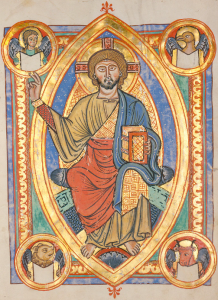
Illumination from the Codex Bruchsal (ca. 1220)
of Christ enthroned, surrounded by the Four
Living Creatures.
h. the great tribulation/the great distress | τῆς θλίψεως τῆς μεγάλης [tēs thlipseōs tēs megalēs]: Although the grand eschatological panoply of Dispensationalism is quite absent from Scripture, the idea of a “Great Tribulation” does have Biblical roots, going back in particular to the Olivet Discourse, recorded principally in Matthew 24-25. (A hyper-literal translation of θλῖψις [thlipsis], “tribulation/distress,” would be “press” or “pressure.”) This suggests that, just before the Second Coming, there will be a final, grueling persecution of God’s faithful. It is not much more specific than that; indeed, this is the passage which contains the famously controversial and much-ignored statement that “No one knows the day or the hour, not the angels of heaven, nor the Son, but only the Father.” On the whole, we don’t like this, preferring to look at everything else Jesus said in this same context and pretend that it’s a code we can use so as to prevent his “coming like a thief.” This is not our cleverest quality; it betrays a definite absent-mindedness to believe that Jesus will be coming back like he said he would, but not how he said he would.
Go here for Part 2, “… And Thousands of Thousands.”
Footnotes
1To seriously oversimplify, there are four major strands of inculturated Christianity, corresponding to four languages and four great ancient sees. One is the Coptic tradition of Alexandria, the native form Christianity took in Africa, now surviving mainly in Egypt and Ethiopia (which has its own distinctive development from its original Coptic roots). Another is the Greek tradition associated with Constantinople, which is also ancestral to the churches of Russia and several other Slavic nations. Latin is third, linked of course with Rome; this is, in the strict sense, Roman Catholicism, which through Western Europe has reached the Americas, the Pacific, and postcolonial Asia and Africa. Finally, we have the Antiochene (or Antiochian) Church, tied to the Syriac language, a form of Aramaic; Syriac Christianity once extended from Antioch all the way to the coast of China.
2This term comes from the Syriac ܦܫܺܝܛܬܳܐ (which I can’t read, but which I gather would come to פְשִׁטְטָה [p’shiṭṭâh] or something similar in Hebrew letters, which ironically were first introduced for writing Aramaic!). In any case, ܦܫܺܝܛܬܳܐ means “simple” or “common,” referring to the role of Syriac as the lingua franca of the Near East and Persia, a role it retained until replaced by Arabic around the tenth or eleventh centuries. The P’šitta thus has, in a sense, the same title as the Latin Vulgate (“common”), and both share a name with the stage of the Greek language spoken in the first century, Koiné.
3You may have heard of the Acts of Paul and Thecla; this work is a part of the Acts of Paul, which also includes a forged Pauline letter, III Corinthians, and an account of St. Paul’s martyrdom. Thecla was reputedly a convert of Paul’s, and may have been a historical person.
4I don’t personally think that St. John wrote all of these, but they are certainly all Johannine, both in the sense that all have been attributed to him and in the sense that they share distinctive themes and motifs. (I have, in much the same way, described the books of Hebrews and Jude as Pauline and Petrine respectively, though I don’t think Paul or Peter wrote either one.)
5For any who haven’t read or don’t remember it, this comes from chapter three of The Horse and His Boy, and is the beginning of Aravis’ explanation to Bree and Shasta, given in the high Calormene style, of why she and Hwin are fleeing north to Narnia as well—or rather, it’s most of the beginning, aside from a few unmarked cuts I made. Tastes will inevitably vary; I find this beautiful, and I find it hard to believe that Lewis could have written it if he didn’t like it too. (We do know from a passing remark in one of his essays, I forget which, that he disliked the Arabian Nights both in childhood and as an adult, but he doesn’t say why.)
6Right to left (following the current of Hebrew writing) and top to bottom, this mosaic has: Reuben, Judah, Dan, Asher, Simeon, Issachar, Naphtali, Joseph, Levi, Zebulun, Gad, and Benjamin. This list is of course out of strict chronological order (save that Reuben and Benjamin are at opposite ends); whether this was for some artistic or religious reason, or merely the preference of the mosaicist, I don’t know.
7Naphtali was one of the two sons of Bilhah, whom Rachel gave to Israel as a concubine to bear “proxy children” due to her infertility, the same way Leah offered her husband Zilpah as a concubine. Thus, despite the absence of Dan (Bilhah’s other child), the concubines’ sons are grouped together, at any rate.
8They do appear reliably in three sets of four. The first set are Peter, James bar-Zebedee, John, and Andrew; the second are Philip, Bartholomew, Matthew, and Thomas; and the third are James bar-Alphæus, Simon, Jude Thaddæus, and Judas (except of course in the list in Acts). The Gospels of Matthew and Luke both place Andrew immediately after Peter; Matthew and Acts re-order most of the second bloc (all four lists place Philip first, but Matthew makes the rest Bartholomew, Thomas, Matthew, while Acts has Thomas, Bartholomew, Matthew); and Matthew and Mark move Thaddæus to the spot before Simon, maybe to get the Judases away from each other (cf. John 14:22).
9Some of you may wonder why I’m repeating this so many times. The reason is that, frankly, Church history has left me spooked. Look up Joachim of Fiore some time—he was a sweet, oddball guy who liked to do speculative theology, carefully disclaimed the title of prophet that other people put on him, and actively submitted his speculative doctrines to the judgment of the Church (which did eventually find some of them heretical, but condemned his ideas and not him); and despite all of that, a group came along less than a century after his death that used his ideas as a pretext for conducting a terrorist campaign in the north of Italy for a few years. I’m pretty sure that, if someone did that with my “Hey, what if the Patriarchs are lined up with the Apostles in Revelation 7?” idea, it would have to be by such ingenious means that I would not in fact be at fault—but also, I really hope nobody does that with any of my ideas, whether they’re in Italy or not!
10This is where Phoenicia gets its name. The Phoenicians referred to themselves as Chanani—Canaanites.
11Bennu was an Egyptian deity in heron-like form, held by some to be the ba of the solar deity Ra. (The ba was one of the parts of the person in Egyptian thought, like the ka or the ren.) Bennu was a creator deity—a position also ascribed to Ra, Atum, Ptah, and other gods—and was held to periodically renew himself; this is thought, via Herodotus, to have become the basis of the myth of the phoenix.
12The citron (an ancestor of the lemon) is also used for Sukkot, but it is not part of the lulav; instead, its fruit (also called a citron) is carried.
13I consider this interpretation less likely, given my opinion that the Apocalypse was written by St. John bar-Zebedee, who would therefore be one of the Twenty-four Elders; however, (1) even if I’m right, that wouldn’t make this interpretation impossible by any stretch, and (2) I might not be right!










 Ad-Free & Subscriber Log-In