

You can find my two-part introduction to the Gospel of John at these two links, and my index/outline for it here; for the previous installment on John 1:19-28, go here.
The Beginning of the New Cosmos, Part II (John 1:29-42)
In v. 29, we pass from the first to the second day of the “new creation” inaugurated by the Logos. Appropriately, this is the day on which Christ’s baptism is recounted (indirectly, through the Baptist’s own report)—corresponding with the day of the original creation on which the waters above and below the firmament were separated from one another.
With v. 35, we reach the new creation’s third day: the first disciples are called, an event of which John gives a strikingly different picture from the Synoptics.
To proceed to the next section (vv. 43-51), go here.
John 1:29-42, RSV-CE
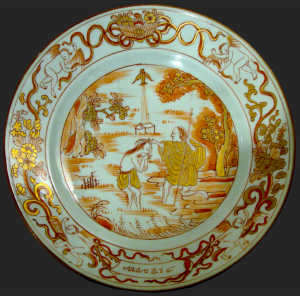
18th-c. Qing Chinese depiction of the Baptism
of Christ on porcelain.
The next daya he* saw Jesus coming toward him, and said, “Behold, the Lamb of God,b who takes away the sin of the world!c This is he of whom I said, ‘After me comes a man who ranks before me, for he was before me.’ I myselfd did not know him; but for this I came baptizing with water, that he might be revealed to Israel.” And John bore witness, “I saw the Spirite descend as a dove from heaven, and it remained on him. I myself did not know him; but he who sent me to baptizef with water said to me, ‘He on whom you see the Spirit descend and remain, this is he who baptizes with the Holy Spirit.’g And I have seen and have borne witness that this is the Son of God.”h
The next day againi John was standing with two of his disciples;j and he looked at Jesus as he walked, and said, “Behold, the Lamb of God!” The two disciples heard him say this, and they followed Jesus. Jesus turned, and saw them following, and said to them, “What do you seek?” And they said to him, “Rabbi” (which means Teacher), “where are you staying?” He said to them, “Come and see.” They came and saw where he was staying; and they stayed with him that day, for it was about the tenth hour.k One of the two who heard John speak, and followed him, was Andrew,l Simon Peter’sl brother. He first found his brother Simon, and said to him, “We have found the Messiah”l (which means Christ). He brought him to Jesus. Jesus looked at him, and said, “So you are Simon the son of John?l You shall be called Cephas”l (which means Peter).
*I.e., St. John the Baptist.
Dieu l’architecte de l’univers [God as
Architect of the Universe], frontispiece for a
Bible Moralisée [Morals From the Bible]
(ca. 1220-1230), both anonymous.
John 1:29-42, my translation
The next day,a he* saw Yeshua coming towards him and said, “Look, the lamb of God,b which takes up the sin of the world.c This is he, of whom I said, ‘One coming behind me has come to be in front of me, because he was there before me’; even Id did not know him, but in order that he should be manifested to Israel, for this I came immersing [people] in water.”
And Yochanan witnessed, saying that “I beheld the Spirite coming down as a dove from heaven, and it stayed on him; even I did not know him, but the one who sent me to immersef in water, that one told me: ‘Upon whomever you shall see the Spirit coming down, and staying on him, this is he who immerses [people] in Holy Spirit’;g and I have seen and witness that this is the Chosen of God.”h
The next day further,i Yochanan was standing with two of his students,j and looking at Yeshua walking around, he says, “Look, the lamb of God.” And the two students heard his talk, and they followed Yeshua.
Yeshua, turning and beholding them following, says to them, “What are you looking for?”
And they said to him: “Rabbi” (which says, when interpreted, Teacher), “where are you staying?”
He says to them, “Come and see.” So they came and saw where he is staying, and they stayed with him that day; it was about the tenth hour.k
Andreas,l the brother of Symeon Rocky,l was one of the two that heard Yochanan and followed him; he first finds his own brother Symeon and tells him, “We have found the Meshicha“l (which is, when interpreted, Anointed). He led him to Yeshua. Looking at him, Yeshua said, “You are Symeon the son of Yochananl—you will be called Keyfa”l (which is interpreted Rocky).
*I.e., St. Yochanan the Baptist.
Textual Notes
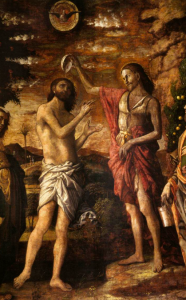
The Baptism of Jesus (ca. 1505),
by Andrea Mantegna.
a. The next day | Τῇ ἐπαύριον [tē epaurion]: Counting the events of vv. 19-28 as the first day, this is the second, the day associated with the creation of the waters. In the original creation account, this day has a strange omission.
And God said, “Let there be a firmament in the midst of the waters, and let it divide the waters from the waters.” And God made the firmament, and divided the waters which were under the firmament from the waters which were above the firmament: and it was so. And God called the firmament “Heaven.” And the evening and the morning were the second day.
—Genesis 1:6-8
What’s missing? The pronouncement “God saw that it was good.”
This is one of several subtle anomalies in the layout of the creation narrative, which reveal further patterns overlaying the seven days. (Another striking break is when God stops naming things.) The number of declarations that creation is “good” or “very good” still total seven: one on the first day, none on the second, two on the third, one on the fourth day, one on the fifth, and two on the sixth. User ScottS on Hermeneutics Stack Exchange (which I didn’t know was a thing) pointed out in answer to a question on this topic that things are only pronounced “good” when they are ready for human use—complete, or perfect if you will.1 “The waters” are not complete until the dry land is gathered out and separated from them, on the third day.

The Creation (ca. 1900), by James Tissot.
We thus seem to get once again the idea that apart from the Logos Incarnate, “nothing was made that was made,” and that this new cosmos he is forging is still for man. We also have an impression that either the Logos himself or his new work of creation is, as yet, unfinished.
b. the Lamb of God/the lamb of God | ὁ ἀμνὸς τοῦ θεοῦ [ho amnos tou theou]: This expression, though so familiar to Christians that we rarely think twice about it, is actually a little odd. Obviously it draws on the templar sacrificial system; except, how? Our minds tend to go to Passover here. But that doesn’t really work as an interpretation of the Baptist’s words, because the original paschal lamb wasn’t about taking away sin at all. It was an apotropaic, one that protected the Israelites from an agent of terror, without any reference to their sinfulness either individual or collective. The idea it points to, or the image it projects, is that of “salvation” in the sense of rescue from danger or suffering. “Salvation” in the sense of pardon—redemption, as distinct from liberation—isn’t really a Passover theme.
Okay; when else were lambs sacrificed? Every day. Twice daily: once in the morning and once in the afternoon, a lamb was offered in the Temple. This was the תָמִיד [thâmydh], the tamid or “perpetual offering,” which was made no matter what else was happening liturgically. Its rite is detailed in Exodus 29. However, the meaning given to this sacrifice in Exodus is God’s presence in Israel: again, not really the removal of sin. Moreover, the theological point made in Hebrews that “it is not possible that the blood of bulls and of goats should take away sins” is not exactly foreign to the Tanakh itself.
I will not reprove thee for thy sacrifices
…or thy burnt offerings, to have been continually before me.
I will take no bullock out of thy house,
…nor he goats out of thy folds.
For every beast of the forest is mine,
…and the cattle upon a thousand hills. …
If I were hungry, I would not tell thee:
…for the world is mine, and the fulness thereof.
Will I eat the flesh of bulls,
…or drink the blood of goats?
—Psalm 50:9-10, 12-13
This points to an important element of the sacrificial system that we—by which I mean we Christians—frequently miss: the sacrificial system was not primarily a system of atoning for sin. That was included, yes; it was not the central purpose.
If we review the legislation for sacrifice found in Leviticus 1-7, we will discover that atonement plays a surprisingly minor role … Only two of these seven chapters address the concept directly. And even when this happens, the discussion centers on inadvertent sins, a small subset of a much larger category. … Klawans puts the focus where it belongs—on the internal, “productive” good of the action. But … what does it produce? … Consider the example of intercessory prayer. … The motivating rhetoric is the need to implore God to act. But does God require such prompting? … As Miller puts it, God “has chosen to be responsive to the human condition.” God commands us to ask, and in the context of intercessions … we see the results of this “engaged” relationship. … [T]he anthropologist Valerio Valeri … writes, “as a gift, sacrifice is effective because it is a token of the relationship between god and man—because it creates that relationship by instantiating it.”
—Gary A. Anderson, That I May Dwell Among Them: Incarnation and Atonement in the Tabernacle Narrative, ch. 4
Nonetheless, release from sin and guilt is indeed linked with the sacrificial system in the Tanakh, specifically Yom Kippur, the Day of Atonement. I think the text hints at Christ’s baptism taking place on Yom Kippur, for reasons I get into below—see “The New Year,” after textual note l. However, the offerings for Yom Kippur aren’t lambs, but a bullock as a guilt offering and a kid2 as a burnt offering.
My guess—it can be no more—is that the author has the tamid in mind most of all, and secondly Yom Kippur, but that the blending of images and meanings from different liturgies here is deliberate. The reason I look first to the tamid is not only because it has the right sacrificial animal, but because we are fresh off John’s prologue. “The Light-of-Light descendeth from the realms of endless day,” and the atmosphere of eternity still clings to him, narratively speaking; it is thus logical to associate him with the perpetual offering. That points to the (no pun intended) most crucial thing about the Incarnation, which is not that God appears on earth to deliver us from sin. It is simply that God appears on earth. That would be an unparalleled magnificence, even if mankind had never fallen.
c. the sin of the world | τὴν ἁμαρτίαν τοῦ κόσμου [tēn hamartian tou kosmou]: It’s interesting that, in this phrase, the word ἁμαρτία (“sin, flaw”) appears in the singular. This might be pointing to the difference between “sins” as discrete acts, and “sin” as a generalized condition—not just individual misses, but the tendency to miss.
d. I myself/even I | κἀγὼ [kagō]: This “intensified” version of the pronoun is slightly unusual. The word κἀγὼ is a contraction of καὶ ἐγώ [kai egō], meaning “and I,” “I too,” or “I also” (with room to mean things like “nor I,” depending on context). I wouldn’t normally draw attention to such a trivial word, or translate it otherwise than as “and I”; but a fondness for κἀγὼ seems to be characteristic of Johannine diction. According to Strong’s Concordance, the word appears a little over eighty times in the New Testament—a full thirty of which are in the Gospel of John alone! In this Gospel, it frequently has more of an “I too” sense than that of a simple conjunction-plus-pronoun.
e. the Spirit | τὸ πνεῦμα [to pneuma]: As I’ve had cause to discuss before, capitalization was not used in ancient manuscripts, so technically, every capitalized word you see in the New Testament is an interpretive choice and not just a translation. Now, most capital letters in English are attached to the beginning of sentences, proper names, and the pronoun “I,” so most of the time this is an “interpretive choice” that carries no real weight. However, now and then, it does. To me (and perhaps to the translators of the RSV), it seems impossible to see πνεῦμα here as something other than a translation of רוּחַ [rúach], the “Spirit of God” which “brooded over the face of the waters” (Gen. 1:2). Both the Hebrew and the Greek originally meant “air, wind; breath,” either acquiring their spiritual connotations later, or not at first making the distinction between physical and spiritual connotations. Then as now, both Jews and Christians believed in many spiritual beings besides God—but, precisely due to their multiplicity, none of them would be spoken of simply as “the Spirit” like this; combined with the aqueous setting and the Spirit’s descent “as a dove,”3 the רוּחַ idea really pushes itself to the fore.
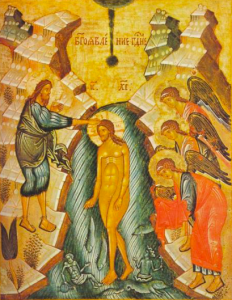
Anonymous ikon (date unspecified) of
the baptism of Jesus.
f. he who sent me to baptize/the one who sent me to immerse | ὁ πέμψας με βαπτίζειν [ho pempsas me baptizein]: We know next to nothing of the Baptist’s “career” outside of what we learn from the canonical Gospels; who, then, is this “one who sent him to baptize”? The saint may mean God, but if so, it’s a little strange that he refers to God by this circumlocution. It’s equally possible that he received his commission from an angel; it’s how his father, St. Joseph, and the Mother of God were all directed. In my opinion this is the likeliest referent. That said, there is at least one other possibility.
It has been speculated for some time now that the Baptist was an Essene, or was linked with them. The Essenes were a sect of Judaism, widely thought to have included the community at Qumran (the creators of the Dead Sea Scrolls). It must be cautioned that the Essenes are not well understood. Our chief contemporary sources on them are Josephus, Philo of Alexandria, and Pliny the Elder, none of whom were Essenes themselves—Pliny was not even Jewish—and their accounts are contradictory on certain points. Moreover, there may have been more than one kind of Essene; if so, the question of whether these kinds were rival sects or something more like distinct religious orders is something else again. But the following is generally agreed about them:
- that they had abandoned the templar system as hopelessly corrupt;
- that they preserved certain mystical or apocalyptic writings which they esteemed as inspired;
- that they lived together, practiced communal ownership, and kept no slaves;
- that they performed ritual immersions for purification daily, if not oftener; and
- that—quite unusually for Jews—they were ascetics who practiced vegetarianism and admired celibacy.
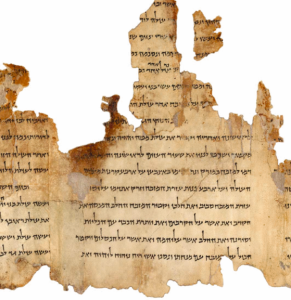
St. John the Baptist was a celibate ascetic who preached baptism as preparation for an imminent divine visitation: that does all seem to chime with the idea of an Essene connection.4 Again, this is speculative, but maybe there was some Essene sage or seer under whom John the Baptist “apprenticed,” as it were (since he was “in the deserts till the day of his shewing unto Israel”), who received a vision of his own and passed it on.
g. this is he who baptizes with the Holy Spirit/this is he who immerses [people] in Holy Spirit | οὗτός ἐστιν ὁ βαπτίζων ἐν πνεύματι ἁγίῳ [houtos estin ho baptizōn en pneumati hagiō]: Interestingly, this alludes to a part of the Baptist’s preaching that, until now, the book of John has said little about: what the “one coming behind me” is going to do. Matthew, Luke, and John all include the Baptist’s line about “whose shoes I am not worthy to bear”; Matthew and Luke, in nearly identical wording, go on to say “he shall baptize you with the Holy Ghost, and with fire: whose fan5 is in his hand, and he will throughly purge his floor, and gather his wheat into the garner; but he will burn up the chaff with unquenchable fire.” If the theory that John wrote last and knew of at least one other evangelist is correct, then the author here is likely relying on the audience’s familiarity with another Gospel or Gospels. His text gives the reader a “prompt” for their memory to fill in the Baptist’s message, and then comes back to rely on this filled-in material.
h. the Son of God/the Chosen of God | ὁ ἐκλεκτὸς τοῦ θεοῦ [ho eklektos tou theou]: Here, we have a variation in manuscripts. Unlike the decision I made back in v. 18, I’m not a hundred percent confident in the reading I’ve decided to use here; the alternative reading (with υἱὸς [huios] “son” rather than ἐκλεκτὸς “chosen”) doesn’t fit the principle of lectio difficilior as well as the one I’ve gone with, but it looks like it’s present in a far greater majority of manuscripts, which does count for something. I decided in the end to offer the ἐκλεκτὸς version, since many Bibles (including the RSV) have the υἱὸς version, making this an opportunity to exhibit the occasional differences between manuscript traditions.
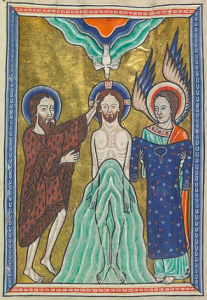
Miniature of Christ’s baptism from a psalter
made (ca. 1185) for Eleanor of Aquitaine.
i. The next day again/The next day further | Τῇ ἐπαύριον πάλιν [tē epaurion palin]: In the new-creation sequence, this is now the third day, corresponding to the day on which dry land is set apart from the seas and plants begin to grow.
And God said, “Let the waters under the heaven be gathered together unto one place, and let the dry land appear”: and it was so. And God called the dry land “Earth”; and the gathering together of the waters called he “Seas”: and God saw that it was good. And God said, “Let the earth bring forth grass, the herb yielding seed, and the fruit tree yielding fruit after his kind, whose seed is in itself, upon the earth”: and it was so. And the earth brought forth grass, and herb yielding seed after his kind, and the tree yielding fruit, whose seed was in itself, after his kind: and God saw that it was good. And the evening and the morning were the third day.
—Genesis 1:9-13
The waters have been present since the previous day, but they are not named Seas until today; until their distinction from the land, they remain unfinished and thus unready for a name. In the new cosmos, we see the Logos begin to draw out and distinguish those who follow him, like land raised from water. This gets us a foreshadowing—or perhaps “fore-blossoming”?—of the motif of chapter 15, in which the disciples are branches of Christ the vine, branches which yield fruit whose seed is in itself (though we’ve gotten so used to seedless grapes that we tend to forget this!). Similarly, at one end of this sequence we have the Baptist, who is so strongly associated with the waters, and what do we find at the other end? Dry land—in the form of the Rock.
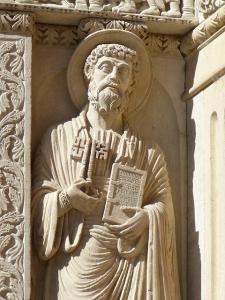
j. disciples/students | μαθητῶν [mathētōn]: One of these two is promptly identified as St. Andrew. The other is widely surmised to be the Beloved Disciple himself, the author of the Gospel. Technically, the text does not specify this, saying only “two disciples”—but the very coyness with which it is written is just what makes everyone suspicious.
k. it was about the tenth hour | ὥρα ἦν ὡς δεκάτη [hōra ēn hōs dekatē]: I.e., approximately 4 p.m. (the ancient clock treated sunrise as “the first hour”), thus making their “one o’clock” loosely equivalent to our six in the morning.
The mention of the time of day may be intended to hint that this was associated with מִנְחָה [minchah], the afternoon office of prayer in Judaism. The precise time for saying Minchah is not fixed, and it is a short office, only taking around ten minutes in its modern form, so it is highly flexible (see the headings “Worship in the Ancient World” and “A Sacrifice of Praise” in this post for more on the offices of prayer in Judaism). It’s possible that, in joining Jesus around the tenth hour, they joined him for Minchah as their first act together.
l. Andrew … Simon Peter … Messiah … John … Cephas/Andreas … Symeon Rocky … Meshicha … Yochanan … Keyfa | Ἀνδρέας … Σίμωνος Πέτρου … Μεσσίαν … Ἰωάννου … Κηφᾶς [Andreas … Simōnos Petrou … Messian … Iōannou … Kēfas]: A few more name-adaption notes.
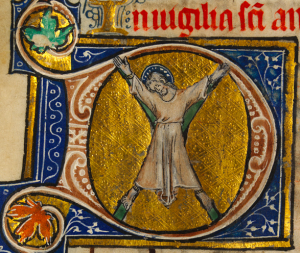
Illuminated capital in an East Anglian missal
(early 14th-c.) depicting the martyrdom
of St. Andrew.
- Andreas, conspicuously, is a Greek name (Ἀνδρέας), meaning “manly, courageous.” It is normally borrowed into Latin as-is, which makes the –w in our form (Andrew) odd—we’d expect it if the name were *Andreus, but not Andreas. Perhaps Andrew picked up its final w through association with Matthew.6
- The form Symeon (rather than Simon), though it does occur in the New Testament (Συμεών), is rare even there. I’ve preferred it as being slightly closer to its Hebrew original, שִׁמְעוֹן [Shim’3oun]. Its meaning is “he hears” or “he listens”; it is closely related to the name Samuel.
- Meshicha is an approximation of the Aramaic מְשִׁיחָא [M’shychâ’]. (The Hebrew form is מָשִׁיחַ [Mâshiyach].) Like its Greek equivalent Christos, it means “one anointed with oil.”
- Yochanan (יוֹחָנָן [Youchânân]) is given in some sources as the name of St. Peter’s, and presumably St. Andrew’s, father; it means “[TETRAGRAMMATON] is gracious.” Other sources give this name as Yonah (יוֹנָה [Younâh]), “dove,” borrowed into English as Jonah or Jonas; allusions to this name are less common in the New Testament than mentions of John, and I think that historically, Peter was probably bar-Yonah rather than bar-Yochanan (since inadvertently deleting a less-common name in favor of a more-common one would be a more natural error for a copyist to make). It’s also possible—though I have no examples of this to offer—that Yonah might have been used as a nickname for Yochanan.
- Keyfa, like the more traditional Cephas (which has been Hellenized), adapts the Aramaic כֵּיפָא [kêyfâ’], an ordinary word for “stone, rock.”
The New Year
Two more in-depth notes are called for on these two days of John’s “new creation” sequence.
You may have heard before of the “high holy days” in the Judaic calendar. These refer to the ten-day stretch from Rosh ha-Shanah to Yom Kippur inclusive, the 1st to the 10th of the month of Tishrei.7 Rosh ha-Shanah is the Jewish new year; it is also considered the date of the Sixth Day of creation, when Adam and Eve were made. 3rd Tishrei is a minor fast,8 followed by six further days of solemn reflection, mourning one’s sins, and making amends and apologies. All of this is preparation for the great fast of יוֹם כִּפּוּר [youm kipúr], traditionally translated “the Day of Atonement.” This has long been among the holiest days in Judaism. In the first century, it was the only occasion upon which the Tetragrammaton was spoken aloud.
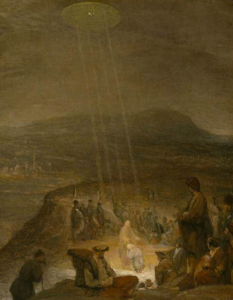
The Baptism of Christ (ca. 1710),
by Aert de Gelder.
Given the strong liturgical motifs of the Fourth Gospel, it’s strange Yom Kippur makes no appearance in it … unless it does. Look back at vv. 29-34. Obviously the general theme of taking away sin matches Yom Kippur, but it’s deeper than that. The evangelist has elaborately evoked the creation of the world by the Logos, and is still doing so; that lines up with the attributed significance of Rosh ha-Shanah. We are not given a specific period of time for which the Baptist has been carrying out his ministry, but the gap this new creation’s first day introduces between the prologue and the first appearance of Jesus in the narrative could suggest the period of the high holy days, and John’s “baptism of repentance” certainly sustains the thematic parallel. This could place Christ’s own baptism on Yom Kippur—the same day on which the high priest would be repeatedly immersed in a mikveh (once for each change of garments the day’s liturgies required).
None of this amounts to proof, of course: the theme of taking away sin is hardly unique to this section of John, nor is this the last time the creation will come up. Still, I think this is a credible possibility.
Vocation, Vocation, Vocation
Second, the calling of the first three disciples. The variance between the Fourth Gospel and the Synoptics suggested by vv. 35-42 is striking in three ways. Only John relates
- that some of the disciples had been followers of St. John the Baptist before Jesus called them;
- that the very beginning of Jesus’ activity took place in Judæa, not the Galilee; and
- that Jesus called several of his disciples—if “called” is the right word here—not from their fishing nets, but apparently apropos of nothing.
So … what, were they called twice? Is one of the evangelists wrong? or are three of them wrong? Mark is rather vague, but Matthew’s account is fairly specific, and Luke really gets into how Jesus called Peter.
I don’t think this is as bewildering as it seems. The solution I offer here may not be correct, but I think it’s plausible, and others can probably be proposed. My guess is based on something John leaves out: Jesus’ temptation in the desert.
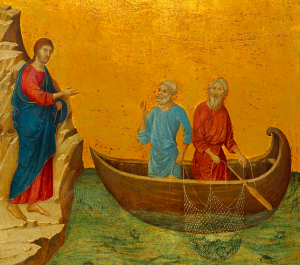
The Calling of the Apostles Peter and Andrew
(ca. 1310), by Duccio di Buoninsegna. This shows
these apostles’ vocation in the form presented by
the Synoptic evangelists (cf. Matt. 4, Luke 5).
In the other Gospels, Jesus’ ministry begins only after his temptation (Matt. 4, Mark 1, Luke 4). It’s hard to be sure, but, given the tight sequencing of days here, these events in John appear to be before the temptation. Now, his temptation in combination with his baptism appear to be viewed by the Synoptics as credentialing events: if so, this might explain why his activity here is so low-key. Perhaps he wants to keep things quiet and informal while has the seal of baptism, but has not yet passed his first great test—this may even be why he at first seems inclined to demur when his Mother implicitly requests his help at the beginning of ch. 2, on the conspicuously cryptic ground that “My hour has not yet come.” And it might explain why, even though they were in some sense already following Jesus, all three of the apostles from this passage received a second, more public call to follow him a little later on, back home in the Galilee.
Footnotes
1This is doubtless why מְלָאכוֹת [m’lâ’khouth]—the rabbinic categories of what constitutes “work,” and is therefore proscribed on the sabbath—include מַכֶּה בְּפַּטִּישׁ [makeh b’paṭysh], a phrase which literally means something like “hammer-tap” and is often translated “perfecting,” “completing,” “fine-tuning,” or “finishing.” The idea of this category is that putting things into a ready-to-use state is a type of work, from which God himself rested on the sabbath. (That is why this category covers such dissimilar actions as tuning a guitar and pouring hot water into a container of Cup Noodles.)
2To be clear: the young of the goat. Do not sacrifice human infants to the Lord our God. He does not like that.
3If you’re wondering what the dove reference has to do with it, the word “brood” in English originally referred especially to the activity of a mother bird nesting over her eggs. This corresponds to one sense of the Hebrew verb used in Genesis 1; the same verb appears in Deuteronomy 32: “The LORD‘s portion is his people … As an eagle stirreth up her nest, fluttereth over her young, spreadeth abroad her wings, taketh them, beareth them on her wings: So the LORD alone did lead him, and there was no strange god with him.”
4It may be that there were Essene ties “in the family,” based on Luke’s account, which makes the Blessed Virgin and St. Elizabeth relatives. This would account for a detail in Luke that is increasingly puzzling the more you think about it: the challenge the Virgin issues to St. Gabriel in Luke 1:34. Her question doesn’t make sense from a girl who has just been stated to be betrothed; the painfully obvious answer to “how this shall be” is “How it normally shalt between a husband and his wife.” That is, her question doesn’t make sense unless she had already vowed herself, marriage notwithstanding, to permanent virginity. (Presumably, this would have involved a private understanding with St. Joseph.) Where the Blessed Virgin would have gotten the idea of vowing herself to celibacy is part of what makes this puzzling—but if the family had relatives who were Essenes, this is easily explained.
5Note that “fan” here refers to a winnowing fan, also known as a winnowing basket. This was a device used in the process of—wait for it—winnowing. Harvesting grain in the ancient world was rather involved. First, the grain had to be threshed (detached from the stalk it had grown on). Then, the seed itself needed to be winnowed: that is, separated from the inedible husk (a.k.a. chaff). This was generally done by tossing it into the air on a breezy day, which helps the thin, light husk pull away from the much heavier seed; after that, the husks can be used as livestock feed or burned as short-term fuel. Winnowing was typically done with a basket specially designed for the purpose, shaped rather like a handle-less shovel or, indeed, a fan.
6Matthew derives from Ματθαῖος [Mat’thaios], a name that comes into Latin as Matthæus. When dealing with Latin, English tends to turn æ into e and chop off the –s from masculine names, and has an odd aversion to final u, preferring to turn it into –w. (English did take the extra step of getting these names not directly from Latin, but via French; however, the French forms are André and Mathieu, necessitating an in-house explanation.)
7Tishrei (or Tishri) most often begins in the middle of September by the Gregorian calendar; occasionally it can begin as late as the first few days of October.
8Except when this date falls on a sabbath, in which case the fast is observed the following day.











 Ad-Free & Subscriber Log-In