

You can find my two-part introduction to the Gospel of John at these two links, and my index/outline for it here; for the previous installment on John 5:1-18, go here.
The Third Sign, Part II (John 5:19-47)
Here, we have the Lord’s longest homily in the book thus far. His last homily was the one delivered to Nikodemos in chapter 3, which concluded without a reply from what seemed to be its sadly bewildered recipient; as of 5:18, the third-chapter theme of judgment has intensified sharply. Following the controversy which broke out in the previous section, due to the Lord’s transgression of a point of sabbatarian halakhah, this sermon touches on apocalyptic themes and on the integrity of Yeshua’s message with the Tanakh which came before it; in these ways, despite the marked differences in manner between the two, the description of Yeshua and his teaching given in John aligns closely with the Synoptics—think of Matthew’s refrain “The kingdom of heaven is at hand,” or of the cryptic statement in Mark that “The Son of Man is lord of the sabbath.” It also touches upon the reliability of his testimony before the Jewish authorities—presumably in the opinion of the Sanhedrin in especial, but also his reliability in the general opinion of the priesthood and the rabbinate. (As a reminder, most members of both would have been Pryshaya, Pharisees, though a segment of the priesthood were Tsaduqin, Sadducees.)
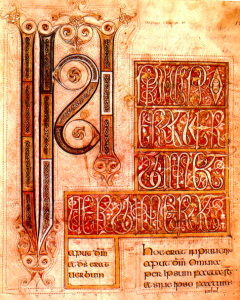
Incipit of John from the Barberini Gospels,
a Hiberno-Saxon illuminated evangeliary1
probably dating to the late 8th century, now
housed in the Vatican Library.
John 5:19-47, RSV-CE
Jesus said to them, “Truly, truly, I say to you, the Son can do nothing of his own accord, but only what he sees the Father doing;a for whatever he does, that the Son does likewise. For the Father lovesb the Son, and shows him all that he himself is doing; and greater works than these will he show him, that you may marvel. For as the Father raises the dead and gives them life, so also the Son gives life to whom he will. The Father judges no one, but has given all judgment to the Son, that all may honor the Son, even as they honor the Father. He who does not honor the Son does not honor the Father who sent him.c Truly, truly, I say to you, he who hears my word and believes him who sent me, has eternal life; he does not come into judgment, but has passed from death to life.
“Truly, truly, I say to you, the hour is coming, and now is, when the dead will hear the voice of the Son of God, and those who hear will live. For as the Father has life in himself, so he has granted the Son also to have life in himself, and has given him authority to execute judgment, because he is the Son of man. Do not marvel at this; for the hour is coming when all who are in the tombs will hear his voice and come forth, those who have done good, to the resurrection of life, and those who have done evil, to the resurrection of judgment.
“I can do nothing on my own authority; as I hear, I judge; and my judgment is just, because I seek not my own will but the will of him who sent me. If I bear witness to myself, my testimony is not true; there is another who bears witness to me, and I know that the testimony which he bears to me is true. You sent to John, and he has borne witness to the truth. Not that the testimony which I receive is from man; but I say this that you may be saved. He was a burning and shining lamp,d and you were willing to rejoice for a while in his light. But the testimony which I have is greater than that of John; for the works which the Father has granted me to accomplish, these very works which I am doing, bear me witness that the Father has sent me. And the Father who sent me has himself borne witness to me. His voice you have never heard, his form you have never seen;e and you do not have his word abiding in you, for you do not believe him whom he has sent. You searchf the scriptures, because you think that in them you have eternal life; and it is they that bear witness to me; yet you refuse to come to me that you may have life. I do not receive glory from men. But I know that you have not the loveb of God within you. I have come in my Father’s name, and you do not receive me; if another comes in his own name, him you will receive. How can you believe, who receive glory from one another and do not seek the glory that comes from the only God? Do not think that I shall accuse you to the Father; it is Moses who accuses you, on whom you set your hope. If you believed Moses, you would believe me, for he wrote of me. But if you do not believe his writings, how will you believe my words?”
John 5:19-47, my translation
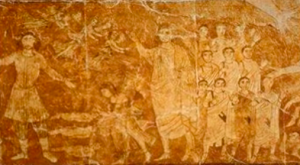
Fresco (3rd-c.) of Ezekiel’s vision of the
valley of dry bones (Ezekiel 37:1-14) from
the synagogue at Dura-Europos in the ex-
treme east of modern Syria.
Then Yeshua said in answer to them: “‘Amin, ‘amin, I tell you, the Son cannot do nothing from himself, except what he sees the Father doing;a for if he does things, the Son also does these things likewise. For the Father lovesb the Son, and shows him everything which he does, and will show greater works than these to him, in order that you may wonder. For just as the Father raises the dead and brings them to life, so also the Son brings those he wants to life.
“For the Father does not judge no one, but has given all judgment to the Son, in order that everyone should honor the Son just as they honor the Father. He who does not honor the Son does not honor the Father that dispatched him.c ‘Amin, ‘amin, I tell you that he who hears my word and has faith in the one who sent me has age-long life, and will not come into judgment but has gone over out of death into life. ‘Amin, ‘amin, I tell you that an hour comes, and is now, when the dead will hear the voice of the Son of God, and they who hear will live. For just as the Father has life in himself, so also he has given life to the Son to have in himself; and he has given authority to him to make judgment, because he is Son of Man. Do not wonder at this, because an hour comes in which everyone who is in monuments will hear his voice and journey out [of them], they that have done good into a resurrection of life, and they who have practiced vile things into a resurrection of judgment. I cannot do nothing from myself; just as I hear, I judge, and my judgment is just; because I do not seek my own will, but the will of the one who dispatched me.
“If I witness about myself, my witness is not true; if another witnesses about me, I also know that it is the true witness he witnesses about me. You sent [people] to Yochanan, and he has witnessed to the truth; I do not receive human witnessing, but I say these things in order that you may be saved. He was a lamp, burning and shiningd—you were willing to exult in his light for an hour; yet I have a greater witness than Yochanan, for the works which the Father has given me, in order to finish them, these works which I do, witness about me that the Father has sent me, and this Father who dispatched me has witnessed about me. You have never heard his voice nor seen his form,e and you do not have his word staying in you, because the one whom he sent, you do not have faith in him. You investigatef the Writs, because you suppose them to have age-long life—and it is these which witness about me; yet you will not come to me, in order that you may have life.
“Glory from people, I do not receive, but I have known you, that you do not have the loveb of God in yourselves. I have come in the name of my Father, and you do not receive me; if another should come in his own name, you will receive that [person]. How can you have faith, receiving glory from one another, and you do not seek the glory from the only God? Do not suppose that I will accuse you before the Father; it is Mosheh who is your accuser, on whom you have hoped. For if you had faith in Mosheh, you would have had faith in me, for he wrote about me. But if you have no faith in his writings, how will you have faith in the things I say?”
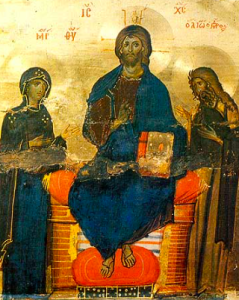
12th-c. ikon of the Deësis1 from the Monastery
of St. Catherine on Mount Sinai.
Textual Notes
a. the Son can do nothing of his own accord, but only what he sees the Father doing/the Son cannot do nothing from himself, except what he sees the Father doing | οὐ δύναται ὁ υἱὸς ποιεῖν ἀφ’ ἑαυτοῦ οὐδὲν ἐὰν μή τι βλέπῃ τὸν πατέρα ποιοῦντα [ou dünatai ho Huios poiein af’ heautou ouden ean mē ti blepē ton Patera poiounta]: I don’t know exactly how old the following material is: its ideas are traceable as far back as R. Yochanan bar Nafcha, who lived in the third century (and studied under R. Judah ha-Nasi, the compiler of the Mishnah), and may be older, but they may have originated with him.
Rabbi Yochanan said: There are three keys maintained in the hand of the Holy One, Blessed be He, which were not transmitted to an intermediary, i.e. God tends to these matters Himself. And they are: the key of rain, the key of birthing, and the key of the resurrection of the dead. Rabbi Yochanan cites verses in support of his claim. The key of rain, as it is stated: “The Lord will open for you his good treasure, the heavens, to give the rain of your land in its due time,” indicates that rainfall is controlled by God Himself. From where is it derived that the key of birthing is maintained by God? As it is written: “And God remembered Rachel and listened to her, and He opened her womb.” From where is it derived that the key of the resurrection of the dead is maintained by God Himself? As it is written: “And you shall know that I am the Lord when I have opened your graves.” In the West, Eretz Yisrael [the land of Israel], they say: The key of livelihood is also in God’s hand, as it is written: “You open Your hand and satisfy every living thing with favor.” … And what is the reason that Rabbi Yochanan did not consider this key of livelihood in his list? … Rain is the same as livelihood in this regard, as rain is indispensable to all livelihoods.2
If your reaction to this (very pardonably!) is “… So?”, here’s the point. We mentioned last week that God’s seventh-day rest did not mean a complete cessation of, for lack of a better word, activity: if it had, creation would have ceased to exist. These “keys” that are “maintained in the hand of the Holy One” are three kinds of action that, according to rabbinic consensus, did not fall under the thirty-nine m’lakhoth outlined in note f of last week’s post. It was—and still is, actually—observably true that God did not cease to sustain creation on the sabbath, and furthermore that people continued being born and dying on the sabbath, so that bestowing life and judging the dead must also be incessant activities on God’s part. (As a mnemonic, one could think of this as very like the spheres of the Fates in Greek myth: Clotho, Lachesis, and Atropos respectively governed the spinning of every life’s thread, its measuring out to its proper length, and its cutting—or, borrowing from R. Yochanan’s language, the key of birth, the key of rain, and the key of the dead.)
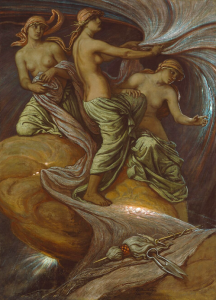
Le Parche Raccolgono le Stelle [The Fates
Gathering in the Stars] (1887),
by Elihu Vedder.
As I said, I personally don’t have proof that this way of thinking predates the third century. However, if it was already current in the first, then everything about this homily falls into place. The initial spark is a transgression of the rules laid down governing the sabbath; as in the Synoptic Gospels (“something greater than the Temple is here”), Christ claims in reply not that the rules are invalid but that he is exempt from them, on the grounds of a unique relationship with God the Father—”the Son cannot do nothing from himself, except what he sees the Father doing”. As bold as this is, this is the only sense in which he directly claims to be “equal to God”: that is the language of the establishment’s accusation, but not of his self-description, since he “did not deem it plunder to be equal to God”. His recurring accent in vv. 19-30 lies on his inseparable unity with the Father, so that the oneness of the Shema is maintained, answering the charge of blasphemy. In tandem with that, having just shown by healing the paralytic at the Pool of Beyt Hesda that he holds the key of birth, the key of rain, or both, he asserts his claim to the key of the dead.
b. loves … love | φιλεῖ … ἀγάπην [filei … agapēn]: This is—a little amusingly—not an example of how important it is to be very precise about word-for-word translation, but one of how little difference there often is between φιλία [filia] and ἀγάπη in the Bible’s usage.
Now, there’s a certain distinction between Eros and Agape that you’ll sometimes find in discussions of psychology, philosophy, and mysticism, which may be illuminating here. The idea is that Eros is a name for the yearning need-love we experience, reaching up to God, whereas Agape indicates the divine, pure gift-love coming down, and that, in general, loves that come in hierarchical pairs (parent-child, teacher-student, etc.) are typified by this.3 We could perhaps forge a parallel to this idea, in reference to natural and supernatural loves rather than to need-love and gift-love, using the terms Agape and Philia to do so. Thus, Agape is the special divine love which can occur only as a gift of grace, while Philia is the more ordinary, comfortable set of affections we experience simply as human creatures. Looked at through that lens, it does seem ironically appropriate that this text speaks of the Father loving the Son in a Philia-sense, but of human beings lacking or having love in the Agape-sense: “within” the Trinity, “none is afore, or after other; none is greater, or less than another,” so the comfy picture that Philia suggests does fit better, even though our own possible experience of God’s love as creatures is always of the Agape kind.
c. that all may honor the Son, even as they honor the Father. He who does not honor the Son does not honor the Father who sent him/in order that everyone should honor the Son just as they honor the Father. He who does not honor the Son does not honor the Father that dispatched him | ἵνα πάντες τιμῶσι τὸν υἱὸν καθὼς τιμῶσι τὸν πατέρα. ὁ μὴ τιμῶν τὸν υἱὸν οὐ τιμᾷ τὸν πατέρα τὸν πέμψαντα αὐτόν [hina pantes timōsi ton Huion kathōs timōsi ton Patera. ho mē timōn ton Huion ou tima ton Patera ton pempsanta auton]: This is a common motif in Semitic culture—identifying a person’s envoy or representative with the person himself. We see it frequently when comparing Matthew with the other Synoptics: Matthew will describe someone as speaking to Yeshua, while Mark and Luke describe a messenger bringing word from that person. (Even Old Testament theophanies are understood, on some interpretations, as appearances of the Metatron, the angelic intelligence held to be “the Voice of God”—an entity in its own right, a little like an official spokesman.) Hence, while obviously compatible with the doctrine of the Trinity, it would not by itself form good evidence for that doctrine.
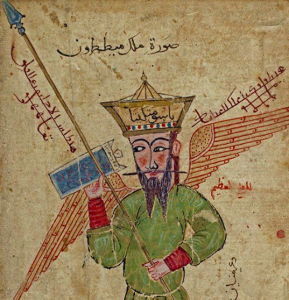
Depiction of the Metatron (14th c.)
by Nasir al-Din Rammal.
The difference between the RSV’s “sent” and my “dispatched” is due to the particular word used in the Greek. Because the literal translation of ἀπόστολος [apostolos] is “sent one, envoy, emissary,” I try to reserve send for uses of ἀποστέλλω [apostellō], which meant I needed another word for πέμπω [pempō]. This is slightly ironic, since ἀποστέλλω is a verb compounded out of the adverbial prefix ἀπό “from” and the more basic verb στέλλω “send for, fetch,” making it structurally a better match for dispatch than send; but, we didn’t get the crucial word “apostle” from πέμπω, so too bad! (However, πέμπω does lie at the root of a very cool and somewhat ridiculous word that I love: psychopomp. Sometimes this means a personification of death, like the Grim Reaper, but often it refers to a kind of guardian or tutelary spirit that guides souls in, or into, the afterlife. In differing ways, both Hermes and Charon were psychopomps in Greek mythology. Folk beliefs in the Abrahamic religions assign the role to the angels Azrael, Michael, or Samael, as well as St. Peter. In the Divine Comedy, Virgil is an excellent example of a fictional psychopomp; appropriately, so is DEATH in the Discworld series.)
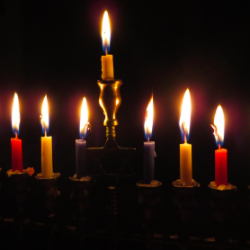
d. He was a burning and shining lamp/He was a lamp, burning and shining | ἐκεῖνος ἦν ὁ λύχνος ὁ καιόμενος καὶ φαίνων [ekeinos ēn ho lüchnos ho kaiomenos kai fainōn]: The second-innermost chamber of the Temple, immediately outside the Holy of Holies, was called the Holy Place or Sanctuary—in Hebrew, the הֵיכָל [hêykhâl], hence the name of Hekhalot literature, a genre closely related to apocalyptic and to Merkavah mystical literature.4 Within the הֵיכָל stood three objects: the Altar of Incense, where an incense unique to the Temple (whose recipe has been lost) was burned twice daily, at the time of the morning and afternoon sacrifices; the Table of Showbread (also rendered “Bread of the Presence,” literally “Bread of the Faces”), which was stocked weekly with fresh loaves of unleavened bread, the old loaves being eaten by the priests; and the Menorah, a seven-branched candelabrum.
Okay; so what? Well, this is by no means proof of anything, but the term λύχνος is closely akin to λυχνία [lüchnia], “lamp-stand,” which appears in the first three chapters of the Apocalypse. There, St. John the Divine5 (who may or may not be the same person as St. John the Beloved6) describes Christ as walking among “seven golden lamp-stands” during the prefatory vision of 1:10-3:22, before he enters the divine throne room in chapter 4. The prefatory vision and the apocalypse proper thus seem to take place in the heavenly Holy Place and Holy of Holies, making the seven golden lamp-stands the analogue of the Menorah. Furthermore, based on parallel motifs, interests, and structural elements (see IV.2.a of the Outroduction), I think it can be safely asserted that the author of Revelation was “of the same school as” the author of John, even if they were different individuals.
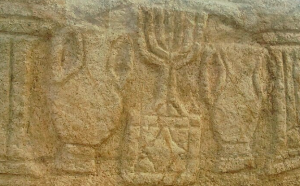
1st-c. depiction of the Menorah from the syna-
gogue of Migdal (Magdala). Photo by Hanay,
used via a CC BY-SA 3.0 license (source).
Okay, so still what? The following is speculative, but I feel there is something in it. What if this reference to St. Yochanan the Baptist as a “lamp” is identifying him with the Menorah? This would not be altogether unlike the Apocalypse’s allusions to SS. Peter and Paul in Rev. 11:3-12; it also seems to fit in with the more or less cosmic “function” of the Baptist suggested by his identification as Elijah (i.e., not Elijah reincarnate, which is what he is presumably disclaiming back in 1:21, but Elianic7 in vocation: cf. Matt. 17:11-13). I find this conjecture the more intriguing in light of two facts.
- That the Mother of God is traditionally identified with the Ark of the Covenant. (I went into this in more detail, a year and a half ago, for my three-parter “The Veiling of the Ark”; that series is on the Lesson8 for Assumption, which is selected from Revelation 11:19-12:12. Its first part gives a brief general sketch of apocalyptic literature, while its second part discusses what is meant by the idea that the Virgin is “the ark of the New Covenant,” and its third part rounds out my notes on the text.)
- That the Parokheth, the Veil which divided the Holy Place from the Holy of Holies, was embroidered with cherubim. We might have expected seraphim: they are generally held to be the highest of the nine choirs, and appear in Isaiah’s vision (Isa. 6:1-8). The cherubim are the second-highest choir. They are typically identified with the tetramorphs of Ezekiel 1 and Revelation 4—and it is the tetramorphs which give us the emblems of the four Evangelists. Granted, this meaning is not explicitly assigned to the tetramorphs themselves, still less to the Parokheth, in Scripture. Nevertheless, it is an exceedingly ancient interpretation; and it does seem peculiarly suitable that the torn Veil of the Temple, which (like a rood screen) simultaneously sets apart and reveals the Most High, should symbolize the Gospels. After all, it is the Gospels which are the verbal element, the logos, of that rift which the Church possesses between now and eternity—between the streets of modern Rome or Baltimore or Tehran on the one hand, and the eternal palace of the Tetragrammaton on the other.
Now consider this in light of the motif, common both to several Pauline epistles and the writings of St. Peter, that Christians are “living stones” being built up into a temple. Is it possible that all the articles of the Temple furniture in the Tanakh are symbols of some human functionary in the Church?
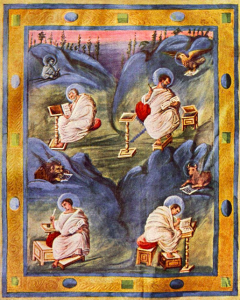
Illumination of the Four Evangelists, with
tetramorphic emblems, from the Aachen
Gospels (820): SS. Matthew and John are
above, SS. Mark and Luke below.
e. his form you have never seen/nor seen his form | οὔτε εἶδος αὐτοῦ ἑωράκατε [oute eidos autou heōrakate]: It may be unintentional (that’s difficult to judge for certain), but this verse does in fact use a term—εἶδος—which was habitually employed by Plato as a term for the Forms.
f. You search/You investigate | Ἐραυνᾶτε [eraunate]: There is a slight ambiguity here: in the Greek, this verb’s second-person plural indicative form (“you investigate” as a statement of fact) is the same as the imperative form (“investigate” as a command). I’m inclined to take it as an indicative, but I might be mistaken.
Footnotes
1A deësis (from Gr. δέησις [deēsis], “entreaty, supplication”) is a type of ikon showing Christ enthroned and flanked by the Mother of God and the Baptist. It symbolizes the intercession of all the saints for humanity, and is a standard element in the ikonostasis, one of the basic architectural elements of any Eastern church (similar in placement and in some functions to the Western rood screen, although differing in both history and exact form).
2This passage comes from the Talmud—more specifically from the Gemarah, which is the part of the Talmud that consists in commentary on the Mishnah. In the interest of keeping as close as possible to the forms of Judaism as they existed in Jesus’ own time, I rarely stray from the Mishnah into later material—for that matter I don’t have a copy of the Talmud proper; I was able to find this text thanks to the generosity of the good people at Sefaria—and I’d have been more hesitant to do so, if not for the fact that the authority cited dates to immediately after the Tannaitic period (ca. 10-ca. 220 CE), the very first generation of the Amoraic period (ca. 220-500 CE). To be quite truthful, I couldn’t entirely understand the various instructions I found online for formal citations from the Talmud; however, I can relate that the text I’ve quoted comes from the Gemarah on the Mishnaic tractate Ta’anit (“Fasting”), beginning with the next-to-last segment of text under the heading “2a,” and that it can be found on Sefaria’s website at this link. Also, since we’re here anyway: I did not learn of this passage in the first place through any ingenuity of my own! I was put on to it by the Sacra Pagina commentary on John that’s listed among my sources way back in the Introduction.
3The expressions “need-love” and “gift-love” come from the first chapter of C. S. Lewis’s admirable The Four Loves: “The first distinction I made was … between Gift-love and Need-love. The typical example of Gift-love would be that love which moves a man to work and plan and save for the future well-being of his family which he will die without sharing or seeing; of the second, that which sends a lonely or frightened child to its mother’s arms. … I was looking forward to writing some fairly easy panegyrics on the first sort of love and disparagements of the second. And much of what I was going to say still seems to me to be true. … But … I cannot now deny the name love to Need-love. … Since we do in reality need one another (“it is not good for man to be alone”), then the failure of this need to appear as Need-love in consciousness—in other words, the illusory feeling that it is good for us to be alone—is a bad spiritual symptom … [And] man’s love for God … must always be very largely, and must often be entirely, a Need-love. … It would be a bold and silly creature that came before its Creator with the boast ‘I’m no beggar. I love you disinterestedly.'” —From pp. 11-14 of the Harvest/HBJ reprint from 1988.
4Merkavah or Merkabah mysticism (from מֶרְכָּבָה [mer’kâvâh], literally “throne” or “chariot”) was a variety of Judaic mysticism which had become fully developed by the late first century CE, but whose antecedents lie much further back. It drew upon both certain passages in the Torah and key prophetic texts, notably chapters 1-3 and 8-11 of Ezekiel; it may even be adumbrated in the vision of the Lord in Isaiah 6.
5This is the title customarily accorded to the author of Revelation, whether or not he is identified with other persons also named John. The title divine here retains a sense that is now archaic if not fully obsolete, essentially equating with “theologian”; it does not carry any connotation of deity: the term is used in the same sense of the vaguely-defined group of high-church Anglican writers who sided with the Cavaliers known as the Caroline Divines (e.g. Lancelot Andrewes, George Herbert, William Laud, and Jeremy Taylor).
6But he totally is the same guy just sayin’.
7This word, which I just learned today!, is the adjective meaning “of, pertaining to, or resembling Elijah.” I assume it’s derived from the Anglicized version of the Hellenic form of his name, Elias (hola, mi sobrino); this form still appears in the King James, alongside many other forms of names no longer current in English: some are fairly intuitive, like Noë for Noah or Jeremias for Jeremiah, while others are much stranger, like Esaias for Isaiah or Eliseus for Elisha. A handful—found more often in modern editions of the Catholic Douai-Rheims translation of the Bible—seem borderline out-of-pocket, like Osee for Hosea or Sophonias for Zephaniah.
8In the terminology of the English tradition, while the word “lesson” can cover the Scriptural readings used in the liturgy in a general way, it can also apply specifically to the first reading, which is nearly always taken from the Old Testament. When used in this sense, Lesson forms a triad with the terms Epistle and Gospel. (With apologies to the Mock Turtle, the word “lesson” itself is derived, via French, from the Latin lectiō “reading”—it picked up its final –n because our form of the word descends not from the nominative form just given, in which Latin words are normally cited, but from the accusative form, lectiōnem.)








 Ad-Free & Subscriber Log-In