

You can find my two-part introduction to the Gospel of John at these two links, and my index/outline for it here; for the previous installment on John 7:32-52, go here.
The Gospel of John: Sukkot, Part III (John 8:12-29)
The unofficial cross1-examination of Christ in Yrushalem continues, and the tension continues to simmer. Next week, in my fourth and final installment on this pericope, it will boil over.
John 8:12-29, RSV-CE
Again Jesus spoke to them, saying, “I am the light of the world;a he who follows me will not walk in darkness, but will have the light of life.” The Pharisees then said to him, “You are bearing witness to yourself; your testimony is not true.”b Jesus answered, “Even if I do bear witness to myself, my testimony is true, for I know whence I have come and whither I am going, but you do not know whence I come or whither I am going. You judge according to the flesh, I judge no one.c Yet even if I do judge, my judgment is true, for it is not I alone that judge, but I and he who sent me.d In your lawe it is written that the testimony of two men is true; I bear witness to myself, and the Father who sent me bears witness to me.” They said to him therefore, “Where is your Father?” Jesus answered, “You know neither me nor my Father; if you knew me, you would know my Father also.”f These words he spoke in the treasury,g as he taught in the temple; but no one arrested him, because his hour had not yet come.
Again he said to them, “I go away, and you will seek me and die in your sin; where I am going, you cannot come.” Then said the Jews, “Will he kill himself, since he says, ‘Where I am going, you cannot come’?” He said to them, “You are from below, I am from above; you are of this world, I am not of this world.h I told you that you would die in your sins, for you will die in your sins unless you believe that I am he.”i They said to him, “Who are you?” Jesus said to them, “Even what I have told you from the beginning.j I have much to say about you and much to judge; but he who sent me is true, and I declare to the world what I have heard from him.” They did not understand that he spoke to them of the Father. So Jesus said, “When you have lifted up the Son of man, then you will know that I am he, and that I do nothing on my own authority but speak thus as the Father taught me. And he who sent me is with me; he has not left me alone,k for I always do what is pleasing to him.”
John 8:12-29, my translation

A sun pillar, (an atmospheric phenomenon
related to haloes and rainbows), seen from
San Francisco, CA. Photo by Brocken Inaglory,
used via a CC BY-SA 3.0 license (source).
Then Yeshua spoke further to them, saying, “I am the light of the world;a he who follows me will not walk around in the dark, but will have the light of life.”
So the Pryshaya said to him, “You are bearing witness about yourself; your witness is not true.”b
And Yeshua told them in response: “Even if I bear witness about myself, it’s true, this witness of mine, because I know where I came from and where I am going; but you do not know where I came from, nor where I am going. You judge according to the flesh, I do not judge no one.c And even if I do judge, this judgment of mine is truthful, because I am not alone, but I and the Father who dispatched me.d In your law,e it is also written that the witness of two people is true. [Here] I am bearing witness about myself, and he bears witness about me who dispatched me—the Father.”
So they began asking him, “Where is your father?”
Yeshua responded, “You neither know me nor my Father; if you perceived me, you would perceive my Father too.”f He said these things while teaching in the treasuryg in the Temple. Then he told them further, “I am going, and you will search for me, and you will die in your sin; where I am going, you are not able to come.”
So they Jews began saying, “[Surely] he will not kill himself? because he says ‘Where I am going you are not able to come’.”
And he told them: “You are of those below, I am of those above; you are of this world, I am not of this world.h So I told you that you will die in your sins; for if you will not have faith that I am, you will die in your sins.”i
Then they asked him, “Who are you?”
Yeshua said to them, “What did I tell you at the beginning?j I have many things to say about you, and to judge; but he who dispatched me is true, and the things I heard from him, I talk about these things in the world.” They did not recognize that he spoke to them about the Father. So Yeshua said, “Whenever you lift up the Son of Man, then you will know that I am and [that] I do nothing of myself, but just as the Father taught me I say these things. And he who dispatched me is with me; he has not sent me off alone,k because I always do what is pleasing to him.”
Textual Notes
a. I am the light of the world | Ἐγώ εἰμι τὸ φῶς τοῦ κόσμου [egō eimi to fōs tou kosmou]: This is the second of the Gospel of John’s “I am the ___” sayings (not to be confused with his uses of “I am,” suggesting the Tetragrammaton). There are seven all told, and they are occasionally repeated, mainly within their own near context:
- the bread of life (first appears in 6:35)
- the light of the world (8:12)
- the door of the sheep (10:7)
- the good shepherd (10:11)
- the resurrection and the life (11:25)
- the way, the truth, and the life (14:6)
- the true vine (15:1)
As the references show, the first five are introduced in the “Book of Signs,” while the opening chapters of the “Book of Glory” add the last two. The motif of light, introduced in the prologue, has seen relatively little use for the bulk of the Fourth Gospel, which has been much more given to water-based imagery (though we have observed two nightfalls, one in ch. 3 and one in ch. 6, both of which seemed to be loosely connected with some kind of sifting of true faith from false). Here, during Sukkot in Yrushalem, the two images cross one another, and light will remain an especially prominent symbol through chapter 10, during which Chanukkah, which according to Josephus was already a “festival of lights” in the first century, will be celebrated.
b. your testimony is not true/your witness is not true | ἡ μαρτυρία σου οὐκ ἔστιν ἀληθής [hē martüria sou ouk estin alēthēs]: The assertion that the Lord’s statement about himself “is not true” is likely a stock expression from the legal sphere, meaning something to the effect of This is inadmissible as evidence. The Pryshaya were adults, and obviously knew perfectly well that the literal meaning here would not necessarily be true; people make correct statements about themselves all the time.
c. You judge according to the flesh, I judge no one/you judge according to the flesh, I do not judge no one | ὑμεῖς κατὰ τὴν σάρκα κρίνετε, ἐγὼ οὐ κρίνω οὐδένα. [hümeis kata tēn sarka krinete, egō ou krinō oudena]: The double negative is used here because Koiné Greek, like most languages, deployed multiple negatives for emphasis and not to change the valence of the sentence with each one. English itself used to do the same thing, in its Middle and Early Modern stages; only the modern form of the language has adopted the curiously pedantic analysis by which each negative word or affix in a sentence changes the quality of the whole sentence.2
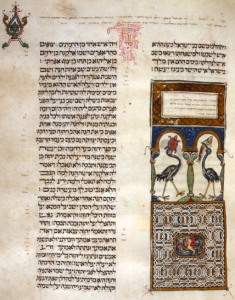
Folio from the Book of Samuel in the Biblia de
Cervera (1300), by soferim Samuel ben Abra-
ham ibn Nathan and Josué ben Abraham ibn
Gaon, with illuminator Josef Asarfati.
But to turn to our text! The phrasing seems to me to be faintly suggestive of I Samuel 16:
And the Lord said unto Samuel, “How long wilt thou mourn for Saul, seeing I have rejected him from reigning over Israel? fill thine horn with oil, and go, I will send thee to Jesse the Bethlehemite: for I have provided me a king among his sons.”
And Samuel did that which the Lord spake, and came to Bethlehem … and he said, … “I am come to sacrifice unto the Lord: sanctify yourselves, and come with me to the sacrifice.” And he sanctified Jesse and his sons, and called them to the sacrifice. And it came to pass, when they were come, that he looked on Eliab, and said, “Surely the Lord’s anointed is before him.”
But the Lord said unto Samuel, “Look not on his countenance, or on the height of his stature; because I have refused him: for the Lord seeth not as man seeth; for man looketh on the outward appearance, but the Lord looketh on the heart.”
—I Sam. 16:1, 4a, 5-7
d. it is not I alone that judge, but I and he who sent me/I am not alone, but I and the Father who dispatched me | μόνος οὐκ εἰμί, ἀλλ’ ἐγὼ καὶ ὁ πέμψας με πατήρ [monos ouk eimi, all’ egō kai ho pempsas me Patēr]: The RSV-CE’s use of judge here extends it from v. 15. This strikes me as an odd treatment of the text. See, the Lord changes verbs here, from κρίνω (cf. note c), “to judge,” to εἰμί, the Greek verb for “to be.” My use of I am in the phrase I am not alone here represents a literal appearance of the being-verb—not (as it might be in English) an implied second use of κρίνω that’s been clipped down to its helping verb, because Ancient Greek doesn’t really use helping verbs. As with double negatives, English is exceptional here. Other languages sometimes have what we call helping verbs—Basque, Kazakh, Polish, Portuguese, Thai—but few rely on them as much as English does, or have so many. This slightly weakens our sense of the shift from a more specific verb to a form of “to be.” We’re used to apparently making that kind of shift, when what we’re actually relying on our audience to do is mentally “supply” a verb we don’t feel like repeating out loud.
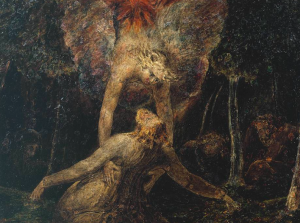
The Agony in the Garden (1800), by William
Blake. Very unusually, this is painted on a piece
of iron; however, it uses tempera, a traditional
element in creating ikons.
But that isn’t what’s going on here—we’re changing from one action (judging) to another action (existing). This same sentiment, in almost the same words, recurs in at least two other places in John: once at the end of this very passage in v. 29, and once in the more sobering context of the Upper Room Discourse, almost at the very end of it (16:32), before the Lord concludes the discourse with the high-priestly prayer of ch. 17 and comes to Gethsemane to ready himself for the Passion.
The RSV’s lack of a reference to “the Father” seems to reflect a different choice of reading of the Greek text: a few important, early manuscripts don’t have “the Father.” However, in this case, the number is so small that even I favor the idea that the majority reading is correct, and a small number of early copyists accidentally deleted it and passed this error on to their successors.
e. your law/your law, | τῷ νόμῳ δὲ τῷ ὑμετέρῳ [tō nomō de tō hümeterō]: This odd choice of words is subtly accented in a way that’s hard to describe concisely. The repetition of the article (here the dative singular form, τῷ) draws attention to the adjective ὑμετέρῳ, “your/s,” but without forcing it to be the topic of the sentence. The word δὲ thrown in between is an example of what’s called a discourse marker, one of those little words that can bear a meaning if asked, but which often do no more than establish tone or help the flow of a text (English discourse markers include hey, I mean, just, look, now, oh, okay, right, so, sorry, uh/um, well, wow, and you know). Koiné often uses δὲ to mean practically nothing, but sometimes it has a contrastive force; paired with μέν [men] in the pattern μέν … δὲ, the two particles mean something like “while on the one hand …, on the other hand” or “whereas …, nevertheless”. Here, the RSV translates it as “[the white space in between two of the words on the page. Which space? It can be whichever white space you want it to be, baby],” because this is not one of those “strong δὲ” syntactic contexts! I’ve chosen to give it just a breath more of a presence by introducing a comma after the phrase it occurs in.3
The oddness, for anyone who isn’t clear what I mean, is describing the Torah as “your law”. As a practicing Jew, indeed a rabbi, wouldn’t the Lord have said “our law”? or perhaps “the law”? Why “your”? I was able to think of three answers (which I’ve put in small font in a desperate attempt to save some space!):
i. Antisemitism. One explanation is very simple: it’s an example of New Testament, and specially Johannine, antisemitism. (And, since there are technically at least two schools of thought that might interpret this text this way, I’d just like to remind everybody that antisemitism is Bad Actually.) This theory has the strength of being obvious, but also has a few less-intuitive weaknesses. The Torah has come up several times already in John; why would this be the moment for the evangelist to suddenly reveal his antisemitic streak? And why would he do so by the incredibly anticlimactic means of a single adjective, and then go nowhere with it? Especially considering that he’s also gone out of his way a few chapters ago to affirm that “salvation is from the Jews” (see especially notes g and h in this post). As I’ve said elsewhere, I don’t want to absolve any part of the New Testament of accusations like this too easily, but, as applied to this specific text, I don’t see that it really explains anything.
ii. Interfaith Conflict. Another theory is that this reflects the particular tension that existed between the late-first-century synagogue and what is called the Johannine community. This refers to a theoretical picture of the primitive Church, which I believe Raymond E. Brown (the same guy from the bibliography) was the first to formulate, though he drew on older scholarship, such as Bultmann’s. The striking difference in style and even content between the Johannine books and the rest of the New Testament,4 as well as their historical references and recurring themes, led some scholars to propose this Johannine community as something approaching a distinctive sect of Christianity. According to a typical formulation of the theory, the Johannine community:
-
- had a uniquely high Logos-centric Christology, a doctrine not yet shared by the rest of the Church.
- tended to retroject their present ideas and concerns into their sacred texts.
- were involved in an especially bitter conflict with those who rejected the infant Beyt Yeshua and ultimately expelled it from mainstream Judaism.
- were especially concerned with in-group loyalty and policing the boundaries of their community.
According to this view, the “your” here reflects the tension that existed between church and synagogue at this point. That tension has been projected backwards into the life of Christ—not (as they would hasten to add) dishonestly or inaccurately, but with the aim of establishing a narrative by which they could make sense of their community’s suffering, aaand if I try imitating their style of talking for even one more clause of this condescending drivel, I’m going to explode.
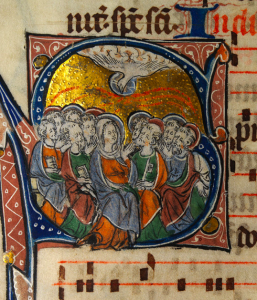
I find some elements of New Testament scholarship extremely helpful—obviously. But almost every time they begin talking about ancient Christians “responding to suffering” or whatever, I see red, because it always seems to carry an undertone of Well, you know, the first generations of Christians were under a lot of stress; they’d never have believed in anything as stupid as the Second Coming or miracles or the deity of Christ if they’d been thinking properly, but we moderns can forgive them that. Being an impenitent supernaturalist myself, I’m already inclined to take that personally, but that is, at the end of the day, my problem. There is a more pertinent issue here, same as with the previous proposal: the explanation does not explain.
That is, it does a little better. The fact that tensions are narratively ramping up between Yeshua on the one hand and the priests and Pryshaya on the other really does make this a roughly natural sort of place to retroject some of the contemporary conflict between the church and the synagogue. But interpreting “your” in light of this theory would seem to concede the Torah to Jewish claims at the expense of the claims of the Johannine community itself. That doesn’t track very well with the rest of the Fourth Gospel, which fairly clearly lays claim, like the rest of the New Testament, to the inheritance of the Old. Only a couple of chapters ago, the Lord was saying:
You investigate the Writs, because you suppose them to have age-long life—and it is these which witness about me; yet you will not come to me, in order that you may have life. … Do not suppose that I will accuse you before the Father; it is Mosheh who is your accuser, on whom you have hoped. For if you had faith in Mosheh, you would have had faith in me, for he wrote about me.
—John 5:39-40, 45-46
There is also a certain amount of controversy around the whole notion of the Johannine community. The problem is that it is entirely a scholarly construct based on reading between the lines of ancient sources; there are no documents claiming directly that it exists, no archæological evidence for it, nothing that describes or alludes to such a thing (i.e., none that do so as some kind of distinct sect within Christianity—the four bullet points above do appear throughout the New Testament as professed marks of the Church in general). So there’s a real risk of question-begging in using it to explain anything.
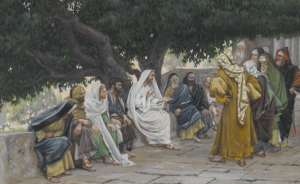
Les Pharisiens et les Saducéens Viennent Pour
Tenter Jésus [The Pharisees and Sadducees
Come to Test Jesus] (ca. 1890), by James Tissot.
iii. Banter. It took me a little time to think of it, but I have a third possibility to suggest: that referring to the Law as “your Law” is, more or less, snark. There’s a reason for this, one specific to this Sukkot pericope of chs. 7-8; it’ll take just a little bit of setup.
We got into various shades of meaning that the word Ἰουδαῖος [Ioudaios], meaning “Jew” or “Judean” in Greek, might have born in the first century back in my post on 3:22-4:3, in note e. The idea there was that, as a word like man can have a variety of antonyms—woman, God, machine, animal, child—so did Ἰουδαῖος. The one we tend to think of is Gentile (which is the opposite of Ἰουδαῖος in the fourth sense from that post’s list of five; however, we got a pointer to a different antonym back in 7:15: Galilean, as an antonym not to Ἰουδαῖος-qua-Jew, but to Ἰουδαῖος-qua-Judean. It may be that the Lord is sarcastically calling the Torah “your Law” as a rebuke to Judean possessiveness or snobbery against fellow Jews from poorer and less educated regions or circles, regions like the Galilee.
f. if you knew me, you would know my Father also/if you perceived me, you would perceive my Father too | εἰ ἐμὲ ᾔδειτε, καὶ τὸν πατέρα μου ἂν ᾔδειτε [ei eme ēdeite, kai ton Patera mou an ēdeite]: Like the courtroom motif, this is a theme that echoes back and forth through the Gospel of John; it particularly recalls the homily given in the back half of ch. 5—which makes sense, since the miracle he alluded to in 7:21-23 was the one from the beginning of ch. 5.
g. the treasury | τῷ γαζοφυλακίῳ [tō gazofülakiō]: The treasury stood between the Court of the Women and the inner courts of the Temple; it was therefore well-placed for someone to be heard by both men and women while teaching as close to the inner sanctum of the Temple as possible.
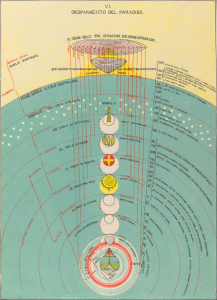
Ordinamento del Paradiso [Arrangement of Para-
dise] (1855), a diagram designed to accompany
Dante’s Paradiso, by Michelangelo Caetani.
h. You are from below, I am from above; you are of this world, I am not of this world/You are of those below, I am of those above; you are of this world, I am not of this world | Ὑμεῖς ἐκ τῶν κάτω ἐστέ, ἐγὼ ἐκ τῶν ἄνω εἰμί· ὑμεῖς ἐκ τούτου τοῦ κόσμου ἐστέ, ἐγὼ οὐκ εἰμὶ ἐκ τοῦ κόσμου τούτου [hümeis ek tōn katō este, egō ek tōn anō eimi: hümeis ek toutou tou kosmou este, egō ouk eimi ek tou kosmou toutou]: Though different in sense, this text (especially juxtaposed with 1:51) sounds reminiscent of a surviving epigram from Heraclitus, the sixth-century Ephesian philosopher. (Even if you think you haven’t heard of him, you’ve heard of him—he’s the “Can’t step in the same river twice” guy.) The quote and a hyper-literal translation appear below:
ὁδὸς.ἄνω…κάτω..μία.καὶ.ὡυτή5
[hodos..anō…….katō……mia…kai….ōütē]
..road.upwards.downwards.single..and..same
This isn’t as difficult to understand as it is to satisfyingly translate: the idea is The way up is the same as the way down or The ways up and down are one and the same (which are fine, they just aren’t as punchy as the Greek).
On a different tack, I was intrigued by the appearance of the definite article here, the τῶν in front of κάτω and ἄνω: it is in the genitive, the “of” case, and in the plural. Hearing a sentence like You are from below, I am from above, my imagination first interprets “below” and “above” primarily as locations; even with the article, if it had been in the singular, I’d have thought much the same. Instead, the text seems to be indicating kinds or groups—perhaps something vaguely like St. Augustine’s image, much later, of the city of man and the City of God. (It also reminded me slightly of a wrinkle I encountered late last year while translating a selection from Philippians, discussed in note f of this post.)
i. I told you that you would die in your sins, for you will die in your sins unless you believe that I am he/So I told you that you will die in your sins; for if you will not have faith that I am, you will die in your sins | εἶπον οὖν ὑμῖν ὅτι ἀποθανεῖσθε ἐν ταῖς ἁμαρτίαις ὑμῶν· ἐὰν γὰρ μὴ πιστεύσητε ὅτι ἐγώ εἰμι, ἀποθανεῖσθε ἐν ταῖς ἁμαρτίαις ὑμῶν [eipon oun hümin hoti apothaneisthe en tais hamartiais hümōn: ean gar mē pisteuēte hoti egō eimi, apothaneisthe en tais hamartiais hümōn]: The RSV (in my opinion) got a little silly over the syntax here—presumably, to avoid needing to end a clause with “I am.” This does often look and sound awkward in English, except when pronounced with stress on the pronoun alone, and usually with an informative or contrastive implication. (“Is anyone brave enough to clean the shark tank?” “I am”—notice that the second speaker doesn’t need to repeat brave enough to clean the shark tank; that’s understood as implied.) Given the preceding sentence, which features the clause I am not of this world, a bare “I am” here struck me as not drawing too much notice to itself, but instead sounding like a repetition-by-implication (cf. note d), and had the small added perk of preserving the original syntax.
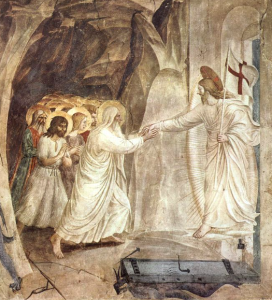
Fresco of the harrowing of hell (1442)
by Fra Angelico.6
j. Even what I have told you from the beginning/What did I tell you at the beginning? | Τὴν ἀρχὴν ὅ τι καὶ λαλῶ ὑμῖν; [tēn archēn ho ti kai lalō hümin]: The RSV makes this sound rather elevated and Johannine and mystical, and also what on earth is he supposed to be talking about, if that’s the vibe here? The Fourth Gospel kind of “soft launches” the Lord’s career as a preacher. One result of this is that we get neither the Synoptics’ accent on his initial slogan—”The Kingdom of God is at hand; repent and believe the good news”—nor any alternative version of how his preaching began. In other words, to all appearances, he didn’t tell them anything at the beginning, not in this Gospel. The first public action of his in the narrative, remember, is not preaching but the cleansing of the Temple! To be fair, that episode does, cryptically, include the claim that he in some sense is the (or a) Temple, which aligns with some of the remarks he has made in this Sukkot pericope (chs. 7-8), like the claim in last week’s text that the washing of the altar is about him. It would be rash to rule out the RSV’s interpretation of the text—I just find it strained.
On the other hand, Yeshua has a handful of these extremely “teacher voice” moments elsewhere, across all four Gospels. One of my favorites comes in Mark 8:10-21:
And straightway he entered into a ship with his disciples, and came into the parts of Dalmanutha. And the Pharisees came forth, and began to question with him, seeking of him a sign from heaven, tempting him. And he sighed deeply in his spirit, and saith, “Why doth this generation seek after a sign? Verily I say unto you, there shall no sign be given unto this generation.” And he left them, and entering into the ship again departed to the other side.
Now the disciples had forgotten to take bread, neither had they in the ship with them more than one loaf. And he charged them, saying, “Take heed, beware of the leaven of the Pharisees, and of the leaven of Herod.” And they reasoned among themselves, saying, “It is because we have no bread.” And when Jesus knew it, he saith unto them, “Why reason ye, because ye have no bread? perceive ye not yet, neither understand? have ye your heart yet hardened? Having eyes, see ye not? and having ears, hear ye not? and do ye not remember? When I brake the five loaves among five thousand, how many baskets full of fragments took ye up?” They say unto him, “Twelve.” “And when the seven among four thousand, how many baskets full of fragments took ye up?” And they said, “Seven.” And he said unto them, “How is it that ye do not understand?”
(If ye, reader, do not understand—I didn’t the first time I read this, though to my chagrin I forget where I picked up the following—here’s the idea. Leaven [i.e. yeast] is, not always but often, a symbol for moral or doctrinal corruption in the Bible: the bread baked for Passover was unleavened, and Passover was the defining holiday of Jewish identity, hence the symbolism. Their master warning them against “leaven” should, therefore, have been a fairly intuitive metaphor for the apostles, who’ve been apprenticing under this rabbi for a year or two by the time we reach Mark 8. Incidentally, the miraculous feeding of the five thousand has already happened at this point, as has the later miraculous feeding of the four thousand; clearly, there is no need for this group to be worrying about food. Christ—who, however well-fed, is apparently growing exhausted by constant traveling and by opponents treating him like a performing bear—tosses out this basic metaphor … and overhears the Twelve fretting because they think he’s mad they forgot to bring lunch. The Lord our God does not of course need my sympathy to be justified in his reactions, but all the same, I too would find this error on the part of my students aggravating.)

“Loaves” of soft homemade mattzah (unleavened
bread of the type used for Passover), similar in
form and texture to naan. Photo by Newmila, used
via a CC BY-SA 4.0 license (source).
On the other hand, returning to the text of the Fourth Gospel, this question could also be read even more tartly. The translation that appears in Sacra Pagina‘s commentary on this text reads, “What is the point of talking to you?” And just to be clear, this is not a paraphrase: it’s taking ἀρχή, which the RSV and I both translate as “beginning,” in its other sense, along the lines of “principle, exemplar, pattern.” The Greek will fully sustain either translation, and the double meaning—if this was spoken in Greek, which it might have been7—may have been deliberate.
k. he has not left me alone/he has not sent me off alone | οὐκ ἀφῆκέν με μόνον [ouk afēken me monon]: Right, people, strap in, it’s Gabriel’s “moaning about how the single word ἀφίημι [afiēmi] pretty much ruins my entire philosophy of translation, which is fine, because I don’t want to translate anything anyway” time. And feel free to un-strap in (strap out?), because the degree to which I hate this verb is frankly a little embarrassing. Anyone who wants to know more about ἀφίημι and its crimes can find a brief intro to it in the opening three paragraphs of this post, which discusses the word’s two appearances in the Our Father.
Footnotes
1Get it?
2To be clear, I’m by no means critical of this development, which allows for unusually delicate shades of negation that have to be effected in much more cumbersome ways, if at all, by other languages. I’m just pointing out that Modern English is comparatively unusual in this respect (as in a good many others, like our abundance of vowel sounds—most languages have about five or six and perhaps a few diphthongs, while English, even in varieties with a narrower vowel range, hit the double digits).
3See what I mean about the vast treasures people miss out on when they can’t read the New Testament in the original Greek?
4Regardless of whether they accept the traditional account of their authorship (most do not), scholars refer to all five books ascribed to him—the Gospel of John, the First, Second, and Third Epistles of John, and the Apocalypse—as the Johannine books. All five do share certain stylistic and thematic traits, and it is more or less accepted that they came from a single “school,” whether or not they came from a single pen.
5This form, with the omega (ω) at the beginning, is rather unusual. If I am remembering correctly, it was peculiar to Ionic Greek (Ephesus was the principal city of Ionia). Attic Greek—no, not that kind of attic; the kind spoken in Attica, the peninsula on which Athens sits—is what became the basis of Koiné, and would have spelled and pronounced this word in a form that may look more familiar, even to non-students: αὐτή [autē], the feminine form of αὐτός [autos] (which originally meant “self” or “same” but is used in John as kind of an all-purpose pronoun).
6This doctrine and image are not specifically relevant to this Gospel passage; however: (1) it’s Eastertide, so it’s liturgically on-theme; and (2) I cannot get over the hilarious detail of having a devil smashed underneath the door at the bottom of the picture!—look again if you missed it, there’s a tuft (?) of something at the top and a couple limbs peeking out at the sides, Wile E. Coyote-style.
7Aramaic would and should be our first guess, as this was the vernacular of a majority of the Jews in Palestine at the time. However, there were native inhabitants of the area who spoke Greek, some of them Jews, and Greek was as much an international language as Aramaic at the time—or rather, more so, since there were pockets of Hellenophones as far east as the former Greek realms in Balochistan, the Hindu Kush, the Pamir Mountains, and Turkestan (founded by the leftovers and latecomers of the conquests of Alexander the Great), but not really any corresponding Aramaic-speaking pockets west of Anatolia and the Sinai Peninsula, or none of importance. The assertion that everything Jesus said must originally have been in Aramaic—sometimes advanced as part of a “the Gospels aren’t reliable” argument—is without foundation; it was almost certainly his mother-tongue, but it is nearly as certain that he also spoke both Hebrew and Koiné Greek. The Passion of the Christ notwithstanding, it’s exceedingly unlikely that Christ spoke any Latin. Conversations between a Roman administrator like Pilate and an accused criminal would most likely have been conducted in Greek—or maybe Aramaic, if the administrator in question were conscientious and well-disposed to the locals; so yes, definitely Greek in Pilate’s case. (There is a remote chance Jesus spoke some Demotic, the then-current variety of Egyptian, which later evolved into Coptic. However, I know of no positive evidence for this; it’s just less unlikely than the idea that he somehow learned Latin.)









 Ad-Free & Subscriber Log-In