

You can find my two-part introduction to the Gospel of John at these two links, and my index/outline for it here; for the previous installment on John 11:47-12:11, go here.
The Gospel of John: The Prologue to a New Torah (John 12:12-50)
The Logos‘s entries into and departures from Yrushalem in chapters 5, 7, 9, and 10 have gone largely un-narrated, or have even taken place on the sly. Here, we finally get a public entry into the city like the one in chapter 2 seems to be—arguably a hint that these are actually the same visit to the Holy City, albeit narrated out of order. (We are informed in Mark, whose chronology seems to me to be the most exact, that the Triumphal Entry took place on one day and the cleansing of the Temple occurred on the following day.)

This also passage leans heavily into the second I am the ___ statement, “I am the light of the world,” thus recalling the grand narrative of Sukkot (which wound up being a four-part translation and commentary project). It is probably no coïncidence that, in the following chapter, we will be seeing the third and final nightfall of the book.
There is a passage from a play that I like which, in my mind, is closely tied to the Triumphal Entry. The play recounts the martyrdom of St. Thomas Becket, the Archbishop of Canterbury—a martyrdom which is in itself exceedingly strange, and not only because it took place in a cathedral, reportedly during Vespers!1 Many bishops have been killed for the faith, but this was not a killing done by outlaws inflamed with a pagan odium fidei; nor did it happen on Christendom’s twilit periphery. It took place in a realm called “the dowry of Our Lady,” at the hands of respected members of the military, during the zenith of the High Middle Ages—the very scene and place and folk and time when, by any reasonable expectation, a Catholic bishop should surely have been safe. But he wasn’t.
Here is no continuing city, here is no abiding stay.
Ill the wind, ill the time, uncertain the profit, certain the danger.
O late late late, late is the time, late too late, and rotten the year;
Evil the wind, and bitter the sea, and grey the sky, grey grey grey.
O Thomas, return, Archbishop; return, return, return to France.
Return. Quickly. Quietly. Leave us to perish in quiet.
You come with applause, you come with rejoicing, but you come bringing death into Canterbury:
A doom on the house, a doom on yourself, a doom on the world.
—T. S. Eliot, Murder In the Cathedral, Act One
This re-entry to the cosmic center (as discussed the commentary on 2:13-23, linked about) occurs just before what’s known as the Upper Room Discourse, which begins in John 13:31 and lasts through the end of chapter 17. That discourse will open with a “new commandment,” a mitzvah which the Torah did not contain. Here, preparatory to that, we get the vivid quasi-parable explaining that a seed must fall into the ground and die before fruit can be borne; this arguably hints at the ultimate severing of what at this stage is still “Beyt Yeshua” from its parent faith of Judaism. Strikingly, this is also one of the rare chapters in which the author of the Fourth Gospel, rather than simply alluding to or paralleling material from the Tanakh, directly quotes from it (three times).
John 12:12-50, RSV-CE

Fronds of the Phoenix dactylifera (date palm).
The next day a great crowd who had come to the feast heard that Jesus was coming to Jerusalem. So they took branches of palm trees and went out to meet him, crying, “Hosanna!a Blessed is he who comes in the name of the Lord, even the King of Israel!” And Jesus found a young ass and sat upon it; as it is written,
“Fear not, daughter of Zion;
behold, your king is coming,
sitting on an ass’s colt!”
His disciples did not understand this at first;b but when Jesus was glorified, then they remembered that this had been written of him and had been done to him. The crowd that had been with him when he called Lazarus out of the tomb and raised him from the dead bore witness. The reason why the crowd went to meet him was that they heard he had done this sign. The Pharisees then said to one another, “You see that you can do nothing; look, the world has gone after him.”
Now among those who went up to worship at the feast were some Greeks.c So these came to Philip, who was from Bethsaida in Galilee, and said to him, “Sir, we wish to see Jesus.” Philip went and told Andrew; Andrew went with Philip and they told Jesus.d And Jesus answered them, “The hour has come for the Son of man to be glorified. Truly, truly, I say to you, unless a grain of wheat falls into the earth and dies, it remains alone; but if it dies, it bears much fruit. He who loves his life loses it, and he who hates his life in this world will keep it for eternal life.e If any one serves me, he must follow me; and where I am, there shall my servant be also; if any one serves me, the Father will honor him.
“Now is my soul troubled. And what shall I say? ‘Father, save me from this hour’? No, for this purpose I have come to this hour. Father, glorify thy name.” Then a voice came from heaven, “I have glorified it, and I will glorify it again.” The crowd standing by heard it and said that it had thundered. Others said, “An angel has spoken to him.” Jesus answered, “This voice has come for your sake, not for mine. Now is the judgment of this world, now shall the ruler of this world be cast out; and I, when I am lifted up from the earth, will draw all men to myself.”f He said this to show by what death he was to die. The crowd answered him, “We have heard from the law that the Christ remains for ever. How can you say that the Son of man must be lifted up? Who is this Son of man?” Jesus said to them, “The light is with you for a little longer. Walk while you have the light, lest the darkness overtake you; he who walks in the darkness does not know where he goes. While you have the light, believe in the light, that you may become sons of light.”
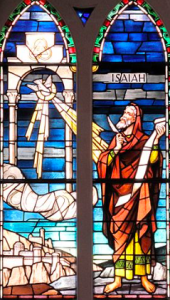
The prophet Isaiah depicted in stained glass
at St. Matthew’s German Evangelical Lutheran
Church in Charleston, SC. Photo by Cadetgray,
used via a CC BY-SA 3.0 license (source).
When Jesus had said this, he departed and hid himself from them.g Though he had done so many signs before them, yet they did not believe in him; it was that the word spoken by the prophet Isaiah might be fulfilled:
“Lord, who has believed our report,
and to whom has the arm of the Lord been revealed?”
Therefore they could not believe. For Isaiah again said,
“He has blinded their eyes and hardened their heart,
lest they should see with their eyes and perceive with their heart,h
and turn for me to heal them.”
Isaiah said this because he saw his glory and spoke of him. Nevertheless many even of the authorities believed in him, but for fear of the Pharisees they did not confess it, lest they should be put out of the synagogue: for they loved the praise of men more than the praise of God.i
And Jesus cried out and said,j “He who believes in me, believes not in me but in him who sent me. And he who sees me sees him who sent me.k I have come as light into the world, that whoever believes in me may not remain in darkness. If any one hears my sayings and does not keep them, I do not judge him; for I did not come to judge the world but to save the world. He who rejects me and does not receive my sayings has a judge; the word that I have spoken will be his judge on the last day.l For I have not spoken on my own authority; the Father who sent me has himself given me commandment what to say and what to speak. And I know that his commandment is eternal life. What I say, therefore, I say as the Father has bidden me.”
John 12:12-50, my translation
The next day, many crowds who were coming for the feast, having heard that Yeshua came into Yrushalem, took the fronds of date palms and went out to receive him, and they were crying: “Hoshana,a blessed is he who is coming in the name of the Lord, and the king of Israel.” Finding a little donkey, Yeshua sat on it, just as it is written:
Do not be afraid, Daughter of Zion:
see, your king is coming,
…..seated upon a donkey’s foal.
(At first his students did not recognize these things,b but when Yeshua was glorified, then they remembered that these things were written about him and that they did these things to him.) Then the crowd witnessed, who were with him when he called Eleazar out of the monument and raised him from the dead. For the sake of this also the crowd received him, that they heard he had done this sign.
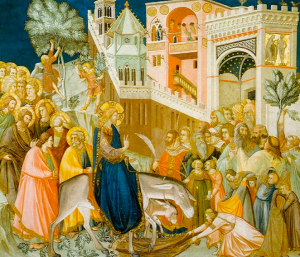
Fresco (c. 1300-1340) depicting the Triumphal
Entry, from the Upper Basilica of St. Francis in
Assisi, by Pietro Lorenzetti.
So the Pryshaya said among themselves, “Behold that you are not profiting nothing—look, the world has gone off behind him.”
Now there were some Greeksc among those who were coming up in order to worship during the feast; so they came to Philip, [who was] from Beyt Tzayad in the Galilee, and asked him, saying, “Sir, we want to see Yeshua.” Philip comes and tells Andre; Andre comes, and Philip, and they tell Yeshua.d
Yeshua responds, telling them: “The hour has come, that the Son of Man will be glorified. ‘Amin, ‘amin, I tell you, unless the kernel of grain falls to the earth and dies, it stays alone; if it does die, it bears much fruit. He who loves his own soul destroys it, and he who hates his own soul in this world guards it for age-long life.e If anyone would serve me, he must follow me, and where I am, there my servant will also be; if anyone serves me, the Father will honor him. Now, my soul is agitated, and what will I say? Father, save me from this hour. But for the sake of this I came to this hour. Father, glorify your Name.”
Then a voice came from heaven: “I both have glorified it and will again glorify it.”
So the crowd standing [there] and listening began saying thunder came; others said, “A messenger has spoken to him.”
And Yeshua said in response, “This voice did not come for my sake but for you. Now is judgment of this world, now the prince of this world will be thrown out; and if I be lifted up from the earth, I will draw everyone to myself.”f He said this, signifying the kind of death he was about to die.
Then the crowd responded: “We heard in the law that the Anointed stays into the age, and how are you saying that it is necessary for the Son of Man to be lifted up? Who is this Son of Man?”
Then Yeshua told them, “A little time yet, the light is among you. Go about while you have the light, lest dark should overtake you, and he who goes about in the dark does not know where he is going. While you have light, have faith in the light, in order that you may become sons of light.” Yeshua said these things, and left and hid himself from them.g Having done all these signs before them, they did not have faith in him, in order that the word of Yshayah the prophet should be fulfilled, which says:
Lord, who has had faith in our report?
…..Or to whom is the arm of the Lord unveiled?
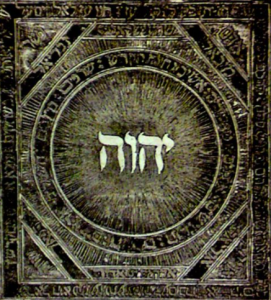
The Tetragrammaton, from a Sephardic manuscript
of the Tanakh.
Because of this they could not have faith, because again Yshayah says:
He has blinded their eyes
…..and he petrified their mind,
lest they should see with their eyes
…..or understand with their mindh
and turn,
…..and I would heal them.
Yshayah said these things because he saw his glory, and spoke about him. Nonetheless, many likewise among the princes also had faith in him, but because of the Pryshaya they would not affirm [it], lest they be put out of the assembly, for they loved the glory of people rather than the glory of God.i Yet Yeshua cried out and said,j “He who has faith in me does not have faith in me but in the one who dispatched me, and the one who beholds me beholds him who dispatched me.k I, light, came into the world, in order that all who have faith in me should not stay in the dark. And if anyone should hear my message and not keep it, I do not judge him, for I did not come in order to judge the world but in order that I will save the world. He who rejects me and does not grasp my message has this judgment: the word which I have spoken, this judges him on the Last Day;l because I have not spoken from myself, but the very Father who dispatched me gave me a charge, what I should say and what I should speak. And I know that his charge is age-long life. The things I say, then, just as the Father has told me, I speak likewise.”
Textual Notes
a. Hosanna/Hoshana | Ὡσαννά [hōsanna]: This is one of the Church’s many Anglo-Semitic terms, ultimately originating in the Hebrew הוֹשַׁע נָא [houshaȝ nâ’] or “save, we pray,” which by the first century had become so closely associated with prayer to God that it could be used as a laudatory acclamation.
b. And Jesus found a young ass and sat upon it; as it is written, “Fear not, daughter of Zion; / behold, your king is coming, / sitting on an ass’s colt!” His disciples did not understand this at first/Finding a little donkey, Yeshua sat on it, just as it is witten: “Do not be afraid, Daughter of Zion: / see, your king is coming, / seated upon a donkey’s foal.” (At first his students did not recognize these things | εὑρὼν δὲ ὁ Ἰησοῦς ὀνάριον ἐκάθισεν ἐπ’ αὐτό, καθώς ἐστιν γεγραμμένον· Μὴ φοβοῦ, θυγάτηρ Σιών· ἰδοὺ ὁ βασιλεύς σου ἔρχεται, καθήμενος ἐπὶ πῶλον ὄνου. ταῦτα οὐκ ἔγνωσαν αὐτοῦ οἱ μαθηταὶ τὸ πρῶτον [heurōn de ho Iēsous onarion ekathisen ep’ auto, kathōs estin gegrammenon: Mē fobou, thügatēr Siōn: idou ho basileus sou erchetai, kathēmenos epi pōlon onou. tauta ouk egnōsan autou hoi mathētai to prōton]: This is an allusion to a passage in Zechariah, one of the more apocalyptically-tinged prophets.
I will encamp about mine house because of the army,
…..because of him that passeth by,
…..and because of him that returneth:
and no oppressor shall pass through them any more …
Rejoice greatly, O daughter of Zion;
…..shout, O daughter of Jerusalem:
behold, thy King cometh unto thee:
…..he is just, and having salvation;
lowly, and riding upon an ass,
…..and upon a colt the foal of an ass.
And I will cut off the chariot from Ephraim,
…..and the horse from Jerusalem,
and the battle bow shall be cut off:
…..and he shall speak peace unto the heathen:
and his dominion shall be from sea even to sea,
…..and from the river even to the ends of the earth. …
Turn you to the strong hold, ye prisoners of hope:
…..even today do I declare that I will render double unto thee;
When I have bent Judah for me,
…..filled the bow with Ephraim,
and raised up thy sons, O Zion,
…..against thy sons, O Greece,
…..and made thee as the sword of a mighty man.
And the Lord shall be seen over them,
…..and his arrow shall go forth as the lightning …
And the Lord their God shall save them in that day as the flock of his people:
…..for they shall be as the stones of a crown,
…..lifted up as an ensign upon his land.
—Zechariah 9:8-10, 12-14, 16
c. some Greeks | Ἕλληνές τινες [Hellēnes tines]: “Greeks” presumably means Gentiles. This makes it a little puzzling that they would be coming to Yrushalem for a Judaic solemnity or be interested in meeting a rabbi—but only a little; as mentioned elsewhere, there were Gentile “God-fearers” among the many peoples of the Mediterranean littoral: Africans, Armenians, Celts, Cyrenians, Lydians, Nabateans, Syrians, Tartessians, etc.,2 besides the Greeks and Romans themselves. However, if Hellenistic Jews had been meant, then the obvious word to use would have been Ἑλληνισταί [Hellēnistai], “Hellenists.” Moreover, this is the very text in which which the universality of the Crucifixion is asserted in v. 32.
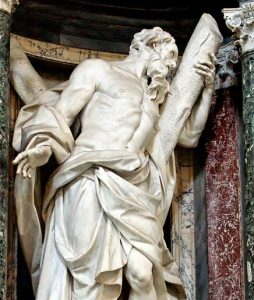
Statue of St. Andrew (1715) by Camillo Rusconi
in the Archbasilica of St. John Lateran. St.
Andrew is traditionally reported to have been
crucified on an X-shaped cross.
d. Philip went and told Andrew; Andrew went with Philip and they told Jesus/Philip comes and tells Andre; Andre comes, and Philip, and they tell Yeshua | ἔρχεται ὁ Φίλιππος καὶ λέγει τῷ Ἀνδρέᾳ· ἔρχεται Ἀνδρέας καὶ Φίλιππος καὶ λέγουσιν τῷ Ἰησοῦ [erchetai ho Filippos kai legei tō Andrea: erchetai Andreas kai Filippos kai legousin tō Iēsou]: Here, as always in the Fourth Gospel, St. Andrew appears in the process of bringing someone else to Christ (cf. 1:35-41, 6:8-11).
e. He who loves his life loses it, and he who hates his life in this world will keep it for eternal life/He who loves his own soul destroys it, and he who hates his own soul in this world guards it for age-long life | ὁ φιλῶν τὴν ψυχὴν αὐτοῦ ἀπολλύει αὐτήν, καὶ ὁ μισῶν τὴν ψυχὴν αὐτοῦ ἐν τῷ κόσμῳ τούτῳ εἰς ζωὴν αἰώνιον φυλάξει αὐτήν [ho filōn tēn psüchēn autou apollüei autēn, kai ho misōn tēn psüchēn autou en tō kosmō toutō eis zōēn aiōnion fülaxei autēn]: Though differently placed in John, we have here a sentiment quite familiar from the Synoptics.
“The Son of man must suffer many things, and be rejected of the elders and chief priests and scribes, and be slain, and be raised the third day.” And he said to them all, “If any man will come after me, let him deny himself, and take up his cross daily, and follow me. For whosoever will save his life shall lose it: but whosoever will lose his life for my sake, the same shall save it. For what is a man advantaged, if he gain the whole world, and lose himself, or be cast away? For whosoever shall be ashamed of me and of my words, of him shall the Son of man be ashamed, when he shall come in his own glory, and in his Father’s, and of the holy angels.”
—Luke 9:22-26
f. I, when I am lifted up from the earth, will draw all men to myself/if I be lifted up from the earth, I will draw everyone to myself | κἀγὼ ἐὰν ὑψωθῶ ἐκ τῆς γῆς, πάντας ἑλκύσω πρὸς ἐμαυτόν [kagō ean hüpsōthō ek tēs gēs, pantas helküsō pros emauton]: In the twenty-fifth chapter of his fourth-century book On the Incarnation of the Word, St. Athanasius, the hero of Nicæa, comments as follows. (I’ve edited the text slightly for readability; this translation is one Archibald Robinson’s, and can be found in full here—thank you, New Advent!)
If any of our own people also inquire, not from love of debate but from love of learning, why He suffered death in none other way save on the Cross, no other way than this was good for us. If the Lord’s death is the ransom of all, and by His death “the middle wall of partition is broken down” and the calling of the nations is brought about, how would He have called us to Him, had He not been crucified? For it is only on the cross that a man dies with his hands spread out. Whence it was fitting for the Lord to bear this also and to spread out His hands, that with the one He might draw the ancient people and with the other those from the Gentiles, and unite both in Himself. For this is what He Himself has said, signifying by what manner of death He was to ransom all: “I, when I am lifted up,” He says, “shall draw all men unto Me.”
And once more: if the devil, the enemy of our race, having fallen from heaven, wanders about our lower atmosphere and there tries to hinder them that are going up (“the prince of the power of the air”), while the Lord came to cast down the devil and clear the air and prepare the way for us up into heaven—by what other kind of death could this have come to pass than by one which took place in the air? For only he that is perfected on the cross dies in the air. Whence it was quite fitting that the Lord suffered this death. For it was not the Word Himself that needed an opening of the gates, being Lord of all; nor were any of His works closed to their Maker; but we it was that needed it, whom He carried up by His own body; He once more made ready the way up into the heavens.
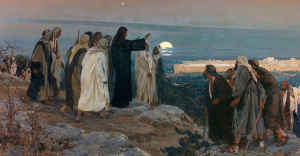
Flevit Super Illam [He wept over her] (1892),
by Enrique Simonet.
h. perceive with their heart/understand with their mind | νοήσωσιν τῇ καρδίᾳ [noēsōsin tē kardia]: Most cultures associate certain internal organs, or body parts more generally, with certain emotional, intellectual, and spiritual faculties. In our own day, we tend to associate the brain with the intellect, the heart with most emotions (but especially love, joy, and sorrow), and to some extent the blood and nerves with anger and fear or anxiety, respectively. In Classical Antiquity and the Medieval period, however, associations were a little different: in particular, the brain was not usually part of the reckoning at all, and the heart often played the symbolic role we assign to the brain. (For instance—and I could have sworn I got this from C. S. Lewis in Studies in Words, but cannot now find it there—the Latin word cordātus, derived from cor “heart,” means not a man of fine sentiment as we might expect, but a man of good sense or prudence.) Hence, it’s often preferable to render καρδία, incorrectly from a physiological point of view, as “mind,” that being what the author is getting at in our terms.
i. they loved the praise of men more than the praise of God/they loved the glory of people rather than the glory of God | ἠγάπησαν γὰρ τὴν δόξαν τῶν ἀνθρώπων μᾶλλον ἤπερ τὴν δόξαν τοῦ θεοῦ [ēgapēsan gar tēn doxan tōn anthrōpōn mallon ēper tēn doxan tou Theou]: This is likely a concealed pun, one that St. Paul also employs in Romans 2:29. The name Judah (from which the term Jew comes), יְהוּדָה [Y’húdhâh] in Hebrew, is traditionally derived from the verb יָדָה [yâdhâh], which means “to praise.”
j. And Jesus cried out and said/Yet Yeshua cried out and said | Ἰησοῦς δὲ ἔκραξεν καὶ εἶπεν [Iēsous de ekraxen kai eipen]: The timing of this is unclear; it gives the impression of something Christ said before the self-concealment of note f, but it does come into the narrative naturally here, serving as a kind of summary of his public teaching ministry, before we come to the Upper Room Discourse (chs. 13-17) that concludes the teachings he gave privately, though not (in the long run) secretly, to the Twelve.
k. He who believes in me, believes not in me but in him who sent me. And he who sees me sees him who sent me/He who has faith in me does not have faith in me but in the one who dispatched me, and the one who beholds me beholds him who dispatched me | Ὁ πιστεύων εἰς ἐμὲ οὐ πιστεύει εἰς ἐμὲ ἀλλὰ εἰς τὸν πέμψαντά με, καὶ ὁ θεωρῶν ἐμὲ θεωρεῖ τὸν πέμψαντά με [ho pisteuōn eis eme ou pisteuei eis eme alla eis ton pempsanta me, kai ho theōrōn eme theōrei ton pempsanta me]: This is a motif common to both John and the Synoptics. Cf. Luke 10:16: “He that heareth you heareth me; and he that despiseth you despiseth me; and he that despiseth me despiseth him that sent me.”
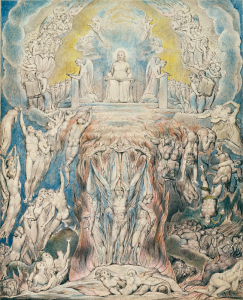
The Day of Judgment (1808), by William Blake.
l. the word that I have spoken will be his judge on the last day/the word which I have spoken, this judges him on the Last Day | ὁ λόγος ὃν ἐλάλησα ἐκεῖνος κρινεῖ αὐτὸν ἐν τῇ ἐσχάτῃ ἡμέρᾳ [ho logos hon elalēsa ekeinos krinei auton en tē eschatē hēmera]: This would seem to contrast with the statements of chapter 5 that “the Father has given all judgment to the Son,” “the Father has given him authority to make judgment, because he is Son of Man,” and “just as I hear, I judge, and my judgment is just; because I do not seek my own will, but the will of the one who dispatched me.” One possible solution is that, just as the Father relinquishes judgment to the Son, so the Son relinquishes judgment—the question being, to whom? “The word that I have spoken” isn’t an entirely transparent answer here, since that is not a person and has no agency … unless we ought to be understanding the Holy Ghost as being “the word that I have spoken”—the Logos of the Logos, as it were, that which is to the Logos what the Logos is to the Father. (This interpretation certainly appears to align with the doctrine of the Double Procession of the Holy Ghost pretty closely.)
This phrasing, on the other hand, seems to correspond with what we mean when we speak of someone being “condemned out of his own mouth.” If this were taken jointly with the previous interpretation, then we get a reflex of both shortly hereafter in John 16:7-11:
It is expedient for you that I go away: for if I go not away, the Comforter will not come unto you; but if I depart, I will send him unto you. And when he is come, he will reprove the world of sin, and of righteousness, and of judgment: of sin, because they believe not on me; of righteousness, because I go to my Father, and ye see me no more; of judgment, because the prince of this world is judged.
Footnotes
1Vespers is the Latin name for the evening office of prayer. It is also, very distantly, akin to the English word west. Vespers is nearly equivalent in the Anglican tradition to Evensong, but the latter also draws on the office of Compline (pronounced kôm-plĭn and derived from the Latin complētōrium).
2About these labels.
• Africans here means people from the Roman province referred to as Āfrica, which in modern terms consisted mainly in Tunisia, northern Algeria, and most of the coast of Libya. They were partially Punic in ancestry thanks to Carthage, a city built by colonists from Phoenicia (especially Tyre).
• Armenians were anciently much more widespread than they are today, occupying most of the Armenian Plateau (opposite the Caucasus Mountains) and much of Cilicia and northern Mesopotamia.
• Celts are best known for living in Gaul, more or less equivalent to modern France, as well as in the British Isles; however, the Halstatt and La Tène cultures, which were probably Celtic, spread over much of Europe, from Portugal to Hungary. There was a notable Celtic admixture in northern Italy as well—so much so that it was known as Gallia Cisalpina, “Gaul on this side of the Alps”—and even a rather smaller area of Celtic settlement in central Anatolia, known after them as Galatia.
• The Cyrenians were Greek in origin; they had colonized a part of the Mediterranean coast of Africa (in our sense) that now makes up northeastern Libya, and there built the city of Cyrene (as in “St. Simon of”).
• Lydians were a non-Greek but Greek-adjacent ethnicity hailing from western Anatolia. The most famous Lydian is of course Croesus, who is still dead.
• The Nabateans were a Semitic people from northern Arabia and the Sinai Peninsula; their capital was the famous city of Petra.
• Syrians were also a Semitic ethnicity, sometimes called Aramæans—the names Syria and Syrian began as clippings of Assyria and Assyrian, as the Romans conflated the two peoples..
• Tartessians came, as everyone knows, from Tartessus, which appears in Jonah as “Tarshish.” This civilization was in southern Spain (modern Andalusia), and was the western extreme of the known world to first-century Jews, among others.







 Ad-Free & Subscriber Log-In