History of the Crusades: The Battle of Tours, 732. Islam Halted

History of the Crusades: The Battle of Tours, 732. Islam Halted February 26, 2015

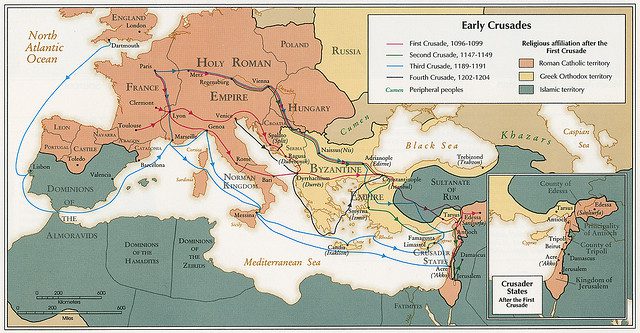
Photo Source: Flickr Creative Commons by http://maps.bpl.org

I hope that you are following this series. Popular media and the anti-history that we are being taught gives an inaccurate view of the Crusades designed to be used in Christian bashing. This has reached the point that the President of the United States can allude to this propaganda as history in a speech about the genocide of Christians in a large part of the world today.

We need to know the truth.

I am aware that there are Islamic teachings which lead to a more peaceful application of that faith. I think that the interpretation referenced here is an accurate depiction of of the application of Islamic teachings in 633-638 AD. It also seems that it is still relevant to Islamic extremists today.

I want to emphasize that this video discusses events which happened almost 1400 years ago. The reason I am posting it here is to correct the inaccurate  history of the Crusades which is being used in the popular media to attack and degrade Christians and Christianity.


Read more: http://www.patheos.com/blogs/publiccatholic/2015/02/history-of-the-crusades-the-rise-of-charles-martel-and-byzantine-iconoclasm-718-731/#ixzz3SsKgzub2


Browse Our Archives


TRENDING AT PATHEOS Catholic
What Are Your Thoughts?leave a comment

2 responses to “History of the Crusades: The Battle of Tours, 732. Islam Halted”

  1. One of the consequences of the Muslim invasion of the Roman Empire was the complete collapse of the huge Egyptian papyrus industry, which had supplied the whole Roman world with comparatively cheap and high quality writing materials for centuries. The so-called barbarian invasions had not halted large-scale trade through the Roman world; indeed, they might even have opened some new markets – archaeology and ancient records, for instance, both suggests that Egyptian traders in the fifth and sixth century visited not only Britain but Ireland too. That is because the “barbarians” did not intend to destroy the rich Roman empire but to place themselves in powerful and profitable places within it.

    Muslim warfare was entirely different. From Syria to Morocco, it is associated with horrible desertification, the destruction of irrigation and terraced fields, the loss of enormous amounts of arable land, the abandonment of whole communities. Dozens of Roman towns can be found in what is now the Syrian desert. And if agriculture was ruined, trade was annihiliated. Sailing completely ceased, except on one route, that between Constantinople and Venice. Why? Look at your maps: nearly all the route from the Greek empire to the city of the lagoons was along the Adriatic, a long and narrow sea dominated by Christian countries on all sides. Until the Turks, much later, seized Anatolia and the Balkans, the Muslims had no reliable base anywhere within raiding reach of the Adriatic. The rest of the Mediterranean ceased to be a high road for trade and was reduced to a nightmare of piracy and slaving.

    This collapse of seaborne trade is the reason why the European Dark Ages are dark. Without Egyptian papyrus, the only writing material available was scarce and expensive parchment. As a result, nearly all forms of writing vanished, except for those intended for exceptionally ceremonial and enduring purposes: law codes, land grant charters, Bibles and other sacred writings. From about 610 to about 750, records almost cease. Pope Gregory I the Great had left behind an enormous registry of letters giving a detailed account of his actions on the international stage; his successors have at best only a few letters ascribed to them at worst not even that.

    The relevance of this to the battle of Tours? This: that in spite of the enduring shortage of written records, the battle is recorded in several sources, both Arabs and Frankish. It clearly made a mark.