

I have a dilemma. I want to share my enthusiasm for a literary work that I regard as a really significant piece of Christian writing, which might even be a key piece of evangelism in its own right, but I can’t do that properly without revealing major spoilers, which concentrate heavily in the last few lines. Bear with me as I try to navigate the problems here. I will also address the mystery of just how this particular story came to be. And it makes for good Holy Week reading.
To begin non-controversially, the story is called “The Man,” by Ray Bradbury, and it is best known from his 1951 collection The Illustrated Man. The original appeared in the wonderfully named Thrilling Wonder Stories in February 1949, and as I will explain, the date is important. (See the original magazine setting here, at pp 69-75)
NON-SPOILER VERSION
“The Man” tells the story of a spaceship exploring unknown realms, boldly going in order to make first contact with alien races and civilizations. By any standard, such a connection would be an exciting and even explosive moment for any race, any people. But in the instance of this one planet, nobody seems terribly concerned, because they have better things to do. Fortuitously or otherwise, the spaceship from Earth has arrived at the time when a mysterious stranger has also arrived at that same planet, preaching amazing doctrines and performing miracles. By whatever name you might want to call him, he is Christ, the Messiah, and it is that planet’s turn to receive him. The Man is faithfully following his promise to tend to the other sheep he has, that are not of his fold – or indeed, of this planet. Why would the aliens bother to divert their attention to anything as trivial as these Earth people in their silvery spaceship?
I strongly recommend the story! Do read to the end. You will be glad you did.
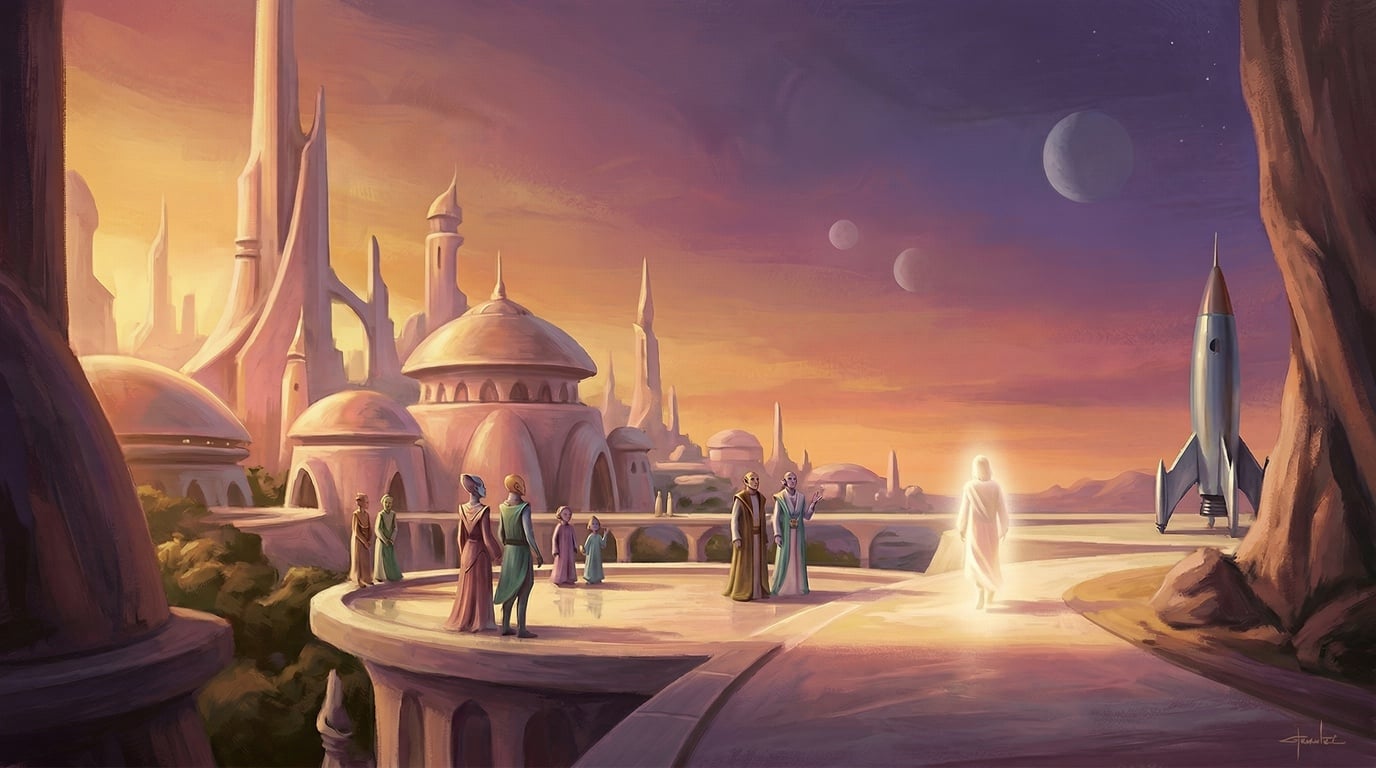 Image courtesy of Alan Crandall: created in Gemini for Patheos
Nothing in what I just said is a spoiler, in the sense that every detail surfaces in the story’s first couple of pages. And having said that, I will now turn to the
SPOILER VERSION!!
The plot focuses on the reactions of the various characters to news of The Man. The commander, Captain Hart, is an ultra-skeptic and seeks out every rational explanation for the strange circumstances, even as they become ever more far-fetched. As he freely admits, Hart lives in a kind of inner turmoil because the world has been in chaos since Darwin’s time:
“Not since everything went by the board, everything we used to believe in, eh? Divine power and all that. And so you think maybe that’s why we’re going out to the stars, eh, Martin? Looking for our lost souls, is that it? Trying to get away from our evil planet to a good one?”
“Perhaps, sir. Certainly, we’re looking for something.”
Following that quest, Martin becomes one of the travelers who accept the Man for what he is, and who ask if they should follow him. But suddenly, he seems to have disappeared from the new planet.
Eventually, Hart leaves that planet in search of the mysterious figure, knowing he can never return. Martin asks him,
“There’s one thing I’d like to know.”
“What?”
“Sir, when you find him—if you find him,” asked Martin, “what will you ask of him?”
“Why—” The captain faltered, opening his eyes. His hands clenched and unclenched. He puzzled a moment and then broke into a strange smile. “Why, I’ll ask him for a little—peace and quiet.” He touched the rocket. “It’s been a long time, a long, long time since—since I relaxed.”
“Did you ever just try, Captain?”
The aliens – the mayor and some followers – then approach Martin, and comment sadly on the departure. As they explain, Hart will pursue his quest until the last moment of his life, but he will never achieve it.
“Yes, poor man, he’s gone,” said the mayor. “And he’ll go on, planet after planet, seeking and seeking, and always and always he will be an hour late, or a half hour late, or ten minutes late, or a minute late. And finally he will miss out by only a few seconds. And when he has visited three hundred worlds and is seventy or eighty years old he will miss out by only a fraction of a second, and then a smaller fraction of a second. And he will go on and on, thinking to find that very thing which he left behind here, on this planet, in this city—”
Martin looked steadily at the mayor.
The mayor put out his hand. “Was there ever any doubt of it?” He beckoned to the others and turned.
“Come along now. We mustn’t keep him waiting.”
They walked into the city.
That is the end of a science fiction story. It is also an amazing piece of Christian writing, which would fit in multiple traditions, but by far the best of all in the evangelical mode. To paraphrase Bradbury: you can spend your whole life seeking out the closest approach to truth, and always falling short: you will always be a minute or a second late, and never find rest or peace. That is what Hart has done, and the name obviously conjures up “Heart.” The heart is always searching for certainty. But as the story tells us, The Man is here, right here, right now, and is available to you. Why would you not simply accept him and his truth? Why do you want to go on seeking, maybe to the last moment of your life, in the likelihood that you will never reach your goal?
This is your moment of decision, right now. Why wait? Say yes.
Come along now. We mustn’t keep him waiting.
I note the idea of the search for “rest,” for peace and quiet, which is actually a strong Early Christian theme, as Bradbury may or may not have known. The Gospel of Thomas, among others, has Jesus declaring that “He shall not cease from seeking until he find, and having found, he will be amazed, and having been amazed he will reign, and having reigned he will rest.”
Ray Bradbury wrote a great many stories, and quite a few have a religious theme. He even published A Chapbook for Burnt-Out Priests, Rabbis and Ministers (2001), a quirky miscellany of spiritually-oriented essays, poems and short stories, which among other things do mention the idea of Christ on other planets. There are also such stories as “The Fire Balloons,” which are the subject of smart writing by Thomas Salerno, among others. But in all this, there is nothing else in his writings that is vaguely like “The Man,” which at least in appearance (and I stress that) seems to be rooted in a firm and even conventional evangelical faith.
If I was looking for literary parallels in roughly the years that he was writing, I would be turning to C. S. Lewis’s Space Trilogy, and of course, both those authors had a special interest in an inhabited Mars. The excellent scholar Bradley J Birzer has a comparative analysis of the two authors here.

But here is the problem. Bradbury is a very well-studied author, and that evangelical model really does not work, or at least for any significant portion of his life. He was always more of a wide-ranging seeker who loved spirituality in general, but not in any particular denominational style. He was, famously, a “delicatessen religionist,” or at least, that is how he described himself half a century after publishing “The Man.” All of which makes it truly odd that he produced that story. Did he pass through a brief and poorly documented evangelical phase in the late 1940s? For what it was worth, he was raised Baptist, but quite nominally.
I originally floated one idea that seemed brilliant to me, but which (of course) turned out to be dead wrong. Bradbury was a definitive Angeleno, writing in Los Angeles in 1949. Hmm, what a combination of place and date! That is one of the key moments in American religious history, as the site of Billy Graham’s first great American revival crusade, and thus the launching point for a new evangelicalism. Central to the whole enterprise was the Decision for Christ. Surely, I thought, Bradbury must have been carried away by the new movement! Nope. The story appeared in February 1949, the revival began that September, so there is assuredly no connection.
Briefly, then, I don’t have an explanation for why “The Man” appears how, when, and why it does. But I remain impressed by the power of its message. To say again:
Come along now. We mustn’t keep him waiting.
Jonathan R. Eller, editor, Remembrance: Selected Correspondence of Ray Bradbury (Simon and Schuster, 2024)











 Ad-Free & Subscriber Log-In