

We are living in a New Gilded Age.
Or, so said Paul Krugman in 2014 as he reviewed economist Thomas Piketty’s Capital in the Twenty-First Century.
In the dozen years since, nothing seems to suggest the name is less applicable. The gap between the top 1% and the 99% is almost unfathomable. From superyachts, superstar wedding singers, and half-a-million bottle service, to space tourism, apocalypse bunkers, and the Mar-A-Lago face, the obscene spectacles of mega-wealth grow by the day. Where did our barons of business, tech titans, and venture capital heroes go so wrong?
In other words, when did business go bad?
Bad Business
For most of Christian history, business was always bad—at least morally.
While there is by no means a clear consensus, there is a thoroughly anti-merchant streak running through many classical traditions. Aristotle, retail trade was “justly censured” because it was an “unnatural” form of wealth accumulation. For Seneca, long-distance trade only existed due to human greed. And in China, the legalist scholar, Han Fei, numbered the merchants among the “five vermin” that undercut the foundations of society by hoarding “their stores to exploit market timing.” Best to reduce them as much as possible. Even among the more conciliatory classical thinkers, merchants were admonished to keep their scales just and balance profit with virtue. Almost unanimously, the idea of lending at interest was condemned.
Early Christians tended to carry forward the anti-merchant streak. This is an unsurprising fact when you consider the apologetical tasks of early Christianity. The early Church Fathers wanted to affirm the best of Greek philosophy, while also one-upping it. If Aristotle was concerned about the unjust nature of trade, then early Christians were, as well. Tertullian argued that Christians should avoid trading as a profession, as it supported idolatry via the spice trade, and it was itself too close to the root of all evil, covetousness. Basil the Great admonished the rich to give away their bread “which you keep in store,” as it belonged rightly to the poor. What was a merchant who was buying low and selling high to do? I’m no business mogul, but last I checked, giving away all your goods at a loss is a bad business plan. Beyond Tertullian (always a bit of an extremist), the Church Fathers tended to avoid directly forbidding trade—especially as the Church rose into prominence as the official imperial religion. Yet, the merchant was always there on the fringe, an easy object lesson on exploitation, extravagance, or greed.
What’s So Wrong with Trade?
Medieval Christians, with their deep love of Greco-Roman philosophy and early Christian authorities, followed suit. Citing those authorities, Aquinas argues that “trading… has a certain debasement… [for] it does not imply a virtuous or necessary end.” He goes on to say that trade is nevertheless lawful if moderate gain is pursued for some public good or consists in basic exchange between households.
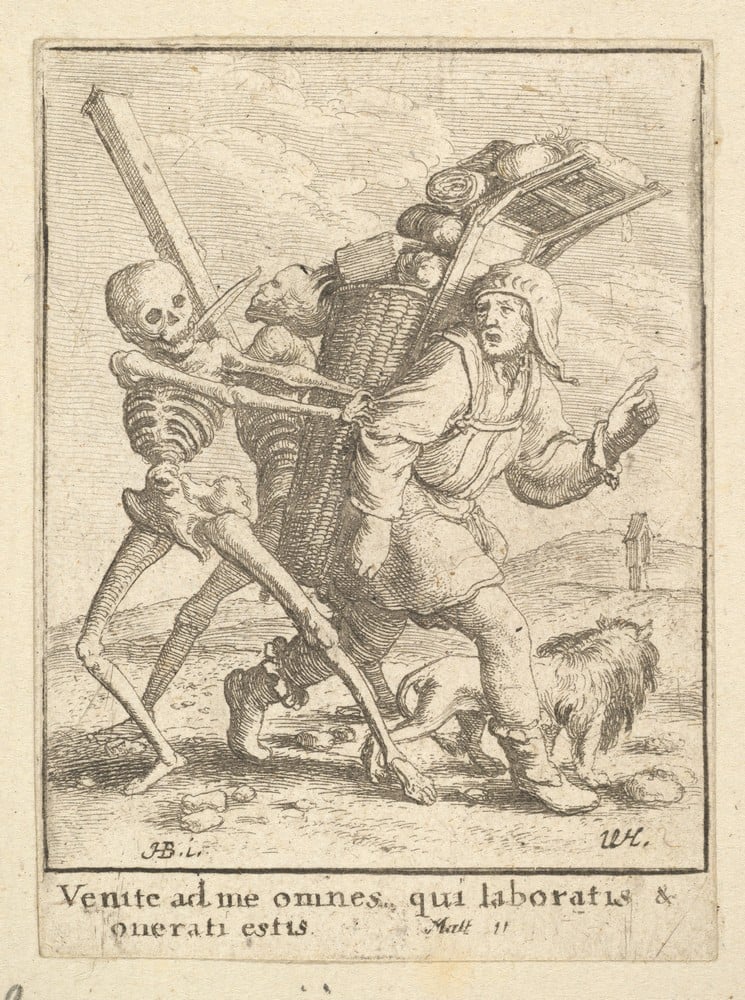
Underlying the rationale for Aquinas—and all of the thinkers above—is an apparent ambiguity in the process of trade itself. The rationale is not hard to understand. Farmers could be lauded for their produce, artisans for their skill, and rulers for their wisdom. Merchants, though, what did they contribute to the world? The movement of goods from one place to another was a natural part of human social relations (e.g., ” May I borrow a cup of sugar?”). Profiting off that process seemed like an immoral surcharge on human relations and a corrupt reversal of human production. To extract something from that natural exchange was inherently exploitative. This rationale is why lending at interest (usury) was often tied so closely to the practice of trade. Both were forms of unnatural profiteering on natural human communal ties.
Considering our contemporary economic system is built on trade and lending at interest, well, it is not hard to imagine what these classical traditions would think of us. Our modern global capitalist system is the stuff of Aristotle’s and Aquinas’ nightmares. Yet, this ban on trading for profit made far more sense for the Western European Christians of late antiquity and medieval Europe. Through most of these periods, trade was highly localized. Communities tended toward self-reliance, with regional trade mostly the stuff of luxury goods.
Thus, if a peddler showed up in your town, they were an outsider who offered you goods at prices that seemed arbitrary and which you knew included a surcharge of some kind. How could you ever know you were getting a fair deal, and if you didn’t, what recompense would you have once the peddler left town? As cities began to grow in the later part of the medieval period, it was no accident that merchant quarters often overlapped with ethnic ghettos; this logic was mirrored in the concentration of lending among medieval Jewish communities. Popular resentment and violence against ethnic minorities, then, almost always had an economic dimension—a relationship that is still on display in contemporary Nativism and anti-Semitism.
Whence Noblesse Oblige?
Today, I think the classical Christian distrust of trade and lending may resonate with many people. I’ll admit, at least part of it resonates with me. It is hard to stomach the juxtaposition of obscene opulence and devastating poverty within my newsfeed. Doesn’t some of that bread belong to the needy?
At the same time, we cannot go back to autarchic agrarian societies with a distrust of foreigners. History cannot repeat itself, and global capitalism is not going anywhere any time soon. There are clear examples of businesses that do operate toward broader social good (even Christian ends), but it does feel that they are the exception rather than the rule. What can be done, then?
Thomas Piketty’s work suggests that the problem is not just structural, but social. If we want to understand the roots of economic disparity, we need to understand the erosion of certain social norms. Why do the barons of business feel so unencumbered about the unrestrained accrual of wealth? Why are golden parachutes and billion-dollar bonuses seen as morally neutral or even good? Where did noblesse oblige go?
To understand that, perhaps it might be good to understand when Christians started baptizing business. More on that in a future post.










 Ad-Free & Subscriber Log-In