

What are the likely taboo topics for sermons in 2026, and what do they tell us about the challenges facing mainline Protestant preachers in the year ahead?
In our nationwide survey, mainline Protestant preachers reported preaching on many social issues with more frequency in 2024 and 2025 compared with previous years. But there were several topics they deemed off limits or approached with extreme caution, including abortion, guns, and Israel/Palestine. As we look ahead to 2026, this article explores the factors that affect preachers’ willingness to address controversial public issues and how they’re navigating the challenges of taboo topics.
By Leah D. Schade, with Amanda Wilson Harper and Wayne Thompson

8 Years Researching Ministry, Preaching, and Social Issues
Since 2017, my team and I have been studying U.S. mainline clergy addressing social issues. Amanda Wilson Harper (Tarleton State University) and Wayne Thompson (Concordia University) and I have surveyed more than 7,000 preachers across four survey waves in the last eight years.*
The 2025 sample was 60% female, 38% male, and 2% nonbinary, gender-fluid, or transgender. Most respondents identified as heterosexual (81%), with 8% identifying as gay or lesbian, 7% as bisexual, and 4% using another self-description. Racially, nine in ten identified as white, and 88% reported English as their primary language.
Participants ranged in age from their early twenties to over 70 (median age 53) and had served in ministry from less than one year to more than 30 years (median 18 years). They represented congregations of fewer than 25 to more than 1,000 in worship attendance, across rural and small-town, suburban, and urban contexts.
Politically, 91% identified as progressive or moderate-lean progressive, 4% as moderate, and 5% as moderate-lean conservative or conservative.
Preaching About Social Issues Increased in 2024-25
Our results show that the percentage of preachers addressing social issues at least ten times in a year doubled from 30% in 2017 to 59% in 2025. We asked respondents in each survey wave to indicate which contemporary issues they addressed in a sermon in the previous twelve months, choosing from a list of 20-30 topics. The 1,017 respondents in 2025 chose from 22 topics ranging from abortion to gun violence to racism.
Ten topics reached a frequency of 50% or more among respondents, with racism, economics, and environment topping the list.
[For the full list of 2024-25 preaching priorities, read: Top 10 Social Issues in Mainline Protestant Sermons, 2024-25.]
Topics Preachers Are Likely to Address in 2026
We also asked respondents to indicate what they intended to address in the coming 12 months, picking up to five. These topics passed the threshold of 30% or higher:
- Economic issues, 53%
- Christian nationalism, 49%
- Immigration, 44%
- Environmental issues, 39%
- Racism, 38%
- LGBTQIA+ issues, 36%
- Hunger/food insecurity, 35%
We note that Christian nationalism was the second-highest priority for respondents, and that it appears to be rising in importance for mainline preachers.
Christian nationalism is the fusion of white supremacism with radical, right-wing Christianity that subsumes politics within its agenda. As reporter Ariana Baio has estimated, half of Project 2025 – the blueprint for American christofascism – has been enacted by the second Trump administration. Thus, it is likely that progressive Christian preachers will address this heresy with more frequency in 2026.
[See also: Survey Shows More Mainline Clergy Addressing Social Issues.]

Taboo Topics for Preachers
In the survey, we also asked which topics they were most likely to avoid in their preaching in the coming year. In other words, it wasn’t that these topics were not a priority for preachers; rather, they would intentionally refrain from addressing them in sermons.
Four topics emerged as the most likely to be avoided:
- Abortion, women’s reproductive rights, 29%
- Guns, firearms (rights or regulations of), 23%
- Israel, Palestine, 18.5%
- Technology, Artificial Intelligence, 18%
However, when factoring in demographics, political orientation, and ministry setting, there were notable variations.
- For politically conservative preachers, LGBTQIA+ issues topped the list of topics to avoid at 45%, followed by gender identity, 40%, Christian nationalism, 37.5%, and abortion, 32.5%.
- For those serving in rural areas, abortion (39.5%), guns (32.5%), and gender identity (24%) were the highest-ranked taboo topics.
- Among preachers of color, Israel/Palestine was the most frequently avoided topic (19%).
- Preachers under the age of thirty indicated that they would most strongly steer clear of technology and artificial intelligence (30%).
Written comments indicated myriad reasons for preachers avoiding hot-button topics. For some, the complexity of these issues is such that addressing them in a single sermon would be inadequate. For others, the issue would be too controversial for their congregation. As one noted, “Preaching about guns would get me fired.” And many lectionary preachers said they would not address a topic if the assigned readings did not speak to the issue.
For Some Preachers, No Social Issues are Taboo
Importantly, one third (33%) of respondents indicated that none of the topics were off limits to them. Certain variables, however, decreased the likelihood of indicating willingness to address taboo topics. For example, those serving in rural or small towns reported less willingness (24%) than those serving in suburban (33%) or urban communities (46%).
Other variables were grouped by personal demographics, professional factors, and congregational factors.
Personal Demographic Factors
Several demographic variables correlated with differences in willingness to preach about taboo topics. While gender made little difference, lesbian, gay, or bisexual preachers were more willing (43%) than heterosexual preachers (31%).
Preachers of color were more willing (42%) than white preachers (32%).
Those aged 50 and up were more willing (33%) than those under 30 (27%).
Thus, preachers who were younger, white, or heterosexual indicated greater hesitancy to address taboo topics.
Professional Factors
Key professional factors decreased willingness to preach on taboo topics.
Seminarians and New Preachers
Student pastors and seminarians were among the least willing (16%). Preachers new to ministry (< 3 years) were less willing (25%) than those with four or more years’ experience (33%). Thus, preachers who are early in their vocational development are the least likely to take risks in preaching. The lack of job security, congregational trust, and confidence in navigating conflict are likely explanations for this hesitancy.
Year of Ministry Credentialing
The year in which respondents earned their ministry credentials also played a role. Thirty-six percent of those who earned their credentials before 2019 were willing to preach on any topic, compared with 23% of those who earned their credentials in 2020 or later. Thus, preachers credentialed more recently appear more cautious than those formed prior to 2019. This may point to a generational or contextual shift in ministerial training amid heightened polarization and post-pandemic caution.
Professional Role
Interim or short-term ministers indicated more willingness to preach on taboo topics (42%) than those who were lead pastors (37%), solo pastors (33%), or associate/assistant pastors, youth pastors, or family life ministers (31%). In other words, one’s professional role matters. Clergy serving in interim or short-term positions show greater willingness to preach on taboo topics than those embedded in long-term leadership roles. This suggests that freedom from long-term consequences can embolden preachers addressing contentious public issues.
Taken together, these findings suggest that vulnerability and power dynamics strongly shape clergy willingness to address taboo topics. Preachers who feel safe within their bodies and within their congregations are more willing to take risks than those who feel less secure. The data indicate that experience, security, and positional autonomy increase willingness to engage taboo issues, while precarity and early-career formation tend to suppress it.

Congregational factors
Demographics, political divides, and size of worship attendance correlated with variations in preachers’ willingness to address taboo topics.
Race and Presence of Youth
Fifty-three percent of those serving congregations of color were willing to preach on any of the listed issues, the highest number of any single variable. Also, those serving more diverse congregations were more willing (40%) than those serving racially homogenous churches (31%).
The presence of youth in the congregation was also an influence. Those serving congregations with youth 6-21% or higher were more likely to preach on taboo topics (36%) than those with 5% or less of youth in the church (28%).
Political Divides and Support from Congregational Leaders
One of the most prominent factors was the perception of political divisions in the church. Those in somewhat or very divided congregations were less willing to preach on taboo topics (24%) than those in progressive or politically aligned churches (40%). Also, only 20% of those who had little or no support from congregational leaders were willing to preach about taboo topics, compared with 35% of those who had some or significant support, a 15-point gap.
Worship Attendance and Budget Size
Size of worship attendance was also a factor. Those who served congregations with worship attendance of 301 or more were less likely to preach on taboo topics (27%) than those at churches with worship attendance between 101-300 (30.5%) or less than 100 (34%).
Similarly, those in churches with congregational budgets greater than $501,000 were less likely (26%) to preach on taboo topics than those with income of $101,000-$500,000 (34%), and $50,000-$100,000 (32%).
Context Matters
In all, the context where a preacher serves shapes their willingness to address taboo topics. Contextual diversity, intergenerational presence, political unity, and leadership support are all enabling factors.
However, congregational size and resources tend to dampen risk-taking. Preachers in larger congregations and higher-budget churches showed lower levels of willingness to engage taboo topics. This suggests that as institutional complexity, visibility, and financial stakes increase, clergy may feel greater pressure to avoid controversy. Thus, the need to preserve stability, donor confidence, and attendance may override personal convictions on prophetic issues.
In all, the data indicate that preachers are most willing to address taboo topics in churches characterized by diversity, relational accountability to marginalized communities, intergenerational engagement, and supportive leadership. Those who are least willing are in contexts marked by political division, resistance, and high institutional risk.
Lowest Priorities for Preachers
2025 was an overwhelming year for many preachers who address social issues. Every week brought headlines of egregious abuses of human rights, economic turmoil, and flagrant violations of both the rule of law and basic standards of human decency. With only 52 Sundays and a smattering of liturgical occasions for preaching, ministers must weigh what topics they will address and what they will put aside for another time.
While not actively avoided by preachers, the data indicated that five topics were among the lowest priorities in 2024-25:
- Native American issues, 2.6%
- Technology, Artificial Intelligence, 2.5%
- Crime or public safety, 2.3%
- Human trafficking/slavery, 2.1%
- Workers’ rights/unions/labor issues, 1.8%
Opportunities for Preaching about Understudied or Controversial Issues
Despite the dearth of homiletical attention, each of these issues has an impact on the lives of parishioners and their communities. This is especially the case as several national concerns have emerged that touch on these topics.
For example, the Epstein files have to do with human trafficking. AI and technology are linked to the question of human agency and theological anthropology. Increasing workers’ rights and supporting labor organizations are essential as the economy continues to be in turmoil. In addition, as ICE officers continue to arrest citizens without warrants and detain them without due process, preachers could critique the way law enforcement is itself committing crimes and eroding public safety.
Preachers can also raise awareness about Indigenous communities that face ongoing concerns over funding and services as Trump’s budget cuts and policy shifts threatened key programs. Policy changes are also affecting tribal land and environmental issues during Trump’s second term. Sermons that address Indigenous issues can name and repent of the church’s role in historically supporting and urging the conquest of native lands. At the same time, preachers can affirm the presence and dignity of tribal peoples today while also calling for reparations and restoration of sacred lands.
With any of these topics, preachers could identify opportunities to integrate them into their sermons with careful attention to biblical and theological framing, tone, and openness to dialogue.
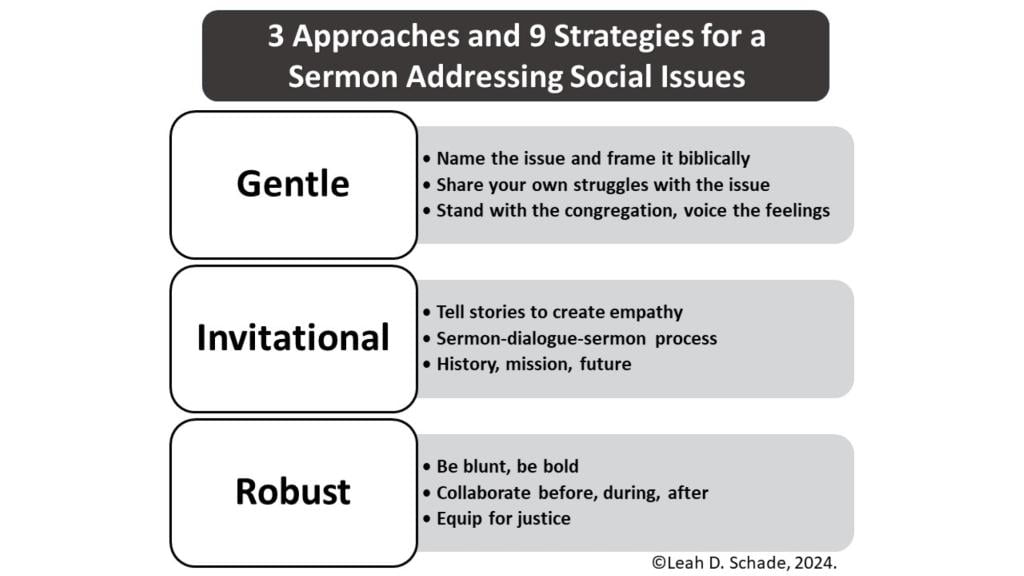
Looking for Tools to Empower Your Prophetic Voice?
I’ve created a free, online, 5-minute assessment tool for preachers and congregations to determine whether they should take a “gentle,” “invitational,” or “robust” approach to social issues. And in my book, Preaching and Social Issues: Tools and Tactics for Empowering Your Prophetic Voice, I offer strategies based on the approach that would work best for different contexts.
*Note: The 2025 study was approved in a human ethics review by the Concordia University Wisconsin-Ann Arbor Institutional Review Board, #IRB-FY25-136. The 2017, 2021, and 2023 studies followed protocols for the study of human subjects.
Read also:
Part 1: Top 10 Social Issues in Mainline Protestant Sermons, 2024-25
2: Preaching about Racism, Economics, and Environment
3: Preaching Immigration, Christian Nationalism, and Democracy
4: Preaching about LGBTQIA+ Issues: National Survey Results
Clergy Stress & Resilience in a Divided America: 2025 Survey
The Rev. Dr. Leah D. Schade is a seminary professor and ordained minister. Her opinions are her own. Leah is the author of Preaching and Social Issues: Tools and Tactics for Empowering Your Prophetic Voice (Rowman & Littlefield, 2024), Preaching in the Purple Zone: Ministry in the Red-Blue Divide (Rowman & Littlefield, 2019) and Creation-Crisis Preaching: Ecology, Theology, and the Pulpit (Chalice Press, 2015). She is the co-editor of Rooted and Rising: Voices of Courage in a Time of Climate Crisis (Rowman & Littlefield, 2019). Her book, Introduction to Preaching: Scripture, Theology, and Sermon Preparation, was co-authored with Jerry L. Sumney and Emily Askew (Rowman & Littlefield, 2023).















 Ad-Free & Subscriber Log-In