

You can find my two-part introduction to the Gospel of John at these two links, and my index/outline for it here; for the previous installment on John 8:12-29, go here.
The Gospel of John: Sukkot, Part IV (John 8:30-59)
The Sukkot sequence at last draws to a close, in one sense: as we will see next week, as chapter 9 begins, the Lord is still only just leaving Yrushalem, though as in chapter 3 there will be an interlude during which the narrative “camera” leaves him for a different figure. These thirty verses evoke the bivalent phrase from the prologue, that “the light appears in the darkness, and the darkness did not grasp it”—the darkness fails to understand the light, and it proves unable to detain the light; the light, in both senses, eludes the dark. This part of the Fourth Gospel shows with great emphasis how tragically little “having faith” sometimes means; though the Parable of the Sower is not told here, nonetheless we see for ourselves seeds that “fell upon stony places, and forthwith sprung up, because they had no deepness of earth”.
This passage also highlights one of the contrasts between John and the other three Gospels. In the Synoptics, especially Mark, while Yeshua is also other things, he is eminently an exorcist, one who enjoys an unprecedented degree of power over demons: the crowds in K’far-Nachum in Mark 1:27 are stunned that all he has to do is command one to leave the man it is possessing, and it immediately obeys. In the Fourth Gospel, from stem to stern, Yeshua never even meets a demoniac. However, just as his teaching in the Synoptics tends to consist in the informal and parable-laden “talks” delivered out-of-doors to mixed audiences, and these contrast with the elegant Johannine homilies given in the Temple or in K’far-Nachum’s synagogue or in the Upper Room, likewise, John does not erase the Lord’s teaching on the devil, but shows his readers a different facet of it—the contemplative, rather than the practical, demonology of “Beyt Yeshua.”1
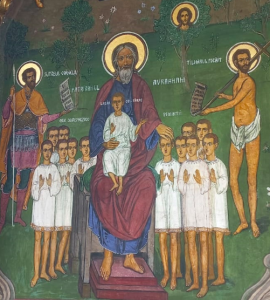
Mural of Abraham in heaven (date unspecified)
from a church in Ploiești, Romania. Photo
by Wikimedia contributor VladG03,
used via a CC BY-SA 4.0 license (source).
John 8:30-59, RSV-CE
As he spoke thus, many believed in him.
Jesus then said to the Jews who had believed in him, “If you continue in my word, you are truly my disciples, and you will know the truth, and the truth will make you free.” They answered him, “We are descendants of Abraham, and have never been in bondage to any one.a How is it that you say, ‘You will be made free’?”
Jesus answered them, “Truly, truly, I say to you, every one who commits sin is a slave to sin. The slave does not continue in the house for ever;b the son continues for ever. So if the Son makes you free, you will be free indeed. I know that you are descendants of Abraham; yet you seek to kill me, because my word finds no place in you. I speak of what I have seen with my Father, and you do what you have heard from your father.”c
They answered him, “Abraham is our father.” Jesus said to them, “If you were Abraham’s children, you would do what Abraham did, but now you seek to kill me, a man who has told you the truth which I heard from God; this is not what Abraham did. You do what your father did.”c They said to him, “We were not born of fornication;d we have one Father, even God.” Jesus said to them, “If God were your Father, you would love me, for I proceeded and came forth from God; I came not of my own accord, but he sent me. Why do you not understand what I say? It is because you cannot bear to hear my word. You are of your father the devil,e and your will is to do your father’s desires. He was a murdererf from the beginning, and has nothing to do with the truth, because there is no truth in him. When he lies, he speaks according to his own nature, for he is a liar and the father of lies.g But, because I tell the truth, you do not believe me. Which of you convicts me of sin? If I tell the truth, why do you not believe me? He who is of God hears the words of God; the reason why you do not hear them is that you are not of God.”
The Jews answered him, “Are we not right in sayingh that you are a Samaritan and have a demon?”i Jesus answered, “I have not a demon; but I honor my Father, and you dishonor me. Yet I do not seek my own glory; there is One who seeks it and he will be the judge. Truly, truly, I say to you, if any one keeps my word, he will never see death.” The Jews said to him, “Now we know that you have a demon. Abraham died, as did the prophets; and you say, ‘If any one keeps my word, he will never taste death.’j Are you greater than our father Abraham, who died? And the prophets died! Who do you claim to be?” Jesus answered, “If I glorify myself, my glory is nothing; it is my Father who glorifies me, of whom you say that he is your God. But you have not known him; I know him. If I said, I do not know him, I should be a liar like you; but I do know him and I keep his word. Your father Abraham rejoiced that he was to see my day; he saw it and was glad.” The Jews then said to him, “You are not yet fifty years old, and have you seen Abraham?”k Jesus said to them, “Truly, truly, I say to you, before Abraham was, I am.”l So they took up stones to throw at him; but Jesus hid himself, and went out of the temple.m
John 8:30-59, my translation
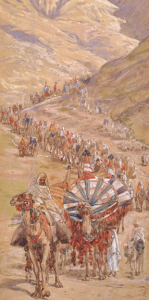
The Caravan of Abraham
(c. 1903), by James Tissot
As he was saying these things, many had faith in him.
Then Yeshua said to those Jews who had had faith in him, “If you stay in this my word, you will truly be my students, and you will know the truth, and the truth will free you.”
They responded to him: “We are Abraham’s seed and have never been enslaved to anyone;a how are you saying that ‘You will become free’?”
Yeshua responded to them, “‘Amin, ‘amin, I tell you that everyone who does sin is slave of sin; the slave does not stay in the household into the age;b the son stays into the age. If, then, the Son frees you, you will in fact be free. I know that you are Abraham’s seed; but you are searching to kill me, because this my word does not hold in you. The things I have seen from the Father, I speak; so you too hear and do things from the father.”c
They responded and told him, “Our father is Abraham.”
Yeshua said to them: “If you were Abraham’s children, you would do Abraham’s works; but now you search to kill me, a person who has told you the truth which I heard from God; Abraham did not do this. You do the works of your father.”c
They told him, “We were not begotten by whoring;d we have one father, God.”
Yeshua told them: “If God were your Father, you would love me, for I came forth and am here from God; for I have not come of myself, but he sent me. Why do you not know my speech? Because you are not able to hear my word. You are from your father, the Accuser,e and you want to fulfill the desires of your father. That one was a murdererf from the beginning, and did not stand in the truth, because no truth is in him. Whenever he tells a lie, he speaks out of his own [things], because he is a liar like his father.g But because I tell the truth, you do not have faith in me. Which of you convicts me about sin? If I tell the truth, why do you have no faith in me? He who exists from God hears God’s message; because of this you do not hear, because you are not from God.”
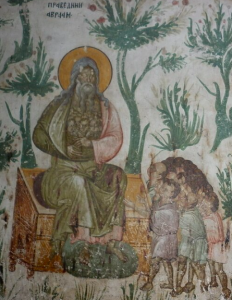
Mural depicting Abraham from Gračanica Mona-
stery in Serbia (date and creator unspecified).
Photo by Wikimedia contributor Andrija12345678,
used via a CC BY-SA 4.0 license (source).
The Jews responded and said to him, “Don’t we say fairlyh that you are a Samaritan and have a demon?”i
Yeshua responded: “I do not have a demon, but I honor my Father, and you dishonor me. I am not searching for my own glory; it is he who searches and judges. ‘Amin, ‘amin, I tell you, if anyone keeps my word, he will not behold death, into the age.”
The Jews told him, “Now we know that you have a demon. Abraham died, and the prophets, and you say ‘If anyone keeps my word, he will not taste death into the age’:j are you greater than our father Abraham, who himself died? And the prophets died; who do you make yourself [out to be]?”
Yeshua responded, “If I glorify myself, my glory is nothing; it is my Father who glorifies me, about whom you say that ‘God is our Father’—though you have not known him, but I know him; and if I said that ‘I do not know him,’ I would be a liar like you; but I know him and I keep his word. Your father Abraham leapt for joy that he saw my day, and saw it and rejoiced.”
Then the Jews said to him: “You are not yet fifty years [old], and you have seen Abraham?”k
Yeshua told them, “‘Amin, ‘amin, I tell you, before Abraham came to be, I am.”l
So they picked up stones to throw at him; but Yeshua hid, and went out of the Temple.m
Textual Notes
a. We are descendants of Abraham, and have never been in bondage to any one/We are Abraham’s seed and have never been enslaved to anyone | Σπέρμα Ἀβραάμ ἐσμεν καὶ οὐδενὶ δεδουλεύκαμεν πώποτε [sperma Abraam esmen kai oudeni dedouleukamen pōpote]: This is simultaneously a fairly natural and an extremely odd thing for the Lord’s opponents to say. On the one hand, if they personally had never lived as slaves (and there is no reason to suppose these Jews in particular had), it’s obviously correct. What’s odd about it is that every Jew, as part of the Passover liturgy, not only commemorates the Exodus, but is held to participate in it: mystically, they do not just reënact the first Seder, but are themselves thus delivered from slavery in Egypt. (Indeed, this may be part of the contextual background that guided the ancient Christian affirmation of the Real Presence, since the paschal setting implied this kind of symbolism in the language of the Eucharist’s institution.)
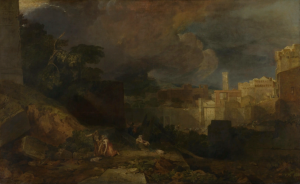
The Tenth Plague of Egypt
(1802), by J. M. W. Turner.
b. for ever/into the age | εἰς τὸν αἰῶνα [eis ton aiōna]: “For ever” is idiomatic; my use of “the age” is an attempt to bring references like this in line with texts that speak about “the age” in less idiomatic ways, e.g. Matthew 12:32 or Hebrews 1:2 (note that the King James uses “world” rather than “age” in these verses).
c. you do what you have heard from your father … You do what your father did/so you too hear and do things from the father … You do the works of your father | καὶ ὑμεῖς οὖν ἃ ἠκούσατε παρὰ τοῦ πατρὸς ποιεῖτε … ὑμεῖς ποιεῖτε τὰ ἔργα τοῦ πατρὸς ὑμῶν [kai hümeis oun ha ēkousate para tou patros poieite … hümeis poieite ta erga tou patros hümōn]: There is a shift here in the Greek from “the father” to “your father” that’s hard to convey in English. I say this after … conveying it very literally, because the thing about the Greek is, it’s much subtler than my translation—much closer, in tone, to the RSV. It would be perfectly natural to leave out an implied ὑμῶν “your” and simply say τοῦ πατρὸς “of the father.” The addition of ὑμῶν the second time steps up the tension by making the contrast more overt.
d. We were not born of fornication/We were not begotten by whoring | Ἡμεῖς ἐκ πορνείας οὐ γεγεννήμεθα [hēmeis ek porneias ou gegennēmetha]: The term “whoring” is a word-for-word rendering of the Greek πορνεία, derived from πόρνη [pornē] “sex worker, prostitute.” By the first century, πορνεία, at least in Hellenistic Jewish use, had acquired the same vagueness its English equivalent now bears: i.e., very few people would use the word “whoring” and expect it to be understood sensu stricto, as it were. This is why it is often rendered “sexual immorality” in modern English translations (since even fornication is only one species under that heading). This is perfectly defensible from a semantic point of view, but completely misses the mark rhetorically. Since most translations I’ve read veer in favor of the former, it seemed best to me to lean in the latter direction as a form of balance.
We were not begotten by whoring would be a fairly natural remark to make, given Yeshua’s negative hints about “your father.” Modern readers are almost certain to pick up on the possibility of a thinly-veiled insult referencing the scandal of Christ’s parentage. Some commentators are apparently skeptical that such talk could already have been current in the late first century, since rabbinical references to his supposed illegitimacy are of later date, and this passage, like the rest of John, is taken to be filtered through contemporary debates between church and synagogue. I find this argument hopelessly circular. Everything is “of later date” than earlier references to the same thing; if this happens to be the earliest allusion to those debates that we have (not the earliest allusion that there ever was, just the earliest we possess), is that really so incredible?—especially since the impact of Christianity upon the wider Jewish world, while widespread, was not necessarily all that deep at the time. If anything, Christian documents would have been likelier to record Jewish attitudes to Christianity than Jewish documents would. Put more briefly, I doubt Christianity was important enough within Judaism for us to expect to see rabbinic remarks of this kind as early as the first century, even if we grant this approach to the Gospel of John.
Moreover, structurally speaking, this would be an excellent place to bring in allusions to the Virgin Birth (if we’re prepared to allow that the author of John may have heard of a doctrine two other evangelists explicitly included, in some detail, in the biographies they had written decades earlier). In terms of events alone—i.e., ignoring discourses for a moment—chapters 7 and 8 are roughly the middle of the Johannine “timeline.” The Mother of God appears directly in only two places in John, namely the beginning of chapter 2 and the back half of chapter 19: just after the beginning, and just before the end. In the former, he tells her that his “hour” has not yet come. In the latter, it has. Accordingly, this architectural midpoint would allow for an allusion to her that doesn’t spoil the symmetry of the book; and indeed, in 7:27 and 42, we have already had two possible nods to her, the first the faintest possible and the second a little more pronounced. That could make 8:41 the third and most nearly-explicit of a series of such allusions in this pericope.2
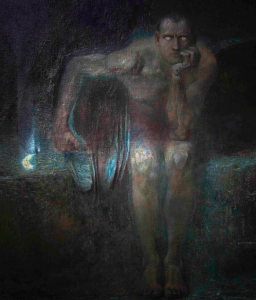
Luzifer [Lucifer] (1890), by Franz von Stuck.
e. the devil/the Accuser | τοῦ διαβόλου [tou diabolou]: This is a natural translation of שָׂטָן [šâṭân], a Hebrew term meaning “adversary, accuser”; my understanding—though I couldn’t find a good source on this—is that it could carry a meaning something like “plaintiff.” This seems to be what it means in Job, which treats הַשָּׂטָן [ha-Šâṭân], “the adversary,” like a functionary of the divine court. The concept of the devil as a, if not the, principal originator of evil in creation (and with it, the use of Satan as if it were a proper name) is a primarily Christian development, and may be entirely Christian in origin.
Now, hints contained in books like Genesis, Zechariah, and Job were developed into a mythos of rebellious angels in the Judaic theology of the Second Temple period; however, this mythos is quite different from the doctrine familiar to Christians. It is most explicitly expressed in the books of Enoch and Jubilees. According to these works, many of the world’s evils—particularly what we might call civilized evils, namely the apparatus4 of warfare, witchcraft, and the sex trade—are due to angelic interference with mankind; but this interference comes in the form of a group of angels known as the Watchers taking human wives, to whom they directly give these sinister secrets and technologies. Mankind is already fallen at this point. The Watchers are apparently more or less the same thing as devils in the Christian sense, but their first motive is lust, sexual lust—a baffling thing to attribute to devils from the standpoint of mainstream Christian orthodoxy, which does not even normally consider devils to have bodies, let alone sexuality. The mythos gives these devils both unfamiliar and familiar names, like Azazel, but their leader is called Shemihazah. Moreover, demons in this schema are not quite the same thing as devils, but are instead the ghosts of the nephilim, the gigantic offspring of these corrupt angels and the wives they took. (I wrote a post last year for Michaelmas that goes into a little more detail about this, and includes a lengthy quotation from the text of Enoch.)
This is sometimes called an alternative account of the origin of evil—i.e., alternative to that of Christianity—but it isn’t really. Its entire plot hinges on the premise that humanity has already been expelled from the Garden of Eden. As for its connection with the doctrine of the primitive Church, obviously the motives and actual behaviors of Shemihazah and Satan are quite different, and the “name” Satan does not appear in Enoch.5 Jubilees calls its Shemihazah-equivalent Mastemah (from the Hebrew מַשְׂטֵמָה [maš’ṭêmâh] “hatred, hostility”), but this appears to be as nearly as the two have ever come to being identified with one another. As far as I’m aware, neither הַשָּׂטָן nor מַשְׂטֵמָה were identified with the figure of the serpent from the opening chapters of Genesis by Jews at the time, whether they had apocalyptic sympathies or not—or if any did, I gather it was not a sufficiently mainstream position to emerge in pre-Christian Judaic literature.
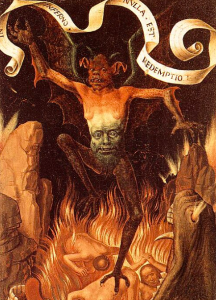
Satan from Triptych of Earthly Vanity and
Divine Salvation (c. 1485) by Hans Memling.
The scroll says In inferno nulla est redemptio,
“In hell there is no redemption.”
f. murderer | ἀνθρωποκτόνος [anthrōpoktonos]: A more literal translation would be “man-slayer, killer of humans, homicide.”6
g. When he lies, he speaks according to his own nature, for he is a liar and the father of lies/Whenever he tells a lie, he speaks out of his own [things], because he is a liar like his father | ὅταν λαλῇ τὸ ψεῦδος, ἐκ τῶν ἰδίων λαλεῖ, ὅτι ψεύστης ἐστὶν καὶ ὁ πατὴρ αὐτοῦ [hotan lalē to pseudos, ek tōn idiōn lalei, hoti pseustēs estin kai ho patēr autou]: This is a bizarre little passage. See, most translations treat ψεύστης ἐστὶν καὶ ὁ πατὴρ αὐτοῦ the way the RSV does, making that αὐτοῦ at the end (the genitive7 form of αὐτός [autos]) mean “of it.” That is, technically, a possible rendering, especially since the Fourth Gospel tends to use αὐτός as a miscellaneous pronoun. But of course if it were that simple, there’d hardly be a textual note on it, would there? The puzzle is that, all else being equal, we would not expect to see αὐτός used to denote a non-personified abstraction like “lying.” I decided to make an independent study of the Gospel of John my final Greek course in college sixteen years ago, under the guidance of the delightful Dr. Lillian Doherty, a fellow Catholic as it happens, who retired in 2023; I vividly remember how startled we both were by the text of this verse, having both been brought up accustomed to the English. The natural way to read ψεύστης ἐστὶν καὶ ὁ πατὴρ αὐτοῦ is not He is a liar and the father of it, but He is a liar and the father of him—or, more idiomatically for English, He is a liar and so is his father.
Now, these are not the only two possible readings of this text. The Pulpit Commentary (compiled by two Anglican scholars over the forty years on either side of 1900) suggests taking ψεύστης, “liar,” as the antecedent of αὐτοῦ, “notwithstanding the difficulty of the construction”—this would result in the meaning He is a liar and the father of the liar, i.e. of liars as a genus. This is … possible, in the sense that it does not, technically, violate the law of non-contradiction. However, the phrase the difficulty of the construction probably belongs in the epoch-making annals of British understatement. I am far from being the world’s the best-read Hellenist, so I can’t rule out the possibility that this construction does appear in some passage from one of those who-even-is-that authors like Ibycus8 or Hermesianax;9 but still, I have never, ever, heard of any author using a construction like this. It’s not even gymnastics, it is straight-up contortionism. And it’s not like it would have been hard to avoid, if that was what the author was trying to say!
But these commentators must have known this. What drove them to thus bend over backwards to give any grammatical meaning to the text except the natural one? Well, well, well, if it isn’t Christianity’s worst pal: Gnosticism. The notion of a “father of the devil” was apparently seized on by certain Gnostic sects, whose theology often involved lengthy genealogies of divine emanations; the Demiurge, or creator of the physical world, was variously conceived as anything from evil (the Marcionite10 view) to well-meaning but incompetent (the Valentinian10 view). Now, when taken seriously,11 Gnosticism is incredibly annoying—a real dorks’ heresy—so I can understand, and on some level share, their reluctance to talk about it. But I’m not on board for an instant with stretching the words of the Bible to breaking point just to avoid talking about Gnosticism; on top of which, the stretch wasn’t even successful: on the contrary, it produced a result so grammatically ludicrous, they had to acknowledge Gnosticism just to explain why they were doing it.
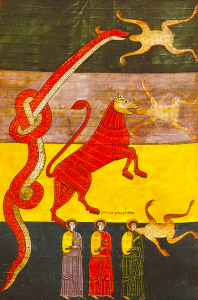
An illumination (1047) from the Facundus manu-
script of Beatus of Liébana’s commentary of Reve-
lation, showing frogs (symbols of impurity)
coming from the mouths of the “unholy trinity.”
The place my mind went in puzzling over what “his father” could be in reference to was not Gnosticism, but another book in the Johannine corpus of the Bible: Revelation. I’ve written fairly often about this book before, and offered an outline of it in a short series for Assumption a couple of years back. In that outline, I described chs. 12-14 as the “Great Interlude” on the “Unholy Trinity,” because it presents us with three figures of demonic malevolence.
- “A great red dragon, having seven heads and ten horns, and seven crowns upon his heads; and his tail drew the third part of the stars of heaven, and did cast them to the earth” (12:3-4). This is Satan “proper,” as the text itself confirms in v. 9, though in the context of the Apocalypse it is often referred to as the Dragon.
- “A beast rising up out of the sea, having seven heads and ten horns, and upon his horns ten crowns, and upon his heads the name of blasphemy; and the beast which I saw was like unto a leopard, and his feet were as the feet of a bear, and his mouth as the mouth of a lion: and the dragon gave him his power” (13:1-2). This creature, often referred to simply as the Beast, is generally identified with the capital-a Antichrist.
- “Another beast coming up out of the earth; and he had two horns like a lamb, and he spake as a dragon; and he exerciseth all the power of the first beast before him, and causeth the earth and them which dwell therein to worship the first beast … and he deceiveth them that dwell on the earth by the means of those miracles which he had power to do … and he causeth all … to receive a mark in their right hand, or in their foreheads” (13:11-12, 14, 16). This being, the one which actually imposes the infamous “mark of the Beast,” is generally called the False Prophet.
These form an obvious parallel to the Father, the Logos, and the Holy Ghost. Now, Revelation explicitly identifies the Dragon with “the Devil, and Satan,” and does not do so with the Beast, so there is a definite weak point in this interpretation; but, if the liar of John 8:44 were the Beast, whose father is the Dragon, then everything about this text falls into place. This would imply a strikingly involved doctrine of this “unholy trinity,” going back apparently to the Lord himself (or at least to the putative Johannine community). I don’t think this is impossible, or even improbable—certain infernal figures, notably Belial, seem to have been much more developed in first-century Judaic thought than the traces they leave on either Testament of the Christian Bible; however, I for one am in no position to speculate any further than this.
I may write a “theological note” post about Gnosticism in future, as sort of a one-off, because there’s such a huge volume of nonsense talked about it in popular culture (and has been for decades now, a phenomenon caused in part by the 1945 discovery of the “Nag Hammadi library,” a trove of Gnostic-and-adjacent manuscripts dating to the fourth century). For the present, I will tie this off here with what is, though only incidentally, a good and sobering summary of Gnosticism from a Catholic perspective:
God they blaspheme, blaspheme their parents’ bed,
…The human race, the place, the time, the blood,
…The seed that got them, and the womb that bred.
—Inferno iii.103-105 (Sayers translation)
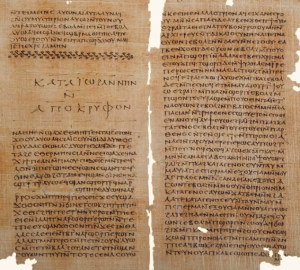
A folio with the beginning of the so-called
Secret Book of John, one of the Nag
Hammadi texts.
h. Are we not right in saying/Don’t we say fairly | Οὐ καλῶς λέγομεν ἡμεῖς [ou kalōs legomen hēmeis]: The word καλῶς is related to τὸ καλόν [to kalon], the term Plato uses in his Republic for “the Good” in the transcendental sense; however, more strictly, it means “the beautiful,” and καλῶς, being an adverb, means “beautifully.” Rendering it thus would have sounded rather odd—even before Trump’s presidencies—but the adjective fair, with its wavering between the meanings “right, equitable, reasonable” and “beautiful, lovely,” fits almost perfectly.
i. a Samaritan and have a demon | Σαμαρίτης εἶ σὺ καὶ δαιμόνιον ἔχεις [Samaritēs ei sü kai daimonion echeis]: Thanks to the heresy that predominated in Samaria, and probably also to figures like Simon Magus (known to us from Acts 8 and a few later legends), Samaria was reputed among Pryshaya to be a haven of occult practices. Given the multivalence that “you have a demon” could carry, from being a literal charge of possession to dismissal as a lunatic, this phrase almost equates with “You’re a carnival huckster,” save maybe that its tone is not as light as that may sound.
j. he will never taste death/he will not taste death into the age | οὐ μὴ γεύσηται θανάτου εἰς τὸν αἰῶνα [ou mē geusētai thanatou eis ton aiōna]: This, like a few other moments in the Fourth Gospel, may suggest a curious inability or unwillingness to retain and repeat Christ’s actual words—for of course he did not say, not here, that such a person would never taste death (γεύσηται), but that he would never see death (θεωρήσῃ [theōrēsē]). It could be mere variation for variety’s sake; but I suspect not. Gary Anderson highlights the way minor variations exactly like this, in a Judaic liturgical context (which the celebration of Sukkot in Yrushalem while the Temple was still standing most certainly is), can carry immense weight in the Torah:
In the remainder of the chapter we will … explore the character of the sin of Eleazar and Ithamar. This will require careful attention to detail because almost no reader would ever guess that something has gone wrong. The sacrificial ritual requires two sin offerings, one for the priests and another for the people. After a detailed description of the procedure … our story ends with the expected formula of approval: “[Aaron had acted] as the LORD commanded Moses” ({Leviticus} 8:10). When the text turns to the people’s offering, our author abbreviates. … There is no hint in this verse {9:15} that anything has gone wrong. Yet in the subsequent chapter, Moses issues a sharp reprimand to Eleazar and Ithamar regarding the way they handled that very offering:
Then Moses made inquiry about the goat of the sin offering [i.e., the people’s offering], and—it had already been burned! He was angry with Eleazar and Ithamar, Aaron’s remaining sons, and said, “Why did you not eat the sin offering in the sacred area? For it is most holy, and God has given it to you that you may remove the guilt of the congregation … You should certainly have eaten it in the sanctuary, as I commanded.” (Lev. 10:16-18)
… Embedded in this reprimand is a loose citation of a law found in Leviticus 6:30. The only way to understand the actions of the priests and the subsequent ire of Moses is to attend carefully to … the sacrificial laws found in Leviticus 1-7 …
—That I May Dwell Among Them, Ch. 5: Liturgical Beginnings and Immediate Sin, p. 10612
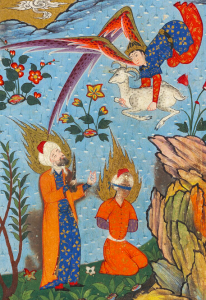
Persian miniature (c. 1577) depicting the angel
Jibrīl (Gabriel) preventing Ibrahim (Abraham)
from sacrificing his son (Isaac in the Bible,
Ismā’īl [Ishmael] in the Quran).
k. You are not yet fifty years old, and have you seen Abraham?/You are not yet fifty years [old], and you have seen Abraham? | Πεντήκοντα ἔτη οὔπω ἔχεις καὶ Ἀβραὰμ ἑώρακας; [pentēkonta etē oupō echeis kai Abraam heōrakas?]: Abraham, the first and greatest of the Biblical patriarchs, was strongly associated with paradise; as we see in the parable of the rich man and Eleazar, the blessed dead might be spoken of as dwelling “in Abraham’s bosom” (which would roughly equate with sitting in his lap, a posture depicted above in the mural from Gračanica Monastery). As for the allusion to “fifty years,” this (according to the Sacra Pagina commentary) was conceived of as a person’s “working life,” from early manhood into old age; notably, this was the period of one full jubilee.
Thou shalt number seven sabbaths of years unto thee, seven times seven years … Then shalt thou cause the trumpet of the jubilee to sound on the tenth day of the seventh month, in the day of atonement shall ye make the trumpet sound throughout all your land. And ye shall hallow the fiftieth year, and proclaim liberty throughout all the land unto all the inhabitants thereof: … and ye shall return every man unto his family. A jubilee shall that fiftieth year be unto you: ye shall not sow, neither reap that which groweth of itself in it, nor gather the grapes in it of thy vine undressed. For it is the jubilee; it shall be holy unto you: ye shall eat the increase thereof out of the field. In the year of this jubilee ye shall return every man unto his possession. … Ye shall not therefore oppress one another; but thou shalt fear thy God: for I am the LORD your God.
—Leviticus 25:8a, 9-13, 17
l. before Abraham was, I am/before Abraham came to be, I am | πρὶν Ἀβραὰμ γενέσθαι ἐγὼ εἰμί [prin Abraam genesthai egō eimi]: This is the boldest and most explicit claim in this Gospel that Yeshua is God since 1:1-3, and the most absolute attributed to Yeshua directly. In other passages, the force of “I am” is softened slightly by having some additional meaning contextually appended; even the use of “I am” while walking on the sea could be explained, ultimately explained away, by a really determined Arian. But with this verse, there is no work-around; evasion of the evangelist’s meaning about the Logos was never natural, but here it becomes finally impossible.
m. but Jesus hid himself, and went out of the temple/but Yeshua hid, and went out of the Temple | Ἰησοῦς δὲ ἐκρύβη καὶ ἐξῆλθεν ἐκ τοῦ ἱεροῦ [Iēsous de ekrübē kai exēlthen ek tou hierou]: This is occasionally taken to be one of the Lord’s miracles—indeed, according to Charles Williams’ history Witchcraft, in the corpus of Renaissance magic, one spell for invisibility invoked this verse (such blasphemous uses of the Bible are quite common in post-Christian magical texts). However, in a crowded urban place like the Temple during a major religious festival (one associated strongly with pilgrimage to the Holy City), even at the end of said festival, I don’t think we need to invoke a specifically supernatural explanation to understand how he could possibly have hidden himself. This interpretation also has the disadvantage of clashing with the structure of the Fourth Gospel, since it is obviously not one of the “seven signs” to which the first half of the book is devoted.
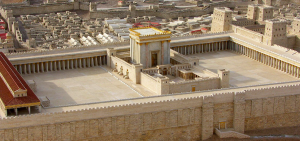
The Herodian Temple complex as represented in
the Holyland Model of Jerusalem. The spacious
outer court is the Court of the Gentiles; the red-tile-
rooved structure on the left is Solomon’s Portico.
Footnotes
1This is my—somewhat fanciful—idea of what Christ’s following may have been called in its earliest years, principally during his earthly ministry; to the best of my knowledge, the expression Beyt Yeshua never actually appears in any ancient document of any kind. (I coined it at all partly because, however doctrinally correct, it felt inappropriate to refer to Yeshua’s disciples before Pentecost as “the Church.”) It is formed on analogy with the two dominant rabbinic schools among the Pryshaya during the late Zugothic and Tannaitic periods, these being the Beyt Hillel or “School (lit. House) of Hillel” and the Beyt Shammai or “School of Shammai.” Very loosely speaking, Beyt Hillel endorsed a “generous” approach to the Torah, while Beyt Shammai was rigorist; the Lord’s teaching more or less aligns with Beyt Hillel on all recorded points except that of divorce, where it is quite as strict as Beyt Shammai.
2I probably wouldn’t mention this idea at all, even in a footnote, if not for the fact that Judaic literature before and since this period is so fond of wordplay, acrostics, and the like. However: it may even be possible that this allusion-without-presence was inspired by, or a coy reference to, the first letter of her name in Greek (the Aramaic מַרְיָם [Mar’yâm] became the Greek Μαριάμ [Mariam], later Μαρία—note the shift in stress, from the last syllable to the penult). That letter, Μ (called μυ [mü], the basis of the Roman M), can be written with a shallow vertex (the downward-pointing angle in the middle), instead of the deep vertex shown in this font3—a shallow vertex being more like the ancient signs from which the letter Μ itself descends—so that her direct appearances in chs. 2 and 19 would correspond to the left and right stems of the letter, and the allusions in chs. 7-8 would correspond to the vertex. As far as I can tell, absolutely nothing whatever depends upon this idea, so your Mariology may vary.
3And, like … all modern fonts, apparently? I feel like M‘s with shallow vertices didn’t used to be uncommon, but I couldn’t seem to find any good examples when I (rather idly) looked around for one online. The closest I came were a couple of runes from the futhorc—take your pick between ᛖ (eh “steed, horse”), which reproduces the shape I’m talking about exactly but isn’t related in origin and doesn’t make the same sound, and ᛗ (mon “man”), which has the right character-lineage and makes the right sound but is slightly differently shaped.
4Though you may, rarely, see apparatuses in print, or the hypercorrected form apparati, the best plural of apparatus is—apparatus; it’s one of those words like sheep or deer. Unlike those two it does come from Latin, but Latin had three types of nouns ending in -us, only one of which took plurals in -ī. The second kind was complex and annoying; the third kind, which included the word apparātus, had plurals in -ūs.
5That is, not in the form alternatively known as the First Book of Enoch, the version that appears in the canon of the Ethiopian and Eritrean Orthodox Tewahedo Churches. The Second, or Slavonic, Book of Enoch does allude to a villainous angel named Satanail or Satanael; II Enoch is also where we get the rare but persistent term Grigori or egregores for the class of angels called “Watchers” in I Enoch (deriving from ἐγρήγοροι [egrēgoroi] “wakeful ones”).
6This usage has become archaic if not obsolete, but in older literature, terms like homicide, suicide, parricide, etc., could be applied either to the crime in question or to the person who committed it—thus, it was once perfectly correct and clear English to describe Romulus as “a fratricide” (because he killed his brother Remus).
7In Greek, the genitive case is the form of nouns and pronouns (and of the adjectives that modify them) that is, in nearly all instances, most conveniently rendered by placing an “of” in front of the genitive noun or pronoun. It can be used to indicate possession, like the English clitic -‘s (a worn-down relic of the Anglo-Saxon genitive), but it also has a few other uses, such as denoting a thing’s origin. It gets its name from the Latin genitus “begotten; produced” + the adjectival suffix -īvus. Latin has one or two more cases than Greek does (namely the ablative for most prepositions and the remnants of the locative for “at/in” when using place names); as a result, the Greek genitive is assigned a few more uses than the Latin genitive.
8Ibycus was one of the nine canonical Greek lyric poets of antiquity—i.e., one who composed verses intended to be sung to the accompaniment of a lyre. At least, this was presumably the original meaning of the term; in recorded history, it was also normal to sing lyric poems alongside a cithara (both the lyre and the cithara were instruments in the lute family, which also includes the guitar), or to an aulos or reed-pipe (a little like today’s oboe).
9No, I’m sorry, I simply refuse to believe that anybody on earth knows who Hermesianax is. I refuse to believe that anybody has ever known this. I refuse to believe that Hermesianax himself could have told us who he is.
10The Marcionites were followers of Marcion of Sinope, a heretic from the northern coast of Anatolia. After being excommunicated by the church in Rome in 144, Marcion founded his own church, which recognized only Paul as a legitimate apostle and subscribed to an “expurgated” canon consisting only in the Gospel of Luke and the Pauline epistles—that is, in Marcion’s versions of these writings, from which all of the (obviously foreign and illegitimate) suggestions that the Incarnation had really happened had been carefully removed. Rather unusually for Gnostics, the Marcionites rejected any allegorical interpretation of Scripture, and also the entire Old Testament; indeed, their theology seems to have been pronouncedly anti-Semitic. The Valentinian Church was in many respects a more typical form of Gnosticism. Valentinus (a second-century figure) was reportedly a man of great eloquence and intellect, and concocted an involved genealogy of emanations from Βυθός [Büthos], “the Deep,” which is totally a normal way to refer to the Lord our God. Two of these emanations fell, and their fall resulted in noble spirits being chained in matter, which the Valentinian savior came to liberate.
11Which actually is a pretty important qualification. I’d be totally into Gnosticism as, say, a video game.
12Further publication details on this (excellent!) book can be found in my bibliography. Since Anderson had occasion to use both parentheses and square brackets in his original text, I have here used curlicue brackets as needed to indicate insertions of mine.









 Ad-Free & Subscriber Log-In