

You can find my two-part introduction to the Gospel of John at these two links, and my index/outline for it here; for the previous installment on John 10:22-42, go here.
The Gospel of John: The Seventh Sign (John 11:1-46)
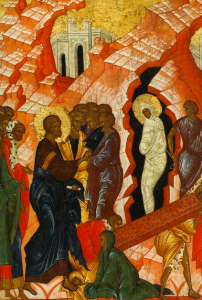
Russian ikon (15th c.) of the raising of Lazarus.
In chapter 11, we come to the climax of the Book of Signs. We also reach one of the most marked adumbrations of the Book of Glory, into which we then transition. As elsewhere, I have used my own adaptions of the names; the usual Lazarus, Martha, Mary, and Bethany are here Eleazar, Marta, Miriam, and Beyt Anya.
Much of note i is of purely historical interest and not essential to understanding the text. I have therefore placed it in small print.
John 11:1-46, RSV-CE
Now a certain man was ill, Lazarus of Bethany, the village of Mary and her sister Martha.a It was Mary who anointed the Lord with ointmentb and wiped his feet with her hair, whose brother Lazarus was ill. So the sisters sent to him, saying, “Lord, he whom you lovec is ill.” But when Jesus heard it he said, “This illness is not unto death; it is for the glory of God,d so that the Son of God may be glorified by means of it.”
Now Jesus loved Martha and her sister and Lazarus.c So when he heard that he was ill, he stayed two days longer in the place where he was. Then after this he saide to the disciples, “Let us go into Judea again.” The disciples said to him, “Rabbi, the Jews were but now seeking to stone you, and are you going there again?” Jesus answered, “Are there not twelve hours in the day?f If any one walks in the day, he does not stumble, because he sees the light of this world. But if any one walks in the night, he stumbles, because the light is not in him.” Thus he spoke, and then he said to them, “Our friend Lazarus has fallen asleep, but I go to awake him out of sleep.” The disciples said to him, “Lord, if he has fallen asleep, he will recover.” Now Jesus had spoken of his death, but they thought that he meant taking rest in sleep. Then Jesus told them plainly, “Lazarus is dead; and for your sake I am glad that I was not there, so that you may believe. But let us go to him.” Thomas, called the Twin, said to his fellow disciples, “Let us also go, that we may die with him.”g
Now when Jesus came, he found that Lazarus had already been in the tomb four days. Bethany was near Jerusalem, about two miles off,h and many of the Jews had come to Martha and Mary to console them concerning their brother. When Martha heard that Jesus was coming, she went and met him, while Mary sat in the house. Martha said to Jesus, “Lord, if you had been here, my brother would not have died. And even now I know that whatever you ask from God, God will give you.” Jesus said to her, “Your brother will rise again.” Martha said to him, “I know that he will rise again in the resurrection at the last day.”i Jesus said to her, “I am the resurrection and the life;j he who believes in me, though he die, yet shall he live, and whoever lives and believes in me shall never die. Do you believe this?” She said to him, “Yes, Lord; I believe that you are the Christ, the Son of God, he who is coming into the world.”k
When she had said this, she went and called her sister Mary, saying quietly, “The Teacher is here and is calling for you.” And when she heard it, she rose quickly and went to him. Now Jesus had not yet come to the village, but was still in the place where Martha had met him. When the Jews who were with her in the house, consoling her, saw Mary rise quickly and go out, they followed her, supposing that she was going to the tomb to weep there. Then Mary, when she came where Jesus was and saw him, fell at his feet, saying to him, “Lord, if you had been here, my brother would not have died.” When Jesus saw her weeping, and the Jews who came with her also weeping, he was deeply moved in spirit and troubled;l and he said, “Where have you laid him?” They said to him, “Lord, come and see.” Jesus wept.m So the Jews said, “See how he loved him!” But some of them said, “Could not he who opened the eyes of the blind man have kept this man from dying?”
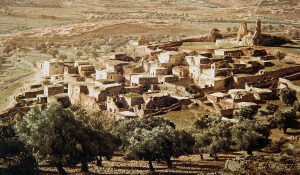
Photograph (1890), colorized, of Al-Eizariya
(the modern Arabic name of Bethany, derived
from the name of Lazarus), taken by
Félix Bonfils.
Then Jesus, deeply moved again, came to the tomb; it was a cave, and a stone lay upon it. Jesus said, “Take away the stone.” Martha, the sister of the dead man,n said to him, “Lord, by this time there will be an odor, for he has been dead four days.”o Jesus said to her, “Did I not tell you that if you would believe you would see the glory of God?” So they took away the stone. And Jesus lifted up his eyes and said, “Father, I thank thee that thou hast heard me. I knew that thou hearest me always, but I have said this on account of the people standing by, that they may believe that thou didst send me.”p When he had said this, he cried with a loud voice, “Lazarus, come out.” The dead mann came out, his hands and feet bound with bandages, and his face wrapped with a cloth.q Jesus said to them, “Unbind him, and let him go.”
Many of the Jews therefore, who had come with Mary and had seen what he did, believed in him; but some of them went to the Pharisees and told them what Jesus had done.
John 11:1-46, my translation
Now, someone was infirm, Eleazar, from Beyt Anya, of the village of Miriam and Marta her sister.a It was the Miriam who anointed the Lord with perfumeb and wiped his feet with her hair—her brother Eleazar was infirm. So the sisters sent [word] to him, saying: “Sir, look, he whom you lovec is infirm.” When he heard this, Yeshua said, “This infirmity is not toward death, but for the glory of God,d in order that the Son of God may be glorified by it.” Yeshua loved Marta and her sister and Eleazar.c Then, when he heard that he was infirm, even so, he then stayed in that place for two days; following after that, he sayse to his students: “Let us go into Judea again.”
His students said to him: “Rabbi, just now the Jews were searching to stone you, and you are going there again?”
Yeshua responds, “Aren’t there twelve hours in the day?f If anyone walks around in the day, he doesn’t stumble, because he sees this world’s light; if anyone walks around at night, he stumbles, because the light is not in him.” He said these things, and after this he says to them, “Our beloved Eleazar has lain down, but I am journeying in order to rouse him from sleep.”
So his students said to him, “Sir, if he has lain down, he will be healed.” But Yeshua had spoken to them about his death. They deemed that he is talking about lying down for sleep.
So then Yeshua said to them openly, “Eleazar died, and I rejoice for your sakes, in order that you may have faith, that I was not there; but let us go to him.”
Then Toma, called “Twin,” said to his co-students: “Let us go too, in order that we may die with him.”g
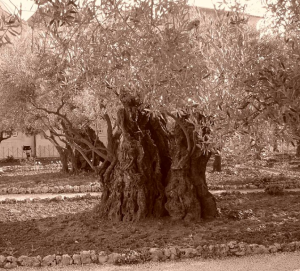
An olive tree from Mount Olivet (on which Beyt
Anya is situated), as much as 2000 years old.
Photo by Evan Bench, used via
a CC BY 2.0 license (source).
Then Yeshua on coming found he had already been four days in the monument. Beyt Anya was nearby Yrushalem, around about fifteen furlongs.h Many of the Jews came to Marta and Miriam in order to console them about their brother. So when Marta heard that Yeshua came, she went to meet him; Miriam was sitting in the house.
So Marta said to Yeshua, “Sir, if you were here, my brother would not have died; even now I know that anything you may ask of God, God will give you.”
Yeshua says to her, “Your brother will rise again.”
Marta says to him, “I know that he will rise again in the resurrection on the Last Day.”i
Yeshua tells her, “I am the resurrection and life;j the one who has faith in me, if he should die, will live, and everyone who lives and has faith in me will not die, not into the age; do you have faith in this?”
She says to him: “Yes, sir; I have faith that you are the Anointed, the Son of God, who is coming into the world.”k And having said this, she went off and called Miriam her sister—she said secretly, “The teacher is here and is calling you.”
When she heard [that], she arose up quickly and went to him; for Yeshua had not yet come into the village, but was still in the place where Marta had met him. Then the Jews who were with her in the household and consoling her, seeing that Miriam got up quickly and left, followed her, deeming that she is heading to the monument to cry there. So Miriam, when she came where Yeshua was and saw him, fell at his feet, telling him: “Sir, if you had been here, my brother would not have died.”
Then, when Yeshua saw her crying, and those Jews who had come with her crying, he growled in his spirit and was agitated in himself,l and said, “Where have you put him?”
They said to him, “Sir, come and see.”
Yeshua wept.m Then the Jews began saying, “Look, how he loved him.” But some of them said: “Couldn’t this man who opened the eyes of the blind also have done [something] in order that this man would not die?”
Then Yeshua, growling in himself again, came to the monument; it was a cave, and a stone had been set in front of it. Yeshua says: “Take away the stone.”
The sister of the deceased,n Marta, says to him, “Sir, it [will] smell already, for it is the fourth day [since his burial].”o
Yeshua says to her: “Did I not tell you that if you had faith, you will see the glory of God?” Then they took away the stone. Yeshua took his eyes away upwards and said, “Father, I thank you because you have heard me—I know that you always hear me; but for the sake of the crowd standing around I say this, in order that they may have faith that you sent me.”p And saying these things with a great voice, he cried, “Eleazar, come outside.”
He who had diedn came out, his feet and hands bound in wrappings, and his visage bound about with a kerchief.q Yeshua told them: “Loosen him, and let him go.”
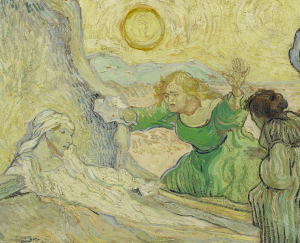
The Raising of Lazarus (after Rembrandt)
(1890), by Vincent van Gogh.
So many of the Jews who had come with Miriam and saw what he did had faith in him; but some of them went away to the Pryshaya and told them what Yeshua had done.
Textual Notes
a. Lazarus of Bethany … Mary and her sister Martha/Eleazar, from Beyt Anya … Miriam and Marta her sister | Λάζαρος ἀπὸ Βηθανίας ἐκ τῆς κώμης Μαρίας καὶ Μάρθας τῆς ἀδελφῆς αὐτῆς [Lazaros apo Bēthanias ek tēs kōmēs Marias kai Marthas tēs adelfēs autēs]: I have dubbed these three “the Lazarus family.” They appear only in the Gospels of John and Luke; even Acts does not mention them, lending color to the tradition that they fled the environs of Jerusalem not long after the events of Holy Week, presumably prompted by the plot against Lazarus’ life mentioned in John 12:9. Luke 10:38 calls the house they lived in Marta’s. Inheritance customs would normally dictate that the house would be inherited by a son if one were available, so it’s possible Lazarus was in some way incapacitated—an intellectual disability, for example. Alternatively, if the children’s mother were already widowed and then died in childbirth with Lazarus, it would presumably fall to one of the girls to manage the house at the very least until their brother grew up, and Marta appears to be the eldest sibling (though the evidence for this is admittedly circumstantial).
The names Eleazar/Lazarus and Marta/Martha mean, respectively, “God has helped” and “mistress, lady.” The name Miriam, which we normally turn into Maria or Mary, was extremely popular in the Levant in the first century. At least two reasons for this are probable: first, since Miriam the sister of Aharon and Moshe was a prophetess associated with the Exodus, the name doubtless spoke to the people’s longing to be free in their own land again and out from under the Roman thumb; and, the name had been borne by several members of the Hasmonean dynasty who preceded the Herods. (In English, the Hasmoneans of this name are usually called Mariamne, which is an alternative Hellenization to Maria.) The Hasmoneans had not, in the end, been a particularly well-liked or successful dynasty; nevertheless, they had started out strong—after all, they started out as the Maccabees!—and, though an ill-advised Hasmonean marriage was what had brought the Herods in, all the same, they themselves were a Jewish dynasty, unlike the current Edomite tetrarchs; and anyway, even when the reigning house is unpopular, a royal name is still a royal name and will still have its fans for that reason. As for its meaning, this is actually debated, and long has been. It appears to contain the radical מ-ר, which encodes meanings like bitter, to be bitter, bitterness; it could conceivably be a reference to the sea, which Miriam the Prophetess is also associated with as the reputed authoress of the “Song of Moshe and Miriam” in Exodus 15: “The horse and its rider he hath thrown into the sea.” (Coïncidentally, the mutinous rumblings of the people at Marah, the place of bitter water, come immediately after this song in the same chapter.)
A word about the town of Beyt Anya, or Bethany, is in order here. The meaning of the town’s name has long been disputed; the element beth (which I generally transcribe as beyt) means “house,” and appears in a large number of place-names in Canaan. The Anya/-any, however, is of uncertain origin. The celebrated Victorian divine J. B. Lightfoot glossed it as “house of figs,” which does match the nearby town of Bethphage “house of unripe figs,” but this has been challenged. Nehemiah 11:32 mentions a village called Ananiah, and Beyt Anya/Bethany does seem like a convincing contraction of Beth Ananiah. This might derive1 from the Hebrew עָנָן [ȝânân] “cloud,” with the familiar suffix –iah representing the Tetragrammaton; “the cloud of the LORD” would of course mean the Sh’khynah that covered the Mercy Seat. This theory is rendered especially intriguing for Christians by St. Luke, the only evangelist who gives us an account—two accounts—of the Ascension:
And he led them out as far as to Bethany, and he lifted up his hands, and blessed them. And it came to pass, while he blessed them, he was parted from them, and carried up into heaven.
—Luke 24:50-51
And when he had spoken these things, while they beheld, he was taken up; and a cloud received him out of their sight.
—Acts 1:9
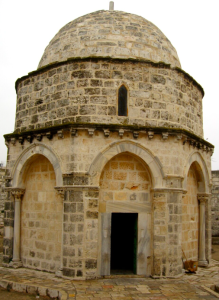
The Ascension Ædicule (from Lat. ædicula “little
chapel”) on Mount Olivet. Photo by Adriatikus,
used via a CC BY-SA 3.0 license (source).
However, the theory most favored by linguists appears to be that the name is from Aramaic, ܒܝܬ ܥܢܝܐ [Beyt Ȝanya’], meaning “house of affliction”—that is, an almshouse, making the name closely analogous to the English Almesbury (supposed to be the site of the priory to which Queen Guinevere retired after Arthur was withdrawn to Avalon—and I do love a pretext for an Arthurian allusion).
Whatever the meaning of its name, Beyt Anya was on the principal road from Yericho up to Yrushalem (and Yericho itself was the point at which Jews who had been traveling along the eastern bank of the Yarden to avoid Samaritan turf would cross back to the western side). Hence, despite its tiny size—today, Al-Eizariya (its modern name) is home to about a thousand people, and there seems little reason to suppose it was bigger back then—it would have seen a good deal of traffic as a final way-station for pilgrims on their way to the Holy City.
We don’t know how close this miracle was to the Pesach that followed. The disciples’ protests in v. 8 suggest not much time could have passed since Chanukah, which ends on 3 Tevet. It’s a little more than three months (or in leap years, a little more than four) between then and 14 Nisan. On the other hand, v. 54 suggests that the Lord and the Twelve stayed away from the immediate environs of Yrushalem for a time, but without going back to the Galilee. If—and it is a big “if”—we’re meant to understand 11:1-12:19, i.e. the sequence from his going to Beyt Anya to raise Eleazar all the way to the Triumphal Entry as taking place in a straightforward and fairly close temporal sequence, then it’s possible this miracle occurred around Tu Bi-Sh’vat (“the Fifteenth of Shevat”).2 This is the “new year for trees,” i.e. for what qualifies as a tree’s first year of growth and fruiting, its second year, etc., which was an important date for calculating first-fruit offerings. Of the sacred Seven Species, four are the fruits of trees: dates, figs, olives, and pomegranates; there are also many other trees in Palestine that either have ritual importance (like the citron, myrtle, and willow, as touched on in the discussion of Sukkot) or produce edible nuts or fruit, including the almond, apple, apricot, carob, hawthorn, pear, plum, and walnut. There is also a certain poetry in the idea that the restoration of a man to life took place on a holiday honoring trees, given the life that was to be hoisted on a tree not long thereafter.
b. ointment/perfume | μύρῳ [mürō]: Μύρον [müron] refers to fragrantly scented olive oil, and is related to the word myrrh; even as far east as the Holy Land, this stuff ranked with precious metals and spices in terms of value. (We will of course be returning to the story the evangelist here briefly alludes to, when we reach chapter 12.) Chemistry as we know it didn’t really exist back then, not even in alchemists’ workshops, so all the ingredients in perfumes were natural; favored ingredients included the following:
- Cassia: this is sometimes referred to as “Chinese cinnamon,” which is actually fairly accurate—Cinnamomum cassia is a relative of cinnamon proper and does grow in southern China and Indochina.
- Cinnamon: “true cinnamon,” also known as “Ceylon cinnamon,” is the dried bark of the Cinnamomum verum tree (or the powder that can be made from this dried bark); it had already been familiar in Egypt for centuries, where it was used in the mummification process.
- Frankincense: this is a resin—a type of liquid produced by certain families of trees, used to heal wounds to the tree’s wood—derived from trees of the Boswellia family, particularly Boswellia sacra (sometimes named the olibanum tree); it is native to the southeastern coast of the Arabian Peninsula, and has a rich, aromatic smell with a hint of sweetness.
- Myrrh: another resin, generally extracted from trees of the genus Commiphora, which grow mostly around the margins of the Indian Ocean. It smells a little like frankincense; however, as its name originally hinted (cf. Ruth 1:20), the scent of myrrh is much more bitter.
- Rose: the name properly applies to several dozen species that all fall under the genus Rosa. Rose leaves, petals, and hips (the name of the fruit borne by the rosebush) are all edible, with a mild, sweet aroma; by the first century, roses had been under human cultivation for hundreds of years.
- Saffron: the stamens of the saffron crocus (Crocus sativa), native to the region of Khorasan; when used in cooking, genuine saffron imparts a rich yellow-orange color and a hot, honey-like taste to dishes it is used in, while in fragrances, it has a scent like hay.
- Spikenard (or simply nard): an essential oil derived from the Nardostachys jatamansi, a Himalayan flower in the Caprifoliaceæ (honeysuckle) family.
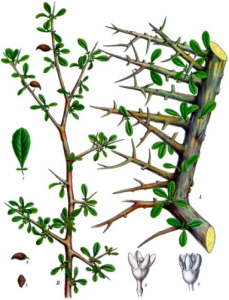
An illustration of the Commiphora myrrha or
common myrrh (a typical source of the resin of
the same name), from Franz Eugen Köhler’s
1897 book, Köhler’s Medizinal-Pflanzen.
c. he whom you love … Now Jesus loved Martha and her sister and Lazarus/he whom you love … Yeshua loved Marta and her sister and Eleazar | ὃν φιλεῖς … ἠγάπα δὲ ὁ Ἰησοῦς τὴν Μάρθαν καὶ τὴν ἀδελφὴν αὐτῆς καὶ τὸν Λάζαρον [hon fileis … ēgapa de ho Iēsous tēn Marthan kai tēn adelfēn autēs kai ton Lazaron]: These phrases use the verbs φιλέω [fileō] and ἀγαπάω [agapaō] (which are of course related to the nouns φιλία [filia] and ἀγάπη [agapē]; both mean “to love,” but φιλέω is more general, while ἀγαπάω tends toward “to love unconditionally or selflessly” (especially in Christian usage). It’s sometimes difficult to say whether a Christian author, including the authors of the New Testament, is using φιλέω to make a distinction from ἀγαπάω, or precisely because the two words were synonyms! Here, I believe it is the latter. However, if I am mistaken, then the drift of the text would be that Christ’s love for the Lazarus family is deeper than they themselves understand.
d. it is for the glory of God | ὑπὲρ τῆς δόξης τοῦ θεοῦ [hüper tēs doxēs tou Theou]: This closely echoes 9:3, and, here as there, sounds kind of awful (see note b of this post). Unfortunately, my grasp of the problem of suffering has not deepened appreciably in the last three weeks.
e. So when he heard that he was ill, he stayed two days longer in the place where he was. Then after this he said/Then, when he heard that he was infirm, even so, he then stayed in that place for two days; following after that, he says | ὡς οὖν ἤκουσεν ὅτι ἀσθενεῖ, τότε μὲν ἔμεινεν ἐν ᾧ ἦν τόπῳ δύο ἡμέρας· ἔπειτα μετὰ τοῦτο λέγει [hōs oun ēkousen hoti asthenei, tote men emeinen en hō ēn topō düo hēmeras: epeita meta touto legei]: Strikingly, the phrasing here emphasizes how counter-intuitive a decision this is. Here and there we see the author of the Fourth Gospel making Yeshua’s actions more explicable, as it were—6:6’s “aside to the audience” following his query to St. Philip in the verse before is a good example (the passage as a whole appears in this post). 11:6-7, by contrast, actively pile up the this-doesn’t-make-sense markers:
- ὡς οὖν: In themselves, these words aren’t that significant; ὡς often means “as” (with which it may be cognate), and οὖν is largely a discourse particle meaning “so” or “then.” However, their presence quietly lends force to the other discourse particles and extra adverbs we’re about to look at, in much the same way that beginning an English sentence with “Next” has a less emphatic feel to it than “So then after that” does.
- τότε: This word just means “then.” It is the first signal that ὡς οὖν was not enough for the author’s meaning.
- μὲν: This word, appearing in this sentence, is quite interesting. It generally highlights the first part of a contrasting dyad of facts or circumstances, and can often be translated (when explicit translation is called for) as “on the one hand”—a phrase which implies an other hand is on its way, and in ancient Greek, that other hand is normally marked by the particle δέ [de]; but there is no δέ in this text. It is not unknown for μὲν to appear thus “naked,” but it’s strange enough that describing it as “naked” is proportionate! In these circumstances, a translation like “even so” or “indeed” may be indicated.
- ἔπειτα: This normally means “thereafter,” which will be funny in about one second.
- μετὰ τοῦτο: This phrase means “after this,” or sometimes “with this” (but with in the sense of following close behind, as in “Are you coming with me?”).
It may be mere vanity that prompts me to think this, given what I’ve said in note d. But this tone of amazement from the text itself, even though the author knows exactly what’s coming next, makes me wonder whether perhaps the evangelist himself did not fully understand why the Lord did this when he, the evangelist, wrote about it.
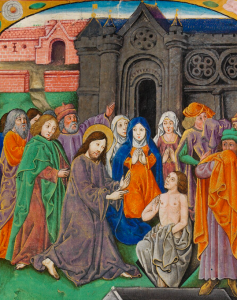
Illumination (c. 1504) of the raising of Lazarus
from the Peniarth Manuscripts, a priceless
collection now housed in the National Library
of Wales at Aberystwyth.
f. Are there not twelve hours in the day?/Aren’t there twelve hours in the day? | Οὐχὶ δώδεκα ὧραί εἰσιν τῆς ἡμέρας; [ouchi dōdeka hōrai eisin tēs hēmeras?]: This is a rather puzzling remark, and the Sacra Pagina commentary was unenlightening on the subject. I wonder whether it might be, or be drawing on, a local proverb; beyond that, I got nothing.
g. Thomas, called the Twin, said to his fellow disciples, “Let us also go, that we may die with him”/Then Toma, called “Twin,” said to his co-students: “Let us go too, in order that we may die with him” | εἶπεν οὖν Θωμᾶς ὁ λεγόμενος Δίδυμος τοῖς συμμαθηταῖς· Ἄγωμεν καὶ ἡμεῖς ἵνα ἀποθάνωμεν μετ’ αὐτοῦ [eipen oun Thōmas ho legomenos Didümos tois sümmathētais: «agōmen kai hēmeis hina apothanōmen met’ autou]: If you’ve seen the name Didymus attributed to the Apostle Thomas, that’s simply a Greek translation of the Aramaic word תְּאוֹמָא [Te’oumâ’]; both words mean “twin.” (If the name had again been translated into Latin, it would be a word you may recognize in its plural form: Geminus “twin” is the singular of Geminī.) This may mean that St. Thomas either was one of a set of twins himself, or bore an uncanny resemblance to some other family member—though as the latter is harder to detect in babies, my money’s on the former.
St. Thomas the Apostle is best known, of course, for his episode doubting the Resurrection, which this very Gospel is the one to recount. I think we should in fairness remember, from time to time at least, that he was ready to go with the Lord on what he took to be a doomed mission, and to summon others to do the same thing. That’s a cut above most of us.
h. about two miles off/around about fifteen furlongs | ὡς ἀπὸ σταδίων δεκαπέντε [hōs apo stadiōn dekapente]: Like many units of measurement in the ancient world, the Greek stade (in the original, στάδιον [stadion]—and yes, this is where we get “stadium” from) was a little imprecise by modern standards; however, the obsolete English furlong, equivalent to 660 feet, is just within the upper bounds of the stade in practical use. (If you think of a stade as two football fields, that’s good enough.) The RSV’s “two miles” is accordingly on the generous side, unless I’ve done the maths wrong; my estimate puts it a little over a mile and a half.
i. at the last day/on the Last Day | ἐν τῇ ἐσχάτῃ ἡμέρᾳ [en tē eschatē hēmera]: Eschatology—the doctrine of ἔσχατα [eschata], “last things”—evolved considerably over the history of Judaism (an evolution which did not entirely cease in Christianity).
For our purposes, we can talk about four layers of thought in the Old Testament, in the following grossly oversimplified list:
- The primitive layer, representing what was thought and written by Israelites from around the thirteenth century BC down to 586 BC, both before the construction of Solomon’s Temple and while it stood. This is held by most scholars to encompass parts of the Torah, some of Joshua, Judges, Samuel, and Kings, chapters 1-39 of Isaiah, and all or part of the books of Hosea, Amos, Micah, Habakkuk, and Zephaniah.
- The Exilic layer, representing what was thought and written during and immediately after the Exile to Babylon, up until the completion of the Second Temple, 586 BC to 516 BC or thereabouts. This is held to cover the rest of Deuteronomy, Joshua, Judges, Samuel, and Kings, chapters 40-55 of Isaiah, Jeremiah, Ezekiel, Obadiah, and most of Psalms 1-89.
- The Persianate layer, dating mainly if not entirely to the period of the Achæmenid dynasty of Iran, 516-331 BC. This is held to include Isaiah 56-66, Joel, Haggai, Zechariah, Malachi, Ruth, Ezra, Nehemiah, and Chronicles.
- The Hellenistic layer, held to date between 331 BC and the life of Christ. Jonah, Psalms 90-150, Proverbs, Job, the Song of Songs, Ecclesiastes, Esther, Daniel, Tobit, Judith, Baruch, the Letter of Jeremiah, Sirach, Wisdom, I Maccabees, and II Maccabees.3
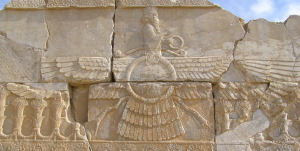
The Farāvahār, an ancient symbol in the Zoroas-
trian faith, depicted in a relief in the ruins of
Persepolis. Photo by Napishtim, used via
a CC BY-SA 3.0 license (source).
For the most part, the idea of a blissful afterlife awaiting the just as a reward is absent from primitive, Exilic, and even Persianate literature in this schema. This is not absolutely true: Isaiah 56 and Psalm 73 seem to offer counterexamples (though these do not appear to belong to the very oldest layer). Nonetheless, in the main, the afterlife in the earlier layers is represented in “Mesopotamian” terms.4 It is שְׁאוֹל [She’oul], “the pit,” a silent, miserable, insubstantial place for small and great alike. This is especially noteworthy in the Psalms: 30 inquires sarcastically, “Shall the dust praise thee? shall it declare thy truth?”, and 115 states positively, “The dead praise not the LORD, neither any that go down into silence.” The chief hope presented in the earlier layers of the Tanakh is that of “living on” through one’s descendants; it was this which justified levirate marriage, a union which would otherwise qualify as incestuous according to Leviticus 20:21. (Notably, this verse even specifies the punishment of childlessness, which would overturn the entire point of levirate marriage if it were not an explicit exception.)
The idea of a disembodied but continuing existence in “Abraham’s bosom,” as the Lord’s parable in Luke 16 calls it, is thus a relatively late idea in the pre-Christian history of Judaism (though, by the estimation of modern scholarship, it emerges well before the halfway point in the total history of the Judaic faith5). Why it arose at all, given that none of the prophets seem to have been sent to herald this revelation, is a puzzle. The Exilic and Persianate layers were apparently written with some Iranian influence, and the Zoroastrian religion which they practiced is widely speculated to have been an influence upon Judaism, particularly the “apocalyptic mode” of Judaism, with its notions of a cosmic war between light and darkness, its corresponding elaboration of angelology, and its Messiah, reminiscent of the Zoroastrian figure of the Saoshyant (“he who brings benefit”); however, there is apparently some debate about which direction the influence went between Zoroastrianism and Judaism. Perhaps the exposure to Zoroastrian ideas in the second and third layers was more resisted, as long as the primary contrast present to the minds of the Jews was between themselves and the Gentile-if-benignant Iranians; but in the Hellenistic layer, following the influx of Greek culture during and after Alexander’s time, the stereotypical Gentile became the Greek pagan instead of the Iranian Zoroastrian, and accepting influence from the latter felt less “off.”
However all that may be, by the first century, mainstream Pryshaya belief positively affirmed the ongoing existence of the soul after death. But it did not look to this as a permanent or desirable thing; the natural state of man was emphatically as an embodied creature (didn’t the Torah say first that “God formed man out of the dust of the ground,” and only after that that he “breathed into his nostrils the breath of life”? giving primacy to the body). Accordingly, the only logical thing to hope for, on Judaic premises, was resurrection from the dead—a power attributed in principle to the LORD in literature from as far back as layer 2, even perhaps layer 1. Thus the idea of a Last Day took shape, at which mankind in general would be resurrected and judged. This receives its most explicit articulation in the books of Wisdom and II Maccabees.
j. I am the resurrection and the life/I am the resurrection and life | Ἐγώ εἰμι ἡ ἀνάστασις καὶ ἡ ζωή [egō eimi hē anastasis kai hē zōē]: This statement, while honestly somewhat cryptic, does bring together several earlier statements from the Fourth Gospel:
Everything came to be through him, and apart from him not one thing came to be. What came to be in him was life, and this life was humans’ light; and the light appears in the darkness, and the darkness did not grasp it. (1:3-5)
“Whoever shall drink of the water which I will give to him, he will not thirst through the age, but the water I give him will become within him a fountain of water springing up to age-long life.” (4:14)
“Just as the Father raises the dead and brings them to life, so also the Son brings those he wants to life. … ‘Amin, ‘amin, I tell you that he who hears my word and has faith in the one who sent me has age-long life, and will not come into judgment but has gone over out of death into life. ‘Amin, ‘amin, I tell you that an hour comes, and is now, when the dead will hear the voice of the Son of God, and they who hear will live. For just as the Father has life in himself, so also he has given life to the Son to have in himself; and he has given authority to him to make judgment, because he is Son of Man. Do not wonder at this, because an hour comes in which everyone who is in monuments will hear his voice and journey out [of them], they that have done good into a resurrection of life, and they who have practiced vile things into a resurrection of judgment.” (5:21, 25-29)
Yeshua told them, “I am the bread of life; he who comes to me will not be hungry, and he who has faith in me will never thirst. … I am the living bread which has come down out of heaven; if anyone should eat of this bread, he will live for ever, and the bread which I will give is my flesh, for the life of the world.” (6:35, 51)
On the last day, [which is] the great day of the feast, Yeshua stood up and cried out, saying, “If anyone is thirsty, come to me, and if he has faith in me, drink. Just as the Writ says, rivers of living water will flow from inside him.” (7:37-38)
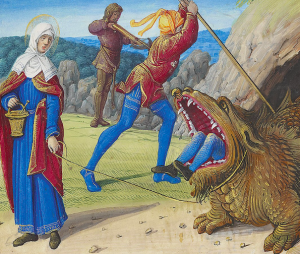
Illumination from the Hours of Henry VIII
(c. 1500) by Jean Poyer, depicting St. Martha
taming the Tarasque.6
k. I believe that you are the Christ, the Son of God/I have faith that you are the Anointed, the Son of God | ἐγὼ πεπίστευκα ὅτι σὺ εἶ ὁ χριστὸς ὁ υἱὸς τοῦ θεοῦ [egō pepisteuka hoti sü ei ho Christos ho Huios tou Theou]: As in note g, so here. St. Martha is perennially associated with her blunder in Luke 11. It is only justice that she should also be remembered from time to time for this unhesitating profession of faith, too, which is as frank and complete as St. Peter’s in Matthew 16.
l. he was deeply moved in spirit and troubled/he growled in his spirit and was agitated in himself | ἐνεβριμήσατο τῷ πνεύματι καὶ ἐτάραξεν ἑαυτόν [enebrimēsato tō pneumati kai etaraxen heauton]: “Deeply moved” is, frankly, an extremely diluted translation of ἐνεβριμήσατο. The verb ἐμβριμάομαι [embrimaomai] is a close derivative of a verb meaning “to snort with anger,” and more specifically “to snort or grunt like an angry war-horse.” I take this to be very much in the same spirit as the startling description of the Lord in Mark 1:40-41:
And a leper came to him, appealing to him and kneeling, saying to him that “If you will, you can cleanse me.” Impassioned, he stretched out his hand and laid hold on him and said to him, “I will; be cleansed”[.]
There, I used “impassioned” to represent a participle that normally just means “angered.” (I translated this pericope in Mark a couple of years ago.) Neither there nor here do I believe Christ was angry at the people around him—least of all the leper or Miriam. I think the real significance was, accidentally, expressed by G. K. Chesterton while talking about something quite unrelated:
Men are moved in these things by something far higher and holier than policy; by hatred. When men hung on in the darkest days of the Great War, suffering either in their bodies or in their souls for those they loved, they were long past caring about details of diplomatic objects as motives for their refusal to surrender. Of myself and those I knew best I can answer for the vision that made surrender impossible. It was the vision of the German Emperor’s face as he rode into Paris. This is not the sentiment which some of my idealistic friends describe as Love. I am quite content to call it hatred; the hatred of hell and all its works …
—The Everlasting Man, Part I, Chapter 7: The War of the Gods and Demons (emphasis mine)
m. Jesus wept/Yeshua wept | ἐδάκρυσεν ὁ Ἰησοῦς [edakrüsen ho Iēsous]: This is celebrated, or joked about, as the shortest verse in the Bible, and it is. (Even in Greek it’s only three words long, and that’s only because Greek uses the definite article with proper names.) However, what drew my attention about it is that this is the first clear instance we have of the Lord mourning with the bereaved—something he troubles to do, even though he will be resurrecting Eleazar literally in a matter of minutes. That act will not, of itself, undo the days Marta and Miriam spent first in anxiety and then in grief; Christ makes a point of acknowledging, and sharing, that pain.
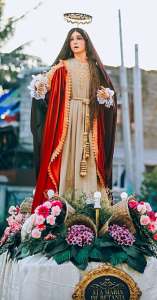
A processional statue of St. Mary of Bethany
from the Philippines. Photo by Raymart San
Jose, used via a CC BY-SA 4.0 license (source).
n. the dead man … The dead man/the deceased … He who had died | τοῦ τετελευτηκότος … ὁ τεθνηκὼς [tou teteleutēkotos … ho tethnēkōs]: The first of these two words is what’s referred to technically as a hapax legomenon in the New Testament. This comes, as we all know, from the Greek ἅπαξ λεγόμενον, of the same meaning.
That meaning is, “said only once”: the word τετελευτηκότος appears nowhere else in the entire New Testament. That is, it’s a perfect participle, and the verb the participle is derived from (τελευτάω [teleutaō] “to end, cease; to finish, complete, accomplish”) does appear elsewhere, but this particular form is used nowhere else. Like the perfective aspect of verbs, where the idea indicated is that the action is complete but can still be relevant, this participle indicates an action—ceasing—that is in itself complete, but is of present pertinence; my use of “the deceased” is meant to hint at this, and at how unusual an expression this is in the Greek, at least in John’s Greek.
Τεθνηκὼς (another perfect participle) isn’t a hapax legomenon, although it’s close: it occurs in one other verse of the New Testament, Luke 7:12, where the son of a widow from the village of Nayin or Nain is raised from the dead during his own funeral procession (which has got to be a freaky experience, seriously). However, it’s a more ordinary term, derived from the basic verb θνῄσκω [thnēskō] “to die.”
o. for he has been dead four days/for it is the fourth day [since his burial] | τεταρταῖος γάρ ἐστιν [tetartaios gar estin]: I heard somewhere or other that there was a Jewish folk belief that the soul of the dead will linger for three days, and would therefore be gone by now, and that this is what Marta is thinking of; however, I’ve never seen a source for that, and I mention it here only to say that it probably belongs with the “needle’s-eye gate” collection of things some irresponsible Christian just made up one day and started saying. More to the point, especially in a warm climate like that of Canaan, decomposition sets in fairly quickly. Imagine how a piece of raw meat would smell if you left it on a counter for four days—I think that’s what Marta has in mind.
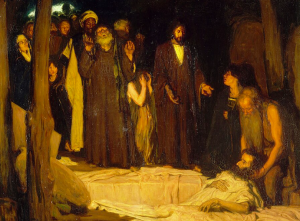
Resurrection of Lazarus (1896),
by Henry Ossawa Tanner.
p. Father, I thank thee that thou hast heard me. I knew that thou hearest me always, but I have said this on account of the people standing by, that they may believe that thou didst send me/Father, I thank you because you have heard me—I know that you always hear me; but for the sake of the crowd standing around I say this, in order that they may have faith that you sent me | Πάτερ, εὐχαριστῶ σοι ὅτι ἤκουσάς μου, ἐγὼ δὲ ᾔδειν ὅτι πάντοτέ μου ἀκούεις· ἀλλὰ διὰ τὸν ὄχλον τὸν περιεστῶτα εἶπον, ἵνα πιστεύσωσιν ὅτι σύ με ἀπέστειλας [Pater, eucharistō soi hoti ēkousas mou, egō de ēdein hoti pantote mou akoueis: alla dia ton ochlon ton periestōta eipon, hina pisteusōson hoti sü me apesteilas]: On the face of it, this is an odd remark. It draws attention to itself in ways that might feel very distasteful; religious language that ostentatiously addresses God “aloud” generally does, and indeed, the Lord himself is at pains to discourage such showiness in the Sermon on the Mount. However, if one pauses for a moment and thinks it out—”I know that you always hear me; but for the sake of the crowd standing around I say this, in order that they may have faith that you sent me”—there’s a real sense in which that is the entire paradigm of the Incarnation. Like the Bible or the Mass (of both of which the Incarnation is the root), it is about God but it is for us.
If God had so pleased, he could have assumed the Theotokos into heaven as soon as she was born, become human privately without associating with terrestrial miseries and stupidities, and thus, by being united to our species, have possessed a sort of “legal fiction” whereby to extend salvation to the human race without our ever even knowing about it, leaving it to be a surprise after our deaths (well, probably shock really, but anyway); or rather, if there’s any issue with God doing things like this, the issue is at any rate not “He isn’t powerful enough.” The objection easily springs to mind that if he had lived a life like that in the secrecy of heaven, it would scarcely qualify as a human life at all. The issue, then, is that—well, in fact, that of his very nature, he growls with the hatred of hell and all its works, weeps with us, and journeys to rouse us from sleep.
q. with a cloth/with a kerchief | σουδαρίῳ [soudariō]: A σουδάριον [soudarion] originally referred to a sweat-cloth. However, cloths of this same type were also used in the ancient world to cover the faces of the dead.
Footnotes
1I’m basing this on the text of Nehemiah 11:32 as represented in the Westminster Leningrad Codex (a digitized form of the Leningrad Codex, the oldest complete copy of the Hebrew Bible) as it appears at biblegateway.com, and on the etymology offered at biblehub.com in its entry for the root of this town’s name, though I’ve interpreted that root differently than they do; I can only hope that I haven’t humiliated myself by exposing my amateurish Hebrew (but if I have, I’ve got nobody but myself to thank for it).
2The month of Shevat is, in the loosest terms possible, vaguely equivalent to February on the Gregorian calendar. Since Hebrew months move around relative to ours and Shevat often overlaps with January, I think we can find in Tu bi-Sh’vat an analogue—again in the loosest terms possible—to Groundhog Day.
3My listing of books in each layer corresponds to their order in my plan of the canon from this post, not to the order in which they are thought to have been written or redacted. The latter is too debated, and in many cases would leave books without a clear spot to position them in (when an early form of a book is held to be very ancient but its final form is held to be quite late). I admit that I’m more disposed than professional Biblical scholars to accept, or at least allow, earlier dates for a large proportion of the material in the Persianate, Exilic, and even primitive layers. One reason for this is that I don’t grant the assumption, common among academics, that any professed prophecy must really be a vaticinium ex eventu; another is that Bible scholars often show themselves curiously poor judges of the significance of a text, which lessens my confidence in their judgment of its dating in a general way. (A good example of this poor judgment that I’ve mentioned before would be the widespread notion that the evidence for the worship of other deities in pre-Exilic Palestine—of which there is an abundance—is evidence that in some way discredits the Hebrew Bible, because it supposedly says the ancient Israelites were monotheists. The problem with this theory is that the Hebrew Bible says no such thing. It says that God told the ancient Israelites to be monotheists; it also says, many times over and at considerable length, that they weren’t: “our fathers have trespassed, and done that which was evil in the eyes of the LORD our God, and have forsaken him, and have turned away their faces from the habitation of the LORD, and turned their backs” [II Chronicles 29:6].)
Nonetheless, I have here summarized the general academic consensus rather than giving my private opinions, for two reasons. One is that the exact dates don’t greatly affect the matter I’m discussing, or not as far as I can tell. The other is, my familiarity even with Hebrew as a language, let alone the Tanakh as such, is far too amateurish for my private opinions to be more than guesses. While I lack full confidence in a given field, even partial confidence merits more respect than the extensive ignorance I know for a fact I’m operating under!
4I.e., as contrasted with Egyptian. Throughout the Bronze and Iron Ages, the Holy Land lay at the crossroads of Mesopotamian civilization to the northeast and Egyptian civilization to the southwest, open to trade and other influence from both cultures. Some Hebrew customs were shared or partially shared with ancient Egypt: circumcision is a good example, and Egyptian priests were forbidden to consume pork. But, as is well-known, the Egyptians had an elaborate conception of the afterlife, and devoted considerable resources to those who had already been consigned to it. The ancient Israelites and Judahites appear in this respect to have aligned more with Mesopotamian beliefs about the netherworld than those of northeast Africa.
5The historical beginnings of Judaism are quite difficult to estimate from the information the Tanakh affords us, but its earliest recognizable form is generally allowed by scholars to have arisen by late in the second millennium BC, likely between 1300 and 1000 BC—the period we now label the tail end of the Late Bronze Age and Iron Age I.
6The tale of St. Martha taming the Tarasque (the name rhymes with “a flask”), a dragon-like monster that supposedly terrorized a town in southern Gaul before her intervention, appears in the Legenda Aurea (“Golden Readings,” though usually half-translated: “Golden Legend”) of Jacobus de Voragine, a thirteenth-century Bishop of Genoa. Published in or around 1266, it was a favorite collection of saints’ lives in the Late Middle Ages and the Renaissance. There is a longstanding tradition that one of the New Testament’s many Maries, usually St. Mary Magdalene, left Judea for the province of Gallia Narbonensis at some point; this could be an error for St. Mary of Bethany, or they could have been the same person, or Mary of Bethany (and her siblings) could have gone with the Magdalene. High-tailing it all the way to Gaul strikes me as unnecessary enough to be a bit far-fetched; that said, it’s certainly not impossible. Not only was travel between the two provinces obviously feasible in any case, but Herod Archelaus (the eldest son of Herod the Great), when deposed from the Judean monarchy in the year 6, was exiled to Vienne, a city in what is now eastern France about twenty miles south of Lyons: in other words, there was at least some precedent for Jews to relocate to southern Gaul in particular.







 Ad-Free & Subscriber Log-In