

I have been describing the abundant discovery of lost scriptures and gospels from the later nineteenth century, which is long before the time that most people think they became available. In fact, not only were such texts “found” after long periods of disappearance, but most were brought out in accessible vernacular translations. The pace of publication was deeply impressive, with scarcely a break from the 1880s through the 1930s. If you were interested in such matters, and had some middle-class disposable income, you could assemble a deeply impressive library, which told you a very great deal about the ancient sects and heresies that have attracted so much sensational attention in our own time. Beyond their availability in popular (translated) books, such ideas could now be accessed very widely through magazines and newspapers, in a massive opening or democratization of technical Biblical scholarship.
People could, and did, use such materials as the basis for quite extensive theorizing about the nature of early Christianity (and Judaism) and they speculated about their secret or suppressed traditions. However much it contradicts our stereotypes, very little indeed of what we now know about such movements and ideas was not readily available back in that distant era.
Please note that I am drawing here on various past writings of mine, including my 2001 book Hidden Gospels: How the Search for Jesus Lost Its Way.
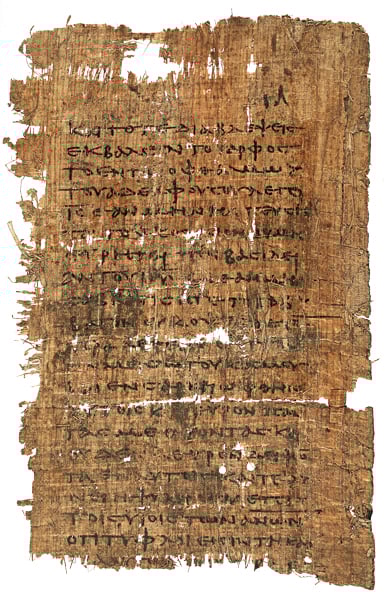 This and all other illustrations in this post are in the public domain
False Writings
In modern times, scholars have learned much from the pseudepigrapha, “false writings” of the Old Testament, works attributed to such figures as Moses or Enoch. Among other things, many such texts profoundly influenced early Christian leaders and writers. More significant were the implications for the canonical Bibles that people knew. Just why had some texts been included, and others not?
One turning point in English-language scholarship came with W. J. Deane, Pseudepigrapha: An Account of Certain Apocryphal Sacred Writings of the Jews and Early Christians (Edinburgh, 1891). For many years thereafter, the key name was Irish scholar Robert H. Charles, who edited and translated many works from the 1890s onward. These included the Book of 1 Enoch (1893 and 1906), Jubilees (1895 and 1902), The Apocalypse of Baruch (1896), The Assumption of Moses (1897), Ascension of Isaiah (1900), and the Testaments of the Twelve Patriarchs (1908). In 1896, he co-edited The Book of the Secrets of Enoch – that is Second or Slavonic Enoch.
Charles then edited a hugely popular collection, The Apocrypha and Pseudepigrapha of the Old Testament in English (Clarendon Press, 1913). The first volume of this included works that Protestants deemed apocryphal, such as Maccabees, but the second volume was much bolder. In a sizable volume (some nine hundred pages) Charles and his fellow contributors included English translations and commentaries of Jubilees, the Letter of Aristeas, Books of Adam and Eve, Martyrdom of Isaiah, I Enoch, Testaments of the Twelve Patriarchs, Sibylline Oracles, Assumption of Moses, the Syriac and Greek Apocalypses of Baruch, Psalms of Solomon, and the Story of Ahikar. Also included was “The Fragments of a Zadokite Work,” which we now know to have been the Community Rule of the Qumran Sect.
In 1917, the SPCK published Charles’s edition of Enoch, which would have reached widely into the homes of clergy and educated laity around the English-speaking world. Charles wrote the magnificent entries on this literature, and on individual works, for the legendary 1911 edition of the Encyclopedia Britannica. In 1914, his Religious Development Between the Old and the New Testaments offered another survey of the pseudepigraphic literature.
Other significant editions and collections followed, suggesting a really enthusiastic mass market. 1917 brought Charles F. Horne, ed., The Sacred Books and Early Literature of the East, and the following year, William J. Ferrar published The Uncanonical Jewish Books (SPCK). One great achievement of these years was M. R. James’s The Lost Apocrypha of the Old Testament (SPCK, 1920), a dazzlingly wide-ranging work that assembled allusions and references to many lost texts. In 1927, E. A. Wallis Budge published his translation of the important Syriac work The Book of the Cave of Treasures. A major source for Jewish extra-Biblical traditions was Louis Ginzberg, Legends of the Jews, 2 vols., 1909-13.
In 1926, Rutherford H. Platt, Jr. published The Forgotten Books of Eden, which basically offered the same texts as the 1913 R. H. Charles collection of Apocrypha and Pseudepigrapha, but without the critical apparatus (and also with some sensational media advertising). In his introduction, the notoriously liberal Episcopal clergyman William Guthrie wrote, reasonably enough:
It is not too much to say that no modern can intelligently understand the New Testament, unless he is acquainted with the so-called “Apocrypha,” and with the “Pseudepigrapha” as well. The very words of Jesus were in many instances, suggested by sayings current in his day, more or less as unconscious quotations from the Testaments of the 12 Patriarchs.
The figure of the Messiah which Jesus adapted to his creative purpose, cannot be imagined by a modern without a perusal of the book of Enoch which is its classic and most entrancing glorification. Without the Odes and Songs of Solomon the atmosphere breathed by the earliest church cannot be divined.
Media Sensations
Early Christian writings were quite as popular, and many new texts now appeared. One celebrated event occurred in 1859, when Constantine von Tischendorf found an astonishing treasure at the monastic house of Mount Sinai: this was the Codex Sinaiticus, a fourth century New Testament manuscript, which also included two long-lost second century Christian texts, namely the Epistle of Barnabas and part of the Shepherd of Hermas. In 1873, a manuscript found in Constantinople included the liturgical text known as the Didache, or the Teaching of the Twelve Apostles. All were soon available in English translation. In the early church, Barnabas, Hermas and the Didache had been serious candidates for inclusion in the New Testament, and all were priceless witnesses to early Christian thought. That was in addition to the Sayings of Jesus found at Oxyrhynchus, which I have described at another post.
Also widely publicized was the ancient Gospel According to Peter, a fragment of which was found in Egypt in 1886. A few scholars still believe that Peter dates from the beginnings of Christian literary activity, and that portions of the work might predate the canonical gospels, though this is a minority view today. A hundred years ago, though, Peter received much wider scholarly respect, and it aroused popular hopes reminiscent of those stirred by the Gospel of Thomas in recent years. As the great scholar J. Rendel Harris remarked in 1899, “If some are quite certain that the gospel in question is merely a pendant from and adaptation of the four canonical gospels, others have been equally positive that a fresh line of tradition has been disclosed, and that we are face to face with a canonical fifth gospel (or one that was something very like canonical in the second century).”
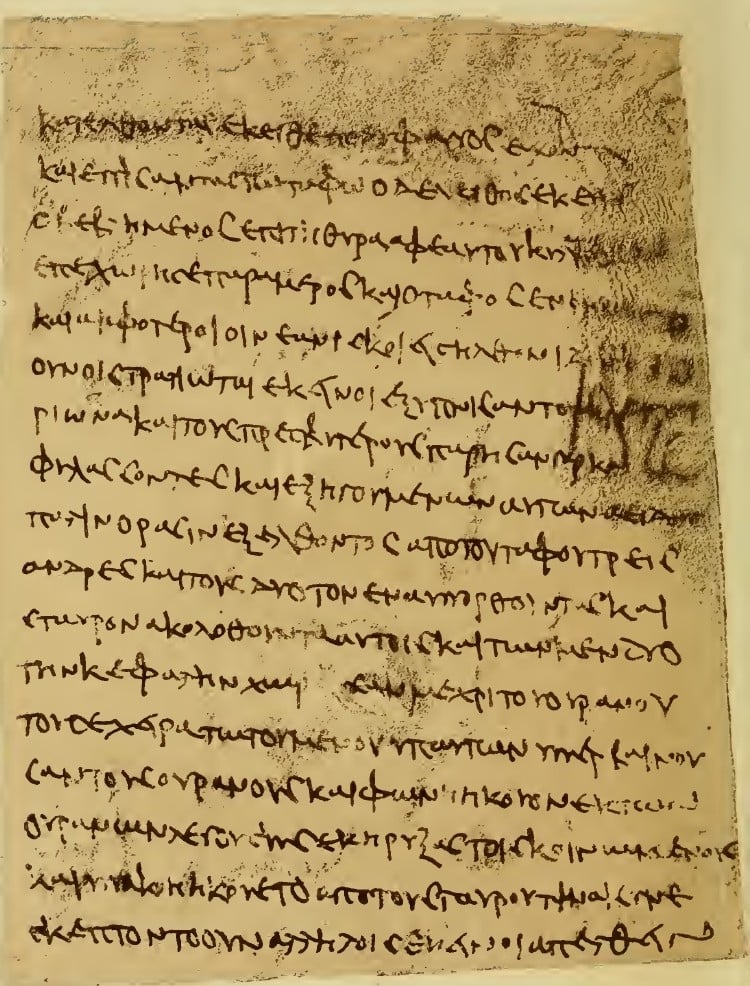
Cumulatively, the various discoveries were impressive. In 1930, Edgar Goodspeed listed the texts which had come to light just since the 1870s: “the Teaching of the Twelve Apostles, the Gospel of Peter, the Revelation of Peter, the Apology of Aristides, the Acts of Paul, the Sayings of Jesus, the Odes of Solomon, and the Epistle of the Apostles – all from the second century.” Between 1890 and 1910, lengthy and well-informed articles about the new finds appeared in all the most prominent English-language magazines and periodicals, including the Contemporary Review, Outlook, McClure’s, The Nation, Nineteenth Century, Harper’s Weekly and the Independent, as well as popular papers like the New York Journal and the Sun.
Such media reports aroused popular expectations about the potential for revolutionary new finds which could shed light on earliest Christianity, and contributed to making the archaeology of religion a genre in twentieth century popular culture. People were speculating hopefully on what might be learned from other lost texts known from ancient sources.
With so many materials of this sort known or actually available, by the end of the nineteenth century an influential school of thought already disparaged the canonical sources while placing extravagant hopes in their rivals, in the hidden gospels. J. Rendel Harris remarked disapprovingly on the existence of a substantial school of thought which held that
our existing gospels are a selection and a survival out of a great mass of similar attempts at gospel writing, and it is inferred that they owe their success not simply and purely to their superior excellence and accuracy but in part at least to the accidents which make some books popular and permanent, and relegate others to obscurity.
That is a radical view, and it sounds very modern.
Publishing the Gnostics
Some newly found texts shed light on Gnosticism and other ancient heresies, and caused scholars to redraw the frontiers of the early Christian movement. In 1842, the long-lost Refutation of All Heresies was found in a monastic house on Mount Athos. This text was (probably) written by the early third century Bishop Hippolytus, a pupil of that great foe of heresy, Irenaeus. Published in English in 1868, the Refutation vastly expanded available knowledge about the Gnostics because of the author’s long quotations from the works of several heretical schools, and his elaborate retelling of Gnostic celestial mythologies. Among other things, Hippolytus was familiar with many texts which sound very much like the documents found at Nag Hammadi. Other finds revealed the heretics in their own words: I have already mentioned the Berlin Codex, which was purchased in 1896.
Here is Francis Legge, writing in 1915: “During the last century, the lost heresiology of Hippolytus and considerable fragments of works by Gnostic authors were brought to light … while the present decade has not only added to our stock of Gnostic fragments, but has revealed to us on the western frontier of China a hoard of Manichaean documents rich beyond our hopes.” Those documents laid the foundation for the modern scholarly study of that faith.
Faith Wisdom
The most intriguing of the new discoveries was the Pistis Sophia (“Faith Wisdom” or “Faith of Wisdom”), an allegorical account of the Gnostic world-system, which some attributed to Valentinus himself. Purchased in the 1760s, this Coptic text remained barely noticed in the British Museum until in 1851 it was made available in Latin and Greek, from a German press. It was discussed at length by Charles King’s pioneering 1864 text The Gnostics and Their Remains,, and as King noted, this was the “sole survivor of the once numerous family of Gnostic Gospels; but fortunately the most important of them all for our purpose, and the very one for whose escape (in its Coptic disguise) the archaeologist ought to feel most grateful to the ignorance of the destroyers.” In 1890-1891, Theosophist G. R. S. Mead published a translation in the magazine Lucifer, and his free standing book version followed in 1896. He was consciously publicizing these texts as hidden gospels: he described Pistis Sophia as a Gnostic gospel, and following King, the text was commonly recognized as “a sort of Gospel coming from some early Gnostic sect.”
Mead became the great contemporary popularizer of the lost heresies. His publications included Fragments of a Faith Forgotten (1900), “some short sketches among the Gnostics mainly of the first two centuries— a contribution to the study of Christian origins based on the most recently recovered materials.” These “short” sketches amounted to over six hundred pages. That was followed by the eleven volume Echoes from the Gnosis (1906-1908), a comprehensive edition of every Gnostic writing then known. The Gnostic John the Baptizer (1924) translated the psalms of the Mandaean sect.
Pistis Sophia initiated the modern rediscovery of the Gnostic gospels, and through King’s book, it had a huge influence on Theosophists. Because it is so elaborately detailed (it runs to some three hundred pages in translation), the work offers a thorough introduction to Gnosticism, including many of the aspects which have attracted the most attention in the Nag Hammadi gospels. Pistis Sophia claims to report the interactions of Jesus and the disciples after the Resurrection, but it differs from the canonical texts in its account of the spiritual powers ruling the universe, its belief in reincarnation, and its extensive use of magical formulae and invocations.
The Jesus depicted here was a mystic teacher or revealer, whose main interactions are with powerful female disciples like Mary Magdalene. As Charles King noted with bemusement in 1864,
A remarkable peculiarity is that all throughout Mary Magdalene is the chief speaker, and the most highly commended for her spiritual knowledge, though once she is sharply rebuked by Peter for her presumption in thus perpetually putting herself forward unbidden— and not giving the men a chance to speak.
That kind of gender emphasis is a familiar feature of several gospels that have come to light more recently, from Nag Hammadi and elsewhere. In the 1860s, it was mind-boggling.
Much of Pistis Sophia concerns the stages by which Jesus liberates the supernatural (and female) figure of Sophia, heavenly Wisdom, from her bondage in error and the material world, and she is progressively restored to her previous divine status in the heavens. Characteristic of these gospels, the events described occur symbolically and psychologically, in sharp contrast to the orthodox Christian concern with historical realities. Much like the Nag Hammadi texts a century later, Pistis Sophia aroused widespread excitement among feminists and esoteric believers, and aspiring radical reformers of Christianity.
How The Word Spread
Editions and translations of the apocryphal texts could be found in every seminary and countless private libraries. Several alternative gospels, mainly late and legendary, were well-known through their inclusion in the popular Ante-Nicene Christian Library, which first appeared in the 1860s, and was expanded as new texts were discovered. By the end of the century, this collection included the Gospels attributed to Nicodemus, Peter, Pseudo-Matthew and the so-called Protevangelium or “First Gospel” of James. The Ante-Nicene collection covered numerous apocryphal Acts of the apostles, including those of Thomas, John, Paul, Peter, Philip, and Andrew. It also included the Refutation of All Heresies with all its invaluable Gnostic sources.
Selections from the same range of Acts and gospels appeared in M. R. James’s best-selling The Apocryphal New Testament (1924), which became the standard English-language resource on early heresies. We also find here several apocalypses distinct from the famous Book of Revelation which we know from the New Testament. James quotes or discusses the apocryphal gospels of the Hebrews, the Ebionites, and the Egyptians, and the works named for Philip, Peter, Matthias, and Nicodemus. He describes the existence of Gnostic tracts like the Gospel of Mary, although he did not find this worthy of discussion at length. He also included the “Oxyrhynchus Sayings of Jesus.”

To return to a question I have raised here before. Given this profusion of sources and speculation that was already circulating by 1910 or so, it really is amazing that later generations were so amazed and entranced by the new outpouring of Gnostic- and heresy-related material (and new gospels) from the 1970s onward. It was almost as if the Lost Gospels were lost and forgotten once again. What on earth was happening?
Perhaps amnesia really is an integral part of the popularization of scholarship.












 Ad-Free & Subscriber Log-In