

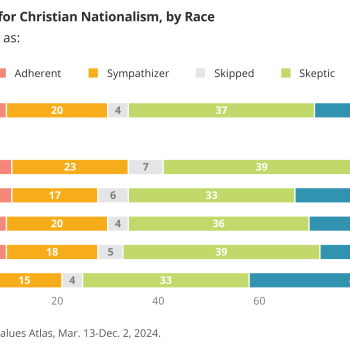
We hear much about Christian nationalism these days, and for good reason. Pastors, pundits, and presidents alike champion control and dominance as means to recover an imagined, nostalgic, strong Christian America. While most Americans (70%) remain skeptics or rejectors of Christian nationalism, the ideology is embraced at higher levels by older, less educated, and churchgoing Americans. Around half of those who attend religious services weekly or more qualify as Christian nationalism Adherents or Sympathizers (51%). The Church is split, almost evenly.
Recent research also finds, somewhat surprisingly, that pastors play a large role in how congregants view Christian nationalism. In her recent article, “We Should all be Christian Nationalists”: Elite Influence on Identification with Christian Nationalism,” Amy Brooke Gauley argues that “elite cues” “significantly affect identification” for those without strong pre-existing views. People in the pews are looking to their spiritual leaders for guidance about how to think about issues of faith and power. As Gauley concludes: “elite discourse plays a powerful and enduring role in shaping public support for Christian Nationalism.”
So how should pastors think and talk about Christian nationalism? That was the urgent question taken up last week by invited scholars, clergy, students, and laypeople at Candler Seminary at a conference dedicated to “Pastoral Leadership in a Time of Christian Nationalism.” “In a time when Christian nationalism is gaining both cultural and political traction,” the organizers asserted, “the work of pastoral leadership requires renewed theological reflection, moral clarity, and prophetic courage.”
Over two days, a slate of four speakers offered their perspectives on the current historical and theological moment we face.
First, Dr. Kristin Kobes du Mez, author of Jesus and John Wayne (and former Anxious Bench-er) spoke on “Jesus and John Wayne and the Evangelical Reckoning.”

Next, Tim Alberta a journalist and author of American Carnage: On the Front Lines of the Republican Civil War and the Rise of President Trump (2019) and The Kingdom, The Power and the Glory: American Evangelicals in the Age of Extremism (2023), gave a lecture “A Ringside Seat to the Messianic Revolution.”
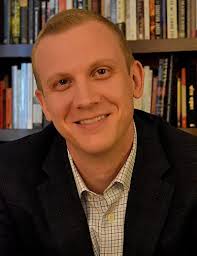
The following day, Dr. Matthew Taylor, author of The Violent Take it by Force, then gave a moving sermon, “Render Unto Ceasar: Preaching the Gospel in an Era of Christian Power,” before Katherine Stewart, author of, among others, the recent Money, Lies, and God, spoke on “ Inside the Movement to Destroy American Democracy.”


Though varied in emphasis and scope, taken together, three themes emerged:
The danger of this moment
Every speaker addressed this. Kristin explained how fellow Christians tried to get her fired, they made “unscholarly” criticisms of her work, and most troublingly, they lied about her in dehumanizing language. A historian at a Christian university, a professing believer in Christ, Kristin was labeled “ a child of the Devil,” a “false teacher.” With an academic background that includes expertise in the German Christian Movement, Kristin explored how such language serves to permit cruelty, disdain, and hatred and to sanction authoritarianism. Social media and the commercial dissemination of bad history and bad theology adds to the problem, as people are radicalized online. Katherine addressed the flow of capital into authoritarian efforts, the “well-networked machine” of think tanks, private organizations and right-wing individuals.
The Theological Conflict inherent in Christian nationalism and the Gospel of Jesus
Tim and Matthew in particular addressed the divergent understandings of Christianity at the heart of the conflict between professing Christians in regard to religious authoritarianism. Framing his remarks around Jesus’ entry into Jerusalem on Palm Sunday, that showdown of powers, Tim encouraged those opposed to Christian nationalism to address it using the gospel of Jesus. He claimed: Bad politics plagues us, but good politics cannot save us; bad communication plagues us, but good media cannot save us; “bad theology plagues us but good theology can in fact save us!” Christian pastors should assert this “good theology” in the face of Christian nationalism, recovering the Jesus, who, on a confrontation course with Pilate, rejected earthly power and domination, even as those with a “ringside seat” to the triumphal entry call for him to save them from Rome. “From the front lines,” he implored, “the only thing that can change people is the theology piece of it.” Matthew Taylor, too, movingly explored the theological crisis, comparing it to Matthew’s account of the gospel of Caesar and the gospel of Jesus. Both Caesar and Jesus declared divine evangelion. Caesar’s way was that of power and dominance and prosperity, Jesus’s one of suffering, serving, and sacrifice. Too often, though, Christendom had tried to have both ways, with devastating effects. What do we do when Ceasar is…Christian? Taylor encouraged that “we must recover the gospel of powerlessness and marginality in every pulpit…the subversive gospel of Jesus.”
The need for courage
Every single speaker asked the pastors and students assembled to have courage. These are dark days, full of uncertainty, that will require the bravery to speak out and resist. Kristin concluded her remarks with admonitions from Hanna Reichl and from Dietrich Bonhoeffer, encouraging pastors to not obey in advance, to avoid complicity, to boldly proclaim the gospel of Christ, and to resist the “worship of power.” Tim, too, encouraged folks to love their Christian nationalist neighbors, to engage them theologically, to reach out. Matthew, by describing the powers of empire, reminded listeners of the subversiveness of their faith. Bearing the eikon of God, Christians must see the ceasars for what they are: fading “tinpot tyrants”and treat them as such. Even if we die, he reminded Christians, we live. Finally, Katherine urged vigilance. “Don’t despair,” she concluded.
The Q & A response was informative and ranging, with questions about the role of social media, political means and ends, about subgroups and the role of Pentecostalism. Overall, it was an important gathering at a critical moment. The speakers were unflinching in their assessment of the moment we are in, rife with religious extremism and authoritarianism. But they were also resolute in encouraging theological defenses of the gospel, Christian subversion, and pastoral courage. Conferences like the one at Candler offer space for those Christians who are not Christian nationalists to see that they are not alone and to gather courage and insight for the theological crisis they are in.












 Ad-Free & Subscriber Log-In