

It seems seasonally appropriate to start October with a post about a witchcraft trial– particularly one that defies expectations for what one might find in an early modern witchcraft case. And this is an especially well-known case, at least in scholarship on Scandinavia: the trial of Anders Poulsen, in February 1692.
The Trial
The events of the trial are summarized and analyzed in Rune Blix Hagen’s chapter “Traces of Shamanism in the Witch Trials of Norway: The 1692 Trial of the Sami Shaman Anders Poulsen.” The trial’s charges and events are both exactly what one might expect and also surprising: Anders Poulsen, an elderly Sámi man (he said at his trial that he was almost 100 years old) is brought into court on charges of possession of (and the use of) a magic drum, with which he had “practiced his evil and ungodly sorcery.” The prosecution, led by Deputy Bailiff Olle Andersen, described Poulsen as a sorcerer, a heathen, and a colleague of the devil who had awakened demons by playing upon his drum. Poulsen’s children (four of whom were present at the trial) and Poulsen strongly argued against this accusation, emphasizing that Poulsen never caused anyone harm with his drum and was a good Christian. But the chief magistrate Niels Knag concurred with Bailiff Andersen’s assessment, writing in the court minutes: “I look upon his doings as ungodliness and the worst kind of sorcery. He has whole-heartedly committed himself to the devil” (Blix Hagen “Traces of Shamanism” p. 4). Poulsen was found guilty, but while waiting for input from a higher court for his sentencing (Deputy Bailiff Andersen was advocating for Poulsen to be “burned to a cinder upon the flames”), a “mad servant” murdered Poulsen, taking judgment into his own hands. (Blix Hagen, “Traces of Shamanism,” pp. 3-5).
This might all seem as expected for those familiar with early modern witchcraft trials: an elderly individual is brought up on specious charges of sorcery, their belongings seized by the state, and the accused dies. However, as Blix Hagen points out, this trial is exceptional in a few ways. First, it goes against the broader trend in the early modern period where accused witches are generally women. This is unusual for early modern Europe, but not for trials of Sámi individuals for witchcraft. Of the 27 individuals identified as Sámi in Scandinavian witchcraft trials, 19 of those convicted were men– highlighting the intersectional nature of witchcraft accusations in the early modern period, where both gender and ethnic factors influenced who was accused (and convicted).
Second, the documents from the trial are more extensive than usual: perhaps because the trial involved not just accusations, but also a demonstration of how Poulsen used the drum in the court, the trial documents span 16 folio pages, with an additional 12 folio pages on Poulsen’s murder. Alongside these documents, we have surviving courtroom minutes and unofficial interrogation notes from Niels Knag and an account of the case by District Governor Hans H. Lilienskiold. Within these trial documents we find the third exceptional feature of this case: the trial centers around a drum and its use– and because of that, we have Anders Poulsen’s demonstration of how he used his drum and his description of its images.
The Testimony
When using the drum in court, Anders Poulsen first prayed in Karelian (Finnish), then crossed himself and the drum before picking it up. As he beat the drum with a hammer, he prayed aloud to his gods asking them to not fear the Norwegians in the courtroom. When Bailiff Knag tried to convince Poulsen to teach him how to use the drum, Poulsen replied that the gods would not allow Knag to learn until he confessed his sins.
The mixture of Christian language and practice with references to other gods and spirits continues in Poulsen’s explanation of what the images on the drum meant. The images on the drum are arranged in five tiers, with the records giving Poulsen’s explanation of the images as including figures associated with storms, with good weather, and with reindeer, but also depictions of God’s child, “who could free people from their sins,” God the father, who would punish sinners or produce salvation, the Holy Ghost, “who could renovate man,” Mary, Christ’s mother, the Christmas kings, two churches, churchgoers, devils, and women bound in hell (Blix Hagen, “Traces of Shamanism,” 7-8).
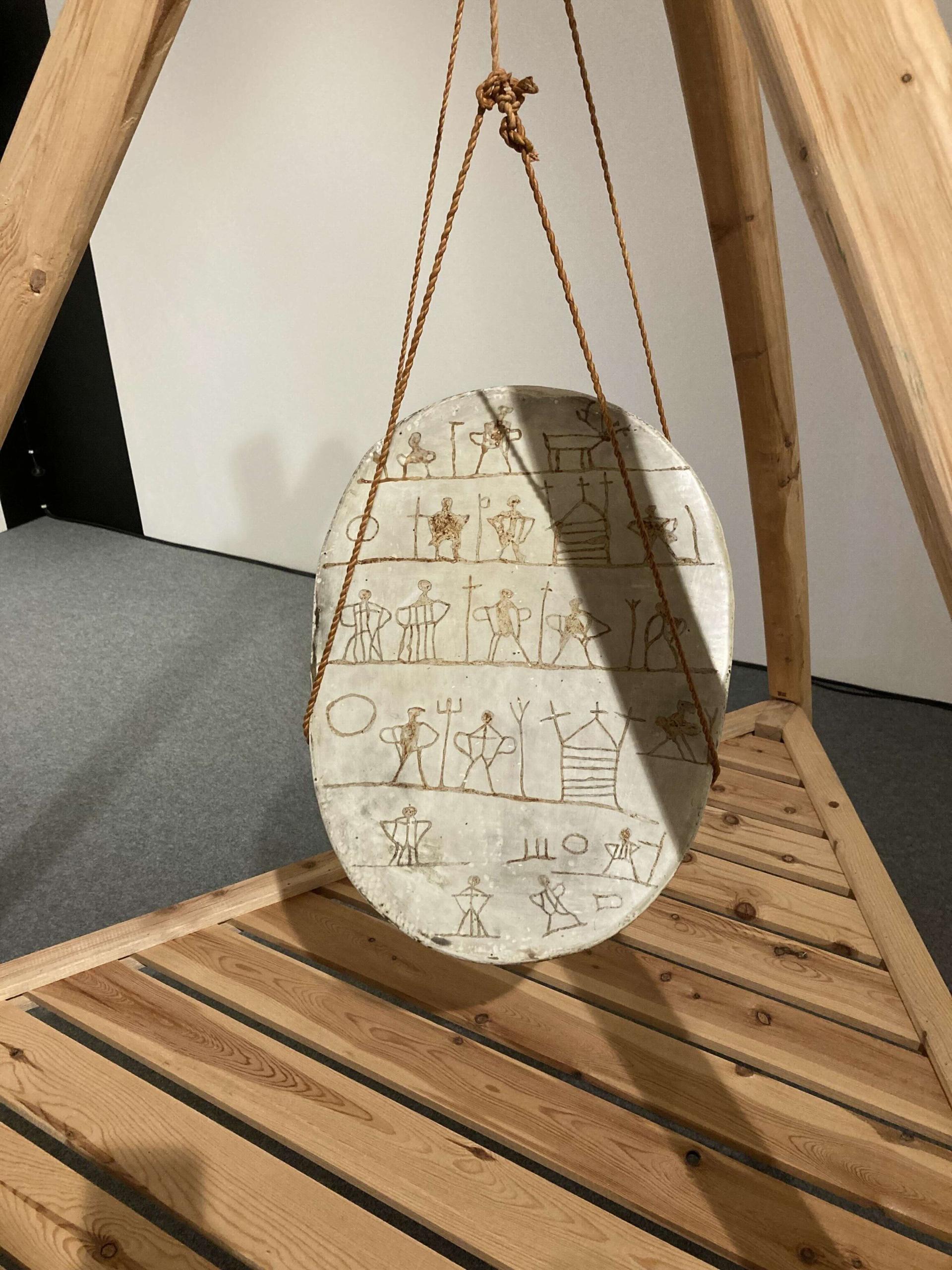
If the trial records can be believed here, Poulsen’s explanation of the drum, like his prayer and crossing of himself before its use, reflects genuine belief in many elements of orthodox faith- including rather complex elements like the Trinity. But that’s the question that many scholars who engage with this trial have taken up: can we believe Poulsen’s explanation?
Those who put Poulsen on trial for witchcraft certainly didn’t. Early scholars on Sámi drums, like Ernst Manker, also didn’t: Manker rather stunningly reinterprets all of Poulsen’s explanations to “correct” them, claiming that Poulsen only explained the drum with Christian terms because of the pressures of the trial. More recent scholarship from Håkan Rydving and Siv Rasmussen has pushed against Manker, arguing that we should take Poulsen seriously. As Siv Rasmussen points out, there is strong evidence that many medieval Sámi practiced Christianity before the Reformation, and that portrayals of the Sámi as unconverted and ignorant came from early modern tensions between Catholics and Protestants and from Scandinavian colonial goals at least as much as from any realities of practice and belief. (Siv Rasmussen, “The Protracted Sámi Reformation– Or the Protracted Christianizing Process,” pp. 77-78, 92-93). Both Poulsen’s accusers and twentieth-century scholars did not believe that an old man who was Sámi and who used a ritual drum could also believe in the Christian God– but to arrive at that conclusion, Poulsen’s baptism, testimony, and community all had to be ignored.
The Takeaways
So what to do with all of this? There are clearly scholarly takeaways to emphasize here, as shown in the recent work revising our understandings of Sámi religious practice, drums, and Sámi/Christian dynamics in the premodern period. But I also think there are some broader takeaways for us, both as historians and as Christians.
First, in continuing what seems to be an accidental series from the Renberg household on reading well: it feels worth noting that part of being a good historian is reading our sources critically– but also seriously. Let me explain a bit more, using the Poulsen testimony as an example. Reading Poulsen’s explanation of the images on his drum critically means reading it with the awareness that it was collected at a trial, in a hostile courtroom, in a setting where there was all sorts of pressure (both implicit and explicit) to present his views in a certain way. We cannot ignore that framework.
But reading Poulsen’s testimony seriously means we cannot just rewrite his words to mean what makes sense to us. Poulsen’s explanation of the Trinity on his drum, a drum he used to talk to gods, may not fit within our framework for Christian practice. But it made sense to Poulsen, and to many of the other individuals in his time period. To deny that Poulsen could have understood elements of the Christian faith is to rewrite his testimony in a way that makes sense to us, not in a way that actually represents his views or the past. We may disagree with Poulsen’s assessment of his own belief, but as historians, we need to at least take his articulated beliefs seriously.
I think that points us towards a broader takeaway, one relevant both within our own culture and within the global church. We are quick to assume that we know who is a Christian and who is not based on our own assumptions about what sets the boundaries for orthodox Christianity. How many times have you heard someone articulate a specific position and thought “they can’t possibly believe in God and also believe [insert any number of contemporary issues here- critical race theory, complementarianism, evolution, etc.]”? And yet- we often encounter people who clearly articulate what they believe in ways that challenge our own assumptions about Christianity. We need to take these living testimonies from those around us seriously and critically as well. We need to challenge our assumptions about what can and cannot be when it comes to Christian faith in practice. And importantly, we need to challenges those assumptions both historically and in our own time and culture.
If we find ourselves telling people- whether in our sources or in our lives- that they’re mistaken and what they believe can’t actually mean what they think it does, if we rewrite what they say they mean into something we want them to mean, we’re not actually listening. Before completely ignoring their explanations for something that makes sense within our own cultural frameworks, we need to stop and take a beat.













 Ad-Free & Subscriber Log-In