

I have been writing on the genre of folk horror, and suggesting that its American roots are very strong, even if they are not sufficiently acknowledged alongside the British contribution. Today I explore this idea in the context of an author I have been reading for a very long time, namely H. P. Lovecraft.
I repeat my definition of the Folk Horror phenomenon, which is grounded in the idea that potent ancient forces and deep-rooted evils survive in the landscape, scarcely acknowledged by the modern world. In isolated communities, active witches or pagan groups mobilize those dark forces, deploying rituals dating from pre-Christian times. Crudely, my own structure of folk horror might be summarized as involving a “Three R” structure, of rural, recovery, and religious. It likely, not necessarily, involves a rural setting. It involves the recovery or return of dark ancient forces. And these “returns” are likely to follow a broadly religious framework, such as an ancient pagan cult.
The whole system acquired a massive boost in 1921 when anthropologist Margaret Murray published The Witch Cult in Western Europe, which argued that historic witchcraft cases gave reliable evidence of an ancient goddess-oriented fertility cult that had persisted in Europe for long centuries after the seeming triumph of Christianity. This gave potential authors a ready-made structure for fantasies about secret cults in remote villages, dark chthonic forces, and human sacrifice. Even better, it was all (apparently) rooted in solid academic history. (To restate the obvious, Murray was a flake, and nobody believes a word of her theories any more).
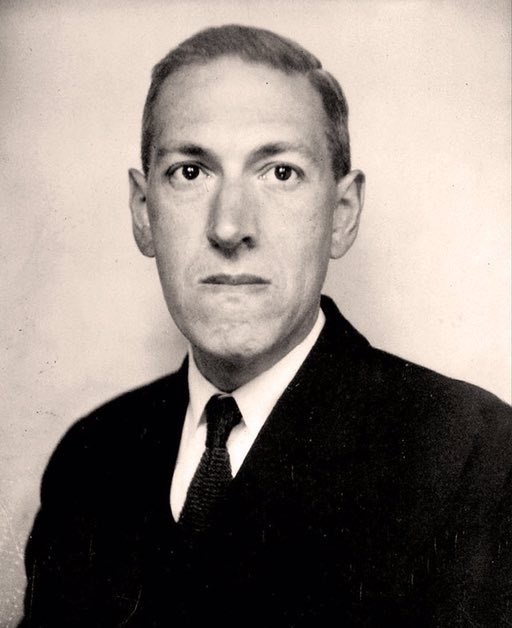
Lovecraft as Folk Horror
In retrospect, H P Lovecraft was the most famous representative of the wonderful magazine Weird Tales, and he has subsequently been the subject of much scholarship, although not much in terms of a contribution to folk horror. In terms of popular stereotypes, his best-known themes fit very poorly with that genre. He is best known for depicting incomprehensibly hideous monsters such as Cthulhu, and others with equally baffling names, while his earthly villains invoke those figures through sorcery and ritual magic, using an invented text such as the Necronomicon. This is surely a world of monster fiction rather than folk horror. Where, then, is the “folk”?
Yet on closer examination, the two types of writing are nothing like as distinct as they appear. Lovecraft himself was a strongly secular author, whose ideas were as close to science fiction as to Gothic: accordingly, his monsters were rarely supernatural or demonic in any sense but were alien creatures from some other dimension or planet. Yet their adherents in this world worshiped those beings as divine and formed cults that the mainstream society dismissed as pagan, or even as witchcraft. Frequently, Lovecraft’s villains are ancient cultish societies operating within a sinister landscape and waiting to direct their evils against some modern-day intruder.
A thoroughly bookish writer, Lovecraft acknowledged his deep debt to such folk horror masters as Arthur Machen. He was also very familiar with the scholarly works that were having such an impact on transatlantic horror writing in those years, and which were in fact the foundational texts of folk horror. In his work, then, we see a quite rapid assimilation of the very well known American tradition (Salem) with the newer British-oriented folk horror (Machen and Margaret Murray).
Examples abound. In 1923, H. P. Lovecraft’s story “The Rats in the Walls” imagined a deadly ancient cult returning to inflict mayhem, cannibalism, and insanity on an English village. Ancient inscriptions leave no doubt of its origins in the worship of Cybele, of Magna Mater, the Great Mother. Beyond suggesting Margaret Murray’s vision of ancient women’s underground cults, the story reflects contemporary racial nightmares of atavism and degeneracy.
In 1927, Weird Tales published Lovecraft’s “The Horror at Red Hook,” which concerns the investigation of a devil cult active in human sacrifice. Supplying a context for such crimes, Lovecraft remarks that his detective hero “had not read in vain such treatises as Miss Murray’s Witch-Cult in Western Europe.” The following year, Lovecraft’s “The Call of Cthulhu” lists Frazer’s Golden Bough as one of the relevant texts that investigators use to understand that strange cult.
In his “Supernatural Horror in Literature,” Lovecraft offered something like a credal statement that could have been advanced by a great many authors of these years. He portrayed witchcraft as a grim clandestine reality in rural life:
This secret religion, stealthily handed down amongst peasants for thousands of years despite the outward reign of the Druidic, Graeco-Roman, and Christian faiths in the regions involved, was marked by wild “Witches’ Sabbaths” in lonely woods and atop distant hills on Walpurgis-Night and Hallowe’en, the traditional breeding-seasons of the goats and sheep and cattle; and became the source of vast riches of sorcery-legend, besides provoking extensive witchcraft-prosecutions of which the Salem affair forms the chief American example.
Lovecraft’s Canon: The Dunwich Horror
Related ideas and references feature prominently in most of Lovecraft’s best-known writings, and especially the longer novellas to which he devoted special attention, and which we should unequivocally count as folk horror. One such was his “The Dunwich Horror,” published in 1929, which has so many resemblances to a contemporary English account of a primitive rural community. It is set in “a lonely and curious country” in north central Massachusetts, the home of a backward family called the Whateleys, who read as if they have been taken from a contemporary eugenic text:
Two centuries ago, when talk of witch-blood, Satan-worship, and strange forest presences was not laughed at, it was the custom to give reasons for avoiding the locality. In our sensible age … people shun it without knowing exactly why. Perhaps one reason—though it can not apply to uninformed strangers—is that the natives are now repellently decadent, having gone far along that path of retrogression so common in many New England backwaters. They have come to form a race by themselves, with the well-defined mental and physical stigmata of degeneracy and inbreeding.
Adding to the English resonances, Lovecraft repeatedly refers to the stone monuments that surround the village, “the great rings of rough-hewn stone columns on the hilltops.” This might seem odd at first sight, since America does not have any close analogies to British megalithic remains, but Lovecraft’s British exemplars always used stone circles, so he had to find some wherever he could. In this story and others, he showed his fascination with the “megaliths” that supposedly littered the New England landscape, and which had become the center of a tourist industry: the best known was at Mystery Hill in New Hampshire, which is now called “America’s Stonehenge“. Whatever their origins, or whether they were actually of natural origin, such great stones were immensely appealing for a faithful disciple of Arthur Machen.
In this story, the sinister family descends from a “Wizard Whateley” whose dark rituals and animal sacrifices have conjured into existence an alien (or demonic) being, who impregnates his daughter. Local families condemn “them witch Whateleys,” whose rituals follow the well-known calendar focused on great festivals such as Halloween. The story concerns the moment in 1928 – the actual “horror” of the title – when a fully demonic child of that original being breaks out to attack the surrounding world. At every point, Lovecraft’s story meshes closely with our definitional criteria for folk horror, including the baleful rural landscape (the author had a special predilection for the word “eldritch”), the presence of ancient evils grounded in unnerving occult practices, and the Summoning that sparks violent return of evil forces into the modern world.
The Case of Charles Dexter Ward
That folk horror element is scarcely less strong in other stories of these years. In 1927, Lovecraft wrote the novel The Case of Charles Dexter Ward, which would not actually be published until 1941. Charles Dexter Ward is a wealthy young resident of Providence whose antiquarian researches lead him to discover the remains of his eighteenth-century ancestor Joseph Curwen, an alchemist and necromancer. Curwen returns from the dead and appropriates Ward’s identity, as he restores his connections with two other former colleagues who had succeeded in extending their life spans by centuries.
At first sight, nothing in this summary would bring the novel within the compass of folk horror, but the resemblances are actually close. The story’s power relies on the richly described evocation of a landscape, which in this instance is not rural but rather that of historic Providence, to which Lovecraft often applies the term “ancient.”
Moreover, the villains who return from antiquity to the present day are thoroughly contextualized with witch-cults, in fact with the best-known such manifestation of that phenomenon in an American context. Although Curwen and his two allies are described as sorcerers, which suggests individual occult activity, they had all been members of the coven that operated in Salem in 1692, and all had received the Devil’s mark personally at the hands of the Rev. George Burroughs. As in The Place Called Dagon, which also appeared in 1927, the villains are refugees from the Salem witch cult.
And above all, it is the great horror novel of return, recovery, or resurrection of those lethal hidden forces.
So yes, based on several of his main classic writings, I do think Lovecraft belongs in the American folk horror canon.











 Ad-Free & Subscriber Log-In