

Since its inception, the ongoing Iran conflict has been awash in religious rhetoric. Secretary of War Hegseth recently closed a press conference by quoting Psalm 144, “Blessed be the Lord, my rock, who trains my hands for war and my fingers for battle,” and the Military Religious Freedom Foundation reported that over 200 service members submitted complaints about the overt religious rhetoric being used by superiors. One officer recalled that he was told that “ President Trump has been anointed by Jesus to light the signal fire in Iran to cause Armageddon and mark his return to Earth.”
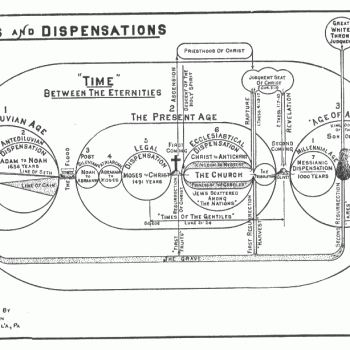
This sort of rhetoric has a clear origin in end-time prophecy watchers of the Charismatic movement. On March 2 of this year, for example, Greg Laurie—of Jesus Revolution fame—connected the conflict explicitly to Ezekiel 38, explaining that” modern-day Iran is ancient Persia.” A day earlier, John Hagee—of end-time chart fame—preached a sermon titled “God’s Coming…Operation ‘Epic Fury.’” The title says it all.

Of course, the tradition of interpreting current events in light of end-time prophecy has a storied history within the American church. Yet, what seems most striking in today’s stream is its corralling into a particular bundle of political ideas. As Richard G Kyle observed in his 2012 book Apocalyptic Fever, this sort of apocalyptic tradition is now imbued with the politics of the Christian Right, Christian Reconstructionism, and Christian Zionism. Today, this bundle of ideas has found a home in the New Apostolic Reformation and wed itself particularly to the person of Trump in fulfilling end-time prophecy (see Matthew Taylor’s 2024 The Violent Take it By Force).
So, if the conflicts in the Middle East are signs of the end, then the United States—and particularly Trump—is God’s hammer smashing the narrative forward. As the head of the White House Faith Office, Paula White-Cain, prayed in 2020, the United States must strike “And strike, and strike, and strike and strike” until it has victory. It is God’s will.
Has it always been thus?
Pentecostal Pacifism in ‘The Great War’
Modern-day doomsday interpretations by charismatic pastors find an easy parallel in early Pentecostal literature. Almost every early issue of Pentecostal papers included sections of the paper outlining some element of society, political event, or conflict as “signs of the times.” Yet, it is hard to ascertain a clear political perspective or interpretive framework. The outbreak of War War I is a case in point.
Writing a few months after the outbreak of the War, the British periodical Confidence dedicated a section to the conflict, arguing that “We British Pentecostal people should pray very earnestly that ‘Militarism’ may come to an end through this war.” Frank Bartleman’s account, a year later, was clear on the nature of the war.
“In London, everything seemed covered with blood. Even the taxicabs were boycotted if they refused to. plaster the vehicle with exhortations to the young men to enlist. Business houses were covered with the mottoes: “Death to German trade.” London seemed to live with but one purpose, and that purpose was to murder Germans. In Germany today they know little else but to kill the English. I turned away from London with a shudder of horror. Even Pentecostal Missionary candidates were persuaded to enlist, and at least one P.M.U. young man, who was to have gone to Africa in December to preach the Gospel, lies at the bottom of the North Sea today. He joined the navy at the outbreak of the war. I tried to stem this tide of “Christian patriotism” while in England, but found little encouragement on that line. May God have mercy!”
The war, at least to Bartleman, had rendered Britain and Germany nations of butchers and corrupted the church through a pied-piper-esque call to patriotic fervor. He was not alone in his assessment of the war or its relationship to Christianity. During the first years of the war, Pentecostals on both sides of the Atlantic were prone to reflect on the nature of patriotic duty. In a sermon at the historic Stone Church in 1915, W. H. Cossum connected patriotism with the “spirit of aggression” and ultimately concluded that patriotism “is a natural thing but it is a childish thing. There is something bigger than that and Jesus is coming to show us that larger thing.” Similarly, a 1915 sermon on Jeremiah concluded that the prophet of tears “would not be regarded as patriotic” if he lived during their time. Patriotism was secondary to Gospel convictions.
Many pentecostals seemed content to live this out in trying times. In 1917, The Pentecostal Evangel published a lengthy testimony by a British conscientious objector, just months after the United States entered the war and enacted its first federal draft. The objector wrote confidently that he and his whole family were convinced “from New Testament teaching that a Christian could not go to war.” Famously, one of the first uses of the 1917 Federal Espionage Act ended in the trial and conviction of a Pentecostal pastor in Vermont, Clarence H. Waldron. Trial testimony made it clear that Waldron’s pacifist preaching and refusal to host a Liberty Loan Sunday were used as pretexts to resolve a church squabble over Pentecostal identity. He received 15 years, but his sentence was commuted a year later by President Wilson.
Taken alone, the above accounts suggest a radical pacifism at work among early Pentecostals. They were clear about what the New Testament said. They saw war as a moral indictment on their society, participation in it as a betrayal of Christian values, and the overall conflict as a reproach of militarism and at least certain forms of empire.
When Pentecostal sources are read more broadly, however, this approach is far from the dominant one. Even many of the above examples are flooded with ambiguity. On the same page decrying militarism, Confidence encouraged all to pray for “decisive victories” and included letters from a British Pentecostal soldier and a German Pentecostal Pastor who was convinced that “true Christianity and true patriotism” were not mutually exclusive. Likewise, while Waldron’s case was national news, Pentecostal periodicals only commented on the case after his sentence was commuted. It was the only reference to the incident. Even the Pentecostal Evangel’s endorsement of the “testimony” of a conscience objector was offset by the publication of a letter by the first superintendent of the Assemblies of God, E. N. Bell. He reminded readers that the denomination’s “General Council has always stood for law and order” and that “it is none of our business to push our faith as to war on others or on the Government.” Bell then encouraged all ministers to lawfully register for the draft, for “it is not time or place for Slackers towards our country or our God.”
In other Pentecostal periodicals, there was implied—and even outright—support for the war. For example, in a typical Pentecostal Holiness screed against movie watching in 1917, one author opted for a surprising nationalistic turn. After decrying the number of dollars wasted annually on the immoral movies, he then calculated that if all those funds were used towards the war fund, “it would only take a little over eleven years to raise the $7,000,000,000” needed. Similarly, the November 1915 issue of Confidence published a poem called “Secret Service” which celebrated the unseen power of prayer in wartime. Any proceeds gained from purchased copies of the poem were being applied to the war fund.
Missions, Manhood, and the Ethics of Piety
It is hard to reconcile the various accounts above. How can radical pacifists be part of the same movement as “law and order” types who urge people to register for the draft and contribute to war funds?
I cannot provide a definitive answer, but I think there may be a clue hiding in Bartleman’s anti-war tirade. The climactic moment of betrayal was the tragic story of the would-be missionary who “lies at the bottom of the North Sea.” The contrast is a stark and specific one. The missionary is ready to risk danger for the sake of the gospel, the soldier for war. One sacrifice is meaningful, the other a waste. Interestingly, Bartleman was not the only Pentecostal to tease at this distinction. In 1918, the Canadian evangelist A. B. Cox was jailed for alleged inflammatory anti-government rhetoric after he refused a request to contribute to the war fund. Cox denied the rhetoric, but he did explain his rationale, stating that he had been paying more than 10% of his income to missionaries and that “I did not feel I could afford any more. I felt it my duty to give all the support I could to our missionaries.” It was soldiers or missionaries.
Remarkably, a sermon by the Englishman Arthur Booth-Clibborn picked up the same contrast in his description of conscientious objection. After dismissing political pacifist movements as “corporate semi-revolutionary things,” he described what true conscientious objection looked like. “The true conscientious objector is the sort of Christian who is gladly willing to go un-armed among savage heathen, far beyond the “protecting” reach of a six-inch shell. He is equally ready to dispense with all the “protection” in “civilized” lands.” In short, pacifism was not a rejection of sacrifice or danger or the threat of violence. Rather, it was a willingness to die for the sake of the Gospel.
The missionary, as an idealized type, represented at least two things for early Pentecostals—and most radical evangelicals, more broadly.
First, missionaries represented the highest form of Christian piety. Within the faith mission milieu of the turn of the century, the missionary was a person who had radically dedicated themselves to God, someone who sacrificed everything for the sake of sharing the gospel. Each individual represented the corporate call of the Church to “go and make disciples.” As such, they did not just signal personal piety; they became subjects of others’ piety. Unrelenting support for missionaries, for the work of the Gospel, was the highest good possible for the average lay person or minister on the “home front.” Why save a penny for war when that penny might save a soul?
Second, as Barnhart, Cleall, Semple, and Manktelow have all pointed out, missionaries were pivotal figures in shaping evangelical conceptions of masculinity. They helped shape a “muscular Christianity of sea-faring and evangelical dynamism,” but that dynamism was often tied up in colonial and imperial imaginaries of domination. For young men at the time, it might not be so easy to demarcate the masculine vigor, sacrifice, and strength of mission work from that of the soldiers. Indeed, soldier imagery was a favorite way to describe the work of the missionary.
This is, I admit, not the place I imagined ending up when I started this piece. Pentecostals of the past could compete with the best end-time-chart-making prophets out there. I wanted to talk about that—it’s fun! Instead, what stood out was the interpretive ambiguity of their ethical visions. Pentecostals of the past were likely to see God at work in the wars of the world, but they were not likely to pray for a government to “strike and strike and strike” until victory. Many did in fact enlist, but they seemed far less willing to see themselves as God’s end-time army. Perhaps the missionary loomed too large as an ever-present reminder that the best sacrifice was for the Gospel. Then again, perhaps the missionary loomed too large in another way, cultivating the same traits that made for good soldiers. As a model for manliness and sacrifice, the missionary is just too vague a starting place.
This is all guesswork to a degree, but I think it might be a clue to understanding the role of personal piety in early Pentecostal ethics. What I can say for certain, however, is that the political imaginations of our present-day prophetic prognosticators seem far less ambiguous than those of their predecessors.










 Ad-Free & Subscriber Log-In