

In recent weeks, I have been writing extensively about the transformations that America experienced during the year of 1893. You won’t be surprised to hear that this is part of a larger book project that I have been developing, although I am still working hard on a proposal. As part of that process of thinking through, I would like to pull this material together and look at some of the long-term consequences, which were truly far reaching, and above all in religious matters. Repeatedly, we look at major trends and events that we tend to associate with later periods, especially in the early twentieth century, but on closer examination that pivotal year is 1893.
That is most evident in terms of the Progressive movement, which is a very well-known fact of American history. Look at the many books and articles on the topic, and it tends to start in 1900, or maybe 1898. But then turn back to some of the recent blogs in my series here. The movement is driven above all by concerns about new urbanization, mass immigration, disastrous social conditions, and the many ill effects suffered by the urban poor. As I have suggested, all those currents are very much in play in 1893 – as a nice symbolic moment, Ellis Island opens in 1892.
From then on, we see the long trajectories developing and accelerating, mainly between 1893 an 1917 or so, but with a very substantial “tail” into the 1920s and beyond. Mass immigration, for instance, culminates in 1907, and the real restrictions do not hit until 1924. The main Nativist movement, the Ku Klux Klan, was a direct lineal descendant of the American Protective Association that was at its height in 1893-94. Urban reform movements gather speed in the new century, drawing heavily on the Social Gospel movement that had become so vital to the churches. Then factor in the Temperance movement which drew so many women into the larger cause, and which owes so much to the Anti-Saloon League founded in 1893. That culminates with the Eighteenth Amendment, and Prohibition in 1919.
Without that Social Gospel and its attendant moral causes and campaigns, Progressivism is meaningless.
The eugenic and bio-criminology movements that became so powerfully evident in that year then steadily gained force, achieving multiple victories in terms of legislation over the next four decades. Again, all these movements developed very sizable constituencies in churches and religious groups, and they are inextricably linked to Progressivism.
To think of other trajectories, I have mentioned the surge in imperial thought and activism in and around 1893, which was inevitably linked to racial ideologies. That has its obvious consequence in the war of 1898 and the subsequent imperial occupations of the Philippines, Cuba, and Puerto Rico. The ensuing national debates ran into the twentieth century, and were not really settled until after 1910. America, of course, maintained that imperial identity many years later, and only withdrew from the Philippines after the Second World War. Again, 1893 left a very long tail.
But to think more specifically about religious matters. 1893 marked an epic clash between exponents of the Higher Criticism of the Bible and conservatives, who were usually literalist. That struggle raged on into the new century, rending denominations, and in 1910 there began the publication of the series of polemical essay collections known as The Fundamentals, which continued through 1915. People who believed those texts were “fundamentalists”, although that concept – if not the name – certainly applied to the partisans in the 1893 battles. The same can be said of the “modernists” who represented their deadly opponents. The Bible Wars that began so acrimoniously in the early 1890s gained new force in the 1910s, and reached a famous climax with the Scopes Trial of 1925. Throughout, the same groups and settings recur, including the Presbyterian Church, and Princeton University.
Another factor that I have mentioned in the growth of critical attitudes to Scripture was the discovery of long-lost texts, which raised questions about just how the canon had been selected. The year 1893, notably, brought the publication of English transition of the Book of Enoch and the Gospel of Peter. The pace of publication accelerated over the next quarter century, creating an avid market for every new supposed lost gospel, which was trumpeted in every popular magazine and newspaper. (I have discussed this phenomenon extensively at this site, and will be returning to it shortly). Again, 1893 was the pivot.
That same year marked the World’s Parliament of Religions, which marked the triumphant entry of South Asian forms of spirituality into the United States. Those ideas and beliefs acquired a huge vogue through the 1930s, marked by the spectacular spread of Theosophy, and the mushroom growth of multiple small sects. At every stage, the relevant ideas and people traced their successes to the consequences of the Parliament, and of 1893. Coinciding precisely with that esoteric explosion was the boom in New Thought and Mind Cure movements, which achieved spectacular heights during the twin California expositions of 1915, in San Francisco and San Diego. 1915 in fact was a great year for the foundation of such cults and esoteric groups.
I have also highlighted the groundbreaking work of Matilda Joslyn Gage from 1893, in which she offered a radical feminist understanding of the scriptures, and also argued that historical witchcraft movements had in fact constituted quite authentic forms of women’s counter-cultural resistance. Those latter ideas gained force after 1910, and were consecrated in the work of anthropologist Margaret Murray in 1921. The resulting view of witchcraft as an authentic underground cult actually became the dominant form of interpretation for decades to come. It also left its heritage in the creation of the modern-day Wiccan and neo-pagan movement.
More generally, the extreme religious relativism that I have associated with James Mooney also became very influential, and shaped later anthropological understandings. Throughout the twentieth century, may others came to share Mooney’s stance that no fundamental difference separated the spirituality of Native Americans from the so-called “high” scripture-based religions. All grew out of common religious impulses, and all relied similarly on myths and mythical narratives.
I also see long continuities in the Black history I have explored here. The early 1890s marked by far the worst era for lynching and racial violence, which remained a critical problem through the 1920s. That issue in turn fueled the rise of organized resistance. The NAACP, founded in 1909, drew massively on the heritage of Ida Wells, revived regularly by such fresh horrors as the notorious Waco lynching of 1915.
The same pattern occurs again and again: the explosion in 1893, and the lasting reverberations over the next generation. I am not suggesting a simple one-date-fits-all model. In the religious story of the early twentieth century, there certainly are events that cannot plausibly be connected with that early 1890s eruption, unless I am missing some obvious linkage. The obvious example is the Pentecostal boom of 1906, which grew out of the Azusa Street Revival. I am sure I can trace some kind of history back to the early 1890s, but I don’t want to force the argument.
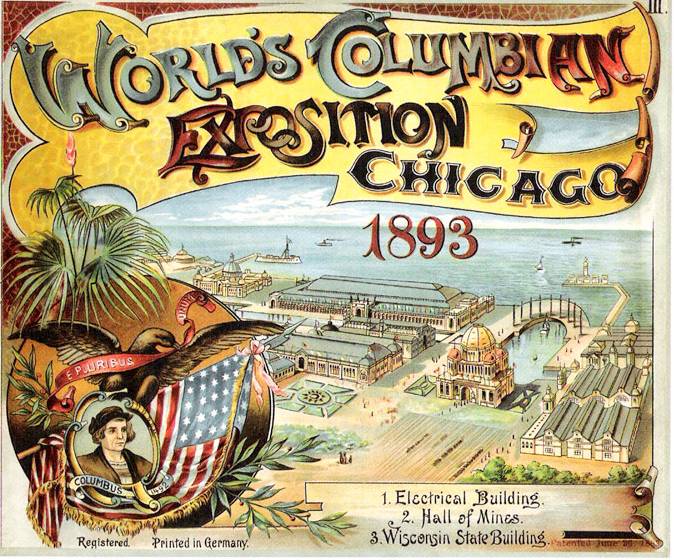
So that is the core of my argument. In the early 1890s, pressing issues were emerging, in consequence of urbanization, ethnic diversification, and very strong influences from European thought and scholarship, and these forces combined to create a cultural explosion in 1893. This occurred because of the sensational opportunities provided by the World’s Columbian Exposition, in Chicago, and the seemingly limitless global audiences so obviously open to hear these self-examinations. Most of these issues, also, were strongly grounded in religious concerns, and were expressed in religious thought and language. It took Americans a full generation to think through the resulting impacts.
And that is the history of the US in the early twentieth century.












 Ad-Free & Subscriber Log-In