

This post brings together quite a few of my very long-term interests – in film, alternative Christian scriptures, esoteric religion and its presence in popular culture – and it integrates them in a very striking way. It’s a complex story, and one I find truly amazing. Briefly, it involves a Western film called The Hired Hand, which includes one of the oddest religious moments in cinema.
By way of background, together with many other people, I regard the New Hollywood era of the early 1970s as one of the most dazzlingly creative in the history of film, the era of M*A*S*H, The Godfather, and (a favorite of mine) Zabriskie Point. Just in the one year of 1971, we find such triumphs as The Last Picture Show, McCabe and Mrs. Miller, Klute, Play Misty for Me, The French Connection, Carnal Knowledge, Harold and Maude, Taking Off, Sweet Sweetback’s Baadasssss Song, Straw Dogs, and plenty of others. And among that 1971 list was a “hippie Western,” called The Hired Hand, which is my focus for now.
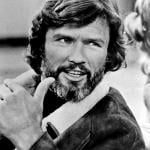
Directed by Peter Fonda, The Hired Hand was written by the brilliant Scottish novelist and screenwriter Alan Sharp, who was a major player in New Hollywood: he also wrote Night Moves. Fonda, meanwhile, was then a red-hot commercial property so soon after the stellar success of Easy Rider, and at least at first, the studios were willing to let him get away with more or less anything.
Hired Hand is typical of its era in that it is lyrical and very slow moving, infuriatingly so for many, and despite their initial hopes, the studio offered little support when it was released. Even so, what was originally a passionate cult following has evolved into general acclaim for the film as a classic of the era.

image is in the public domain
The film begins with three characters drifting through the Old West: Arch Harris (Warren Oates), Harry Collings (Peter Fonda) and their young friend Dan Griffen (Robert Pratt). They enter a small town, where Dan is killed. As Harry and Arch bury him, Arch reads from a handwritten book that he has found in Dan’s possessions. Arch reads, meditatively,
Jesus said, “If those who lead you say to you, ‘See, the Kingdom is in heaven,’ then the birds of the heaven will precede you. If they say to you, ‘It is in the sea,’ then the fish will precede you. But the Kingdom is within you, and it is without you … The disciples said to Jesus, “Tell us how our end will be.” Jesus said, “Have you then discovered the beginning, that you inquire about the end? For where the beginning is, there shall the end be. Blessed is he who shall stand at the beginning; and he will know the end and will not taste death. … His disciples said to Him, “When will the Kingdom come?” Jesus said, “It will not come by expectation. It will not say ‘see here’ or ‘see there.’ But the Kingdom of the Father is spread upon the earth, and men do not see it.”
Yes, that is an extensive selection from the Gospel of Thomas, the non-canonical second century work which created a sensation when it was partially rediscovered in Egypt in the 1890s, and it was very widely publicized. The complete text, which is what we are getting here, was discovered at Nag Hammadi in 1945, and popularized through such bestselling books as Robert M. Grant’s The Secret Sayings of Jesus (1960).
The film, obviously, offers no explanation why a saddle-tramp in nineteenth century America would have been in possession of such a treasure, nor are we meant to explore the point. The words are there for their dramatic effect, and their impact was enormous. Fonda reported that he was himself intended to read the passage, but he repeatedly failed, because he choked with emotion at the beauty of the words. He had to give the speech to Oates.
You’d have to see the film yourself to assess the full relevance of the Thomas text to the plot. The central idea is that Harry returns to the wife he has deserted years before, and agrees to serve her as a hired hand. Perhaps scriptwriter Sharp thought of the “hired hand” in John 10.12, and allowed his mind to roam over some other sayings of Jesus that were much discussed in cultured circles in the 1960s, including the then-voguish Thomas. But as I will suggest, there might have been another and still more immediate connection, and specifically to Peter Fonda.
The use of the text in that film powerfully illustrates the work’s appeal in the underground culture of the years around 1970, when there was such excitement over occult and esoteric ideas, of secret scriptures. That was over and above the nascent Jesus Movement, with its apocalyptic obsessions, and its desire to know “how the end would be.” Together, these trends created a sizable market for texts that claimed to reveal this mystical oracular Jesus, and cheap paperback versions of The Secret Sayings of Jesus were easily available.
One key advocate of Thomas was Dennis Hopper, who was deeply invested in mystical pursuits, and who of course had co-starred with Fonda in Easy Rider. As he reported in 1987, “That book was given to me by a prostitute junkie that I knew in New York, …She gave it to me … and at that time I was really an agnostic. And it turned my head around as far as religion … [Thomas] says there’s only one law you have to abide by, that is ‘Don’t lie and don’t do what you hate.’ Don’t lie and don’t do what you hate and all things will manifest themselves before heaven … A lot of the imagery from Easy Rider and The Last Movie came from that.” Hopper regularly cited Thomas simply as his favorite book. When he married Michelle Phillips in 1970, “[Hopper] got married reading The Gospel of St Thomas aloud to Michelle.”
So the explanation of the text’s appearance is not too hard to find. But even so, to hear the Gospel of Thomas – in a 1971 Western? Who would have suspected?
I won’t get into this here, but another apocryphal (and Gnostic) Thomas text appeared in Terrence Malick’s film Knight of Cups (2015). Throughout the film, we encounter the “Hymn of the Pearl,” which survived in the Acts of Thomas. I’ll return to that topic in a future post.
I am expanding this post from an earlier discussion at this site.










 Ad-Free & Subscriber Log-In