

I have written in the past about how invaluable cartoons and caricatures can be for historical sources, and as teaching materials. In my current project, on 1890s America, I have been using one example that could almost spin out into a book in its own right, if explicated properly, or it could just as well supply the draft for a decent course on the history of religion. It is so rich.
My post also presents a plea for help in identifying one crucial but mysterious character in the story!
 All images are in the public domain
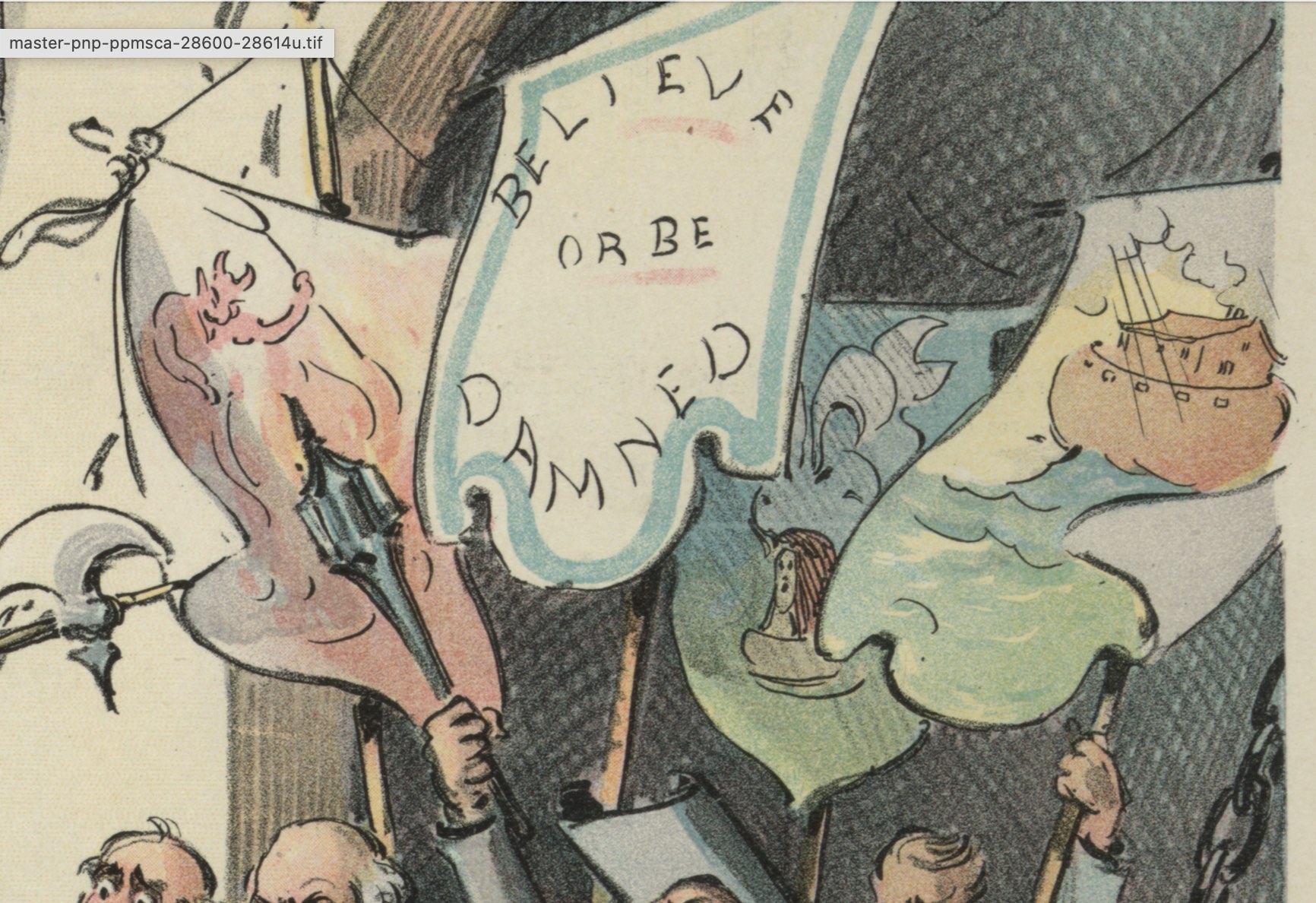
The cartoon “The Last Stand — Science Versus Superstition” appeared in the satirical magazine Puck in July 1899, and was the world of rising star artist Udo Keppler. It shows a heroic band of six scholars deploying their mighty machine gun against an attack by fanatical primitives, who represent hidebound reaction and “Medieval dogmatism.” The progressives follow the motto “Think or be Damned”; the reactionaries follow “Believe or be Damned”. The liberal/Modernist weaponry has barrels labeled History, Archaeology, Evolution, Enlightenment, Geology, while their ammunition boxes are marked “Scientific Facts,” “Historical Facts,” and “Rational Religion.”
This is in short a summary of the cultural wars that had divided denominations over the previous quarter century, over Higher Criticism, Evolution, the truth of Genesis, and so on.
The liberal warriors involved here were the figures who had actually been involved in those key intellectual struggles. Let me identify (most of) them. Manning the heavy gun is Felix Adler, while feeding the belt is Minot Judson Savage.
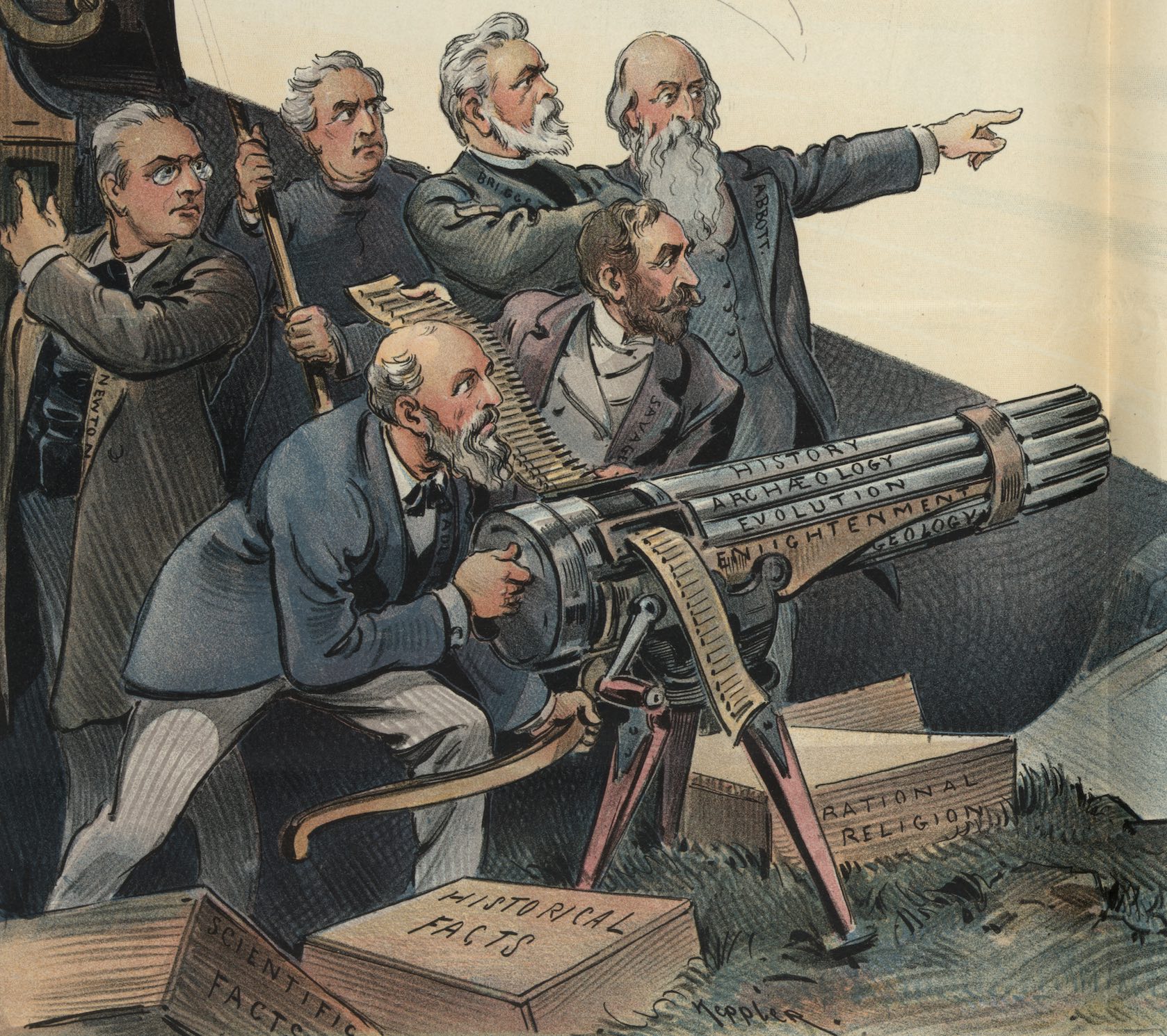
Felix Adler was a German-born Jewish scholar and wide-ranging social reformer, a classic Progressive. A rationalist, he founded the Ethical Culture Association.
Minot Judson Savage was a Unitarian minister famous for his early and enthusiastic support of evolutionary teachings (and incidentally with a passionate faith in spiritualism).
In the row behind, from left to right, we find four figures, three of whom are duly labeled on their clothing. These are:
R.Heber Newton was an Episcopal cleric, the author of The Right And Wrong Uses Of The Bible (1883), which was one of the earliest popular American surveys of Higher Criticism and its implications. Although Newton’s book earned him the threat of a heresy trial, his bishop refused to proceed.
*Another man*, the Standard-Bearer, who is the only character not labeled as far as I can see, and I have looked hard. The Library of Congress description makes no attempt to identify him, or to acknowledge his existence. Nor does any other discussion of the cartoon that I can see. The fact that he is bearing the progressive/Modernist standard surely suggests that the cartoonist sees him as a pivotal figure.
Charles Augustus Briggs was another famous exponent of Higher Criticism, who in 1893 had faced a sensational heresy trial in his Presbyterian denomination. Expelled from the ministry, he continued to publish extensively, and was later ordained in the Episcopal church.
Lyman Abbott was a Congregationalist preacher who wholeheartedly accepted evolutionary theory, and who wrote The Evolution of Christianity (1892) and The Theology of an Evolutionist (1897). As he declared, “The Bible is not a final authority in science. … An infallible book is an impossible conception, and to-day no one really believes that our present Bible is such a book.”
So who is the Standard Bearer? I am amused to see that the Library of Congress page ignores him entirely, and states, wrongly, “Print shows five men…” (!) Nope, there are six. This may sound ridiculous, but I think I know the reason why he is unlabeled. All the others are named on their lapels, and he is not wearing such a convenient garment, so there was nowhere to write. No lapel, no label. Hence the anonymity.
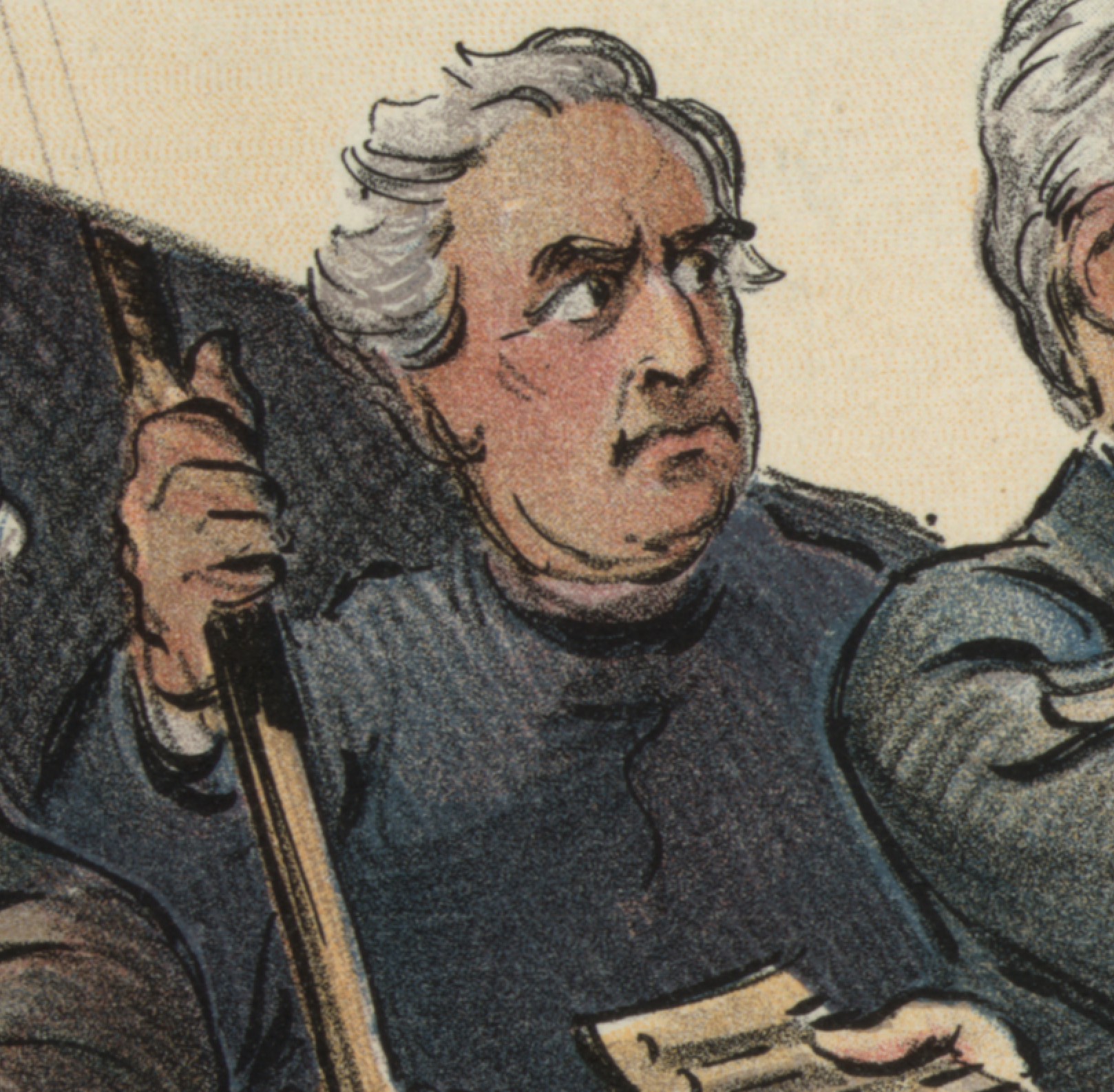
It has to be a minister or cleric who was celebrated in the late 1890s as a high-profile advocate of Biblical higher criticism or evolution, or both. It also has to be someone who is alive in 1899. Is he wearing a clerical cassock, which might make him Episcopal or even Catholic? For what it is worth, he is flanked by two Episcopalians, namely Newton and Briggs.
I have played with a number of candidates (Arthur McGiffert? Joseph Cook? William Graham Sumner? Washington Gladden? John Augustine Zahm? Henry Codman Potter? William Reed Huntington?), but none comes vaguely close to fitting the face in the portrait, which is very detailed. My best bet was Andrew Dickson White, but he never shed his beard.
Who is this? I am sure it will turn out to be someone quite obvious, but I am in brainlock.
Looking at the cartoon more broadly, there is so much to talk about in a potential class. Look at the “primitives”, the medieval reactionaries.
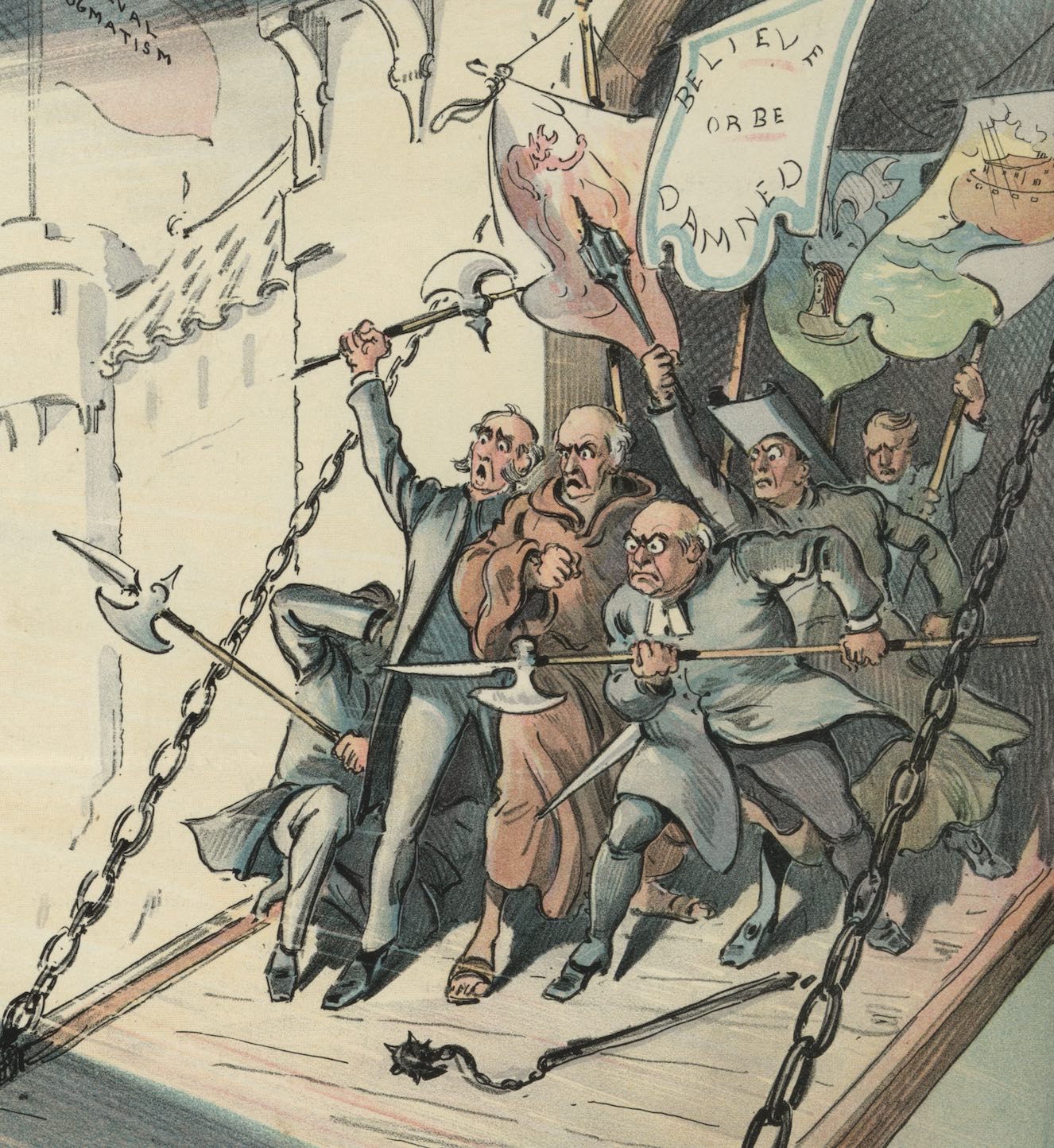
I am pretty sure these do not represent individuals, and the only real identifier is that one is in Catholic clerical garb, with headwear. One carries a banner showing the Devil, and presumably Hellfire and Damnation. Another has Noah’s Ark, recalling the Flood that anti-literalists so mocked. And next to that is a crude image of Jonah and the whale.
The general scene strongly recalls Mark Twain’s A Connecticut Yankee in King Arthur’s Court (1889) but there are some uglier more recent resonances. In the use of a heavy machine gun against fanatical primitives, the scene would make any reader think of the colonial wars of the previous few years, such as when the British used machine guns to slaughter countless poorly armed Native combatants in southern Africa. There are also shades of the bloody US conflict then reaching its height in the Philippines.
As I say, there is a great deal to be said here. But who is that Standard Bearer?
BRIEF UPDATE
I had a technical problem with posting something below, so I will include it here. Someone made the suggestion that the mystery man was Robert Ingersoll, to which I tried to reply as follows:
That is a very plausible suggestion, but I am not sure if it is right. Ingersoll would fit in lots of ways, and even better, he died in 1899, around the time of the cartoon, so he would have been newsworthy. But I am looking at his photo at the Wikipedia page on him, and other online images, and the physical appearance really strikes me as very different. Crucially, the standard bearer has way more hair, and Ingersoll had a pretty round fat face, unlike my mystery man. Take a look and see what you think?
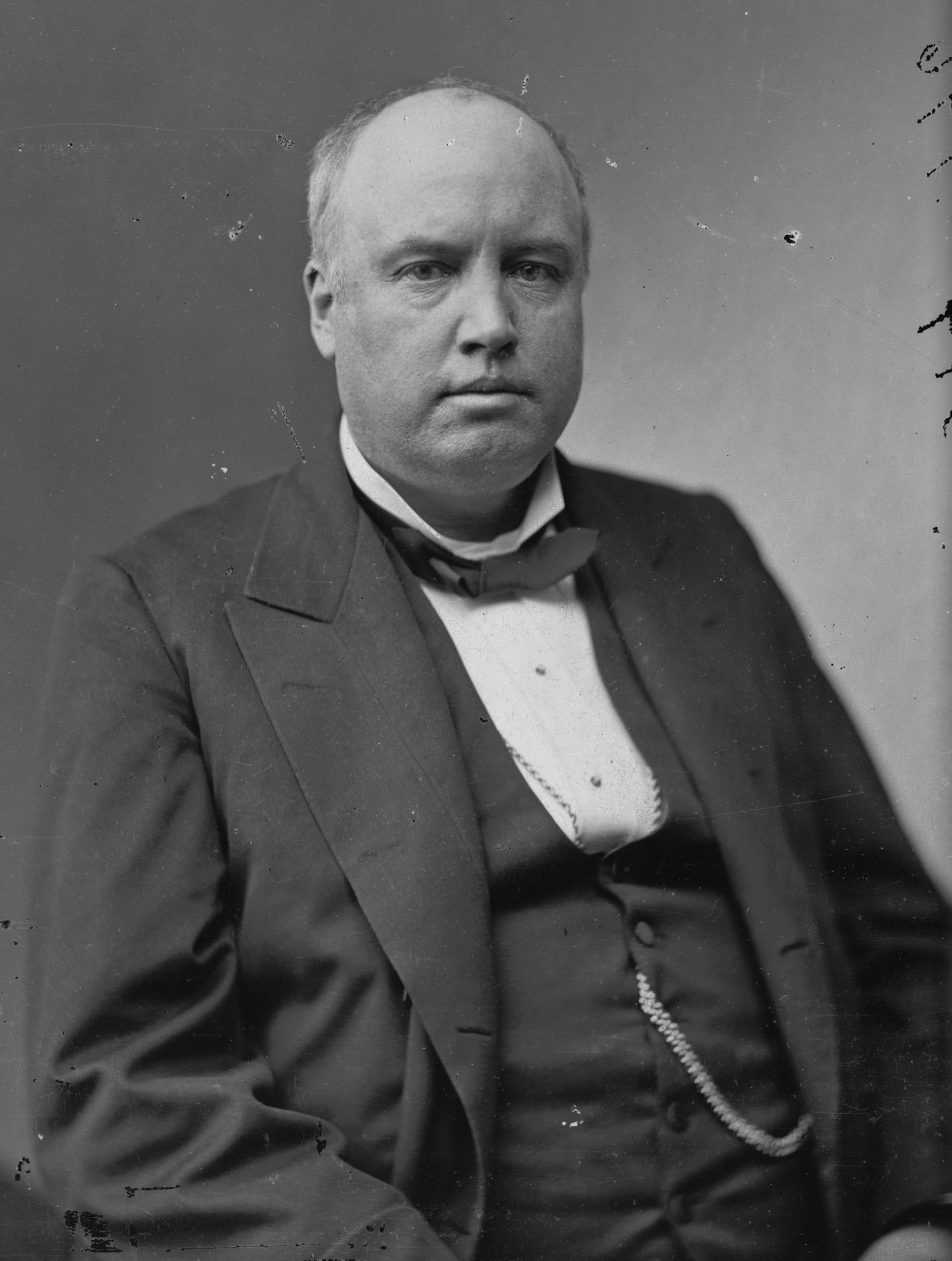
Also, I am puzzled why the mystery man is wearing what appears to be clerical garb, while Ingersoll always wore a suit and tie.










 Ad-Free & Subscriber Log-In