

I am continuing my series on Lost and Found Scriptures. I believe I have a scholarly find in this area, a first, and I am putting it out here to see if anyone can help me confirm this.
For several decades now, the topic of alternative and non-canonical gospels has been a very lively field of scholarly endeavor: we think of such authors as Karen King and Elaine Pagels. Normally, attention focuses on the so-called Gnostic Gospels, like those found at Nag Hammadi in 1945. My topic concerns a somewhat different text, a Jewish-Christian writing called the Gospel According to the Hebrews, which now survives only in very partial reconstruction. In 1879, this Gospel was the subject of a substantial book-length study by Edward B. Nicholson. His arguments about the work have not aged well, and frankly, I do not accept them.
But here is my point. As far as I know, Nicholson’s book is the first ever written on a single lost, alternative, or non-canonical Christian gospel, certainly in English, and I can’t think of parallels in German. That is distinct from books on alternative gospels as a category, or on groups of gospels, such as the Gnostic texts. This is in no sense the first book ever written about “lost gospels,” but I think it might be the first on a specific case study.
Am I right about this? If so, that surely marks a critical landmark in that field of study.
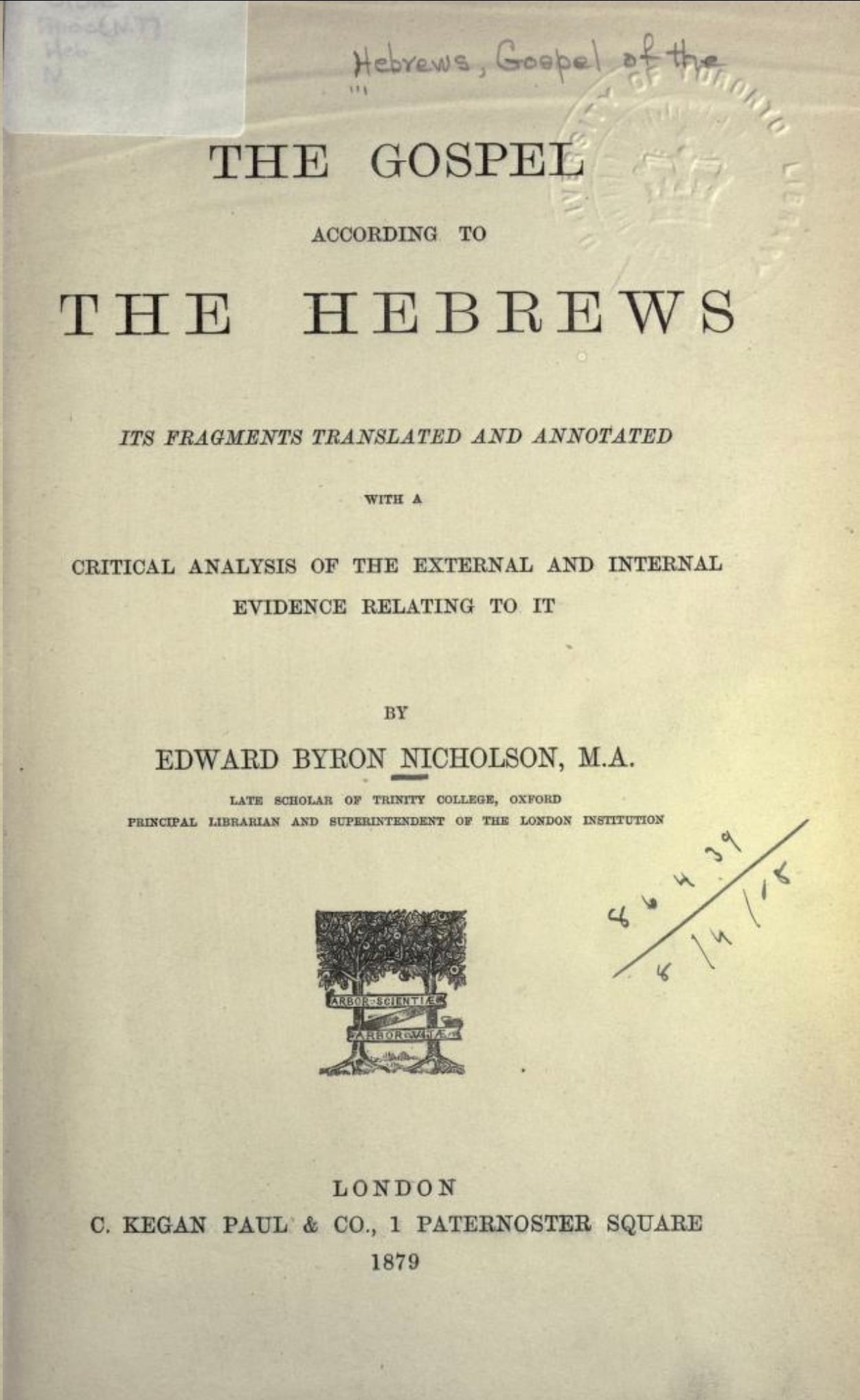 All images are in the public domain
By way of background, the 1860s and 1870s were a time of fervent investigation of alternative Christianities and non-canonical gospels, by scholars such as Adolf Hilgenfeld in Germany, and Joseph Lightfoot in England. One particular problem concerned the cryptic evidence that suggested the existence of an ancient gospel written in Hebrew or Aramaic, and somehow associated with Matthew.
Although the academic debate was lengthy and intricate, it depended on the interpretation of a passage by the early second century bishop Papias of Hierapolis, who had sketched what he believed to be the origin of the gospels. As quoted by the fourth century historian Eusebius, Papias had said that the evangelist Matthew had arranged (or organized) the logia (ta logia synetaxato) in the “Hebrew dialect”, and everyone interpreted them as best they could. Alternatively, according to some manuscripts, Matthew had composed them himself, rather than arranged them. Given the very short length of Papias’s account, the problems are immense, not least that vanishingly few scholars believe that such sayings originally circulated in Aramaic or Hebrew, rather than Greek. However, it did ring true to the extent that early Christians really had venerated individual sayings or logia of Jesus. Nineteenth century scholars were already well aware of the notion of a lost Sayings source called Q.
Papias seemingly knew a very early collection of logia of Jesus, which circulated under the name of Matthew. Evidently that was not the canonical gospel of Matthew, with all its fleshed-out narratives, but (thought some people) it might well have been the text recorded in ancient times as the Gospel of the Hebrews. That was one of many alternative texts well known in early times, when it appealed particularly to “the Hebrews that have accepted Christ.” However, it long enjoyed a prestige that set it far above the many other candidates for gospel status. Some early Fathers considered Hebrews a Fifth Gospel, or at least knew of rivals who dared raise it to that rank. In the fourth century, Eusebius counted int among the antilegomena, the disputed books that might or might not belong in the New Testament canon: different churches and church leaders held different views. This category also included such distinguished company as the Book of Revelation, the Catholic Epistles, the Epistle to the Hebrews, and the Didache.
Confirming its importance, at least according to some scholars, a couple of early accounts of the gospel harmony known as the Diatessaron, the “Through Four,” referred to it as the Diapente, that is, the Through Five. If that version of the title really had existed (and as we can say today, it almost certainly did not), then the church of the second century recognized five gospels rather than two. By far the best candidate for the missing text would be the Gospel of the Hebrews.
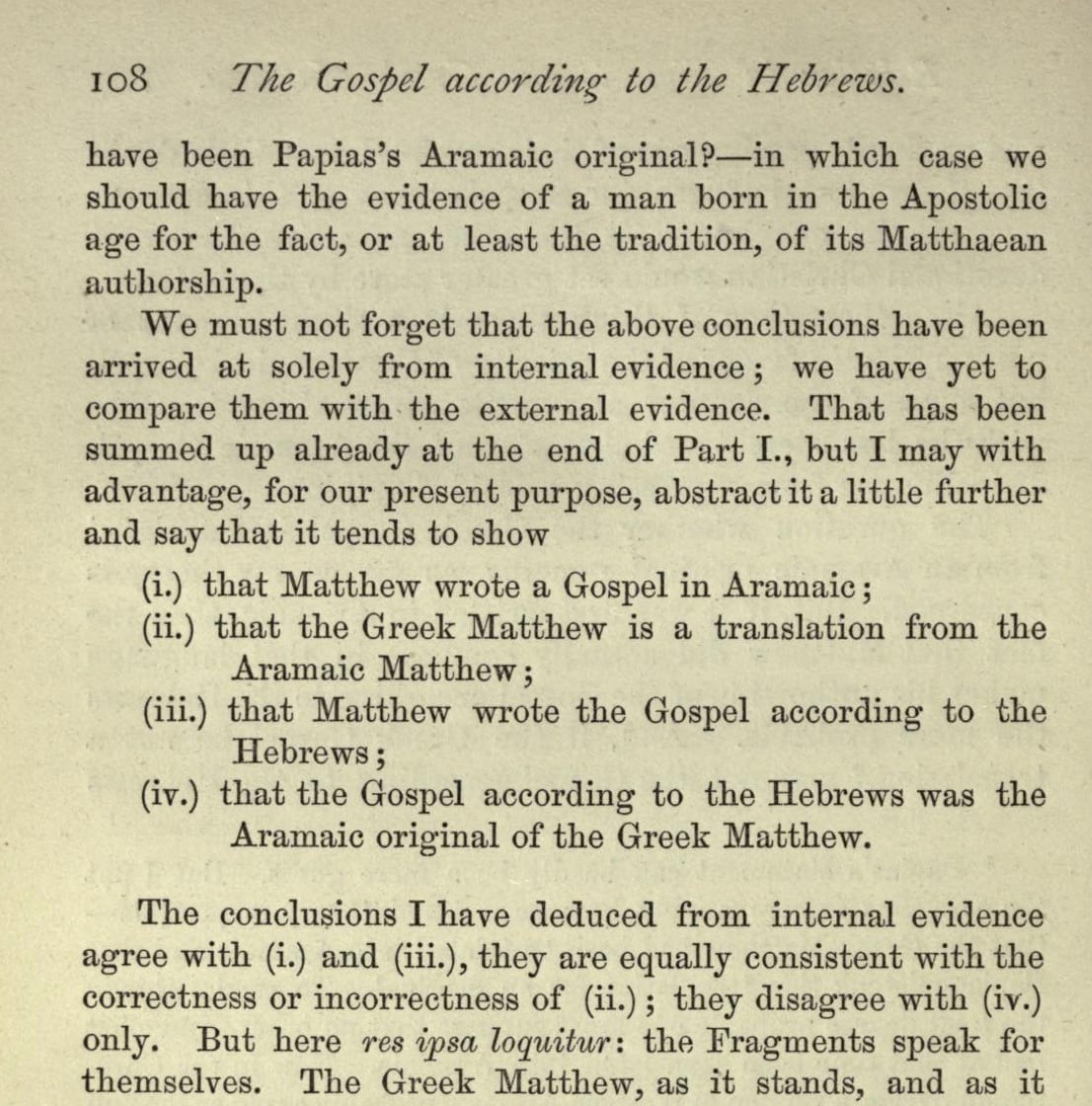
The Gospel of the Hebrews thus mattered greatly in the scriptural tradition, and in 1866, Hilgenfeld had collected the 33 surviving fragments in his survey of all available extra-canonical New Testament texts. The work also earned the attention of the versatile scholar Nicholson, the long-serving head of Oxford’s Bodleian Library. Amply acknowledging his debt to Hilgenfeld, Nicholson surveyed all the available fragments of Hebrews as well as Patristic references and likely parallels, and hypothesized that the work had the same author as Matthew’s canonical gospel. That argument is almost certainly incorrect, and in modern times it has been dismantled by such scholars as Bart Ehrman.
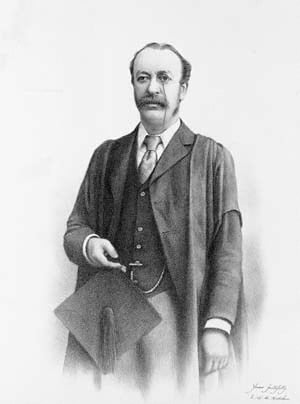
But the crucial point is that Nicholson was treating the Gospel of the Hebrews, albeit known only its very fragmentary form, as a gospel worthy of a book-length commentary, and to that degree equivalent to the canonical texts. As such, it signaled a whole new phase of scholarship.
Am I right? Was it the first of its kind? What are the other possible contenders?









 Ad-Free & Subscriber Log-In