

In 379 (or conceivably 380) the Christian bishop Eusebius was martyred in the North Syrian city of Dolikha. That statement might sound totally unsurprising: surely martyrdom was an occupational hazard of early Church leadership? But this particular case has elements that make it truly noteworthy and indeed weird. Understanding the story actually tells us a great deal about how we write that early Christian story, and how we understand heresy.
Here is the problem. Eusebius of Samosata was a fervent leader of the church faction defending the Council of Nicea and its view of the Trinity. From 364 through 378, the Roman emperor of the east was Valens, who hated that Nicene statement and favored generally Arian or semi-Arian positions. Technically, he was a Homoian, a “Liker,” someone who believe the Son was “like” the Father, but not of the same Essence, as Nicea had declared. Valens removed many pro-Nicene clerics, and sent many prominent figures into exile. One obvious target was Eusebius, who spent several years traveling the eastern empire. Matters changed fundamentally after Valens was killed by Gothic invaders at the Battle of Adrianople in 378. The new regime switched decisively to the pro-Nicene side, and exiles like Eusebius now made a triumphant return to their home cities.
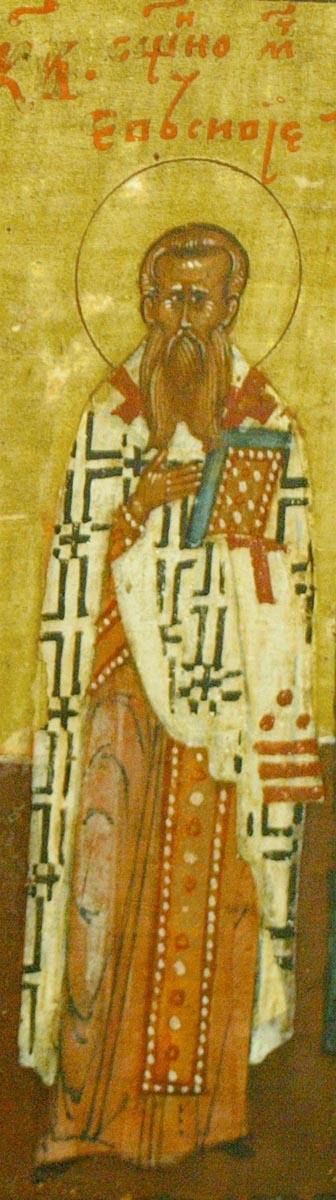
image is public domain
Why, then, did he get martyred in 379, at which point martyrdoms and persecutions had ceased? It is rather like hearing that someone was killed in a German bombing raid on London, but in 1952**(see below for a further thought on this point).
To understand the story, we need to think about how Christian writers through history have told the story of rival belief systems, which they view as heresies. However often we assert that “the winners write history,” it is difficult for moderns to recall just how totally the views of a losing side could be eliminated. Throughout the Roman and indeed Byzantine period, regimes were happy to suppress writing that had been judged false, seditious, or (increasingly) heretical, and the task of destruction was undertaken very effectively in an age before the arrival of printing. In consequence, we rarely have accounts of defeated schools of thought from those rival leaders themselves, and virtually all our available sources reflect the winning side.
That one-sided survival means that we always have to be aware of some very common motifs in the partisan debates of the age. Of course, “we” are always orthodox and mainstream, while “they” are heretical and fringe, but the rhetoric goes beyond that. When describing the rival, “we” generally label them with the name of some prominent leader, suggesting that such abhorrent ideas must have been the work of one deranged or sinister individual pursuing his own vanity, and only attracting a clique of like-minded individuals. As far as possible, “we” never admit that the condemned “-ism” must be rooted in some larger community or population.
At first sight, the story of Eusebius matches that interpretation very well. When Eusebius was removed from his diocese, he was replaced by the “Arian” Eunomius. According to the orthodox historian Theodoret, Eunomius was thoroughly boycotted by the whole community:
not an inhabitant of the city, were he herding in indigence or blazing in wealth, not a servant, not a handicraftsman, not a hind, not a gardener, nor man nor woman, whether young or old, came, as had been their wont, to gatherings in church. The new bishop lived all alone; not a soul looked at him, or exchanged a word with him.
Local inhabitants treated his bathwater as polluted by dint of heresy. A despairing Eunomius abandoned the city, but his successor was no more fortunate. When local boys were playing, their ball passed near the feet of the new Arian intruder. “The boys lit a fire and tossed the ball through the flames with the idea that by so doing they purified it.” Evidently then, we are meant to believe, the orthodox had a total monopoly, and the only Arians were a few renegade clergy sponsored by an evil emperor.
So what happened to Eusebius who was, I reiterate, martyred after the fall of Valens and his Arian regime? Eusebius actually fell victim not to an angry emperor or prefect, but to an ordinary Arian (or Homoian) woman who dropped a roof tile on him as he passed in the street, fatally wounding him. This occurred not in his main city of Samosata but in a town some forty miles distant.
This is one of the vanishingly rare occasions in which an orthodox historian in this era actually admits the existence of pro-Arian (or pro-any heresy whatever) popular sentiment among the laity, and without that one lucky throw, we would not even know a word about it. Surely, it is reasonable to assume that this unspecified woman was not the only lay person to feel incensed about the Nicene victory. Her aim just happened to be better than that of her neighbors.
For the sake of argument, assume that the stories of Samosata being so faithfully orthodox are correct. So how far beyond city limits did you have to go to find equally implacable Arians or Homoians? In the larger metropolitan region, in the diocese as a whole, did such fervent Arian or Homoian partisans constitute five percent of the lay public, or 95 percent? We can never know.
The incident also suggests that Arians and Homoians were not prepared to accept their current political defeats philosophically, and they had a reasonable expectation that matters might yet change in their favor. Another orthodox historian, Socrates, records persistent Arian subversion in Constantinople through the 380s. They were not going gently into that good night of theological oblivion.
So when you do read about heresies, in historical accounts that say literally nothing about their popular support, do remember that tile.
**I mentioned the ludicrous concept of someone being “killed in a German bombing raid on London, but in 1952”. Anyone who ever researched the vast resources of the British Library in years gone by will nod wryly at that point. At least in past years, you regularly had the experience of ordering a book in the catalog and being sent a note that it had been “destroyed in German bombing in 1940.” That included books published in 1953. It was almost as if they couldn’t find the requested item, or, just as likely, could not be bothered to look. Not that I hold a grudge.











 Ad-Free & Subscriber Log-In