

My current series of posts concerns what I call the first discovery of lost gospels and scriptures, which became a major force in both scholarship and religious life at the turn of the twentieth century – the start of that century, rather than the end.. Today, I look at a critical component of this sweeping cultural change, namely the vital role played by esoteric movements, and especially the Theosophical Society. To oversimplify, the ideas they presented in the late nineteenth century, and which then stood at the far distant margins of respectable thought, have today become pretty standard and orthodox, and you may well hold them yourself.
The Countercultural Jesus Movement
If you have read popular recent books about early Christianity, and especially if you have read such very influential scholars as Elaine Pagels and Karen King, then you have encountered a package of ideas that goes something like this:
Even before Christianity was defined in any clear sense we know, the early Jesus Movement was a very diverse grouping. It was egalitarian long before it was institutional and hierarchical. The movement gave a prominent place to women. Important early leaders saw the truths of the movement as interior and psychological rather than material and historical: that was particularly true of a pivotal idea such as Resurrection. Early believers venerated a wide variety of texts and gospels that presented Jesus as a revealer of mystic truths, which he commonly presented to women disciples such as Mary Magdalene. That Jesus often sounds much like an Asian teacher of Wisdom, and Buddhist analogies abound.
Over time, an emerging institutional church suppressed much of this activity, which was often dismissed as Gnostic or otherwise sectarian. The alternative gospels were suppressed and (where possible) destroyed, and the church placed all its trust in four canonical gospels. Jesus was raised from egalitarian mystical teacher to divine status. For convenience, the Council of Nicea of 325 is often cited as the moment of transition.
In reality, those suppressed heresies contained a picture of Jesus at least as valid as that of later orthodoxy, and so did their scriptures. That is what we find when we dig through the accumulated mass of later theological additions.
That is my personal attempt at a summary, but I think it is fair.
Now, nothing in that package of statements is necessarily incorrect, although I have argued with lots of specific points (and I have great regard for the scholarship of both King and Pagels). My present point concerns chronology. When did it become possible for people to believe all this? And when did such ideas become standard in public discourse? If you read many contemporary works on the topic, the key transition occurs in 1945, with the discovery of the long-buried Nag Hammadi gospels, in Egypt. As those works were translated and brought to public awareness in the 1960s and 1970s, so a whole new paradigm was formed, which Pagels’ book The Gnostic Gospels so effectively publicized in 1979. That is clear enough.
Enter Theosophy
With that in mind, let’s turn back a full century before that, when, well, pretty much everything in what I have called the “Countercultural” package was well known and freely expressed, and in the context of a fast-growing cultural phenomenon.
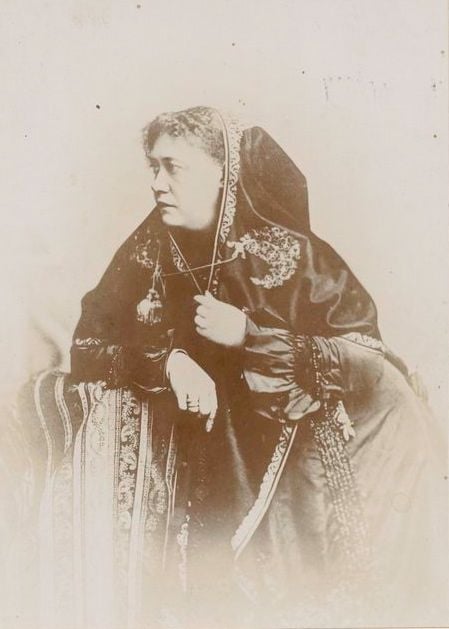
The Theosophical Society was founded in 1875, with Helena Blavatsky as a dominant influence. I will say little about the movement here as you can look at my past posts on the topic, in which I stress its inordinate impact on European culture over the following half century. The artistic and creative influence was just overwhelming. Modernism is incomprehensible except in the light of Theosophy.
In 1877, Blavatsky published a large (700 page) book called Isis Unveiled, which summarized the core ideas of the new movement, and which would fascinate esoteric believers for decades to come. It also says a remarkable amount about Christian origins and Gnostics, and so much of it creates a very strong sense of déjà vu. Let me say here that I have quoted from this quite extensively in an earlier post, and you should also look at that.
To oversimplify a vast book (which is frankly heavy-going), Blavatsky believed that the earliest Christians were mystical Essenes and Gnostics, and that the ignorant clods of the Great Church had systematically suppressed their truths and secret doctrines, which at many points echoed Buddhism and Hinduism. Gnosticism, in fact, was the lineal successor of the older Jewish mysticism of the Essenes.
Very little of what she said was actually novel to her, and she relied heavily on the well-known book of Charles W. King, The Gnostics and Their Remains (1864). King had already framed that movement in the context of Jewish mysticism, of Indian and Buddhist spirituality, and of Zoroastrianism. King, incidentally, was also one of the first authors in that era to draw heavily on an authentic rediscovered Gnostic gospel, namely the Pistis Sophia, which became available in Latin in 1851. But through Isis Unveiled, King’s work became available to a much wider world.
I offer a few samples from Blavatsky, from the “Gnostic heavy” Book II, but I resist the temptation to offer ten thousand words of quotations. She saw the Gnostic leaders Basilides and Valentinus as heirs of the earliest Jesus movement at least as authentic as any of the Church Fathers. She stressed the feminine nature of divinity. After all, most broadly Gnostic systems portrayed the fall of a female Sophia, Wisdom, into the ignorance of the material world, from which she must be redeemed. Blavatsky closely follows King in drawing on the mythological scheme of the Pistis Sophia. Repeatedly, such Gnostic divine figures are portrayed as androgynous.
The Orthodox triumphed, but only for a while:
They ignorantly supposed that the most dangerous writings of this class had perished with the last Gnostic; but some day they may discover their mistake. Other authentic and as important documents will perhaps reappear in a “most unexpected and almost miraculous manner.”
Hmm, fast forward to Nag Hammadi.
Blavatsky’s other great work, The Secret Doctrine (1888) included a chapter on “The Upanishads in Gnostic Literature,” which stressed the enormous importance of the Pistis Sophia. She believed that the ancient Hindu mystical treatises known as the Upanishads “have passed entirely into Gnostic literature; and a Brahmin needs only to read Pistis Sophia to recognize his forefathers’ property, even to the phraseology and similes used.” “Let [the student] read Pistis Sophia in the light of the Bhagavatgita, the Anugita and others; and then the statement made by Jesus in the Gnostic Gospel will become clear, and the dead letter blinds disappear at once.”
 all images here are in the public domain
“The Breasted God”
Women remained prominent in the Theosophical movement, and some developed daring feminist theologies, which were presented in Blavatsky’s magazine Lucifer. They were greatly aided by the steady outpouring of newly discovered ancient texts, which were systematically published by Theosophist G. R. S. Mead. Time and again, feminists turned to those lost “Gnostic” gospels as primary sources of authority. Following those Gnostics of old with remarkable fidelity, Blavatsky and her contemporaries interpreted Christ’s death and resurrection as a symbolic and psychological reality, that reflected transformations within the soul of the believer. In this vision, “Christ” was not a historical personage, but a title given to any true initiate.
One much-read exponent of these ideas was Theosophist Anna Kingsford,who declared that “Religion is not historical and in nowise depends upon past events … . The Scriptures are addressed to the soul, and make no appeal to the outer senses.” Her best known work was the lectures published as The Perfect Way: Or, The Finding of Christ (with Edward Maitland, 1882). Kingsford argued that
As mystical Scriptures, [the Gospels] deal, primarily, not with material things or persons, but with spiritual significations. … the Gospels are addressed, not to the outer sense and reason, but to the soul. … For Religion is not in its nature historical and dependent upon actual, sensible events, but consists in processes, such as Faith and Redemption, which, being interior to all men, subsist irrespectively of what any particular man has at any time suffered or done.
Those scriptures taught the core truths of all the great religion, above all that of reincarnation. As such, “The Gospels bear evidence of being compiled or adapted in great measure from older Oriental Scriptures.” Just how or when they were written remained uncertain, and it was at least possible that “their central figure [Jesus], being himself an Initiate and Adept in the religious science of Egypt and India, actually rehearsed in his own person the greater part of the sacred mysteries.” Over time, those pristine truths had been suppressed by the hierarchical institutional church, by “sacerdotalism,” but a heroic resistance was maintained by
that great school which, apparently because it approached too near the truth to be safely tolerated by a materialising sacerdotalism, was denounced as the most dangerously heretical, — the school of the Gnostics, — the leader, Carpocrates, taught that the Founder of Christianity also was simply a person who, having a soul of great age and high degree of purity, had been enabled, through his mode of life, to recover the memory of its past.
“The world’s coming redemption” would be “born of the spiritual union in the one faith of Buddha and Christ.”
Kingsford was no less radical in her insistence on the feminine face of divinity, which of necessity must contain both male and female elements.
That name of Deity which, occurring in the Old Testament, is translated the Almighty, namely El Shaddai, signifies the Breasted God, and is used when the mode of the Divine nature implied, is of a feminine character.
In her Esoteric Christianity (1902), Annie Besant likewise offered a framework for such a mystical inward-oriented faith, based on the supposed teachings of Jesus, and drawing heavily on the Pistis Sophia.
“The Feminine Element in the Divinity”
I have recently posted on Theosophist Matilda Joslyn Gage, whose 1893 book Woman, Church and State offered a sweeping feminist theological system. As we have seen, though, her ideas were not wholly novel, but were rather importing the familiar ideas of British and Irish thinkers, mainly Theosophists, and notably Anna Kingsford herself. That importation marked a crucial stage in the development of feminist spiritualities in the US.
Like Kingsford, Joslyn Gage likewise argued for the two essential faces of the divine, both the male and female:
The androgynous theory of primal man found many supporters, the separation into two beings having been brought about by sensual desire. …. One of the most revered ancient Scriptures, The Gospel According to the Hebrews, which was in use as late as the second century of the Christian era, taught the equality of the feminine in the Godhead; also that daughters should inherit with sons. Thirty-three fragments of this Gospel have recently been discovered. The fact remains undeniable that at the advent of Christ, a recognition of the feminine element in the divinity had not entirely died out from general belief, the earliest and lost books of the New Testament teaching this doctrine, the whole confirmed by the account of the birth and baptism of Jesus, the Holy Spirit, the feminine creative force, playing the most important part.
Note her reliance here on a “lost gospel.” (Oddly, she never cites Pistis Sophia). In words that sound very modern, she also writes that
It was however but a short period before the church through Canons and Decrees, as well as apostolic and private teaching, denied the femininity of the Divine equally with the divinity of the feminine. There is however abundant proof that even under but partial recognition of the feminine principle as entering in the divinity, woman was officially recognized in the early services of the church, being ordained to the ministry, officiating as deacons, administering the act of baptism, dispensing the sacrament, interpreting doctrines and founding sects which received their names.
As she argued, correctly, an excellent case could be made for understanding the Holy Spirit as a female person of the Trinity. Again, she turned to a lost gospel to support this idea:
An early canonical book of the New Testament known as “The Everlasting Gospel” also as “The Gospel of the Holy Ghost” represents Jesus as saying, “My mother the Holy Ghost, took me by the hair of my head up into a mountain.”
That is actually from the Gospel of the Hebrews, and it is optimistic to describe it as an “early canonical” text. Like many others in later years, Joslyn Gage claimed that many early gospels had been suppressed, regardless of their historical or spiritual value:
Thus we see the degeneration of Christianity has had its epochs. One occurred when the Council of Nicea allowed chance to dictate which would be considered the canonical books of the New Testament, accepting some theretofore regarded as of doubtful authenticity and rejecting others that had been universally conceded genuine.
“Pioneers Of The Liberation Movement Of Their Sex”
With so many documents about Christian origins becoming readily accessible, the materials were present for a radical feminist revision of early Christian history. Just how thoroughgoing such an endeavor could be was indicated by Frances Swiney’s important book The Esoteric Teachings of the Gnostics (1909), which is virtually forgotten today. Swiney, of course, was a Theosophist.
For Swiney, the Gnostics found their chief supporters among the emancipated women of the Roman Empire, “early pioneers of the liberation movement of their sex, dialectical daughters questioning the truth and authority of received opinions, earnest intellectual women.” She saw Gnostics as the direct predecessors of the suffragette women of her own day.
Yes, that was written in 1909, not 1980, or in 2025.
Without the benefit of the Nag Hammadi texts, Swiney uses the Pistis Sophia to provide a strikingly full portrait of the Gnostic world-view. She saw the Gnostic faith as a far more spiritual and egalitarian doctrine than the crude beliefs of the orthodox church. Gnostics taught reincarnation; they believed “that the real human is male-female, devoid of differentiated sexuality; the duality of manifestation now existing being a transitory phase of existence”; while the notion of Christ’s vicarious sacrifice for sins was a “monstrous doctrine” invented by the orthodox:
Though Gnosticism long predated Christianity, the Gnostics were the first Christians; they accepted Christ in the full realization of the word; his life, not his death, was the key-note of their doctrine and their practice.
Gnostic beliefs were expressed in gospels which, Swiney believed, were accepted and regarded as canonical decades before a like veneration was extended to orthodox texts like the letters of Paul. The surviving Gnostic fragments, “the few mutilated relics that remain of these writings, [are] the most valuable evidence of what primitive Christianity really was, and what was the contemporary opinion of Christ and his teaching.”
These noble Gnostic thinkers, “the guardians of the most sacred truths of existence,” were subjected to orthodox persecutions that collectively represent “the bloodiest and the blackest records that history can show us”. These acts were inflicted by “the uninformed, narrow-minded fathers of the primitive church.” Worse than merely obscurantist, the Christian reaction specifically represented male persecution of women: “The Gnostics kept true to the original pristine faith in the Femininity of the Holy Spirit. A truth universally suppressed in the fourth century AD by the male priesthood of the Christian Church.”
Male priests had systematically doctored the surviving texts: “It is very suggestive of a sinister motive that in most of the erasures and where pages are missing in these Gnostic writings, the subject treated is in the context is some hidden mystery, the interpretation of which was unacceptable to the masculine mind and to bigoted orthodoxy.” The iniquitous exclusion of women from the faith and its scriptures was the direct cause of “the persecution, degradation and maltreatment of womanhood” through the succeeding centuries.
In 1916, Theosophy’s historian W. J. Colville quoted both Swiney and Kingsford in his account of “The Esoteric Teachings of the Gnostics – The Divine Feminine” (in his Ancient Mysteries and Modern Revelations). As he remarked, “No more fascinating doctrine than that of Gnosticism can possibly engage our interest, and especially now that the position properly assignable to Woman is one of the burning issues of the times.”
If all these ideas were front and center in religious thought at that early date, it does make us wonder why and how they were so thoroughly forgotten as to appear startling and novel just a couple of generations later. And when you read histories of the modern interpretation of the New Testament and the early Jesus Movement, just note how rarely anyone thinks to mention Theosophy.













 Ad-Free & Subscriber Log-In