

It’s a stunning stone church, painted white and towering over the surrounding landscape, with the sparkling waters of the fjord and snow-covered peaks of the mountains behind it. The church is fairly simple in its design: a pointed roof, no bell tower or elaborate façade. But when you consider where this church is and when it was built, it’s incredibly impressive. This is Trondenes Kirke, built in its current form between the thirteenth and fifteenth centuries. Near the modern town of Harstad and in the Arctic Circle, this is the northernmost medieval stone church and the world’s northernmost surviving medieval building. The first baptism in the region took place in the pond outside, around the year 1000. Baptisms still take place inside the church, in its massive stone baptismal font from almost 900 years ago, for the church is still in use.
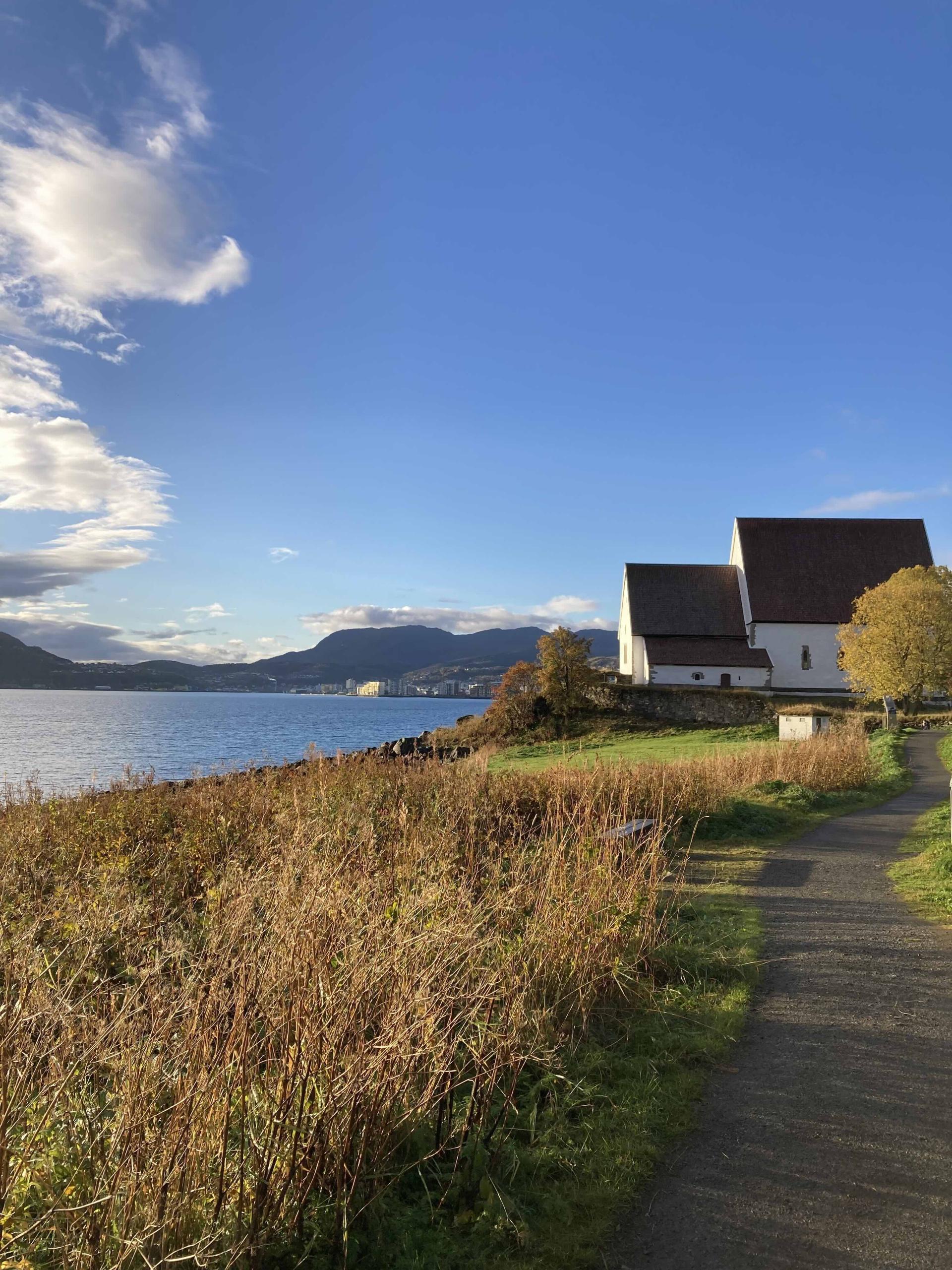
Both the site’s continuity of use as a church and the survival of much of its medieval interior make it a remarkable place to visit– I knew about both of those elements going into our family’s visit in early October. What I didn’t know, however, was just how unusual some of the surviving church art is, reflecting the priorities of its historical parishioners in some beautiful and moving ways. I also didn’t know how much of the church’s art was used throughout the liturgical year, teaching theology not just through what it depicted but through how it was used.
Art and Parish Priorities
Much of the surviving art in Trondenes Kirke dates to the fifteenth century, when the church’s extensive renovations came to their conclusion. And remarkably, some of the art inside survived: despite the religious changes of the Reformations, despite the 19th-century tendency to “fix” medieval churches, and despite the use of the land around the church as a prison camp for Soviet soldiers in World War II. Some of the church features, like the wooden pulpit and rood screen between the nave and the chancel, date from the 18th century. But other, more medieval features remain too.
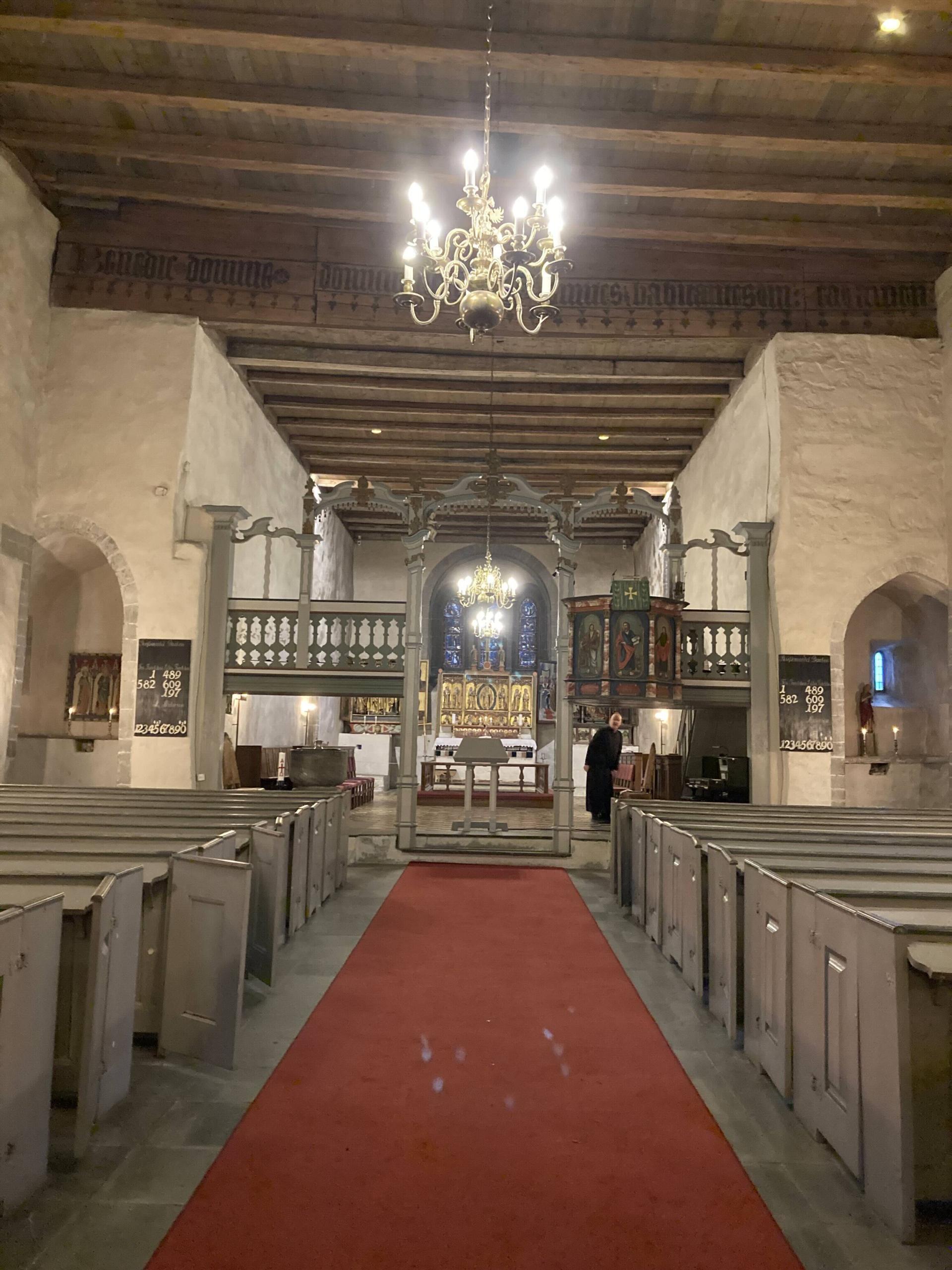
The church prior to the Reformation would have been covered inside with rich frescoes (some of which can still be glimpsed under the lime wash applied in the early modern period); a large Latin blessing stretches across the wooden ceiling beam between the altar and the congregation, also dated to the fifteenth century and discovered during recent restoration work. Looking at the walls and ceiling of Trondenes Kirke would have put you, as a medieval churchgoer, into the biblical narrative, where you could join the Holy Family on their flight to Egypt or flock, together with the saints, to the altar in worship. The painted figures on the walls, you, and your earthly neighbors all gathered together under the blessing, a tangible representation of the communion of saints in your neighborhood and beyond.
If the 18th century rood screen and pulpit is the first thing you see when you step into the church, the gilt altarpieces that stand behind it are certainly the thing you’ll look at most. Three of the seven original altarpieces still stand in the front of the church, where they were placed in the late 1400s; a fourth surviving altarpiece is in the Cultural History Museum in Oslo. Funded by the region’s resources (stockfish, specifically), the altarpieces reflect regional themes and priorities, with images connected to crusades, national saints, martyrs, and pilgrimage.
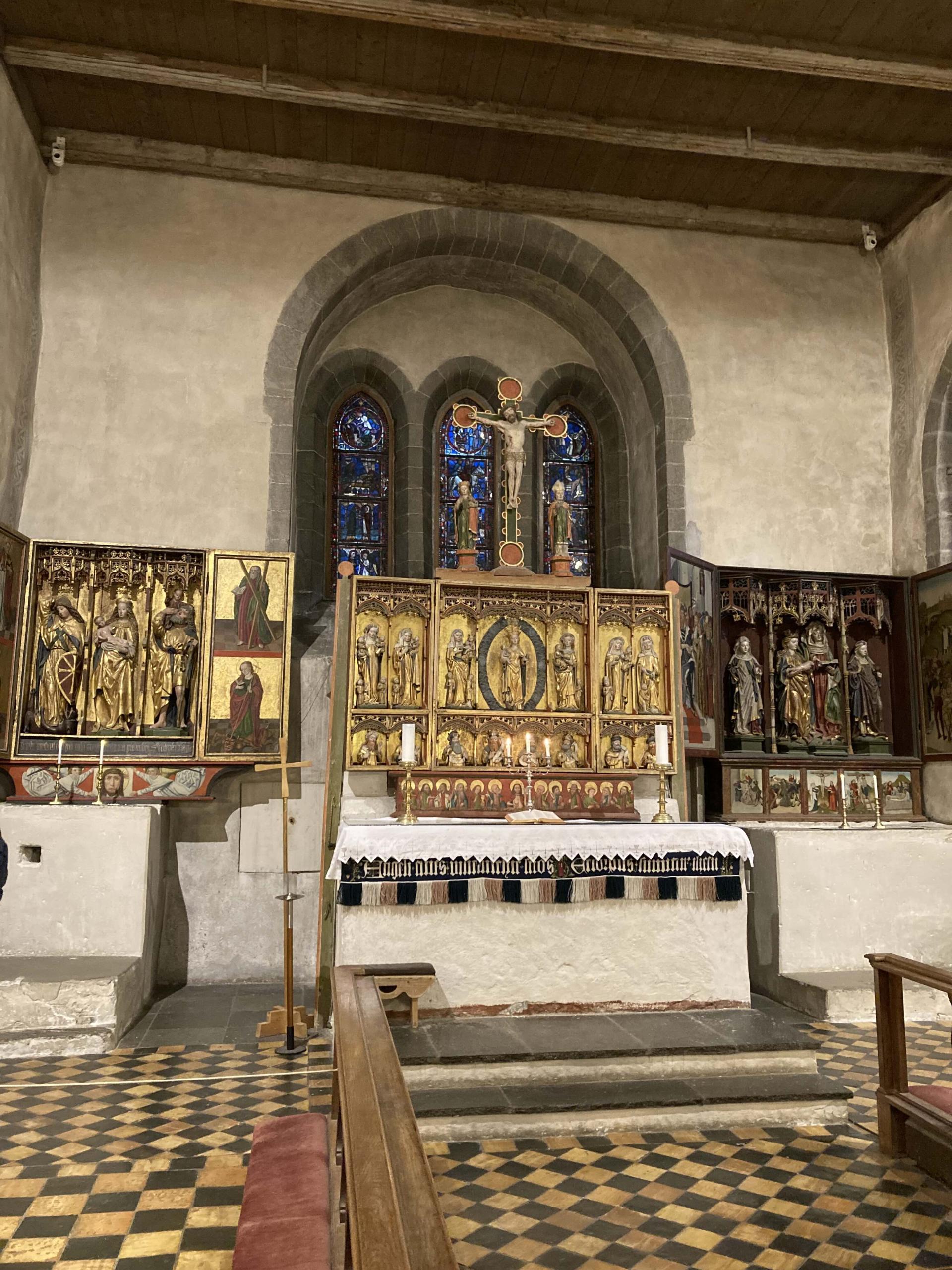
Rognald Heiseldal Bergesen analyzed the art within Trondenes Kirke and its functions. In his work, he demonstrates that the church at Trondenes was extremely active, with the size of the choir area indicating a number of clergy served in the church. What Bergesen terms the “functional fabric” of the church shows us that church was a center of learning and of religion in the area. He also shows how the altarpieces and their motifs were used throughout the liturgical year, and how the figures depicted on them connected to the region’s priorities. For example, according to Bergesen, “the Holy Family is on two of the altars- a very rare motif in Scandinavia.” He thinks this unusual depiction was chosen because the Holy Family was seen as the “self-image of the urban bourgeoisie- which controlled large parts of [the stock fish trade].” Similarly, the image of Akakius and the 10,000 martyrs that appears on the altarpiece depicting St. Birgitta is also unusual, appearing only in two places in Norway. Bergesen links this combination of images to “the crusader ideology surrounding Saint Birgitta, and perhaps Trondenes’ location in the border area of the Christian world,” perceived as a frontier against “pagan” Sámi and Russians. (Translated from Sigrun Hogetveit Berg’s interview with Rognald Heiseldal Bergesen, 05.08.2012). St Nicholas appears in numerous places in the church, as one might expect for a church with significant maritime connections: St Nicholas is the patron saint of sea captains. In short, reading the art chosen for Trondenes Kirke teaches us a lot about the people who built the church and what mattered to them: they worried about their safety at sea, saw themselves as part of the Holy Family, and pictured themselves as crusaders and martyrs on the edge of the Christian world.
Art and Parish Parents
I think there’s another theme we need to notice in the Trondenes Kirke altarpieces though, one less connected to the clerics who worked in the church. The center altarpiece of Trondenes Kirke is dominated by depictions of women and children, to a degree that I’ve not seen in other medieval art.
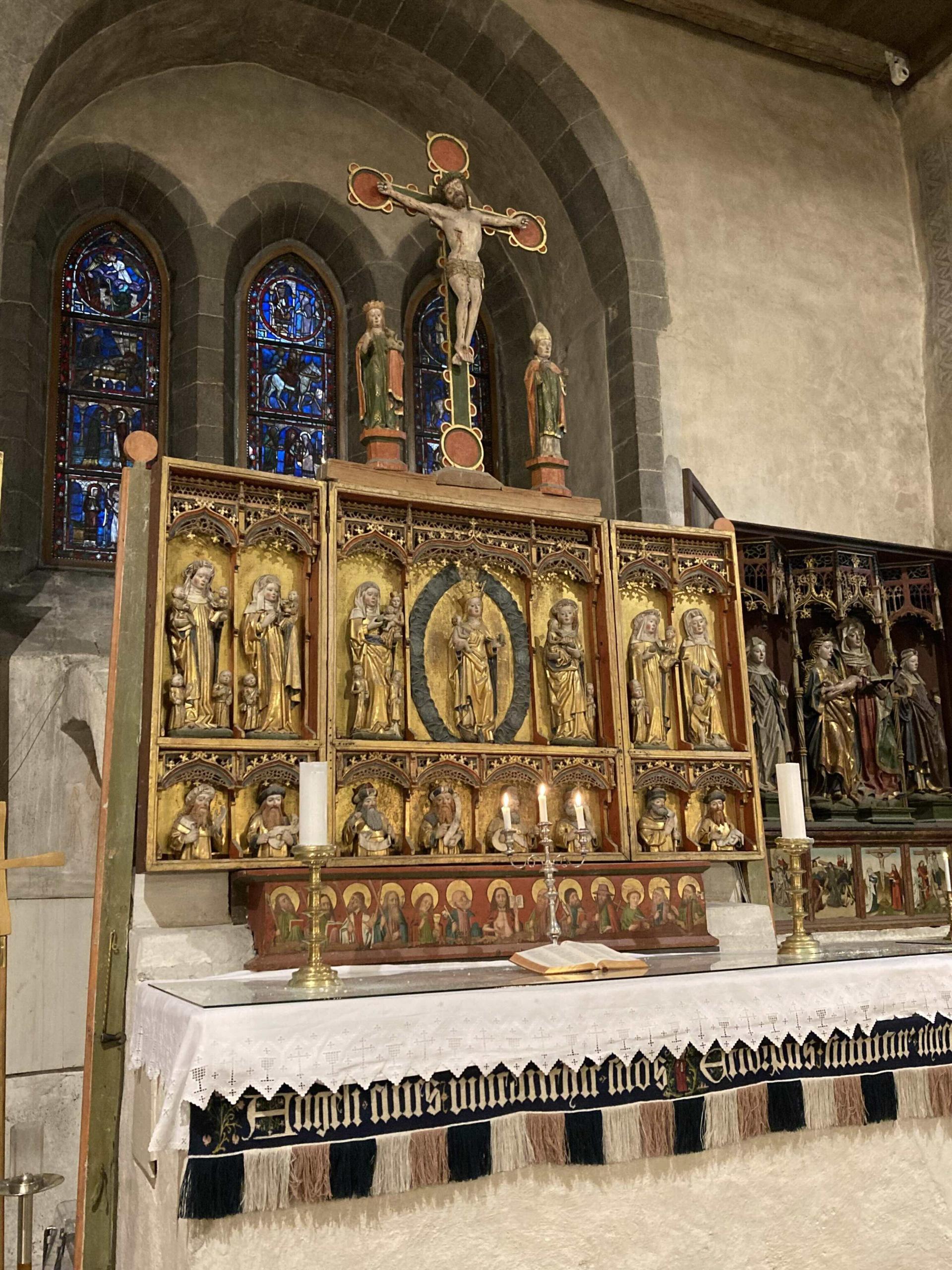
On top of the altarpiece is Christ on the cross, with St Margareth and a dragon on one side and a bishop on the other. In the first row of figures within the altarpiece, though, stand seven women, the matrilineal family of Christ. Each of these women holds a baby, and many of the women have children standing at their feet. One of these women, the one at the center, is the Virgin Mary holding the infant Christ. To her left is her mother, Anne, with the infant Mary and Mary’s sisters at her feet. On her right is Mary’s grandmother Susanna, holding Anne with Anne’s sister at her feet. Four more women, all from Mary’s family, complete the central row. Thus, the center of this altar shows three generations of women with their children, centering Christ, yes, but also emphasizing the role of mothers in the Gospel narrative.
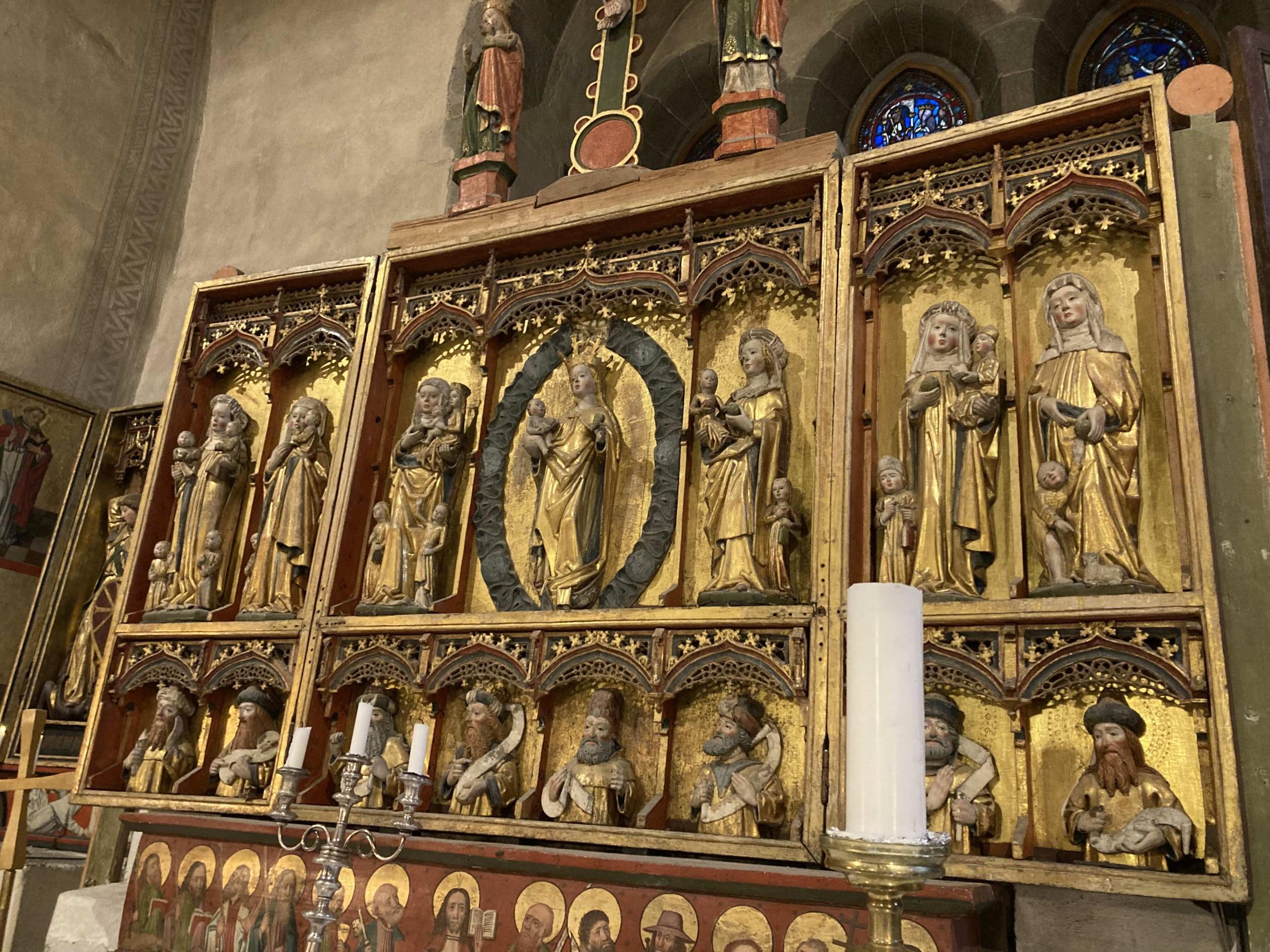
Below these women, much smaller in size, are significant men from the scriptures: Simon, David, Joseph, John, Zebdee, Job, Ehud, and Zacharaias. Many of these men are either in the lineage of Christ or play key roles in heralding his coming– yet it is worth noting they are much less visible than the women of the altarpiece.
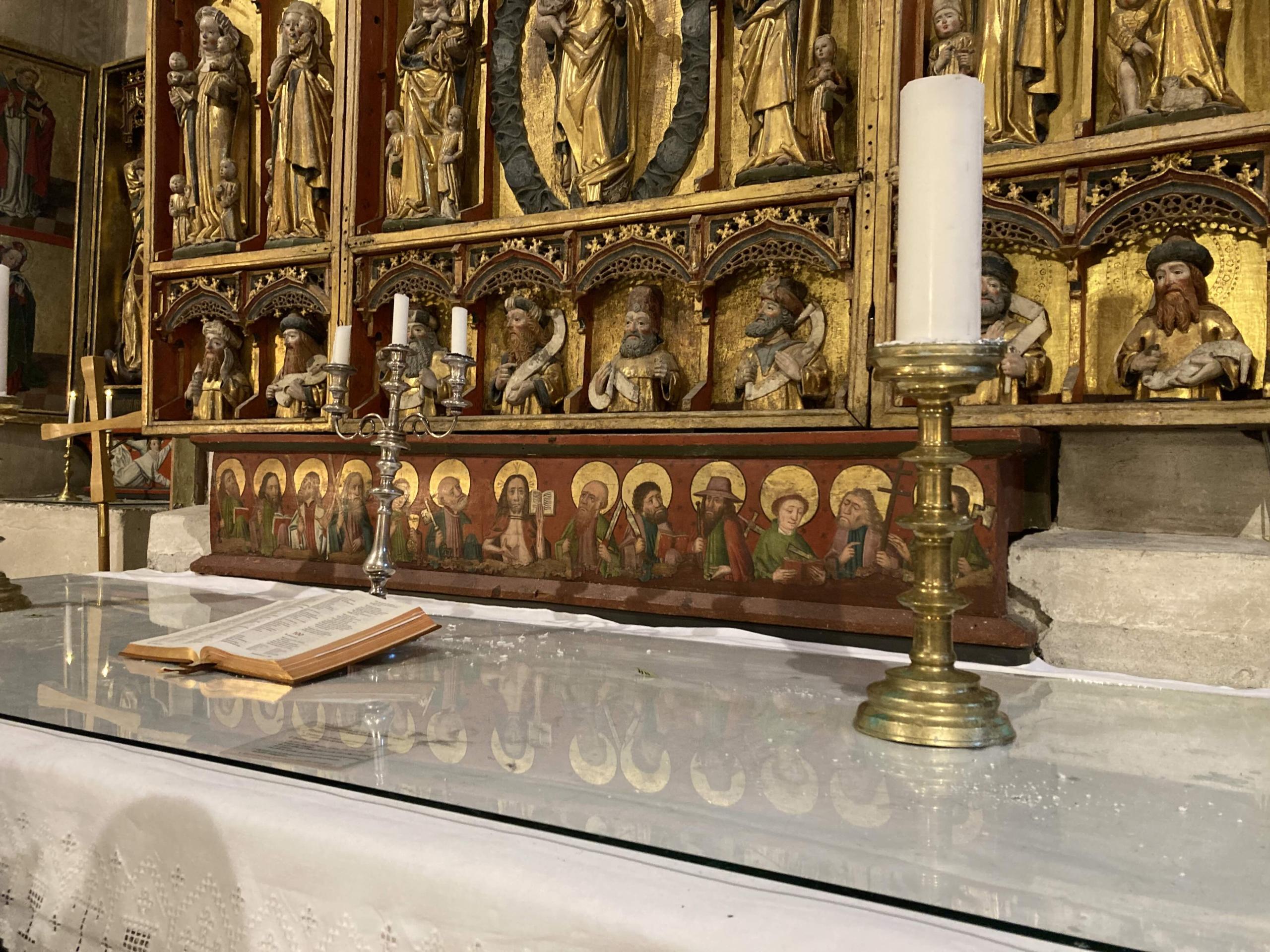
Finally, the smallest panel, directly above the altar where the elements would have been placed, is a depiction of the Last Supper. The center of this image is maybe the most surprising part of this whole altarpiece: here we have Christ, offering his body and his blood, cupping his hand below his side wound in a gesture that is immediately recognizable to any mother as connected to breastfeeding. Read as part of the entire altarpiece, with its emphasis on mothers and children, we here have a striking image of Christ as Mother, giving life to the church through his blood like a mother nourishes a baby through breastfeeding (a theme that surprises us but would be less surprising to figures from the early and medieval church like Ephrem the Syrian). What an arresting way to depict this theological truth– perhaps not recognizable to anyone who does not spend time with a breastfeeding mother, but immediately obvious to the medieval mothers who would have viewed this altarpiece. As a mother myself, I found this altarpiece to be incredibly moving; as a fifteenth-century woman, looking at this altarpiece full of women and mothers, surely the experience must have been much the same.
Church for the Church
I had much more to say about the art of Trondenes Kirke (and probably will say more in future posts- I didn’t even get to how the art was used throughout the liturgical year!) For today, I think we’ll stop here, with this powerful depiction of the work of women in the church and of Christ as mother. Bergesen’s analysis of the altarpieces as reflecting the economic and social priorities of the church is clearly insightful, for the altarpieces do help us to see the priorities of the people who furnished Trondenes Kirke. But I also think they show us a bit about how the church clergy likewise saw and met the needs of their parish.
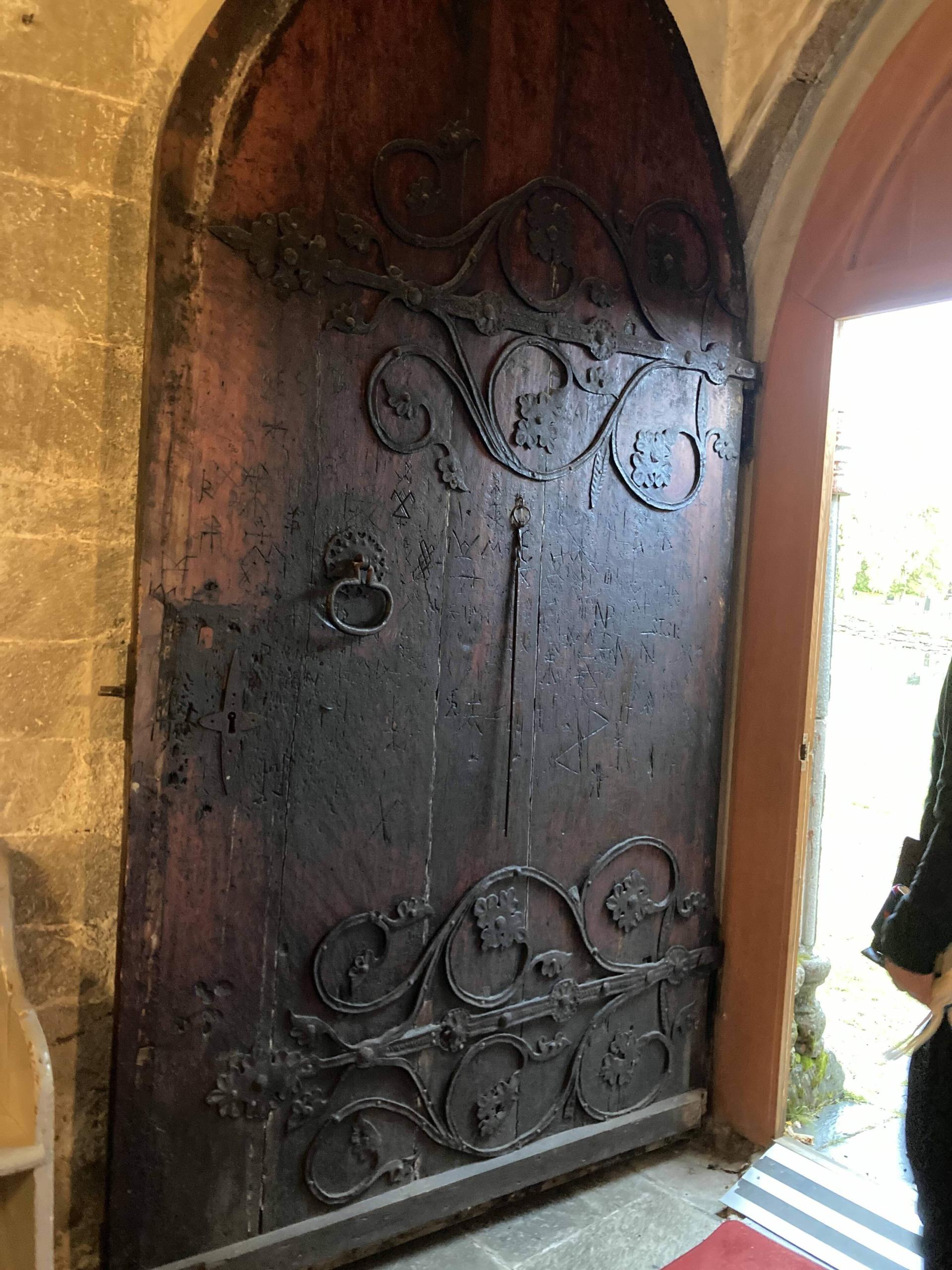
For all that Trondenes Kirke was a center of ecclesiastical authority and of learning in the medieval north, it feels like a church that serves the people rather than the powerful. The parish certainly had mothers and children, who could see themselves in the spaces of their church; the many saints meant to protect mariners and those at sea, along with the graffiti ships behind the altar, perhaps made both sailors and their families feel cared for. The runes and letters carved into the church’s medieval door, left by children learning how to read from Trondenes’ clerics, reflect the ways in which Trondenes’ clerics used learning not just for their benefit but for the community. There’s something beautiful about allowing the spaces of a church to be shaped not just by aesthetics, but by the needs of its people. Are our churches spaces where we center Christ and the needs and experiences of his people in the same way? If not, perhaps it’s time to do some rearranging.









 Ad-Free & Subscriber Log-In