

Western society has an odd relationship with patience. While most would claim patience is a virtue in some sense, our entire society is set up to deny its cultivation through its demand for immediacy. As we are nearing the holidays, let me provide a festive example. Christmas shopping used to entail heading out to face a horde of shoppers at the local mall, walking from store to store for hours on end hoping to find the perfect gift. If you were brave enough to order online, you would have to fight the glacial pace of dialup internet and wait for weeks for the gift to be delivered. Now we can order gifts online and have them there the following day. AI might even remove the need to consider what gifts to give, by providing a list for you! No crowds, no waiting, no fuss. We have not quite reached instant gratification here, but we are getting close.
The problem with our society’s increasing demands for immediacy is that all acquired virtue is formed through habit (if the Christian Aristotelian tradition is correct), which typically requires time and daily effort by the grace of God and the work of the Holy Spirit (Galatians 5:22-23). And so, theologians such as Thomas Aquinas and John Calvin have followed and nuanced Aristotle’s idea in Nicomachean Ethics: “by doing just actions we come to be just; by doing the actions of temperance we come to be temperate; and by doing brave actions brave (Aristotle, Nicomachean Ethics 2.1). How then, do we become patient? By performing patient actions, that is exercising an ‘even mind’ in the face of ‘evil things’, suffering, or even boredom, if we take Augustine’s definition (Augustine, On Patience 2).
There are many ways we might facilitate the cultivation of patience in our lives, but one historical expression was through the liturgical seasons, especially Advent and Lent. These seasons emphasize repentance of sin and waiting on the coming victory of Christ. While this victory is already won, early Christians encourage us to participate in the expectant waiting for the full realization of the kingdom in our own lives and in this world throughout these seasons. In waiting, one has the opportunity to practice patience.
Trondenes Kirke Triptychs
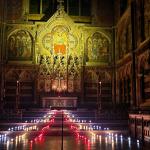
I encountered an interesting manifestation of this notion in a recent trip to Trondenes Kirke in Norway, the northernmost medieval cathedral in the world (which Lynneth Miller Renberg wrote about, here). The cathedral contains three Triptychs at the front of the church, featuring beautiful artwork. A “triptych” is a piece of art which is unique in form, rather than a particular style. Like polyptychs, it contains multiple panels of artwork, often telling a story or displaying related scenes. But uniquely, it always contains three panels which are on hinges, thus allowing it to be displayed open or shut. While the interior is typically the most elaborate, the exterior display often has images as well, changing the story depending on whether it is opened or closed.
In Trondenes Kirke, there are three triptychs at the front of the church which display various images of saints, accounts from the gospels, and martyr stories that are to teach one about following after God. The most striking is the oldest, likely created around 1460 in the workshop of Bernt Notke in Germany. The triptych centers the virgin Mary holding the infant Christ, with important female saints around her—

Anne, Susanna, and others—along with their children. Below, one sees various male figures from the Scriptures, such as David, Joseph, and John. All the characters are shrouded in gold, a depiction of their inherited righteousness and new status in Christ as saints—a status which these parishioners obtained in Christ and sought after in their own lives. The dark ring around Christ and Mary in the center pulls our attention to them, demonstrating that this is all on account of the nativity, the incarnation of Jesus Christ. The Christ child brings salvation and bestows sainthood upon us.
But surprisingly, this picture is often hidden. At the beginning of Advent, the triptych is closed to display an image on the outside—a much humbler, but no less pregnant one. Rather than a triumphal and regal Mary, the exterior image is a depiction of Mary conversing with an angel at the annunciation. While still displaying a halo, exhibiting medieval conceptions of Mary’s sinlessness, she has not a crown, but the Word of God. In this, she is earnestly waiting for the proclaimed messiah, who was promised by the prophets.

The theological effect is striking, especially considering the liturgical calendar and the opening and closing of the triptych. While it is imperative that Christians contemplate Christ’s salvific and triumphal work, transforming us into new creations (2 Corinthians 5:17), it is also important to participate in the longsuffering of those waiting on the messiah, such as those in the Old Testament. The Trondenes Kirke triptych is a visible reminder of this. Those medieval Christians witnessing the closed triptych in Advent, waited in mourning, repentance, and patient expectation with the virgin Mary for the coming messiah. And on Christmas day the triptych is opened, allowing them to celebrate Christ’s birth and marvel in the victory that Christ accomplishes.
Liturgical Seasons and Cultivating Patience
One wonders if our culture of instant gratification has seeped into how we think about theological realities and hindered our virtue formation. Why would we take part in Advent and Lent, when Christmas and Easter have already taken place? Why not decorate our houses for Christmas before Halloween? The ancients might help us, here.
First, they might argue that virtue formation is not supposed to be instant—it is the process itself which accomplishes the desired outcome. In this, waiting is necessary (though not sufficient), especially for the development of patience. Second, by putting in spiritual practices that emphasize our waiting on the Lord, we are reminded of what we are waiting for. The world is not as it should be, and there will be a time when all will be made new. Waiting and reflecting on our need for a messiah, therefore, allows us to recognize the evils in the world while practicing hope for its restoration. Third, this spiritual discipline allows us to experience the reality of Christ’s salvific work anew each season. Without periods of intense reflection, we might forget the overwhelming grace of God in the routine of life. In other words, we better understand the joy of the nativity if we consider the depths of our plight in Advent.
In all of this, it is important to note that acquired virtue, those virtues which are attained through habits in the Christian life (like patience), are ultimately secondary to the grace of God given in the salvific work of Christ. God’s grace brings unity with himself and this unity grounds the theological virtues—faith, hope, and love. It is out of love for God in particular, that the acquired virtues must flow, meaning that patience has an end—hope in Christ. The beauty of Advent and Lent is that this end is on the fore, in the cultivation of patience. We are not patient for virtue’s sake, but patient in our knowledge that God has already overcome sin and death and will do so fully in the end. Our endurance, longsuffering, our ‘ability to tolerate evil things with an even mind’ (Augustine, On Patience 2) in these seasons are for full union with God in his kingdom. As we enter this advent season, might we learn how to grapple with the fact that we still deal with pain, sin, and death as we wait on the fully realization of Christ’s kingdom, like the medieval Christians worshipping in the Trondenes Kirke. May we wait together, in humble and patient expectation for the coming messiah.









 Ad-Free & Subscriber Log-In