

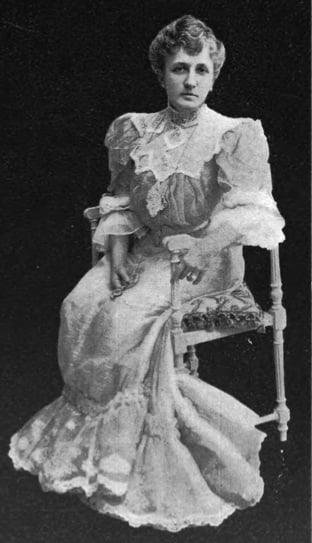
Helen H Gardener (1853–1925) was a celebrated reformer in the Gilded Age and Progressive era, and she is a major character in the book I am presently writing on the 1890s. She was a central figure in feminist and suffragist causes, and especially in the defense of women and young girls from male sexual depredations. Her greatest cause, and her greatest victories, involved the raising of the age of consent, which prior to the 1890s had been incredibly low (ten in most states). Gardener was also a freethinker, close to Robert Ingersoll.
Today, I will describe one of her novels, Is This Your Son, My Lord (1890), which is anything but well known, even to specialists, but which is a valuable and even startling historical resource for anyone interested in the era. (The title is borrowed from Macbeth). It has a huge amount to offer historians of religion in that era, or anyone looking for a spiritual “state of the art” around 1890. Specifically, it is a powerful satire on the Episcopal Church. It is endlessly quotable. And of course, it is freely available full text.
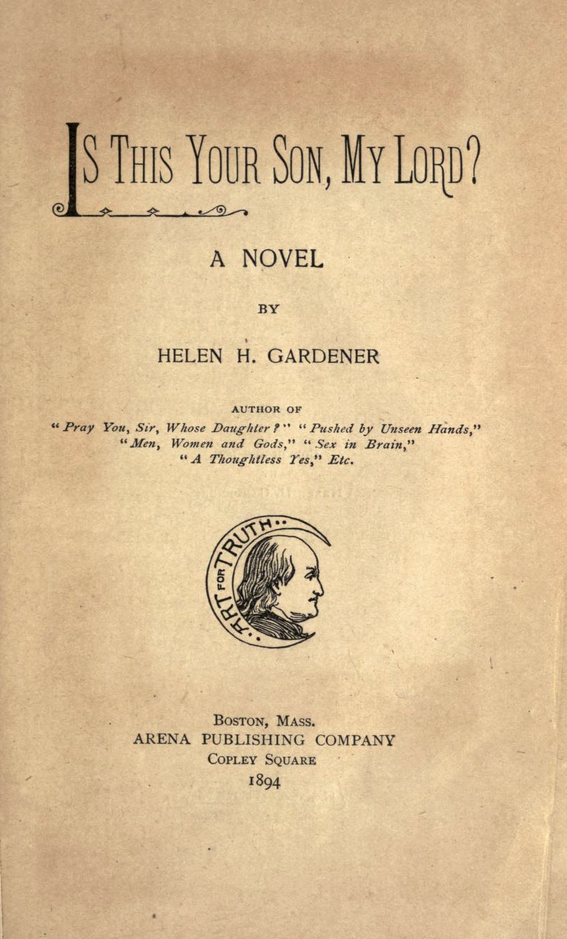
In its day, Is This Your Son, My Lord? was a huge bestseller, passing the 25,000 copy mark within a few months of publication, and Elizabeth Cady Stanton offered a laudatory introduction to a second edition. Much of its appeal was its shock value, as it dealt with really sensitive matters that, in modern eyes, seem like the sort of thing that Victorian authors were too shy to address.
In modern terms, the book offers a sweeping survey of toxic masculinity. Gardener focused on the double standard prevailing between men and women on sexual matters, and the book was daring in its treatment of illegitimacy and “fallen women,” portraying young men whose fathers are happy to see them sexually active before marriage. The novel begins with a doctor warning (in coded terms) that an adolescent boy, Preston Mansfield, is suffering from excessive masturbation, leading his father to encourage him to have a relationship with a woman urgently, regardless of legalities or social mores.
At no stage do these characters pay heed to the interests or needs of the women they use and abuse. The father himself rapes and “ruins” a fifteen year old girl, who later also becomes the victim of the son, Preston, by whom she has illegitimate children. An “outcast,” she turns to prostitution. Gardener scorns the common language of a man “making an honest woman” of his victim by means of marriage. The book portrays predatory young men who regard young teenage girls as ideal targets. When the son is a grown man, he instantly realizes the peril that his old college friend Fred Harmon poses to a fourteen year old girl.
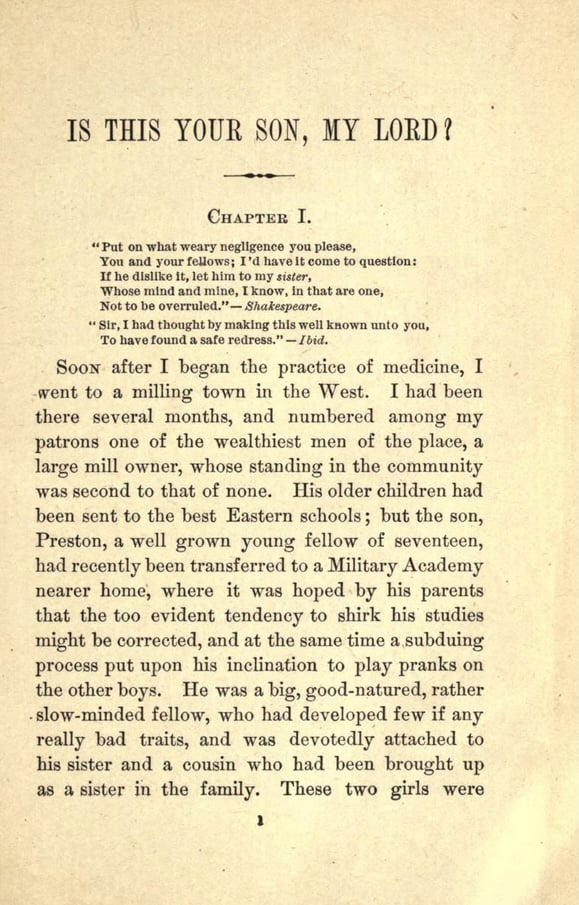
That sexual material was powerful enough, but in its day the religious critique was also stark. Fred Harmon himself has high social pretensions but lacks the income to support them. From his earliest days, his mother plans his career as an Episcopal clergyman holding a fashionable parish:
His mother believed that the Episcopal Church held the highest ideals in morals, religion, art, and music, to be found in this world. Fred believed that it was the organization of greatest power and influence to which a gentleman of culture could belong, and that it was a social lever and a moral screen that no man in his senses could afford to ignore.
But clearly, neither mother nor son hold any degree of belief in fundamental Christian doctrines, nor do they have any clear understanding of them. Fred is all surface and no substance.
Certainly, this book is a novel rather than a biographical study, and it comes from an avowedly freethinking author; but it does suggest the kind of religious adherence that you might plausibly find in an upscale family at this time. They care passionately about following the religious proprieties, although the content of their belief is minimal.
Gardener is good on depicting the ways in which the young men of her era lose traditional faith, usually at university, and the key doubts that arise. Although Fred’s mother leans most strongly to the High Church, which appeals so much to the wealthy and stylish, she is very comfortable with the Broad Church tradition, which is happy to accommodate doubts about inconvenient dogmas. Gardener precisely catches – and satirizes – the Episcopal devotional rhetoric of the era. The mother warns her son:
I do not, myself, believe in those unpleasing religious notions expressed in the creed of our beloved church. You must remember that the progressive Churchmen explain them all quite satisfactorily. The ethical beauty and exquisite taste of Dr. Broadchurch’s explanation of the crucifixion, you surely have not forgotten. I cannot reproduce it, of course, but I know it was most charming. My nerves were soothed and my artistic nature warmed for days afterward. Ask him, some day, to explain these points about the vicarious atonement theory, as you call, it (quite vulgarly, I think. You must have gotten that form of expression from young Ball. Be very careful not to use it again). Give up looking at it in this literal way, and accept it as the Broad Churchmen hold it, if you cannot take the High Church view. Its justice and harmony with natural laws ; its appeal to one’s higher nature and ideals ; its display of tenderness, are all quite a poem as Dr. Broadchurch presents it. You can close your eyes and drift into a realm of spiritual exaltation where questions and doubts are impossible; where the dear Christ touches your heart and illumines your understanding.
Supporting her skeptical approach is the rector, who “told Fred that a literal belief that Christ was a god and had no human father — or that he arose from the dead in any material sense — in any sense that all the dead are not arisen — is not at all vital. He does not accept that view, and he explained to Fred that it was quite unnecessary — and Fred saw it clearly.”
Fred’s betrothed, Maude, lists the (fairly obvious) reason why he must never be ordained as an Episcopal cleric:
” And then, Fred,” Maude added, quite seriously, ” you say, yourself, that you don’t believe the Creed and the Thirty-Nine Articles, and you believe that Christ was the son of Joseph, and you don’t believe in the justice of the vicarious atonement, and — oh, I’m sure, Fred, from what you said to father that night on the veranda, that a man who had the least self-respect, couldn’t be an Episcopal clergyman and think as you do. Why, Fred, there weren’t three grains difference between your belief and father’s, and he isn’t even a Unitarian. He’s an Agnostic.” Fred beheld the vision of his mother again, horrified and indignant. According to her belief Agnostics and Anarchists were about the same thing, and neither were persons one would ever care to meet out on a dark night.
Fred mocks her literalism, and declares that he can accommodate his views to a Broad Church position, the same kind of vision held by (he thinks) Heber Newton and Phillips Brooks. His mother would be fine with that, provided he wore the vestments that proclaimed him to be High Church.
Maude’s father is even more hostile, seeing the skeptical approaches of liberal theology as deliberately deceptive and hypocritical:
I should not object, if you were an Episcopalian, mind you, or any other sort of a Christian, if you were honest in it ; but I have no use for the layman who holds his creed for revenue only ; and for the clergyman who accepts a salary from honest believers for mystifying and explaining away all there is of real meaning in the plan of salvation, my contempt is simply unbounded.” This was a new theory to Fred, and it struck him as worthy of some thought ; but he smiled as he thought how this man of uncouth speech expressed what he had been taught to call “the higher criticism of progressive theology.” Obtaining money by false pretenses, indeed !
Another character, Harvey Ball, offers his survey of the professions available to a young man like his friend Albert, who had sought to be a soldier. But as Harvey explains, that is a dead or dying profession, unlike such potentially modern and progressive rivals such as Law, Medicine or Journalism. In this regard, he says, the military life is very much like its close analogy, of Theology, but the key difference is that Theology simply cannot evolve to accommodate modernity:
War and Theology belong to the same age. They belong to the infancy of the race. The former is civilized by progress to the extent of Gatling guns and torpedo boats ; the latter to the verge of sealing hell over, and reading the vicarious atonement and original sin out of good society. But in the nature of things, Theology must get its light from the past. It is based on a revelation long since closed. It cannot say, ‘ We expect to revise this until it fits our needs,’ — as in law, or medicine, or journalism. The religious law — revelation — is sealed. A clergyman who is honest, — and let us hope Albert will be that, no matter what he undertakes, — must go to the records of the dead past for his light, his inspiration, his guidance. The final appeal of any Orthodox clergyman must be the Bible. He cannot doubt the justice of Jehovah, and be an Orthodox clergyman. He cannot question the goodness of the Jewish God, and be true to his ordination vows. He cannot throw over what may shock or pain him in the New Testament ; he cannot maintain his mental integrity in discussing the miracles, and be an honorable minister.
In short, father, if Albert ever outgrows the creed of a dead age, he will either have to stifle his manhood and his mental integrity, or he will have to throw over his profession, — one or the other. Every one knows how hard this last is for a minister to do. It means a loss, a struggle, a painful break with many years of his life, with many loved and loving friends, and — often it means a vast deal more than that to a man so unhappily placed.
So many of these arguments and debates would be very familiar in the new century, and especially during the Modernist/Fundamentalist collisions; but here they are, fully developed, in 1890.
I have just here picked up on some selected themes from Is This Your Son, My Lord?, but there is so much else. It demands to be read, recovered, and even added to the canon.













 Ad-Free & Subscriber Log-In