

“Your Petitioners believe in the Republican doctrine that all men are born free and are entitled to protection by Law, in person and property —” ~Citizens of Plympton, MA
“It is not down in any map; true places never are.” ~Herman Melville, Moby Dick
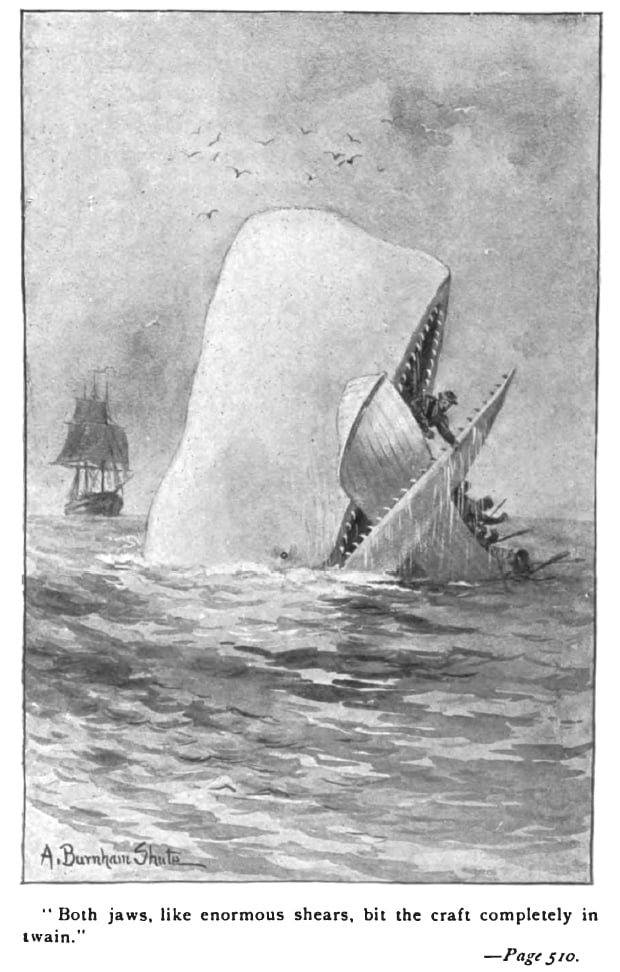 I’ve been joking with friends recently that I’m hunting a white whale. My whale though is an enormous scroll of paper that may or may not have survived to today. If it has, it would be nearly two hundred years old, yellowed, and likely beginning to fall apart. I first became aware of this document when reading the rough journal of the congressional clerk for the House of Representatives. A brief note mentioned that John Quincy Adams introduced a petition in support of the Cherokee from the Citizens of New York City, and that it was forty-seven yards long. This excited me in way you may only understand if you’ve spent time in an archive. I immediately decided to cross check this with John Quincy Adams’s diaries, which are legendarily detailed and entirely digitized. In Adams’s diary, I found this from an entry dated March 4, 1832—just a day before he introduced the petition in the House.
“I received by the Mail several Letters, and with one of them a Memorial signed by several thousand persons upon the existing relations between the United States and the Cherokee Tribe of Indians, and the imprisonment of the Missionaries. The Memorial was the result of a very numerous Meeting at New-York, and a Letter from a Committee of the Signers requested me to present and support it — Blunt wrote to me some days since…”[1]
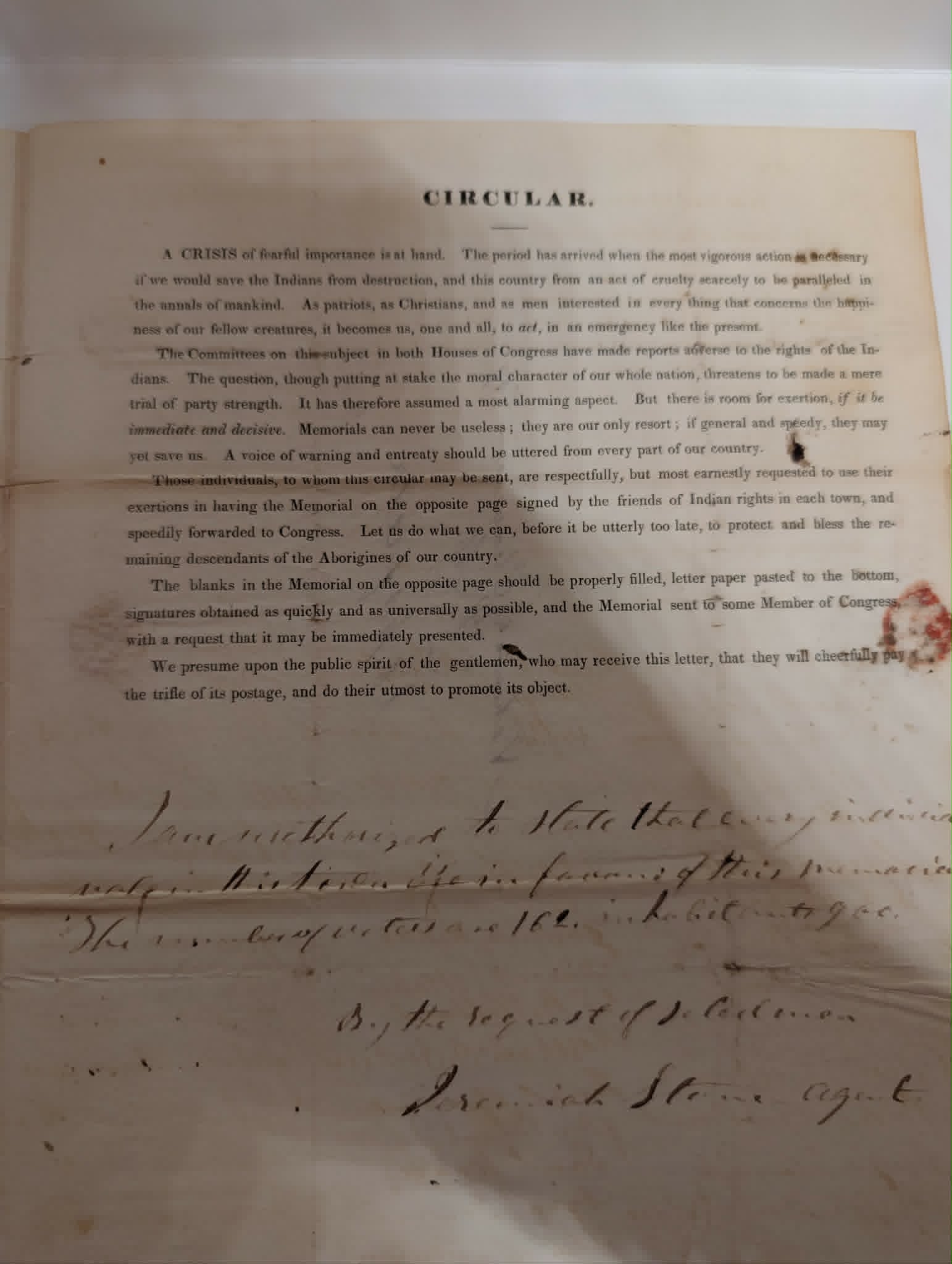
A second reference in a trusted source was enough to convince me that this document existed at some point. I remain uncertain if it has survived but exploring it theoretically here will allow me to explain a bit more about the work I am doing around related petitions for my dissertation. If you’ve followed my writings here, you’ll know that this was not an isolated petition, nor is the date it appeared unremarkable. Beginning as early as 1829, before the election of Andrew Jackson to the presidency, Evangelical and Quaker organizations were petitioning Congress on behalf of the Cherokee Nation. I’ve read through and am in the process of digitizing hundreds (if not thousands) of these petitions. For the purposes of this article though, I’ll be working with nineteen petitions that I’ve picked essentially at random from the dataset. Here I want to explore the arguments used by these petitions and the beginnings of an argument about kinship and community within them. Many of the petitions were created following a prompt from Jeremiah Evarts, correspondence secretary of the ABCFM. These petitions (including five of the nineteen examined here) all began with these words: “your memorialists feel constrained to come before the National Legislature, with an earnest request that the publick faith may be preserved inviolate, in all the transactions of the Government with the Indians.”[2]
Arguments
Arguments within these petitions fall into a few buckets with many petitions layering several different moves for rhetorical power. Legal/constitutional, civic, theological, and civilizational progress are all registers of argument used to argue that Indian rights and particularly the rights of the Cherokee nation must be respected by the United States. I could easily expand these categories (in fact, I think there are closer to seven) and give more examples beyond those I will here, but again, this is a first foray into the petitions and only a few initial observations. As I delve further into them, I will return both in my dissertation and here to explain what I am learning.
Legal arguments on behalf of the Indians are most often framed in terms of both treaty law and natural law. Take for example a petition from the citizens of Canton, CT. They wrote “the Indians have an indisputable title to their territory your memorialists believe cannot be questioned, since it has been distinctly recognized by our government in all their negotiations with them.”[3] The inhabitants of Aurora, OH were among the most intellectually sophisticated and radical of the memorialists, writing
“1st That these several tribes are sovereign and independent nations. 2d That the State of Georgia has no right to extend her jurisdiction over the Indians residing within the chartered limits of that State 3d That consequently the laws of the State of Georgia in reference to the Indians are unconstitutional and void 4th That as the Indians hold their lands both by occupancy and inheritance, for no prior right or claim can be produced and consequently are the rightful owners of the soil and cannot be disinherited or denationalized unless it be through the abuse of power 5th That the general government has power to protect and therefore should protect the Indians from all oppression.[4]
It is worth noting that Aurora is part of the Western Reserve, lands whose earliest white inhabitants were New Englanders from Connecticut. The Aurora memorial’s numbered-proposition format is rhetorically singular in the corpus — it articulates as a citizen petition the legal-philosophical structure that John Marshall would later formalize in Worcester v. Georgia (March 1832). The fact that an Ohio Western Reserve town deploys this argument in citizen-petition form before the Marshall opinion is independent evidence of how rapidly the legal vocabulary of Indigenous sovereignty had become a working language of evangelical-(post-Federalist) Whig political mobilization. Similarly, Newport, RI directly quoted John Marshall, explaining that the Indians “in the language of the Chief Justice [they] have a ‘legal & just Claim’ independently of any guarantee from the United States.”[5]
Theological arguments were often framed as guiding the nation to avoid judgement from the heavens. Durham, NH spoke of “the fearful judgments of Heaven which we may expect” while another town in New York wrote that they were provoked to write by “the apprehension of the Divine displeasure, which will not fail to punish a Nation that, unmindful of its engagements…”[6] In these nineteen petitions, I only find two scriptures quoted, and they both come in edge cases. The golden rule is quoted in a women’s petition from Farmington, ME: “the moral obligation we are under to ‘do unto others as we would that they should do unto us’”[7] Two different Quaker petitions from the Ohio and Philadelphia yearly meetings quote Job 29:13 invoking on behalf of Congress that “the blessing of them that are ready to perish may come upon you.”[8] The same biblical citation closing both Yearly Meeting memorials, drafted one day apart in locations 500 miles distant, is striking and perhaps evidence of denominational coordination through the Orthodox Friends’ Meeting for Sufferings correspondence.
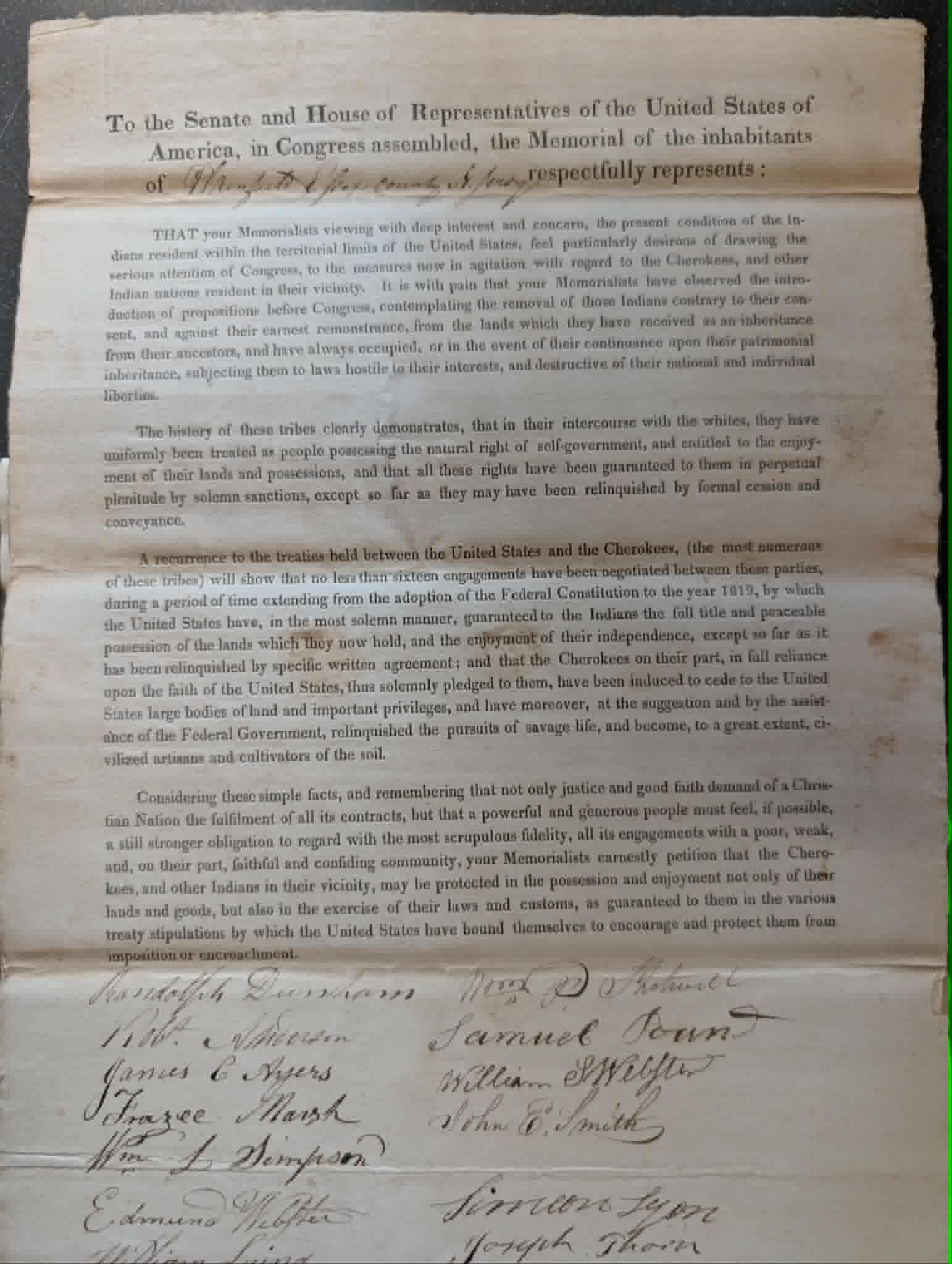
The argument cluster I am referring to as “civic” refers to petitions which appeal to the national honor and its reputation amongst other nations. The Ohio Quakers describe “the crime and the indelible disgrace of having exterminated a whole race of people.”[9] A petition from Abington, PA described the duties of the United States as a Christian nation: “not only justice and good faith demand of a Christian Nation the fulfilment of all its contracts, but that a powerful and generous people must feel, if possible, a still stronger obligation to regard with the most scrupulous fidelity, all its engagements with a poor, weak, and, on their part, faithful and confiding community.”[10] While Newport, NH emphasized that the Cherokee were allies, “the offence is committed against weak and defenceless allies, in whom no offence is found, or even suspected.”[11] The asymmetry-of-power argument—that the United States’s strength compounds rather than mitigates its obligations—appears in both major printed circulars. It also follows an argument made by Evarts in his essays defending Indian Rights. Here he had directly addressed the nation, asking “How shall we as a great, powerful, intelligent, and prosperous people discharge towards their comparatively small communities, the duties which we owe them?”[12]
A particular move credited primarily to Quakers, who deploy direct experiential authority: “as a religious Society, we have long been engaged in the work of Indian civilization; nor is this the first time that we have petitioned Congress in their favour” “have moreover, at the suggestion and by the assistance of the Federal Government, relinquished the pursuits of savage life, and become, to a great extent, civilized artisans and cultivators of the soil”[13] The “civilization” register is double-edged—it obviously operates within an assimilationist frame (“relinquished the pursuits of savage life”) even as it argues against dispossession. It is also an evidentiary move: by establishing that Indigenous peoples have done what the United States asked them to do (adopted agriculture, governance, Christianity), the petitions render the Removal proposal as breach of contract by the United States, not refusal-to-civilize by Indigenous nations.
Prosopography
These petitions aren’t a mere count of consciences but a map of a network. I realize it’s easy to get lost here in jargon between Newport NH and RI and between Plymouth and Plympton, but hang with me. Kinship clusters—the brothers, the in-laws, the father-and-son signatures—make the household visible as the unit of mobilization. That’s evangelical politics in 1830: not individuals choosing positions but families enacting them, through the meetinghouse, the voluntary society, the religious press. In many of these petitions, we find clusters of between three and eight members of the same family signing the petitions back-to-back. Lexington, NY has the highest kin density in the entire dataset, seventy-five percent. Seven Pecks on one 53-signer petition is the most concentrated single-surname showing in this sample of petitions. Add to that five Johnsons, three each of Baldwin/Beach/Pond/Wolcott, then a long tail of pairs. Lexington is a Catskill backcountry town in Greene County.
Kingston and Plympton Massachusetts are helpful for seeing these kin networks play out. The closing of the Kingston petition is a detail to mark. Positions #98 and #99—the last two signatures on the entire 99-signer document—are Stephen Bradford and Stephen Bradford 2d. A father-son pair, both bearing the name of the Plymouth Colony governor, closing out a petition signed by 99 Plymouth-descended men against the dispossession of Indigenous nations. The Plympton kin clusters confirm the Plymouth-Colony-genealogical-royalty pattern. Six Bradfords, five Bryants, five Wrights, plus the long tail of three-counts (Ellis, Lobdell, Loring, Parker, Perkins, Sampson) and pairs (Bosworth, Churchill, Holmes, Sherman, Thomas). Three consecutive runs are particularly telling: Signatures #55-57 (run of 3): Samuel Bryant → Zenas Bryant → Zenas Bryant 2d —almost certainly a three-generation family group signing in immediate sequence, the closest thing yet to a household-line mobilization made visible in the data. Signatures #58-59 (run of 2): Ebenezer Lobdell → Charles H. Lobdell — likely father and son closing the petition, the same “kin-pair finale” pattern Kingston (Bradford → Bradford 2d at #98-99) and Newport NH (Wilcox → Wilcox at #101-102) showed #51-52 (run of 2): Bela Bosworth → Henry E. Bosworth—likely brothers.
This suggests the petitions were passed around in particular churches or community meetings in which extended families sat together. I hope to prove or disprove this argument over the summer through examining church membership records for relevant denominations in the towns petitions originated from.
Conclusion
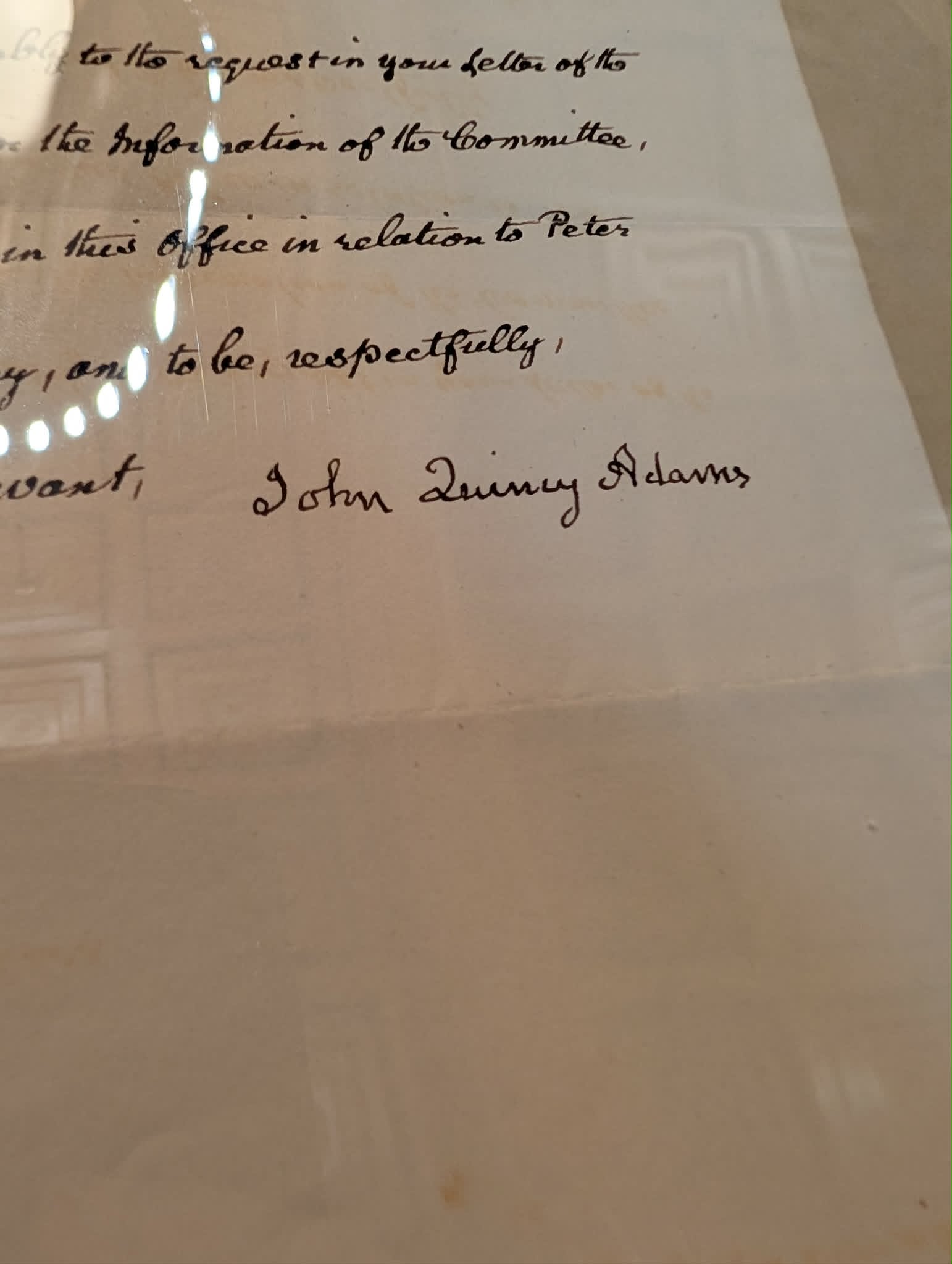
As a friend opined to me recently, to be an activist in any time is to be strangely obsessed in ways obscure to your contemporaries. All of this brings us back to the former president in the House of Representatives. Even John Quincy Adams looked at those defending Indian rights a bit askance. This was not yet the Quincy Adams who would defend the Amistad prisoners or radically fight against slavery, claiming he would spend the blood of a million white men to end it. In 1832, he was a defeated, single-term president and newly elected congressman, still finding his feet. Indeed, while those defending Indian rights were all in ecstasy in early March, 1832—Adams already saw defeat on the horizon. On Friday March 3, the Worcester decision had been decided by the Supreme Court—deciding finally that Georgia could not extend her laws over the Cherokee. Despite this, that Sunday morning, Adams was not optimistic. Continuing from the earlier quote of his diary, he writes
Blunt wrote to me some days since, and mentioned that this Memorial would be sent to me, and I had intended to answer him, declining to present it— But his Letter had escaped from my memory, and remained unanswered— I now concluded, though after much hesitation to present it to-morrow Morning, well assured that it will be of no avail, but willing to perform to the utmost of my power, my duty.[14]
I still don’t know where my white whale is. The more I think about it though, the disappearance feels sadly appropriate, even painful. The largest evangelical political mobilization of the early republic produced a forty-seven-yard scroll, perhaps the crowning achievement of the coalition fighting for Indian rights, that has been lost in the waves of history. But like Adams, I hope my duty and power may be enough to keep looking.
[1] https://www.primarysourcecoop.org/publications/jqa/document/jqadiaries-v38-1832-03-p389–entry4?navmode=searchresults&doci=114&ss=Cherokee
[2] Evarts circular form, found in: Francestown, NH (1830); Kingston, MA (Feb 1831); Newport, RI (Jan 1831); Sheffield, MA (1831)
[3] Canton, CT (Jan 25, 1829 or 1830 — date pending verification)
[4] Aurora, Portage County, OH –date pending
[5] Newport, RI (Jan 1831)
[6] Durham, NH (Feb 23, 1831), handwritten memorial Lexington, NY—date uncertain.
[7] Farmington, ME women (Jan 6, 1830)
[8] Ohio Yearly Meeting (Jan 21, 1830); Philadelphia Yearly Meeting (Jan 22, 1830)
[9] Ohio Yearly Meeting (Jan 21, 1830)
[10] Abington, PA printed circular (Jan 26, 1830 et al.)
[11] Newport, NH printed circular (Feb 23, 1831)
[12] Andrew III, John A. 1992. From Revival to Removal: Jeremiah Evarts, the Cherokee Nation, and the Search for the Soul of America. Athens: The University of Georgia Press. p 209
[13] Ohio Yearly Meeting (Jan 21, 1830), Abington, PA printed circular (Jan 26, 1830 et al.)
[14] https://www.primarysourcecoop.org/publications/jqa/document/jqadiaries-v38-1832-03-p389–entry4?navmode=searchresults&doci=114&ss=Cherokee







 Ad-Free & Subscriber Log-In