

You can find my two-part introduction to the Gospel of John at these two links, and my index/outline for it here; for the previous installment on John 6:52-71, go here.
The Gospel of John: Sukkot, Part I (John 7:1-31)
The seventh and eighth chapters of John take place during the festival of Sukkot, which occurs on the 15th to 21st of the month of Tishrei, so that it usually falls in late September or early October in the Gregorian calendar. This is the greatest of the harvest festivals, and the third and last of the three great pilgrimage feasts.
Of the sacred Seven Species of Canaan—barley, wheat, figs, grapes, dates, pomegranates, and olives—the third, fourth, fifth, and sixth are, in the culinary sense, fruits.1 The grape and date harvests finish up around the same time the pomegranate harvest occurs, and after the later of the two fig harvests, so there is an abundance of fruit in the Holy Land around this time. Devices called lulavim, literally “palms” (but bound together with willow and myrtle branches) are carried about and waved, along with a lemon-like fruit called an etrog, known in English as the citron.2 Additionally, Sukkot occurs less than a week after Yom Kippur, and signals a dramatic change in liturgical atmosphere; we pass from the austere heights of the pronounced Tetragrammaton and the high priest’s entry alone into the קֹדֶשׁ הַקֳּדָשִׁים [Qodhesh ha-Qàdhâshym], the Holy of Holies, to a week of feasting, singing, and sleeping outdoors in the last of the mild summer weather, before the rains of the month of Cheshvan properly set in. (In the Mediterranean, winter is associated not so much with cold, as it is in northern Europe, but with storms—hence the misfortunes recorded in Acts 27 and 28.)
While the Temple stood, Sukkot was the occasion of a unique ritual: the washing of the altar. Water was drawn from the Pool of Siloam, which lay in the southeastern corner of the Holy City, and then carried up the steep streets to the Temple—an ascent of a little less than 400’—where it was poured out over the great horned altar that stood in the Court of the Priests, in front of the entrance to the Sanctuary, cleaning it. The drawing of this water from the Pool of Siloam was a moment of immense excitement and even of spectacle—Simon ben Gamaliel (the son of the Gamaliel mentioned in Acts, and like him the Nasi, or president, of the Sanhedrin in his day) is said to have juggled torches in celebration of the water-drawing. The Mishnah, in the tractate Sukah, “Booth” or “Tent,” from the division Mo3edh, “Appointed Time” (or section II, subsection 6 of the book), says simply that “He who has not seeing the rejoicing at the House of the Water-Drawing has never seen rejoicing in his life.”
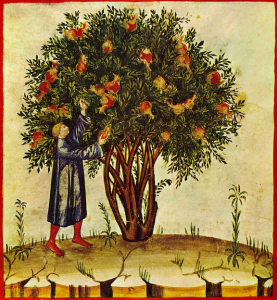
Illustration (late 14th c.) of a pomegranate
tree from an Italian manuscript.
John 7:1-31, RSV-CE
After this Jesus went about in Galilee; he would not go about in Judea, because the Jews sought to kill him. Now the Jews’ feast of Tabernacles was at hand. So his brethren said to him, “Leave here and go to Judea, that your disciples may see the works you are doing. For no man works in secret if he seeks to be known openly. If you do these things, show yourself to the world.” For even his brethren did not believe in him. Jesus said to them, “My time has not yet come, but your time is always here. The world cannot hate you, but it hates me because I testify of it that its works are evil. Go to the feast yourselves; I am not going up to this feast, for my time has not yet fully come.” So saying, he remained in Galilee.
But after his brethren had gone up to the feast, then he also went up, not publicly but in private.a The Jews were looking for him at the feast, and saying, “Where is he?” And there was much muttering about him among the people.b While some said, “He is a good man,” others said, “No, he is leading the people astray.” Yet for fear of the Jews no one spoke openly of him.
About the middle of the feast Jesus went up into the temple and taught. The Jews marveled at it, saying, “How is it that this man has learning, when he has never studied?”c So Jesus answered them, “My teaching is not mine, but his who sent me; if any man’s will is to do his will, he shall know whether the teaching is from God or whether I am speaking on my own authority. He who speaks on his own authority seeks his own glory; but he who seeks the glory of him who sent him is true, and in him there is no falsehood. Did not Moses give you the law? Yet none of you keeps the law. Why do you seek to kill me?” The people answered, “You have a demon!d Who is seeking to kill you?” Jesus answered them, “I did one deed, and you all marvel at it. Moses gave you circumcision (not that it is from Moses, but from the fathers), and you circumcise a man upon the sabbath.e If on the sabbath a man receives circumcision, so that the law of Moses may not be broken, are you angry with me because on the sabbath I made a man’s whole body well? Do not judge by appearances, but judge with right judgment.”
Some of the people of Jerusalem therefore said, “Is not this the man whom they seek to kill? And here he is, speaking openly, and they say nothing to him! Can it be that the authorities really know that this is the Christ? Yet we know where this man comes from; and when the Christ appears, no one will know where he comes from.” So Jesus proclaimed,f as he taught in the temple, “You know me, and you know where I come from?g But I have not come of my own accord; he who sent me is true, and him you do not know. I know him, for I come from him, and he sent me.”h So they sought to arrest him; but no one laid hands on him, because his hour had not yet come. Yet many of the people believed in him; they said, “When the Christ appears, will he do more signs than this man has done?”
John 7:1-31, my translation
Now after these things, Yeshua walked around in the Galilee, for he did not want to walk around in Judea, because the Jews were seeking to kill him.
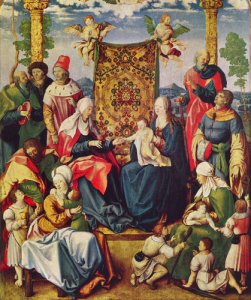
Die Heilige Sippe [The Holy Kinship] (1514),
by Wolf Traut. “The Holy Kinship” denotes
the Lord’s extended family.
The Jews’ Feast of Tent-dwelling was near. Then his brothers said to him, “Depart from here and go into Judea, in order that your students may also behold these works of yours that you are doing; for no one does anything in secret and also seeks to be out in the open: if you are doing these things, manifest yourself to the world.” For not even his brothers had faith in him.
So Yeshua said to them: “My time has not arrived yet—your time is always ready. The world cannot hate you, but it hates me, because I bear witness about it, because its works are oppressive. You go up to the feast; I am not going up to this feast, because my time has not yet been fulfilled.” Saying these things, he stayed in the Galilee.
Yet when his brothers had gone up to the feast, then he went up himself, not manifestly, but as [it were] in secret.a
So the Jews were seeking him in the feast, and said, “Where is that man?” And there was much murmuring about him among the crowds;b for some said that “He is good,” while others said “No, but he misleads the crowd.” Nonetheless, no one talked about him out in the open, due to fear of the Jews.
When it was already the middle of the feast, Yeshua went up into the Temple and taught. Then the Jews were amazed, saying, “How does this man know scripture, [who] has not studied?”c
Then Yeshua responded, and said to them: “My teaching is not mine, but that of him who dispatched me; if anyone wants to do what he wants, it will be known about my teaching—whether it is from God or I am talking from myself. He who talks from himself seeks his own glory; he who seeks the glory of the one that dispatched him, this man is true, and injustice is not in him. Didn’t Mosheh give you the law? And none of you does the law. Why are you seeking to kill me?”
The crowd responded, “You have a demon!d who is seeking to kill you?”
Yeshua told them in response, “I did one work, and you were all amazed. Because that Mosheh gave you circumcision—not that it is from Mosheh, but from the fathers—and on sabbath,e you circumcise a person. If a person receives circumcision on sabbath, in order that the law of Mosheh may not be loosened, are you angry with me that I made a person healthy on sabbath? Do not judge by sight, but judge with just judgment.”
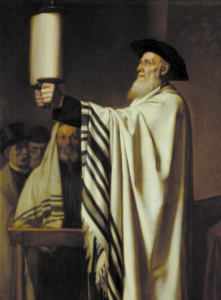
Presentation of the Torah (1860), by Édouard
Moyse, now housed at the Musée d’Art et
d’Histoire Judaïsme, Paris; used via
a CC BY-SA 4.0 license (source).
Then some of the Yrushalemites said: “Isn’t this that man whom they were seeking to kill? And look, he is speaking openly and they say nothing to him; can it be that the princes truly know that this is the Anointed One? But we know where this man is from; whereas whenever the Anointed One comes, no one knows where he is from.”
Then Yeshua cried outf while teaching in the Temple, and said, “You both know me and know where I am from;g and I have not come of my own accord, but he who is true is [the one] who dispatched me, whom you do not know: I know him, because I exist from him, and that one sent me.”h
So they sought to seize him, but no one laid a hand on him, because his hour had not yet come. Many of the crowd had faith in him, and were saying, “When the Anointed does come, will he do any more signs than those this man has done?”
Textual Notes
a. So saying, he remained in Galilee. But after his brethren had gone up to the feast, then he also went up, not publicly but in private/Saying these things, he stayed in the Galilee. But when his brothers had gone up to the feast, then he went up himself, not manifestly, but as [it were] in secret | ταῦτα δὲ εἰπὼν αὐτὸς ἔμεινεν ἐν τῇ Γαλιλαίᾳ. Ὡς δὲ ἀνέβησαν οἱ ἀδελφοὶ αὐτοῦ εἰς τὴν ἑορτήν, τότε καὶ αὐτὸς ἀνέβη, οὐ φανερῶς ἀλλὰ ὡς ἐν κρυπτῷ [tauta de eipōn autos emeinen en tē Galilaia. Hōs de anebēsan hoi adelfoi autou eis tēn heortēn, tote kai autos anebē ou fanerōs alla hōs en krüptō]: This seems like an extremely puzzling, even troubling, sequence: to all appearances, it represents the Lord as deceiving his brothers about his intentions. There are a few possible solutions to this problem.
a. The neat solution. Perhaps Yeshua simply and humanly changed his mind after his brothers had already left; if so, he would of course have had no way of informing them, so there wouldn’t really be a question of doing so. Moreover, given that the author of John prefers to accent the divine nature of the Logos (cf. 6:6), such a change of mind probably isn’t the sort of thing he would bring up, even if it were true.
b. The Jesuitical solution. Perhaps when he said “I am not going up to this feast, because my time has not yet been fulfilled,” he was referring to a “fulfillment of his time” that would come more or less right after they left—in other words, saying something that was technically true, though he knew it would be misinterpreted by his family.
c. The “Rahab” solution. James 2:25 seems, equally startlingly, to praise the Jerichoite prostitute Rahab for not only practicing deceit but flat-out lying to protect the Israelite spies she was harboring (see Joshua 2 and 6 for full details). This suggests, and some Catholic moralists have concluded, that the duty to tell the truth admits not only modification but complete abrogation under some extreme circumstances. Given that (per v. 1 of our passage) Yeshua’s life was reportedly in danger, this may fit the circumstances required, if this reading of the moral implications of James 2 is correct.

An etrog (citron)2 and a lulav (myrtle, palm,
and willow branches bound together), festal
“gear” for celebrating Sukkot.
As discussed in note g of this post, this is as close as John comes to the “rejection in Nazareth” motif that appears in one form in Matthew and Mark and in another in Luke; here, it harks back to vv. 10-13 of the prologue.
b. there was much muttering about him among the people/there was much murmuring about him among the crowds | γογγυσμὸς περὶ αὐτοῦ ἦν πολὺς ἐν τοῖς ὄχλοις [gongüsmos peri autou ēn polüs en tois ochlois]: This is one of many lines in John that complicates our understanding of how Yeshua was received among the Jewish people in his day. Some takes on the Gospel of John—rather lazy ones, to my mind—make it sound as if it presented the reader with a black-and-white, unrelievedly antisemitic picture of the Jewish people, which simply isn’t true (though it is quite true that Christian antisemites3 are as happy to take phrases from John out of context as they are to butcher everything else in the Bible). Incidentally, this passage exemplifies the diverse set of meanings I discussed in textual note e of this post from back in February; throughout chapter 7, “the Jews” seems to be meant in sense 5 from that list, or perhaps senses 3 and 5 together.
c. How is it that this man has learning, when he has never studied?/How does this man know scripture, [who] has not studied? | Πῶς οὗτος γράμματα οἶδεν μὴ μεμαθηκώς; [Pōs houtos grammata oiden mē memathēkōs?]: The confident assertion that he “has not studied” may seem to come from nowhere, but it probably reflects the Lord’s dialectal speech. Matthew 26:73 highlights the fact that Galileans had a fairly distinctive accent—as easy to pick out as a Southern drawl or an Irish brogue; anybody who went to Yrushalem and got a decent theological education would surely have been instructed at the same time in how to speak “properly.” Exactly what this Galilean accent consisted in is not well-understood, or at any rate not by such sources as I’ve been able to find. Apparently the Babylonian Talmud relates “in one place” (thanks, Professor Hoehner, very helpful) that the Galileans tended to “swallow” their guttural sounds, which refers to these letters:
- א
- ה
- ח
- ע
- ר
Their respective names (with my usual transcriptions) are ‘alef (‘), he (h), cheth (ch), 3ayin (3), and resh (r).4, 5 Exactly what “swallowing” meant, I am not anything like a good enough Hebraist to be sure: for ‘alef and the h-like sounds, it might mean dropping them entirely in at least some contexts; as for resh, I gather it was probably what we call a trilled r at the time, but perhaps in the Galilee it was a further-back, uvular r, as it is in most Modern Hebrew. Or, perhaps the statement that Galileans “swallowed their gutturals” only applied to א and the h-like sounds—or maybe only to ח and ע, the most guttural of the five. We also probably have a little evidence from the Gospel of Mark. Mark contains more transcriptions of Aramaic words and phrases than any of the other canonical Gospels: here and there, such as in 5:41 or 7:34, we get what seem like slightly “clipped” or “simplified” versions of the Aramaic—unless, of course, the evangelist is transcribing the actual sounds Yeshua pronounced faithfully, and these are examples of consonants being blended or endings dropped in just the way the Galilean dialect tended to.
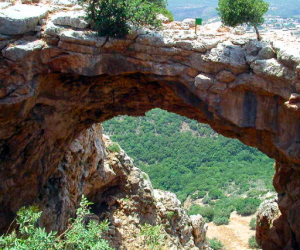
Keshet Cave, a natural arch in the Betzet
Stream Nature Reserve in the Galilee,
northwest of Tiberias and northeast of
Haifa. Photo by Mark A. Wilson.
d. You have a demon! | Δαιμόνιον ἔχεις [Daimonion echeis]: This is probably a stock expression, amounting to little more than “You’re crazy” would today. Given that first-century Palestinian Jews (among others) did believe quite seriously in demons and in demonic possession, it may seem strange that they would have such a trivializing figure of speech. But it is surely no more strange than the fact that we, who believe in mental health, should have a figure of speech like “You’re crazy.”
e. the sabbath/sabbath | σαββάτῳ [sabbatō]: The sabbath is here referenced without the article in the Greek, almost as if it were a “stuff”; this is because there is not a particular sabbath in view, but just sabbaths in general. (Greek is one of the few languages that uses the definite article pretty consistently as a determiner; English actually doesn’t deploy the as regularly as you’d think.)
f. proclaimed/cried out | ἔκραξεν [ekraxen]: “Proclaimed” strikes me as a little overly-softened. Κράζω [krazō], the verb being used here, originally referred to the “croak” of a crow or raven; its usual translations are “to scream, cry, shout, shriek.”

A fan-tailed raven (Corvus rhipidurus, one of
two corvid species endemic in and around the
Holy Land) from Ethiopia. Photo by Charles J.
Sharp, used via a CC BY-SA 4.0 license (source).
g. You know me, and you know where I come from?/You both know me and know where I am from | Κἀμὲ οἴδατε καὶ οἴδατε πόθεν εἰμί [kame oidate kai oidate pothen eimi]: It’s difficult to put into words, but—while not a question in the Greek—there is a feel to this phrase, a sort of “Oh really now?” quality, that makes the question mark a defensible interpretive choice.
h. I come from him, and he sent me/I exist from him, and that one sent me | παρ’ αὐτοῦ εἰμι κἀκεῖνός με ἀπέστειλεν [par’ autou eimi kakeinos me apesteilen]: There’s a pretty interesting grammatical oddity here, in English. Normally, of course, the verb “to come” is a plain active verb (by which I mean a verb indicating action, not active as opposed to passive); however, it also has contexts where it fades into being something like a stative verb, i.e. a verb indicating some form of being or becoming—the phrase “where babies come from” is a classic instance. The RSV’s translation of this verse could be read either way, though in the Greek it’s unequivocally a stative verb (of which Greek has two, εἰμί and γίνομαι [ginomai], earlier γίγνομαι [gignomai], meaning “to be” and “to become” respectively).6
Postscript on the Strangest Book of the Bible
It’s not Revelation. Revelation, when approached 1) as an apocalyptic/hekhalot-ic book 2) in the Johannine “school” 3) with a strongly liturgical significance, is not weird at all. No. The weirdest book of the Bible is the one read in synagogues for the supremely joyful festival of Sukkot—that is, for Shemini Atzeret, the eighth day of this seven-day feast, which is and isn’t exactly part of Sukkot.7 I’m talking about the fourth of the Five Scrolls,8 titled קֹהֶלֶת [Qoheleth], meaning “Preacher” or “Lecturer,” but usually transposed into its Latinized-Greek form: Ecclesiastes.
We are told the entire theme of the book in its opening verses:
Vanity of vanities, saith the Preacher,
…vanity of vanities; all is vanity.
What profit hath a man of all his labour
…which he taketh under the sun?
One generation passeth away, and another generation cometh:
…but the earth abideth for ever.
The sun also ariseth, and the sun goeth down,
…and hasteth to his place where he arose. …
There is no remembrance of former things;
…neither shall there be any remembrance
of things that are to come
…with those that shall come after.
I the Preacher was king over Israel in Jerusalem. And I gave my heart to seek and search out by wisdom concerning all things that are done under heaven: this sore travail hath God given to the sons of man to be exercised therewith. I have seen all the works that are done under the sun; and, behold, all is vanity and vexation of spirit.
—Eccl. 1:2-5, 11-14
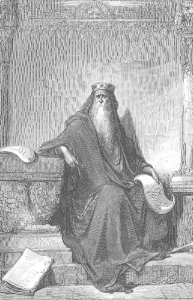
King Solomon in Old Age (1866), by Gustav
Doré; Solomon is the conventionally-ascribed
author of Qoheleth.
Except … is that the theme of the book? pure melancholia, not to say nihilism? Of course the answer is “no”; the author brings his book to an end thus, tying into the Torah-centered themes discussed in footnote 7 [EDIT: when first published, this read “note a” instead of “footnote 7″—apologies for any confusion!]:
Let us hear the conclusion of the whole matter: Fear God, and keep his commandments: for this is the whole duty of man. For God shall bring every work into judgment, with every secret thing, whether it be good, or whether it be evil.
—Ibid., 12:13-14
Yet a reader could pardonably find this ending a little forced. After all, hasn’t “the Preacher” been going on for eleven-and-a-bit chapters about how “all is vanity”? Well—no; at least, I have a hunch not. That hunch centers on the constant refrain-word of Qoheleth, the word typically translated vanity or meaningless: הֶבֶל [hevel], the literal meaning of which is “steam, vapor, breath” (the name Abel is related).
I think that probably what the author of Ecclesiastes is getting at is not that everything is meaningless or pointless, but that everything is ephemeral. That is often painful or frustrating, certainly; yet it’s by no means the same thing as pain or frustration. It is a possible occasion of them, but one which can also lend a certain beauty to what it touches. This fits in perfectly well with the pessimistic segments of the book, while at the same time fitting in better with its occasional sunnier moments (such as 2:24-26, 3:10-13, 5:18-20, and 9:7-10); it matches the transitory nature of the dwellings that give Sukkot its name, and the sojourning period those dwellings commemorate; and it blends with the famous passage from the opening of chapter 3, which otherwise seems a little random:
To every thing there is a season,
…and a time to every purpose under the heaven:
A time to be born, and a time to die;
…a time to plant, and a time to pluck up that which is planted;
A time to kill, and a time to heal;
…a time to break down, and a time to build up;
A time to weep, and a time to laugh;
…a time to mourn, and a time to dance;
A time to cast away stones, and a time to gather stones together;
…a time to embrace, and a time to refrain from embracing;
A time to get, and a time to lose;
…a time to keep, and a time to cast away;
A time to rend, and a time to sew;
…a time to keep silence, and a time to speak;
A time to love, and a time to hate;
…a time of war, and a time of peace.
—Ibid., 3:1-8
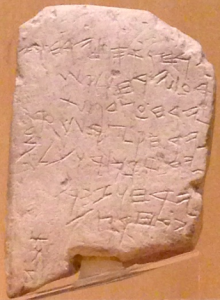
The Gezer calendar (10th c. BC?), in Paleo-
Hebrew script, summarizing agricultural
duties over the year. Authorship unclear; used
via a CC BY-SA 3.0 license (source).
Incidentally, it also brings Ecclesiastes into accord with the broader tradition of Ancient Near Eastern wisdom literature. It too laid a certain emphasis on the ephemerality of life. The Epic of Gilgamesh is a justly famous example:
Said the tavern-keeper to him, to Gilgamesh:
…“O Gilgamesh, where are you wandering?
The life that you seek you will never find;
…when the gods created mankind,
death they dispensed to mankind,
…life they kept for themselves.
But you, Gilgamesh, let your belly be full,
…enjoy yourself always by day and by night!
Make merry each day,
…dance and play day and night!
Let your clothes be clean,
…let your head be washed, may you bathe in water!
Gaze on the child who holds your hand,
…let your wife enjoy your repeated embrace!
For such is the destiny …”
—Sippar tablet iii, ll. 1-149
But this, to my mind, would finally be intolerable without belief in the general resurrection.
Footnotes
1Botanically speaking, olives are also a fruit, but of course in culinary terms they belong among vegetables (in “1990s food pyramid” terms), or among salty foods (according to flavor profile). Also, although referred to as trees for obvious reasons, date palms are more closely related to grasses than they are to most trees, and are considered merely “tree-like” by botanists!
2The citron (Citrus medica) is one of the naturally-occurring species of the genus Citrus; the citron that appears in the photo next to a lulav appears to be unripe, as ripe citrons are normally yellow, looking very like knobbly-rinded lemons (and the citron is ancestral to the lemon, which, like most citrus fruits consumed by humans today, is a hybridized fruit). The citron and lulav together being required for proper celebration of Sukkot is interesting, because the four tree species needed—the citron, date palm, myrtle, and willow—come from four distinct habitats, all present in Canaan:
i. The citron is frost-intolerant and requires a humid subtropical environment, easiest to find on the coastal Plain of Sharon.
ii. The date palm grows happily in semi-arid climates, like the edge of the Negev in the south.
iii. The myrtle prefers sunny hillsides, like those of Samaria or northern Judea.
iv. The willow prefers cool climates like those found in the mountains toward Lebanon, and searches out water quite aggressively, to the point that willows are practically weeds in some contexts. (Interestingly, willows have historically been used in a few places, England included, as a replacement for the palm fronds traditionally associated with Palm Sunday; the structure of the lulav is probably not the reason for this, but, as Chesterton might put it, it is a coïncidence that does coïncide.)
The upshot of this is, in order to appropriately celebrate Sukkot, ancient Hebrews from these four different environments would have had to bring a large surplus of what was available to them, and then trade with fellow pilgrims for the other three species they needed.
3I would gladly dismiss the expression “Christian antisemite” as a contradiction in terms. Certainly it is as ludicrous as it is despicable; it makes about as much sense as “Christian murderer.” Then again, sometimes Christians commit murder. Doing so is sure to damage their faith and perhaps destroy it, but it does not efface the mark made by baptism on their souls, nor shut them out of God’s forgiveness if they ever repent. That is one reason I can’t honestly say “Christian antisemite” is a contradiction in terms. There is another reason, which has more to do with “P.R.,” but not in the way you’re probably thinking. Plenty of people past and present who have professed Christianity have also (without openly renouncing that faith) expressed antisemitic views or sentiments, gone along with antisemitic policies, and provoked and perpetrated antisemitic violence of all kinds; some of them have been Christian hierarchs. This is a disgrace that, in my view, Christians (and Catholics in particular) have no right to set aside with a cheap Well, according to my tactical definition of Christianity, the people who did all that stuff weren’t real Christians anyway. If we are “members of one another,” we must also blush and render penance for other people’s crimes; it can’t be all glorying in other people’s virtues. Otherwise, we are found to be summer saints and sunshine apostles.
4If you’re wondering why I didn’t put the explanations of each letter up next to the letters, like you would expect: thanks, word-processing software that, at apparently completely random times, starts categorically refusing to put letters where I want them no matter what I do! It makes total sense that ‘alef, he, and cheth were coöperating, but then out of nowhere 3ayin absolutely insisted on changing places with the bit of text that came next! That’s fine and not at all annoying!
5About these four sounds.
i. The letter ‘alef indicates a glottal stop, which is a sound we do have in English, but for some reason don’t treat as a phoneme. Probably the clearest example is the sort of soundless stop suggested by the hyphen between the syllables of ah-ah-ah, when that not-quite-word is used to say something like Oh no you don’t or Hold on a second there.
ii. He is an h-sound, just like our letter h.
iii. Cheth is a more robust fricative than he, along the lines of the ch in the Scottish loch, but further back in the throat.
iv. The classical pronunciation of 3ayin is debated (it is typically either silent or another glottal stop in Modern Hebrew, and is sometimes pronounced as the ng of English “sing” in Yiddish). I write it as I do, using a 3 to stand in for the Middle English letter yogh (or 3ogh), because I take it to have been a voiced velar fricative—a sound with roughly the same relationship to the Spanish pronunciation of j that z has to s: s : z :: jSp : 3. Another possibility is that 3ayin was a uvular fricative rather than a velar one, or that it was a uvular trill, both of which would place it even further back in the throat.
6Please note: when I say that these are “stative verbs,” whether referring to English or Greek, this is a purely semantic category, one discussing these verbs’ meaning. Stative verbs are not distinct from other verbs in any grammatical, morphological, or syntactic way in either language—they don’t have special rules or endings or anything like that. It’d be like talking about a collection of verbs that are all “discourse verbs,” verbs of speaking, writing, or otherwise conveying information: it’s a category based on what these words describe, not how they behave in a sentence.
7Not much emphasis is laid on Shemini Atzeret in the Torah; its name means “the eighth day of assembly,” and its only explicit mentions come in Leviticus 23:36 and 39. Today, it is at this point that the yearly cycle of readings from the Torah concludes and therefore begins anew: the end of Deuteronomy and the beginning of Genesis are proclaimed, to great festivity (hence the holiday term sometimes conflated with Shemini Atzeret and sometimes distinguished from it, שִׂמְחַת תּוֹרָה [Šim’chath Tourâh], “rejoicing in the Law”). Unluckily, the only information I’ve yet been able to find about either Shemini Atzeret or Simchat Torah didn’t make it clear when in history this became the reditus-point of the Judaic lectionary.
8The “Five Scrolls” are the Song of Songs, Ruth, Lamentations, Ecclesiastes, and Esther. These are read for Pesach, Shavuot, Tisha b’Av, Sukkot, and Purim: Pesach and Shavuot are ancestral to the Christian observances of Easter and Pentecost, while Tisha b’Av, Sukkot, and Purim have no direct descendants in the Christian calendar. Obviously this post is part of our discussion of Sukkot in the subtext of John, and we have touched upon the first, the second, and the fifth already. As far as I can tell, Tisha b’Av does not feature in the subtext of John, which makes a certain sense: it is a mournful day, commemorating the destruction of both Solomon’s Temple and the Second Temple (which coincidentally fell on the same Hebrew date, according to tradition), but in John, the Temple itself is an ectype of which Christ himself is the archetype: all templar focus ultimately returns to him.
9This comes from the Penguin Classics volume The Epic of Gilgamesh published in 1999, a compendium of surviving fragments of the Gilgamesh story—no single copy has survived entire, and the tale was told and retold over hundreds of years, in multiple languages: it is set in Sumer, and the earliest fragments are in Sumerian, but the most complete versions are in Akkadian (a Semitic language from northern Mesopotamia and the lingua franca of the Near East roughly between the 20th century BC and the 7th, after which it gave way to Old Aramaic). The portion quoted here comes from the Sippar tablet (Sippar was a city not far from modern Baghdad), which preserves part of an Akkadian version dating to the 17th or 18th century. It appears to contain the most complete extant version of the exchange between Gilgamesh and Shiduri, an alewife, who is trying to dissuade Gilgamesh from wasting his precious time on a quest for immortality after the death of his treasured friend Enkidu. Gilgamesh does not listen at the time, instead searching out Utnapishtim, the Sumerian Noah (who received the gift of deathlessness from the gods after the Great Flood); however, Gilgamesh does not succeed in achieving immortality, and the implied lesson of the tale is that which Shiduri expresses here. It is striking that St. Paul refers to precisely such an outlook in I Corinthians 15:32, during his discourse on the significance of the Resurrection.









 Ad-Free & Subscriber Log-In