Last updated on: February 10, 2022 at 10:54 am By GFA Staff Writer
WILLS POINT, TX – Gospel for Asia (GFA World and affiliates like Gospel for Asia Canada) founded by Dr. K.P. Yohannan – Discussing Bakul and his family, the debilitating effects of drinking impure water, waterborne diseases, and the Gospel for Asia Water Filter that changed lives.
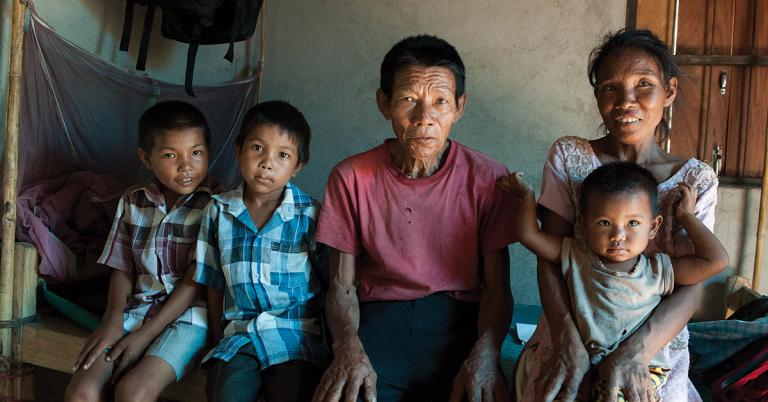
For years, Bakul and his family faced the debilitating effects of drinking impure water. Stomachaches, diarrhea, weakness, coughs and colds haunted them with every glass they drank. “I would take medicine for my stomach pain,” Bakul shares. “However, in spite of continuous treatment, I continued to struggle from unbearable pain in my stomach.”
Chance Encounter Changes Lives
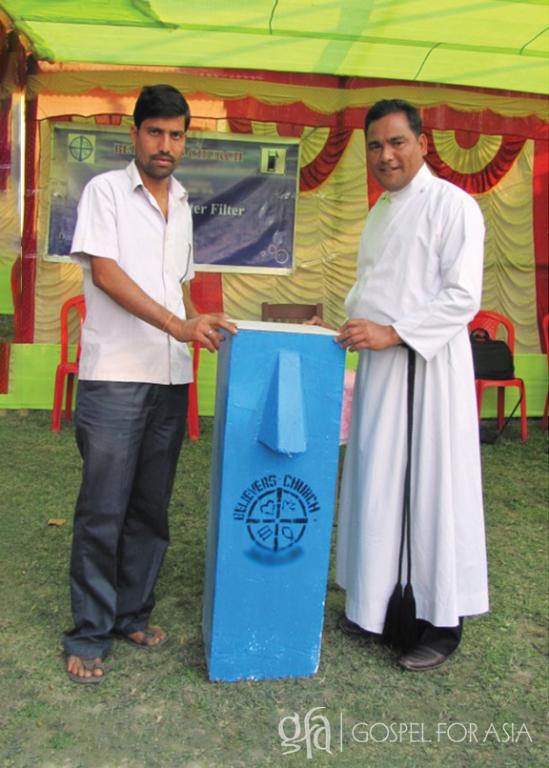
A Gospel for Asia pastor named Thorley served in Bakul’s village, but Bakul didn’t know much about him. One day, however, as Bakul passed by the church, he saw a large crowd: The pastor was passing out BioSand water filters to several people in the village.
“I asked Pastor Thorley to give me a water filter, and to my surprise, he gave me a filter,” Bakul shares. “Now nobody is suffering from stomach problems in my family.”
Bakul, having witnessed the kindness and generosity of Christians, has become curious to learn more about Jesus Christ. What’s more, Bakul is able to interact with Gospel for Asia (GFA) workers when they visit to perform routine maintenance on his filter.
*Names of people and places may have been changed for privacy and security reasons. Images are Gospel for Asia stock photos used for representation purposes and are not the actual person/location, unless otherwise noted.
Last updated on: September 11, 2022 at 8:37 am By GFA Staff Writer
WILLS POINT, TX – Gospel for Asia (GFA World and affiliates like Gospel for Asia Canada) founded by Dr. K.P. Yohannan – Discussing the struggles many experience with having no access to clean water, the waterborne diseases they are exposed to, and the Gospel for Asia Pastor that brought a Jesus Well to his village.
M
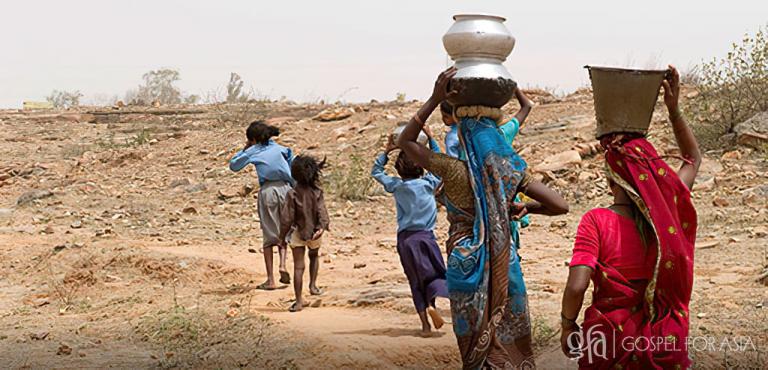
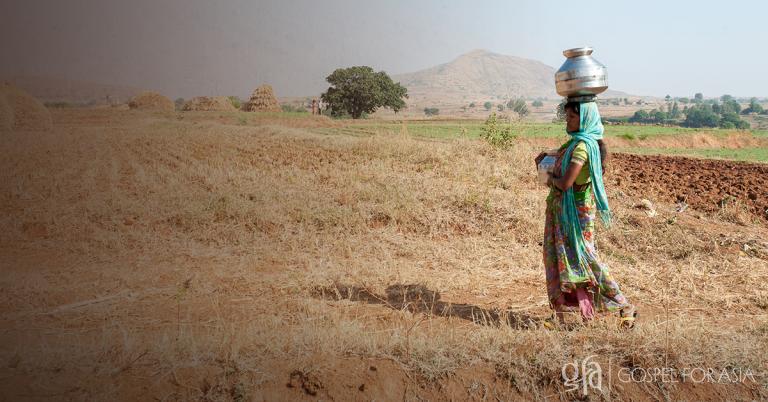
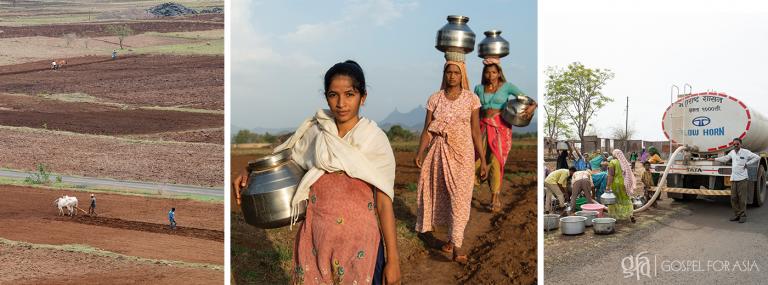
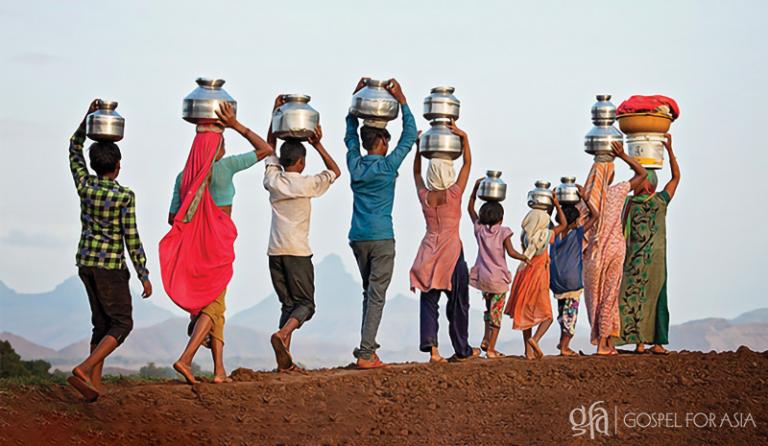
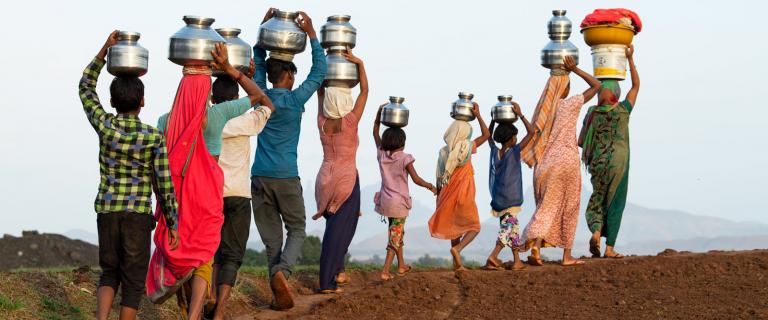
orning came early for the villagers. They trudged down a dusty path as the heat began to rise with the sun, dawning a new day. The morning light exposed strange yellow and red stains inside the pots they carried by hand, or had lifted above their shoulders or they placed atop their heads. Those stains revealed an immense struggle in the villagers’ daily lives.
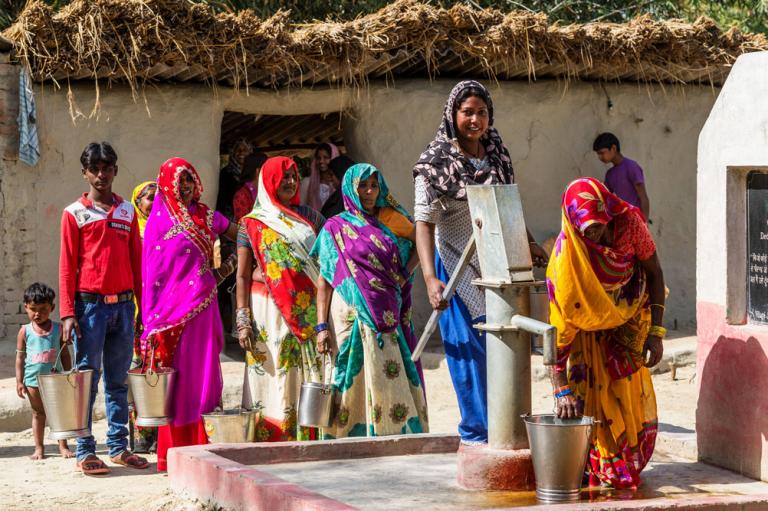
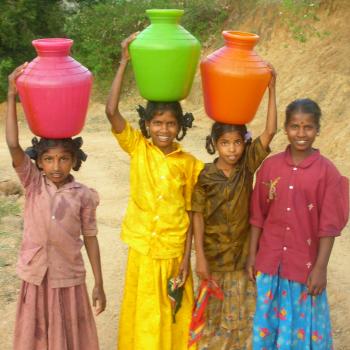
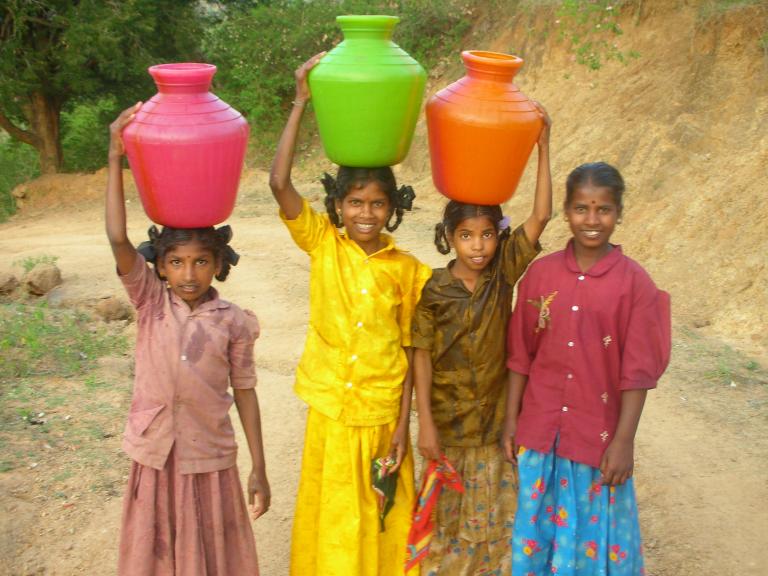
The families in Pastor Sahay’s village, struggled to find good water, like these women. The pumps in their village brought forth dirty water and caused them to have health issues.
Muddy Water Leaves Marks on Vessels and Stomachs
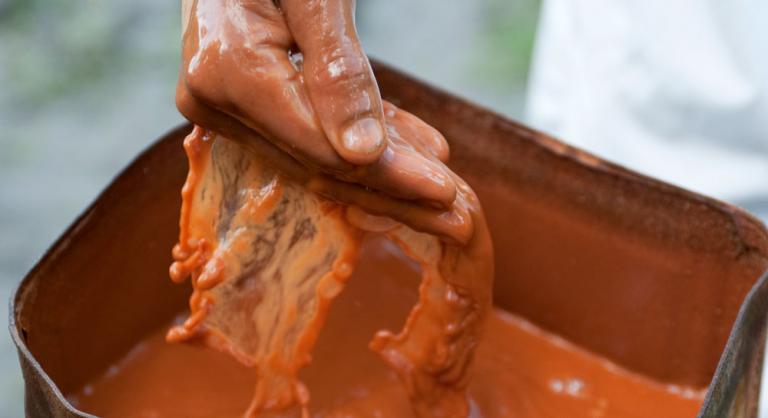
The water in the village was not safe to drink. Hand pumps installed years prior gushed forth muddy, red-colored water. It was obvious this was the culprit to the stains inside the water pots. But it wasn’t just the villagers’ vessels that bore the mark of the undrinkable liquid; their continual stomachaches and kidney problems made the statement loud and clear. If they wanted clean water to drink, they had to wake early to search for it outside their village.
Pastor Brought a Jesus Well that Impacted a Village
Gospel for Asia (GFA) pastor Sahay served in this village. He and his congregation distributed food once a month to the slum nearby. This impacted the community greatly, and many saw the love of Jesus through their simple acts of kindness. Pouring his life out faithfully unto the Lord, Pastor Sahay tried to help the community as much as he could. He was not unaware of the urgent and crucial need for clean water. Because someone gave to Gospel for Asia (GFA) to help provide clean water for people in Asia, Pastor Sahay could take action; he introduced a Jesus Well to the village he loved so well.
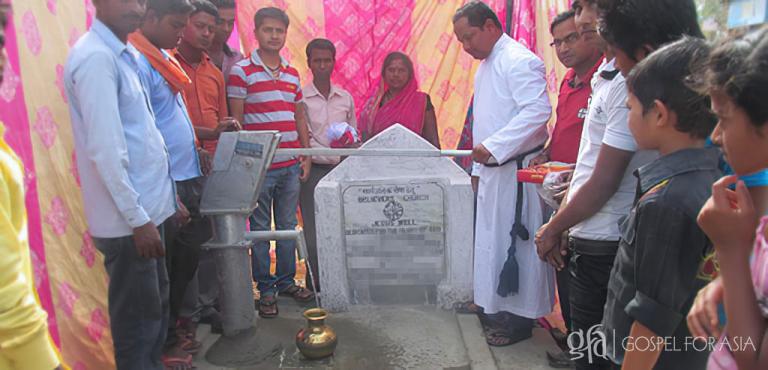
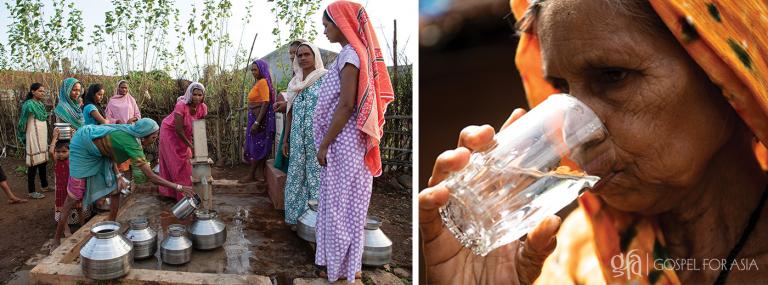
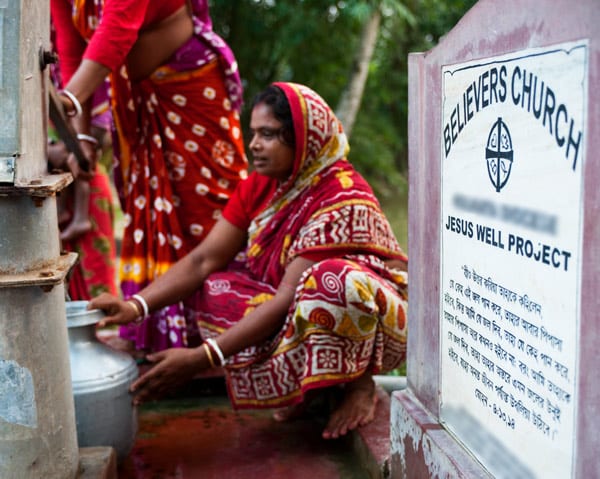
After the Jesus Well in Pastor Sahay’s village was completed (pictured), it was dedicated to the Lord. This well pours out clean water freely to those who come to it for a drink.
The Jesus Well was placed in a convenient spot: right by the road, in a public area where anyone could acquire clean water. The Jesus Well was also right by a school, hospital, auto shop and the local market. A man named Tunava who ran a small food stand close by the well said, “I used to bring water from far away to wash the vessels and for the customers…now, I can get pure drinking water at any time, and it’s very close to my shop.”
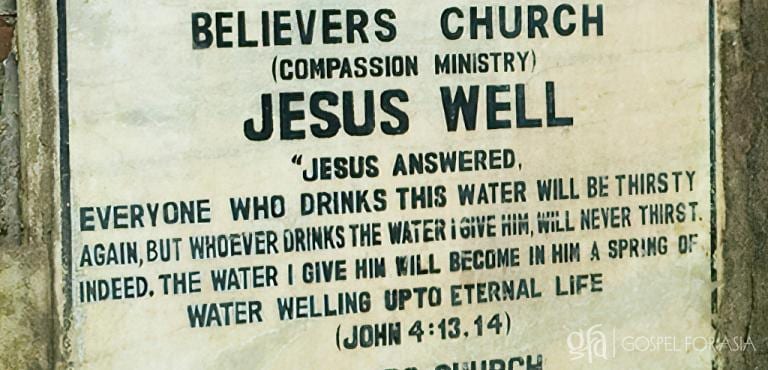
Today, around 200 people drink refreshing, pure water from this well every day and are able to read God’s Word inscribed on the well’s plaque that speaks about the Living Water offered freely to all, taken from the passage found in John 4:13–14.
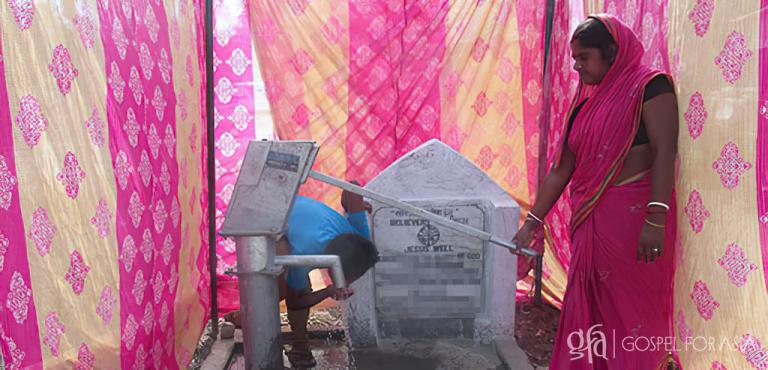
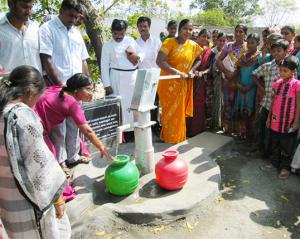
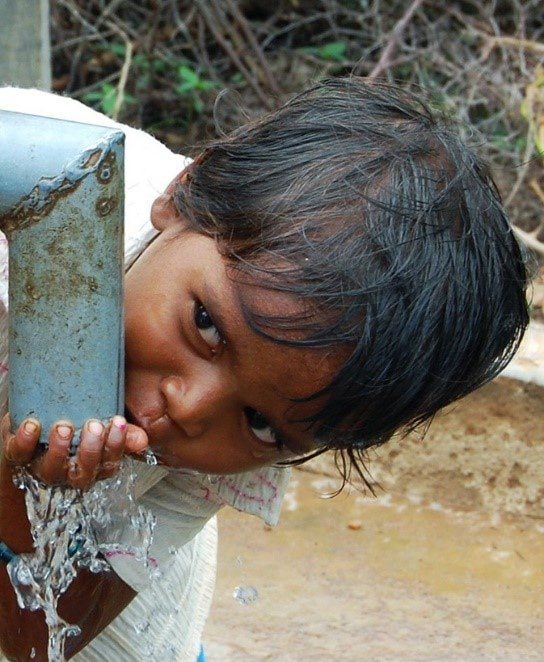
A local woman pumps water for her daily use from the new well on the day it was dedicated. Her family is no longer threatened by waterborne illness that had been impacting her community.
Jesus Well Stands as a Beacon of Hope to Community
Because of this act of kindness, many hearts have been touched, and families have desired to hear more about the love of Jesus. This opened doors for Pastor Sahay and his congregation to display more of the hope of Christ to those around them and share about the God who offers living water for their souls. The village chief was very grateful to Pastor Sahay and said, “I could not help my villagers by providing them with a hand pump. But thanks [to the church] for providing a Jesus Well for my community.”
A local man in the village was very touched by the gift of the Jesus Well and expressed his thanks saying, “I appreciate the work of the church for the community. These days, no one thinks of others, but the work the church is doing is really appreciable.”
This village now has a tangible reflection of the Living Water that Jesus offers every time they pump the clean, fresh water from the Jesus Well. No longer do they have to fear waterborne illnesses when they take a glass of its water. They’ve also had the opportunity to learn about God’s tremendous love. You can be part of giving hope in buckets of water by giving a Jesus Well today.
*Names of people and places may have been changed for privacy and security reasons. Images are Gospel for Asia stock photos used for representation purposes and are not the actual person/location, unless otherwise noted.
WILLS POINT, TX – Gospel for Asia (GFA World and affiliates like Gospel for Asia Canada) founded by Dr. K.P. Yohannan – Discussing Gafur and his wife, Dishita, the isolation they experienced due to their faith in Jesus, the struggle of walking 4 miles daily to fetch clean water, and Gospel for Asia (GFA) providing Jesus Wells to these communities in need.
Discussing Gafur & Dishita, the struggle of walking 4 miles daily to fetch clean water, & Gospel for Asia (GFA) providing Jesus Wells to communities in need
What would you do if the people in your community forbid you from using the local water to drink, take showers or wash your clothes? You would have to immediately find another water source for your family and livestock to survive.
This happened to Gafur and his wife, Dishita, a couple living in Asia. One of their sons was seriously ill when they requested a visiting pastor to pray for him. God answered in a wonderful way and healed the boy completely. This miracle led the boy’s grateful parents to put their trust in Jesus! However, as the family started to take part in church activities, the villagers opposed them and the other believers.
The villagers stopped talking to them, didn’t invite them to any social functions and no longer allowed them to draw water from any source in their community.
The believers then had no choice but to walk two miles—one way—to a hand pump installed on government premises and carry water back to their homes in large pots every single day.
Walking 4 miles every day
for 7 years adds up to 10,220 miles.
Imagine how many trips Dishita and her family had to make over the next seven years to fetch enough water for drinking, taking baths, cooking and washing dishes and clothes for their seven-member household!
Yet in spite of all these hardships, Gafur, Dishita and the believers in this village remained faithful to the Lord and trusted Him to meet their needs.
A Jesus Well like this one now provides clean water for Gafur, Dishita and their whole village.
And He did! In January of 2016, thanks to the generosity of our Gospel for Asia (GFA) family, a Jesus Well was drilled in this village for the Christians and all the other people in their community to use. When the believers freely shared their clean water with the villagers, the people’s attitude changed. Now the villagers talk with the believers and are interested in hearing about the love of God. Some even ask for prayer and visit house prayer meetings.
The struggle for access to clean water this group of Christians faced is shared by millions of poor people. Often because of extreme poverty, discrimination or drought, their only water sources are polluted, stagnant ponds. They have no other option but to use that filthy, disease-ridden water for drinking and every other human need, as well as for watering and cleaning their livestock. Consequently, people suffer much sickness, and tragically, many children die as a result.
We can change the suffering of such a community in need by providing them with a Jesus Well. Or you can help a family by giving a BioSand water filter, which turns polluted water into clean, safe drinking water.
This plaque by a Jesus Well displays John 4:13-14.
Both are truly life-saving gifts that remind people of the love and care of their heavenly Father. Jesus Wells even have an inscription that says, “Jesus said, ‘Whoever drinks of this water will thirst again, but whoever drinks of the water that I shall give him shall never thirst’ ” (John 4:13–14).
*Names of people and places may have been changed for privacy and security reasons. Images are Gospel for Asia stock photos used for representation purposes and are not the actual person/location, unless otherwise noted.
WILLS POINT, TX – Gospel for Asia (GFA World and affiliates like Gospel for Asia Canada) founded by Dr. K.P. Yohannan – Discussing Mudit and his family’s poverty, the struggle to provide food and clothing as well as for his children’s education, and the Gospel for Asia Supported Bridge of Hope center that opened doors to a new way of life.
B
eady eyes surveyed the landscape without fear. A long, snakelike trunk searched the ground, looking for consumables. Two ivory tusks protruded from the mouth of this king of beasts. Four legs, like tree trunks, supported the mammoth body as it moved through the familiar domain.
Mudit’s heart sank at the sight. There was nothing he could do to stop the elephant from eating its way through his small plot of farmland.
As Mudit realized his time, effort and investment had been wasted yet again, despair etched itself deeper into the elderly father’s heart. How could he ever provide food for his children?
A Community Bereft
Mudit lived near a tea estate with thousands of other families. For years, their primary occupation had consisted of harvesting and processing tea leaves. The wages were never spectacular; sometimes they were barely enough for each family to survive. Then the estates started to close.
The communities quickly deteriorated as families struggled to make ends meet. Teenagers turned to thievery, cutting down public trees for lumber and stripping the area of metal to sell for scrap. Some families moved away, seeking to find a fresh start elsewhere. Many who remained took the daily risk of traveling in search of work, potentially wasting a day and travel expenses if work wasn’t available.
Mudit, despite being 65 and unable to do much physical labor, soon found himself among that group. If he found work, he could earn a small amount every day, but that only happened three or four days a week.
“I struggled to provide for my children’s education, for their clothing and food,” Mudit explains. “If anybody is sick at home, I have to borrow money from people.”
He endeavored to grow potatoes and other vegetables to feed his young children, but wild elephants would occasionally help themselves to the produce from his small plot of land.
“I am not able to buy enough food for the children,” Mudit says. “What we have, we try to manage with that.”
Helping as Much as They Can
The local government school fed several children a daily meal, but not every child could afford to enroll; the price of notebooks and other supplies might be a week’s worth of the family’s wages. Many children labored alongside their mothers and fathers instead. Mudit’s eldest son, Patag, only 13, was among them, while his two younger sons, Titir and Binod, found themselves on a happier path.
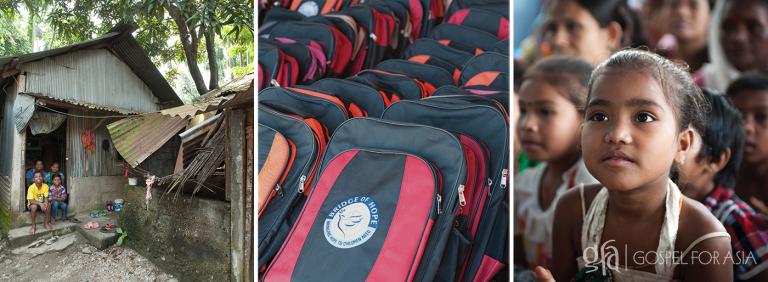
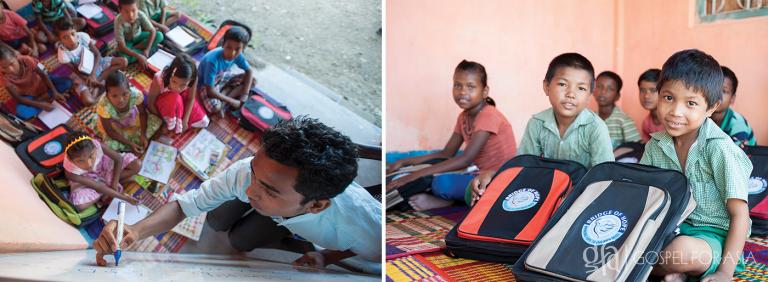
Seeing the desperate situations of many parents and children, a group of Gospel for Asia (GFA)-supported workers started a Gospel for Asia (GFA)-supported Bridge of Hope center in the area, hoping to alleviate the strain of several families. At the center, 120 children would receive a daily meal, school supplies, clothing and toiletries, along with compassionate care from the social workers and teachers.
“Now my two children Titir and Binod go to our Bridge of Hope project center, and that has been a great help for my family,” Mudit shares, “because they are given every basic thing that my children need, including food. … I would never be able to buy any of those things for my children and for their education. This has been a great help for me.”
Only the Beginning
The transformation in Mudit’s children is more than just full bellies and new clothes. Children in Bridge of Hope centers across Asia have found freedom to pursue dreams of becoming doctors, engineers, teachers and officials. Through the tutelage and attention they receive, children have the opportunity to excel and bless their communities in many ways.
“Bridge of Hope has taught them so many good things,” Mudit shares. “I can see the change and the development in their thinking. If Bridge of Hope had not been there, I think my children would have discontinued going to school [by] now. They would be roaming here and there . . . but now they are changed and happy. They always want to go to school.”
Although the Bridge of Hope center has already made a difference in the lives of Mudit’s family, many others still struggle. There are thousands of children living in or near the tea estates. Thousands of children who know the struggle for survival.
“There is no way possible to help each family or each individual,” shared a local Gospel for Asia (GFA)-supported worker. “I would say 25–30 Bridge of Hope centers in [these] tea gardens is not going to be enough.”
Through all the challenges, the work is just beginning, and for now, at least 120 children in the tea gardens have a chance for a better future through Bridge of Hope.
We don’t yet know how Titir’s and Binod’s stories will end—their journeys with Bridge of Hope are just beginning. But they will have enough food, love, care and guidance to carry them through another day, no matter how many other dangers are prowling around.
At Gospel for Asia-supported Bridge of Hope centers, 70,000 children across Asia are receiving free education, food and medical care—and ultimately discovering a new way of life!
*Names of people and places may have been changed for privacy and security reasons. Images are Gospel for Asia stock photos used for representation purposes and are not the actual person/location, unless otherwise noted.
Learn more by reading the Gospel for Asia Special Report on how millions of children are trapped between extreme poverty and the profits of others: Child Labor: Not Gone, but Forgotten
Click here, to read more blogs on Patheos from Gospel for Asia.
Last updated on: August 25, 2022 at 10:57 am By GFA Staff Writer
WILLS POINT, TX – Gospel for Asia (GFA) – Discussing the great need for solutions like Jesus Wells to combat the water crisis that millions suffer under.
Every March through May, drought settled in Vimal’s area, exasperating their water crisis by drying up the small ponds and turning the fields to dust. No longer able to water their cattle in the little streams and ponds in the fields, Vimal and the other farmers of the village brought their livestock to join the women and children at the well, swelling the line waiting for water.
Bickering often broke out in these long lines because villagers were convinced their own needs were greatest. During the dry season, there was not enough water to go around, and villagers had to forgo bathing and limit cooking. The lack of access to clean water filled the village with tension and illness.
Several years ago, Vimal’s relative became sick because of the unsafe water coming from the well.
“[My relative] complained of stomach pain,” Vimal shares.
“He suffered for more than two months, and the problem started to grow even worse. After two months, he passed away because of stomach pain and, I believe … consuming unsafe water.”
Other families suffered loss too. A young boy around 5 years old developed severe diarrhea because of the contaminated water. Not having a hospital close by, the family had to wait until the next morning to see a doctor. The boy was too sick, and the doctors were not able to help him. He passed away.
These difficulties soaked into the fabric of the community, infusing it with a great sense of need.
The First Drops of Hope
Pastor Bharit
Pastor Bharit began ministering in Vimal’s village, praying for people and sharing God’s love. He knew the troubles of this community intimately because he grew up there. He brought comfort to deathbeds and encouragement to the weary.
Vimal became the first in his village to join Pastor Bharit in worship and prayer. As Vimal’s heart for the Lord grew, so did his burden for his community. He began asking God to provide good, clean drinking water for the village. As Pastor Bharit’s congregation grew, they joined Vimal in praying for abundant, safe water, trusting God to take care of them in their crisis.
As the congregation, which had grown to more than 100 people, began planning for the Jesus Well, they looked for the best place to put it. They wanted a good location that would be convenient to all the villagers, eliminating the several miles traveled each morning and evening to fetch water.
Vimal’s neighbor heard about the planned Jesus Well. Though not a member of Pastor Bharit’s congregation, he donated a portion of his land for the well. Being alongside the road in a central location, it was the perfect spot.
“Because of this Jesus Well we are helped so much,” Vimal says. “My family doesn’t have to walk a far distance … Now the time [spent] fetching water can be invested in any other work.”
The health of the community has improved tremendously. When the Jesus Well was first installed, the community had it tested, at the direction of the local authority, for safety. After testing the water in a lab, the report came back that the water was very pure and safe to drink.
Word spread to other villages about the pure water available from the Jesus Well, and people now travel several miles to get water from Vimal’s village. As Vimal sees the needs beyond his village, he has begun praying for more Jesus Wells for surrounding communities, so everyone can share in God’s blessings.
Last updated on: September 10, 2022 at 7:47 pm By GFA Staff Writer
WILLS POINT, TX – Gospel for Asia (GFA) Special Report #1 – Discussing the world’s quest for access to pure water that is safe to drink.
India: Success and Challenge
In recent decades, India has emerged as a global economic powerhouse. It is now the seventh-largest economy in the world by nominal gross domestic product (GDP)[27] and at least the fourth largest in purchasing power parity.[1] Much of this success stems from the technology field, India’s fastest-growing sector. Information technology, process outsourcing and software services are among the country’s booming industries.
600 million Indians face high-to-extreme water stress.[6]
By 2020, 21 cities could completely run out of groundwater.[7]
By 2030, the country’s water demand is projected to be twice the supply.[8]
The booming cities have borne a large portion of India’s water stress. Bangalore, known by some as India’s Silicon Valley, is a good example. The city’s needs were once met by wells that reached 300 feet deep. But now, 400 bore wells must go down as far as 1,500 feet to find water. How long will that suffice? No one knows.
In the countryside, the challenges are different but just as dire. Agriculture uses some 80 percent of India’s water.[9] When water is unavailable, the farmers feel it immediately. They can quickly lose their livelihoods.
Much of India is arid or semi-arid. Vast areas receive rain only sporadically from storms brought by the summer monsoons. Many people collect their water from surface sources, which are often contaminated. The daily trek to a local pond is a regular feature of life for many rural Indians. They may walk for hours just to obtain their day’s supply of water. That leaves little time to work productively or improve their lives.
For years, Gospel for Asia (GFA) has been helping to equip national workers to get wells installed in needy communities. They’re called Jesus Wells and are fitted with a plaque sharing Christ’s words to the Samaritan woman:
“Whoever drinks of this water will thirst again, but whoever drinks of the water that I shall give him will never thirst. But the water that I shall give him will become in him a fountain of water springing up into everlasting life” (John 4:13–14).
Israel: A Glimpse into the Future
While discussions of global water issues typically focus on the problems, it’s also helpful to consider the success stories. One of those is the tiny state of Israel.
After World War I, the territory of Palestine came under the control of the United Kingdom. As the British government was considering what to do with this important strip of land, its economists concluded that the area’s water resources could only support about 2 million people.[10] There were slightly more than 800,000 residents there at the time. But after the modern state of Israel was created in 1948, that number nearly doubled in just three years—and kept climbing.[11] Today, Israel is home to more than 8 million people,[12] with another 2.8 million in the West Bank[13] and 1.8 million in the Gaza Strip.[14]
Clearly, a drastic program was needed to meet the water demands of this booming population. Through the efforts of visionaries such as water engineer Simcha Blass, Israel not only met this challenge but became an exporter of water technology, water-intensive crops—and water itself. The story of that success can serve as a model and inspiration for other countries.
Israel points the way to a future free from water insecurity.
Simcha Blass, an Israeli visionary in the clean water field. Photo by Ybact on Wikipedia / CC BY-SA 3.0
Israel’s leaders realized that all those new immigrants would need to eat, so food production became an urgent priority. The Negev in the south of Israel was a vast dry desert where few people lived. But Simcha Blass was convinced there was water underground that could be accessed through deep drilling. He was right. That was the beginning of an agricultural boom in one of the world’s most inhospitable environments. Some people saw it as a fulfillment of the prophecy in the book of Isaiah: “The desert and the parched land will be glad; the wilderness will rejoice and blossom” (Isaiah 35:1 niv).
Blass also envisioned pipelines that would stretch from the water-rich north of Israel to the south where water was most needed. Through years of effort, his visions became reality.
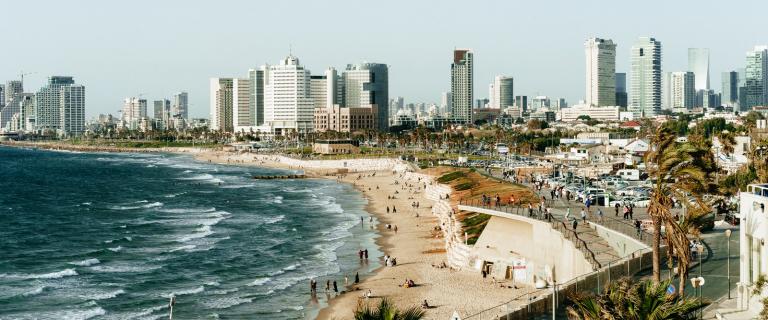
Israel’s visionaries then turned their sights to the world’s most abundant water source—the oceans. The idea of processing seawater for drinking and agriculture has long been an elusive dream for people around the world. Israeli scientists experimented with several desalination techniques, most of which proved too costly to be practical. But with perseverance, Israel developed a system which, though still expensive, provides an important supplement to its other water sources. Israel now has several functioning desalination plants on its Mediterranean coast, which provide an astonishing 27 percent of the country’s water.[15] Most importantly, the desalination plants serve as a kind of insurance policy against severe droughts and other disruptions. The ocean, after all, is always there.
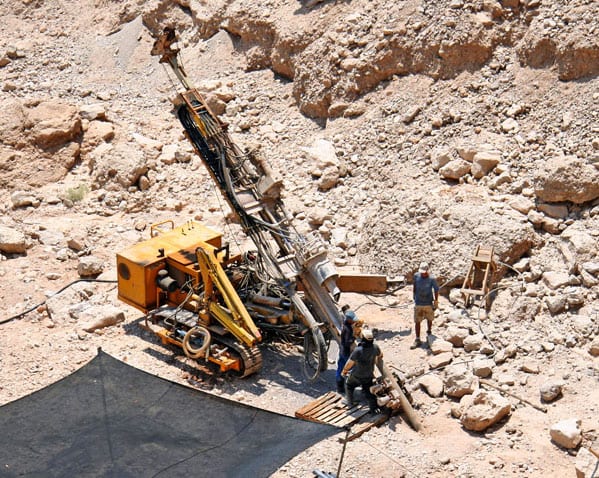
Drilling for water in Qumeran Valley, Israel Photo by Tamarah on Wikimedia / CC BY-SA 2.5
Reclaimed waste water is another promising source of water for agriculture that Israel has used effectively. The idea of reusing sewage is repulsive to most people, but when water is at a premium, as in Israel, it’s an option that can’t be ignored. The main concern with recycled waste water is that dangerous microbes or other contaminants might remain even after processing. That could endanger anyone exposed to it, as well as the crops treated with it and the groundwater under the crops. Israel addressed this risk with a process that resembles a giant version of the BioSand water filters described earlier.
Israel’s sewage treatment plants were located near some sand dunes, under which there was a known water aquifer. The water engineers began speculating: What if the treated waste water were released into the sand and allowed to percolate down into the groundwater? Would the sand act as an effective filter? It was a risky experiment, but worth trying. After more than a year, the results were in. Yes, the sand made the water clean, safe enough for agricultural use. Today, Israel reuses more than 85 percent of its sewage, which provides 21 percent of its water.[16]
Israel also pioneered the use of drip irrigation, which made it possible to grow abundant crops by using limited water supplies efficiently.
These innovations may seem out of reach for many developing countries. Their implementation would require concerted, long-term effort, and they can be expensive. But they show what is possible. These are things we know can be done—because they have been done. They point the way to a future free from pure water insecurity. And that’s something all people can aspire to.
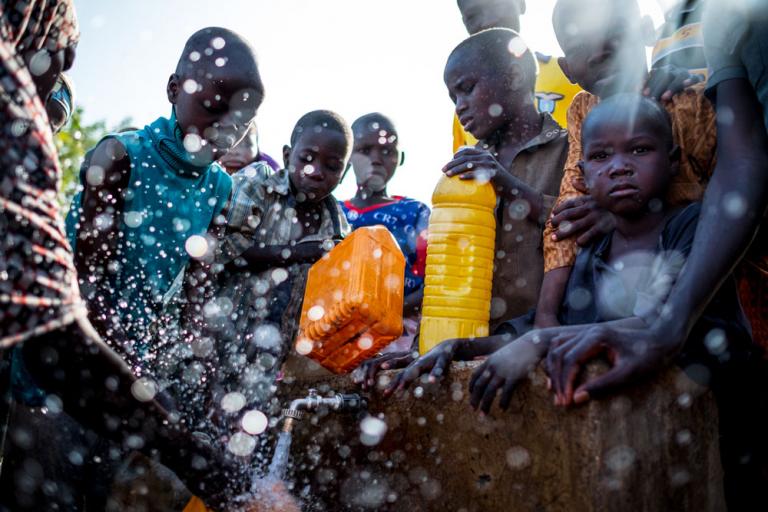
Internally Displaced People fill containers with water at a tap inside the Dalori camp in Maiduguri, Borno State, Nigeria. Photo by Ashley Gilbertson VII Photo, UNICEF
The Big Picture
The world’s need for pure water has only accelerated with the inexorable growth in population, which could reach another 2 billion by 2050. And by then the demand for water could increase by 30 percent.[17]
The United Nations has appropriately designated March 22 as World Water Day to focus on the global need for pure water. Along with international bodies like the U.N. and the World Health Organization, countless nonprofits and NGOs are addressing the issue. Many of them focus on Africa, which has some of the most severe water problems. But Asia is in urgent need of help too, and even affluent countries are not immune from water emergencies.
Those who deal with the global pure water crisis recognize the critical need for funds to attack the problem. Usually, the people most in need don’t address their own problems because they simply can’t. They don’t have the resources. And they often don’t have the leisure time to think beyond their immediate survival. So outside funds are essential to solving the problem. But that’s not all that’s needed.
Relief organizations that drill wells in poor communities must also think about their long-term maintenance. When the local people haven’t been taught how to care for the wells, over time those wells become useless. In a 2009 report, the International Institute for Environment and Development (IIED) noted that 50,000 such wells in rural Africa had become nonfunctional. The reason was distressingly clear: “The root cause is the water community’s failure to plan for maintenance of the infrastructure in a systematic way …”[18]
Outside organizations came in, installed wells with the best of intentions, and then left. But their work did not endure.
Gospel for Asia (GFA) knows of the pitfalls that beset many relief efforts. To ensure their work will be sustainable while keeping costs low, Gospel for Asia (GFA)-supported workers employ local people to drill Jesus Wells, and they train local people to maintain the wells. In addition, Jesus Wells are constructed with local components, making them much less expensive than those brought in from outside. Buying materials in bulk saves even more money. Gospel for Asia (GFA)-supported workers can install a complete well for 1,400 USD. By drilling deep, they can reach water that may have been inaccessible before. Villagers can be assured of pure water even through the dry seasons.
Jesus Wells are conveniently located for community access, and the water is always freely available to anyone, regardless of religion, class or background. Each Jesus Well serves an average of 300 people, and the wells are built to last for decades.
Along with providing pure water, Jesus Wells strengthen the local economy and inspire a healthy pride of ownership.
In 2017, Gospel for Asia (GFA) helped install more than 4,600 Jesus Wells in Asian communities. But that’s just a start. With the generous support of donors throughout the world, Gospel for Asia (GFA)-supported workers will continue to help address the global water crisis—one community at a time.
Six Steps to Pure Water Security
The world’s water problems can seem overwhelming. Some of the solutions are complex, difficult and expensive. But others are simple, easy and cheap. Here’s a short list of things that can make a difference—starting with the easiest and ending with the ones that still await as promises for the future.
Provide BioSand water filters.
Just one of these portable, inexpensive items can literally save an entire family from a life of sickness and hardship. To deprive vulnerable people of this simple solution would be tragic.
Drill deep wells.
Not every well will endure through droughts and overuse, but here’s the key to long-term success: Don’t stop when you hit water! Keep drilling. Deep wells will ensure the water keeps flowing through the dry times.
Train local people to maintain the wells.
What good is a well that’s broken or contaminated? Remember 50,000 wells in Africa alone are sitting unused because of inadequate maintenance. It’s not enough to provide the well. Instilling the knowledge to maintain it over the years is also essential.
Launch water-reclamation programs.
Sewage may be unpleasant, but it’s also a valuable resource. Properly treated, reclaimed water can revolutionize agriculture almost anywhere in the world.
Develop national water policies.
Water is a community resource. It can’t be managed effectively with scattered, isolated efforts. Most national governments are grappling with this reality. Some are responding with effective programs. That must happen on a wider scale.
Pursue desalination.
It’s expensive now. But so are sickness, poverty and death. The ocean is the one water source that will never be depleted. This is a promising avenue for the future.
Dying of Thirst: The Global Water Crisis – The Crucial Quest for Access to Clean Water: Part 1 | Part 2
This Special Report article originally appeared on gfa.org.
[15] Siegel, Seth M. Let There Be Water, p 252. 2015 Thomas Dunne Books.
[16] Siegel, Seth M. Let There Be Water, p 252. 2015 Thomas Dunne Books.
[17]The United Nations world water development report 2018: nature-based solutions for water; facts and figure, p. 2. UNESCO Digital Library. 2018.
[18] Skinner, Jamie. Where every drop counts: tackling rural Africa’s water crisis. International Institute for Environment and Development. http://pubs.iied.org/17055IIED. March 2009. Accessed December 27, 2018.
Last updated on: August 25, 2022 at 11:47 am By GFA Staff Writer
WILLS POINT, TX – Gospel for Asia (GFA) Special Report Part 2– Discussing the global water crisis and the quest for access to clean water.
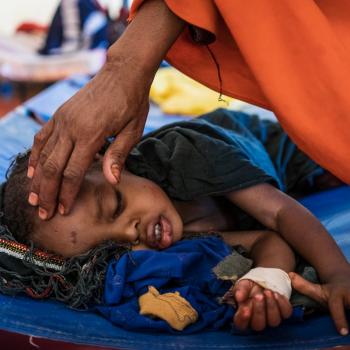
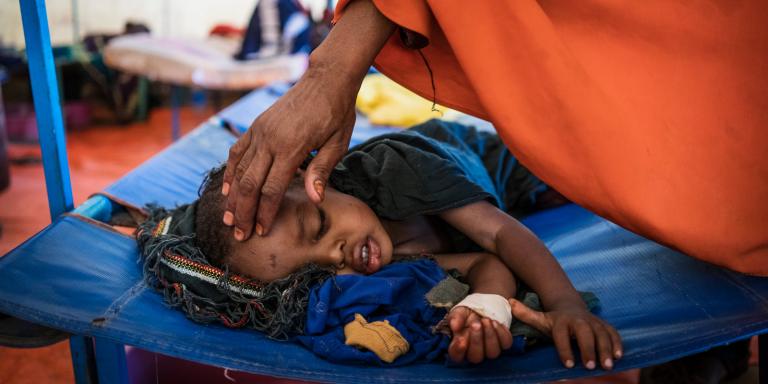
A mother cares for her son who is being treated for cholera at a UNICEF-supported cholera treatment center in Baidoa, Somalia Photo by Mackenzie Knowles-Coursin, UNICEF
Waterborne Diseases Caused by the Global Water Crisis
Children are most vulnerable because their metabolisms use more water than adults’, and their body weight consists of more water proportionally than an adult’s. Their kidneys are also less able to conserve water.[2]
Diseases that are so deadly can be prevented
with changes that are simple.
In some documented cases, improving the quality of water at the source, combined with treatment of household water and safe water-storage systems, has reduced the incidence of diarrhea by 47 percent. And studies show that simply handwashing with soap can reduce the incidence by 40 percent.[4] These figures underscore a tragic truth: Diseases that are so deadly can be prevented with changes that are simple.
Trace Element Contamination Adds to Global Water Crisis
Sometimes it isn’t living organisms that make people sick, but it’s the naturally occurring elements in the water. Heavy metals and other trace elements are usually present in our diets, and in fact, many of them are essential—but only in tiny quantities. When we ingest more than the safe levels, we can experience illness and even death.
In 2014, four Jesus Wells were dug by Gospel for Asia-supported workers in one drought stricken region—now approximately 5,300 people benefit from these wells. Read the story »
Some of these elements are in the ground and leach naturally into the water we use, while others are introduced into the water supply through industry, mining and agriculture.
This was the problem facing four Asian villages when Gospel for Asia (GFA)-supported workers came to the scene in 2014. This area typically experienced several months of drought, followed by heavy monsoon rains. But the water left by the rains was contaminated with chemicals. Villagers with enough money could buy their own water, but the poor had to walk long distances every day to ask for water from local landlords. Gospel for Asia (GFA)-supported pastors in the area arranged for wells to be installed in all four villages, bringing clean water at last to approximately 5,300 people.
Water is a fragile resource, and its problems
are not limited to the developing world.
Since lead paint was identified as a major problem in the United States during the 1970s, a concerted national campaign reduced its impact over time. But Americans received a wake-up call in 2014 when the water supply in Flint, Michigan, came under scrutiny—as described by Karen Burton Mains in GFA’s special report “The Global Water Crisis: Finding Solutions to Humanity’s Need for Pure, Safe Water.”[5]
Residents complained about the color, taste and smell of their water. It turned out that the service lines from water mains to individual homes in Flint were made of lead and were not treated with corrosion inhibitors, which keep the contamination at acceptable levels. Eighty-seven cases of Legionnaire’s disease were associated with the contaminated water, leading to 12 deaths. Overall, more than 100,000 people had been exposed to a dangerous poison.
The Flint saga reminded everyone that water is a fragile resource, and its problems are not limited to the developing world.
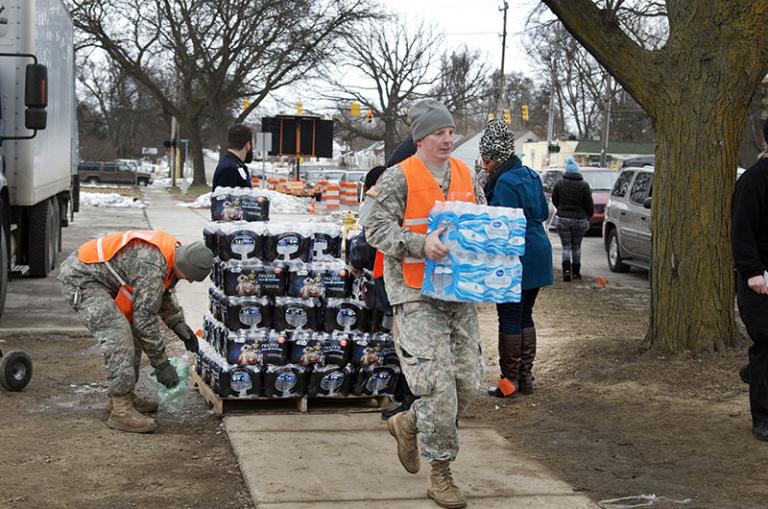
The National Guard delivers bottled water to residents of Flint, MI.
In 2017, the Reuters news agency conducted an investigation that revealed how widespread such issues really are even in the United States. Their reporters discovered 3,810 areas in the U.S with childhood lead poisoning rates twice as high as those found in Flint. And 1,300 areas showed lead levels four times greater than those found in Flint.[6] The affected locations included 34 states and Washington D.C. In the best of outcomes, such a national scandal should at least inspire compassion for others around the world who struggle to find clean water.
Arsenic is well known as a poison, but it’s actually an element that occurs naturally throughout the world. When it enters a water supply, however, it can cause unimaginable suffering.
In 1983, scientists discovered arsenic in the water of 33 villages in West Bengal, India. Subsequent investigations revealed similar contamination in 2,417 villages along the flood plains of the Ganges River.[7]
Arsenic poisoning can cause severe abdominal pain, nausea, vomiting and diarrhea. Other symptoms include abnormal heart rhythm, muscle cramps and tingling extremities. Some victims first notice unusual lesions and growths on their skin, and many then discover they have cancer. Victims of arsenic poisoning can recover if the source of their illness is removed in time.
Several other disease-causing trace elements—most of them heavy metals—contaminate water supplies today. Cadmium accumulates in the kidneys and hepatic system and can cause cancer. Chromium, likewise, can cause liver and skin cancer when it reaches high levels. Zinc and copper can also be dangerous to health.
A simple family solution to the global water crisis are biosand water filters.
A Simple Solution to the Global Water Crisis
People in the developed world rely on their water providers to protect them from such threats. For those who can afford it, a home filtration system offers added security. But people living in poorer areas have no such protection. They often collect their water from fetid ponds or polluted streams. They’re exposed to all the worst dangers that may be hidden in their water.
Aanjay, a farmer in Asia, saw firsthand the effects of contaminated water on his family and his entire village.
“We were forced to use dirty and filthy water for cooking and drinking,” he recalls. “Thus, we suffered stomachache, jaundice, typhoid and diarrhea.”
The villagers also had to use the tainted water for bathing, which caused skin infections.
That changed when some Gospel for Asia (GFA)-supported pastors provided BioSand water filters for Aanjay’s family and several others.
“Along with receiving a filter, families also received health and hygiene training that works to significantly lower the incidence of waterborne illness,” Aanjay says. “Now the villagers are getting purely filtered water for drinking. Since [the Biosand water filters] were installed, all water-caused and waterborne diseases have ceased.”
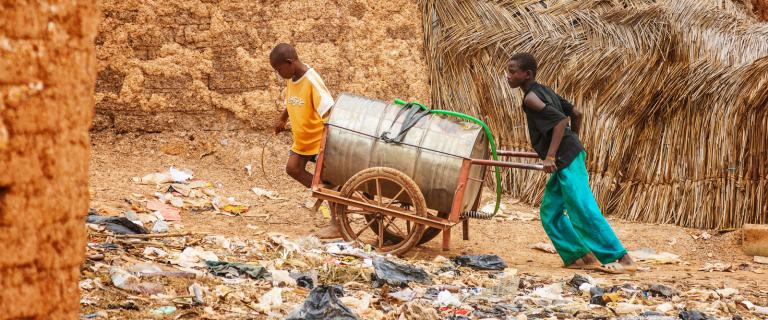
Two young boys towing a can of water in the slums of Ouagadougou, Burkina Faso, in order to distribute water to the inhabitants.
Burkina Faso: Africa’s Anguish
Recurring drought, contamination and lack of funds have all contributed to Africa’s severe water problems. A vivid example of all three can be found in the little landlocked country of Burkina Faso.
Located in the vast savanna region south of the Sahara Desert, Burkina Faso endures up to eight months of dry weather each year.[8] When drought makes conditions even worse, as it did in 2016, a true crisis occurs. That year, the capital, Ougadougou, was able to provide only intermittent water service for its 2 million residents. People were forced to travel far into the countryside to find usable water.[9] Water shortages like this, and the power outages that accompany them, have become a normal part of life for city residents.
Nearly half the residents of Burkina Faso live without clean water.
For people in rural areas, the hardships are even worse. Eighty percent of Burkina Faso’s people are subsistence farmers,[10] so droughts are especially devastating for them. The country is also plagued by waterborne diseases common to undeveloped areas—diarrhea, hepatitis A and typhoid fever.[11]
According to Water Aid UK, 4,500 children under the age of 5 die of diarrhea each year in Burkina Faso, and nearly half the residents live without clean water.[12] When the rains do come, mosquitoes that breed in the standing water spread malaria, yellow fever and dengue fever.
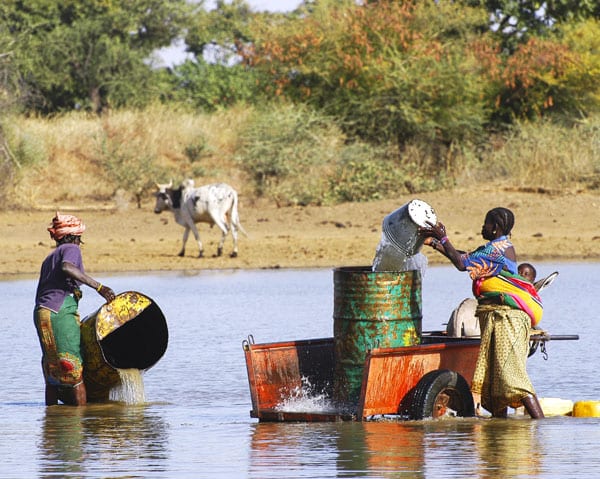
These women are collecting water for crop irrigation in Burkina Faso, where the global water crisis is severe.
One of the main industries in Burkina Faso is gold mining. But the mining process has introduced deadly arsenic into the groundwater.[13] On top of all these challenges, the rapidly-growing population is putting unprecedented stress on the water supply. War and disruption in neighboring countries have displaced millions of people, many of whom seek refuge in Burkina Faso. This has only exacerbated a problem that was already severe.[14]
Efforts to improve conditions in Burkina Faso haven’t always been effective. Relief workers from Water Aid UK found that many existing wells there were unusable because of broken handpumps. And toilets provided by the government to improve hygiene were going unused—because people don’t know what to do with them.[15] This underscores the importance of education to go along with physical improvements. One without the other leads to failure.
[7] Ghosh, N.C., Singh, R.D. Groundwater Arsenic Contamination in India: Vulnerability and Scope for Remedy, Uttarahkand, India, National Institute of Hydrology, Roorkee, p. 2. Accessed December 26, 2018.
They wake up each morning knowing they must fight to survive.
For those of us who enjoy ready access to clean water, these numbers are difficult to grasp. But for the individuals they represent, life is simple: They wake up each morning knowing they must fight to survive. The day might begin with a long journey to a watering hole. Everything else depends on that crucial task. For others, the day begins and ends in wretched poverty—because chronic illness prevents them from working. And for some, a normal day means watching their children die slowly from waterborne disease.
This is the heartbreaking reality for people around the globe. The widespread lack of clean water is a crisis we can’t ignore. But to address it, we must understand it.
Why Clean Water Is So Crucial
Water comprises about 60 percent of every human body. It’s essential to the functioning of our cells. And when we don’t take in enough water, things go wrong very fast. We can survive for weeks without food, but without water, we last only a few days.
When acute dehydration sets in, we feel thirsty; then we can begin to experience headaches, dizziness, muscle cramps and rapid heartbeat. If we don’t receive water in time, we may drift into a quiet sleep—and then death. The effects of chronic dehydration can be less dramatic but just as insidious. Over time, the skin may become dry and flaky. Constant fatigue and muscle weakness make it impossible to function normally.
A lack of clean water affects every imaginable area of life
Another cruel fact of life for millions is that the water they do have is contaminated with microbes or deadly trace elements. They can choose to go thirsty—or drink water that makes them sick.
To stay healthy, we need to drink about a half-gallon of water each day. But of course, we need water for more than drinking. We use it to wash our clothes and our bodies. We need it to care for our livestock and to irrigate our crops. So a lack of clean water affects every imaginable area of life. Overall, we need between 13 to 26 gallons to perform all our daily tasks.
Access to safe water is also a key to economic well-being. Farmers need a steady supply of water for their livelihood. If there are no reservoirs to draw from, they must rely on the rain. So when drought hits, the effects can be catastrophic—for the farmers and their entire communities.
People crippled with waterborne disease often spend most of their money and time dealing with it. Work, education and other activities that might help them prosper must be put on hold. Considering all these factors, it’s no wonder that the places with least access to safe water are also among the poorest.
Sulem Hire 9, carries the jerry can holding water to her home which is four kilometers away from the borehole. Photo by Mulugeta Ayene, UNICEF
Plentiful—Yet Scarce
There’s enough water on earth to fill 326 million cubic miles (or 1.36 billion cubic kilometers).[6] In fact, 71 percent of the earth’s surface is covered with water.[7] So why is water still so scarce for so many people?
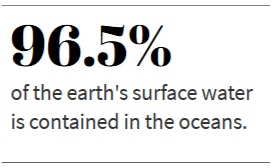
To start with, 96.5 percent of the earth’s surface water is contained in the oceans.
To start with, 96.5 percent of the earth’s surface water is contained in the oceans.[8] And of course, its salt content makes it useless for drinking. Desalination can make saltwater drinkable, but the high cost of that process has put it out of reach for most of the world—so far.
Of the earth’s freshwater, 68.7 percent is locked away in ice caps, glaciers and permanent snow. Another 30.1 percent is in the ground.[9] That leaves only a tiny fraction available as usable surface water, which comprises 78 percent of the water we use. The source of that surface water is the oceans. When water evaporates from the ocean surface, it leaves its salt content behind, and some of it then reaches the earth as precipitation—mainly, rainfall. That water then flows through our rivers and streams and collects in lakes and ponds. We depend on that runoff for most of our water needs.
But geographic and atmospheric conditions can prevent the rain from reaching some places. About 40 percent of the earth’s land mass is considered arid or semi-arid. And together, those areas receive only about 2 percent of the earth’s water runoff.[10] As a result, people who live in those regions often face chronic water shortages and a constant struggle to find adequate water. They typically rely on wells that tap the water in the ground. But when those wells fail, disaster follows quickly.
Through the generous donations of Gospel for Asia (GFA) supporters around the world, the well project began. But it was risky; the land was notoriously dry. Few local people believed a well was even feasible. The team drilled deeper and deeper into the hard rock terrain with no results. The effort seemed futile. And then, at last—they struck water.
But the team didn’t stop. They drilled even deeper so the villagers would be assured of water through the dry months. And now, they have clean water year-round for drinking, cooking and bathing.
“We never thought a well would be drilled in our village,” Nidhar confides. “But the true need of this village was met by Gospel for Asia (GFA). We are truly thankful for it.”
Twin Hazards: Drought and Flooding
Even places accustomed to adequate rainfall can be vulnerable to drought, which may come without warning. Its impact usually depends on the preparations people have made beforehand. Most of the developed world has systems and infrastructure in place to mitigate a drought’s worst effects. In 2018, Washington state and areas of the American Southwest experienced a severe drought, which caused hardship but no large-scale human catastrophe. But it’s a different story when drought strikes poor areas that are already struggling. People die of dehydration. Crops fail and famine follows. Economies are devastated.
Drought is a terrible affliction, but the opposite problem can also occur, and sometimes in the very same places—too much water at once.
People die of dehydration. Crops fail and famine follows.
Economies are devastated.
Many communities in arid regions are physically unprepared for floods, which often come suddenly. And a lack of groundcover in the desert can make the flooding even more destructive. Floodwaters often mingle with raw sewage, which can cause skin rashes, tetanus, gastrointestinal illnesses and wound infections in people exposed to it. The standing water left behind by floods also breeds mosquitoes, which transmit vector-borne diseases such as dengue, malaria and West Nile fever. In some places, rodents proliferate after flooding. These creatures carry microbes such as leptospira bacteria, which are then released in the rodents’ urine. As a result, leptospirosis can reach epidemic levels after a flood. Left untreated, it can cause respiratory distress, liver failure and death.
Dying of Thirst: The Global Water Crisis – The Crucial Quest for Access to Clean Water: Part 2 | Part 3
This Special Report article originally appeared on gfa.org.
[2]Progress on Drinking Water, Sanitation and Hygiene: 2017 Update and SDG Baselines.Geneva: World Health Organization (WHO) and the United Nations Children’s Fund (UNICEF). Licence: CC BY-NC-SA 3.0 IGO. 2017. Accessed December 26, 2018.
[3]Progress on Drinking Water, Sanitation and Hygiene: 2017 Update and SDG Baselines.Geneva: World Health Organization (WHO) and the United Nations Children’s Fund (UNICEF). Licence: CC BY-NC-SA 3.0 IGO. 2017. Accessed December 26, 2018.
[4]Progress on Drinking Water, Sanitation and Hygiene: 2017 Update and SDG Baselines.Geneva: World Health Organization (WHO) and the United Nations Children’s Fund (UNICEF). Licence: CC BY-NC-SA 3.0 IGO. 2017. Accessed December 26, 2018.
[5]The United Nations world water development report 2018: nature-based solutions for water; facts and figures. UNESCO Digital Library, p. 2. 2018.
[6] Lutgens, Frederick K., Tarbuck, Edward J. The Atmosphere: An Introduction to Meteorology. Upper Saddle River, New Jersey, Prentice Hall. 2004, p. 94.
Driven by a passion to serve people Jesus referred to as “the least of these,” in 1979, Dr. KP Yohannan led a group of prayer believers to establish Gospel for Asia with a vision to turn the passion into practice.
Putting Our Passion into Practice to Serve the Least of These
While millions of people in North America were consumed with the debut of the Dukes of Hazzard, the release of The Muppet Movie, the introduction of the McDonald’s Happy Meal, and things on a more significant scale such as the American hostage crisis in Iran, the search for the Unabomber, and the peace talks in Washington between Egypt’s Anwar Sadat and Israel’s Menachem Begin, a small group of Christians had been fasting and praying in Dallas. They were praying that the Lord would open the way for them to reach “the least of these” in ways that would improve their living conditions and demonstrate the love of Jesus to change their lives forever.
Who are “the least of these?” There is no simple definition and there are even theological debates on the subject. The Lord referred to them as the hungry, the thirsty, the poor, the sick, and the imprisoned. The answer boils down to this – God has always shown a special concern for the poor and needy, so it should come as no surprise that He expects us to do the same. This is not a matter for debate. It is an indicator of Christ-mindedness.
A native of South Asia, Dr. Yohannan has always been acutely aware of the presence and needs of those whom we could call “the least of the least,” “the poorest of the poor,” and those without access to the common necessities for healthy lives or to an awareness of the Gospel.
Dr. Yohannan also understood that the leadership of the emerging nations, many of which had endured the commercialization associated with the colonialization of the British Empire, were wary of outsiders and their agendas. His ground-breaking book, Revolution in World Missions, pointed to the necessity and marked the beginning of reaching, training, and equipping local believers within their native countries who could reach their own people with the love of Jesus.
One of the ways that Gospel for Asia’s national workers serve “the least of these” is by providing care for women, the objects of culturally-based rejection and scorn in much of South Asia.
Serving Women Who Need Training and Assistance
Serving women who need literacy or vocational training minister to the least of these.
In 2017, Gospel for Asia (GFA) and its worldwide affiliates working in 18 Asian nations empowered more than 350,000 women through various ministry efforts.
In some areas where GFA-supported workers minister, women especially have it difficult. Some silently suffer violence at the hands of their husbands, their close and distant relatives and even strangers who exploit and abuse them.
In 2017, to make a positive difference, Gospel for Asia (GFA) helped provided free health care training to 289,033 women. This training focused on teaching women the basics of how to care for themselves and their families. They also learned how to keep a safe and hygienic home for their families and how to take care of themselves while pregnant. In addition, GFA taught 50,624 women in rural villages how to read and write, which will safeguard them from being cheated at the market and from entering into exploitative and usurious agreements with lenders. Another 10,965 women received vocational training that will provide them with valuable skills to make an honest living.
But more than this, as women experience the love of fellow human beings who are willing to serve and minister to them, their understanding of their worth and value in society is elevated. GFA-supported workers treat each girl and woman they meet with respect. They speak words of life into the hearts of women who’ve silently suffered violence, letting them know they matter, they have value and they are loved — even if the rest of society doesn’t think so.
As Dr. KP Yohannan noted, “It’s heartbreaking to consider the unthinkable struggles so many women go through, many of them unseen by anyone else in the world. We want them to know that they are precious in God’s sight, that they have unique value and worth as people created in His image, and that they are not forgotten.”
Providing Clean Drinking Water to Those Using Contaminated Sources
Another problem that plagues around two billion people worldwide – both women and men – is drinking water from stagnant ponds or water sources contaminated with feces. It is estimated that 502,000 deaths are caused each year by diseases, such as diarrhea, cholera, dysentery, typhoid, and polio, which are transmitted through contaminated water.
Providing clean water serves the least of these who are getting sick from contaminated water sources.
To meet the critical need for water in some of the neediest regions across Asia, GFA has spearheaded the “Jesus Well” project. In 2017 alone, Gospel for Asia was able to help provide 4,673 wells. That’s 4,673 sources of clean, fresh drinking water. One well typically provides clean water for at least 300 people and can last up to 20 years. GFA supporters around the world have allowed the rate of installation of Jesus Wells to continue and remain consistent, with tens of thousands of wells installed in the past several years. The Jesus Well project is one of the largest clean water initiatives in the world.
In regions where water might be accessible, but it’s just not safe to drink, GFA-supported workers provide BioSand water filters. These simple structures — locally built from concrete, sand, and rocks — filter water to remove 98 percent of biological impurities, providing safer water for drinking and cooking. In 2017, GFA helped provided 11,324 BioSand water filters for families and individuals.
As critical as these needs are, they are just a sampling of all that God has done through GFA in 2017. Around 234,300 families received much-needed income-generating gifts. GFA-supported workers organized 1,245 medical camps in villages and remote communities. They also helped install 6,364 toilets in communities desperately in need of safe sanitation facilities—and so much more.
“These statistics serve as an aerial view of what God accomplished in one year throughout communities in Asia,” Dr. Yohannan said. “God has done so much through His servants, who are faithfully ministering to the poor, desperate and needy around them. We praise God for giving us the opportunity to join Him in his work, and we are deeply grateful for the love, prayers and sacrificial giving of our donors so others may experience the grace and mercy of Christ.”
To learn more about all that God accomplished in GFA, click here.
About Gospel for Asia
Gospel for Asia is a Christian organization deeply committed to seeing communities transformed through the love of Christ demonstrated in word and deed. GFA serves “the least of these” in Asia, often in places where no one else is serving, so they can experience the love of God for the first time.
=====
Click here, to read more blogs on Patheos from Gospel for Asia.
Much of Asia’s Water Has an Extreme Level of Contamination
As one of the most densely populated countries in the world, the water crisis in Asia affects hundreds of millions of people. One of the primary reasons behind the contamination is a lack of sanitation facilities. The situation is improving, but it’s still a crisis.
Although World Bank statistics show that the practice of open defecation has steadily declined in the 21st Century, there are still places where half the population still has no sanitary toilets. With open defecation, surface and ground water sources take on harmful pathogens and parasites that cause illnesses and even death. Water.org says 500 of Asia’s children die every day from diarrhea that comes from contaminated water.
The problem isn’t just a lack of understanding about contamination, it’s more a lack of access to basic human needs. Water is essential for survival, and clean water is scarce. Thankfully, some Asian nations, such as India, have an educational campaign to curb open defecation and encourage people to use toilets. But when no facilities exist, there’s no other choice.
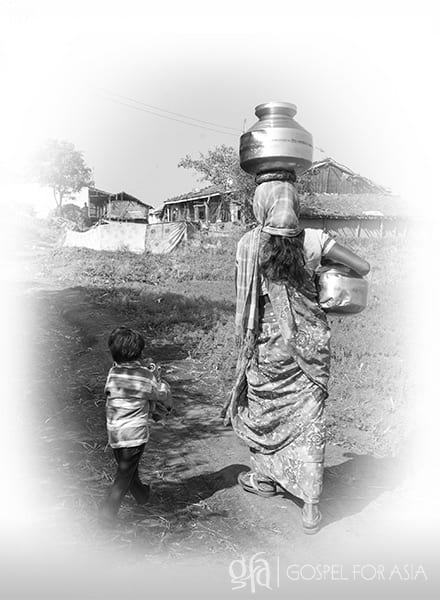
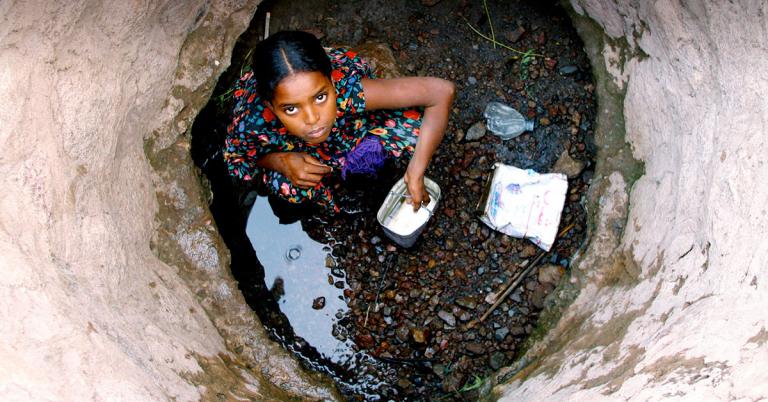
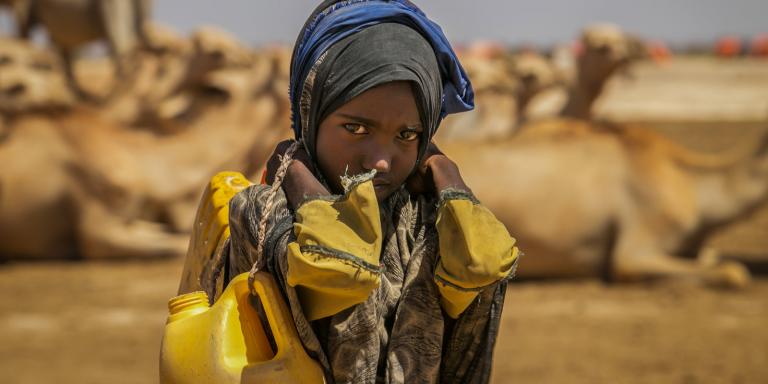
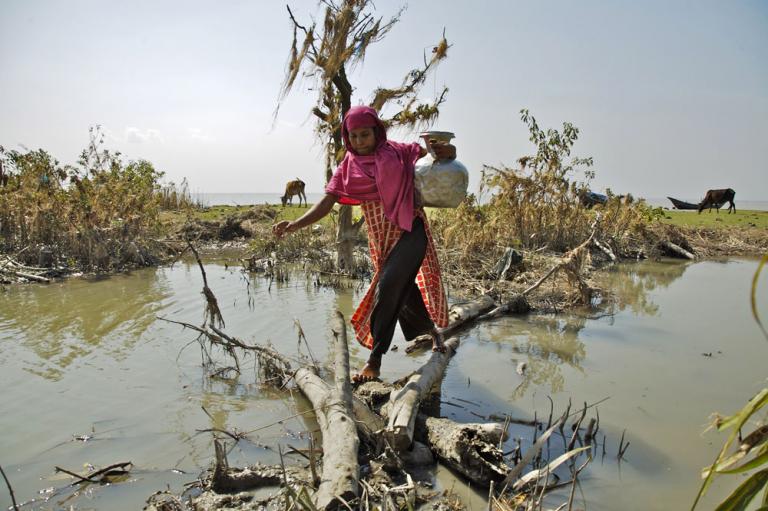
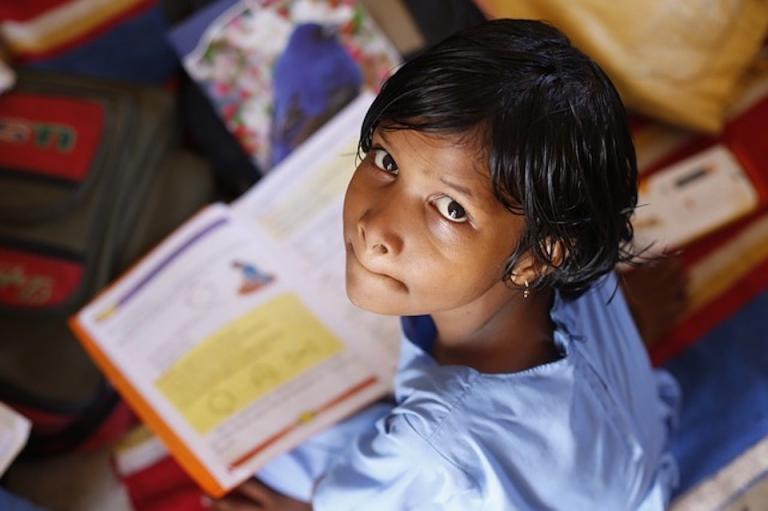
Young girls in Asia are expected to fetch clean drinking water for their families, often at the expense of being in school
Fetching Drinking Water is Considered Part of Domestic Life in Asia
Water for drinking, cooking and bathing must come from somewhere. In the Western world, it comes from a tap. In rural Asia, carrying water is an integral part of domesticity. It’s also a full-time job. Child labor in Asia is unlawful in most situations, but laboring for the family’s survival is different. When the family is in need of clean drinking water, education can and often does go by the wayside.
A clean source, such as a well that’s deep enough to go beneath ground water contamination, is often miles away. Unfortunately, there are only so many hours in a day. The trip to and from a source can consume the better part of it.
Carrying Water is Difficult, Demanding Work
Under ideal circumstances, it takes an average adult about 30 minutes to walk a mile at a normal pace. Asia’s girls don’t labor under ideal circumstances.
The paths they take aren’t usually paved. Their footwear isn’t a pair of cross trainers. The containers they carry to their destination are significantly heavier on the return trip. One gallon of water weighs nearly 4 kilograms (or more than 8 pounds).
Time that might be spent on a girl’s studies is used, instead, for physical labor that helps sustain life. It’s no wonder so many of Asia’s precious girls quit school before they graduate. When clean water isn’t a given, fetching it becomes part of their everyday life.
In many parts of the world, children get up on a weekday morning, have breakfast and head out to another day at school. There’s ample water at home for brushing their teeth, for making oatmeal and to carry in a bottle with their backpack.
GFA’s clean water initiatives strive to change that reality. A BioSand water filter gives a family a way to filter dirty water into clean water at home. One Jesus Well can provide an entire village with abundant clean water for as many as 300 families per day, for decades.
With clean, healthy and safe water available near the home, children can be children. Girls can focus on their studies as much as their male peers.
Something as simple as water can have the very literal effects of saving lives and giving children, especially girls, the hope of a better future.
For more on the global clean water crisis, go here.








 To start with, 96.5 percent of the earth’s surface water is contained in the oceans.










 Ad-Free & Subscriber Log-In