

I have been writing about the modern rediscovery of ancient Jewish and Christian scriptures, including Lost Gospels. We usually tend to think of such finds in the context of the 1940s, with the Nag Hammadi library in Egypt in 1945, and the Dead Sea Scrolls at Qumran in 1947. In reality, people already knew a very great deal about such things long before that point, and the great age of rediscovery occurred between the 1880s and the 1920s. Today, I will focus on two really remarkable years of historic discovery, finds that transformed our knowledge of ancient religion, namely 1896 and 1897. That concentration suggests just how very rapidly the pace of scholarly discovery was at that time: these events deserve to be far more famous than they are.
As I remarked last time, I will here only summarize a much longer story that I have told elsewhere. Do check out that link.
The Treasures in the Attic
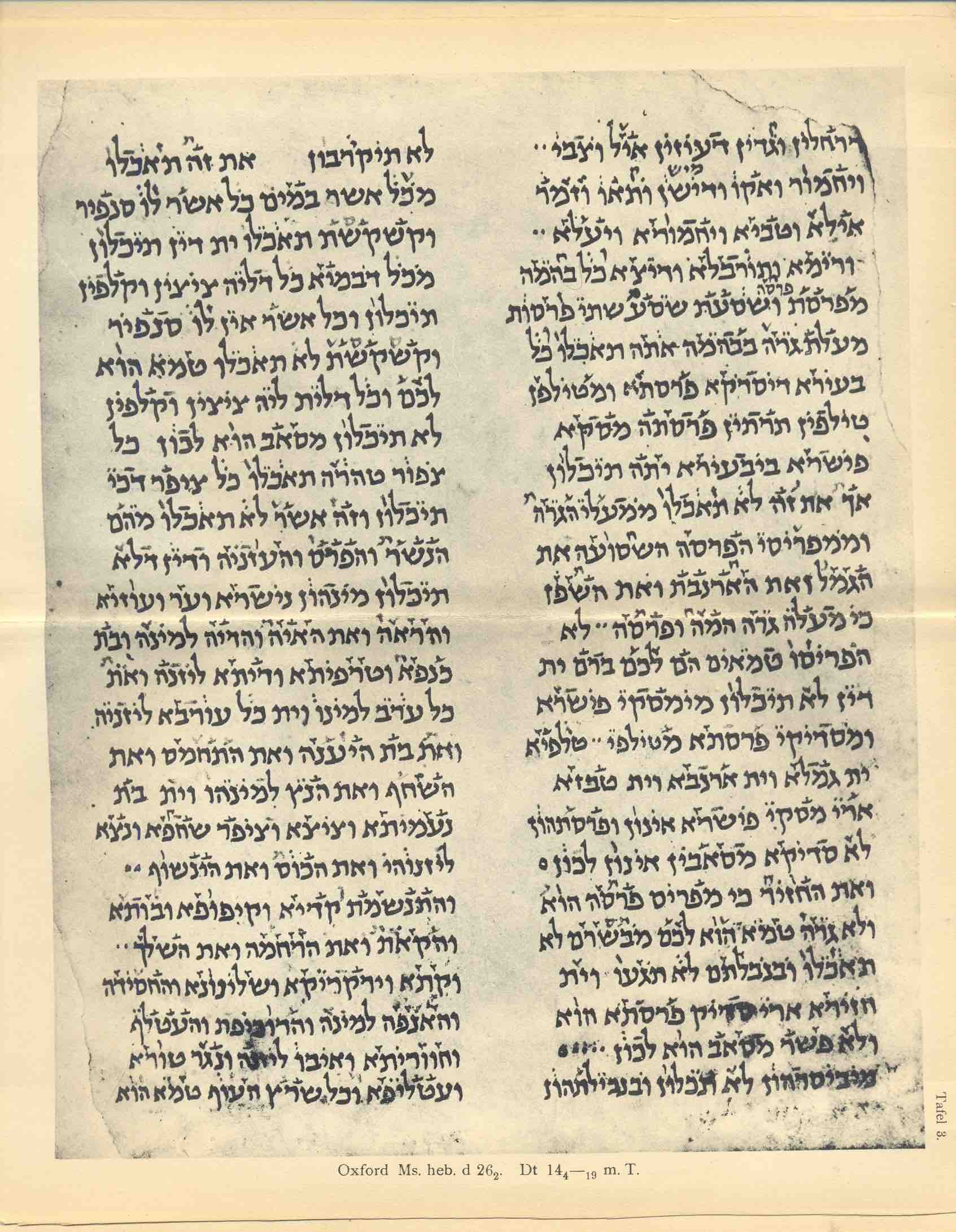
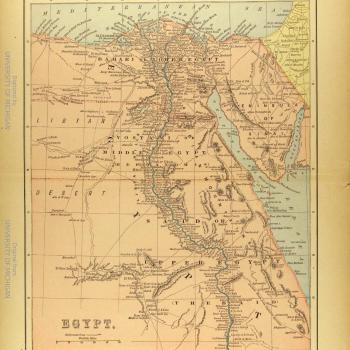
In 1896, the scholarly world first became aware of the world that created what we know as the Dead Sea Scrolls. The story involves the so-called Cairo Genizah, one of the most exciting textual finds in modern history. Briefly, a synagogue needs a special storage room for obsolete or damaged manuscripts that contain the sacred Name of God. As it would be blasphemous to destroy these texts, they are stored, indefinitely, in a genizah. In the late nineteenth century, scholars were astonished to discover the texts preserved in one such storage place in the Ben Ezra synagogue of Fostat, Old Cairo.
The documents have since been examined and published at great length, and taken together, they provide invaluable information about long centuries of Jewish life in the Middle East and Mediterranean world, and Jewish interactions with Muslims and Christians. The main researcher of the documents, and their great advocate, was rabbi Solomon Schechter. Schechter headed the Jewish Theological Seminary of America, and was a critical figure in the development of Conservative Judaism.
 all images are public domain
I can only begin to sketch some of the implications here, but one early finding concerned the Biblical book of Sirach or Ecclesiasticus. You can read all about this at this older post. The key issue was that, by finding a Hebrew original, the discovery transformed perceptions of that text and its proper position within the Biblical canon. That sounds technical, but it was an early example of the sort of rethinking that would follow the discoveries at Qumran.
The First Scrolls
The Genizah discovery made a media splash at its time, and especially one evocative aspect of the find. Schechter discovered some mysterious fragments which he perceptively (and correctly) attributed to a then unknown Jewish sectarian group, and in 1910 he published them in an academic book called Documents of Jewish Sectaries (Cambridge University Press, 1910). The first of this was entitled Fragments of a Zadokite Work. The Fragments received still wider attention when they were discussed in R. H. Charles’s collection, The Apocrypha and Pseudepigrapha of the Old Testament in English (Clarendon Press, 1913), ii, 785-834.
What Schechter had published was a substantial fragment of the Damascus Document or Community Rule, a foundational text of the Qumran community: a fuller version was found among the Scrolls in 1947. But even in 1910, that fragment gave enough information to reconstruct the main outlines of the sect, and its foundation story. That involved a prophetic religious leader called the Teacher of Righteousness, who was in mortal conflict with another cleric called the Wicked Priest, with his “scoffing” followers. The Teacher’s persecuted followers followed him quite literally into the wilderness, where (as we discovered in the 1940s) they founded the Qumran community. Schechter called these sectarians “Zadokites”, which was wrong, but a brilliant deduction.
Schechter could have known nothing of Qumran, but his deductions from the text as he had it were brilliant. He was very anxious to avoid going beyond his evidence, and to invent “sects from texts,” as the modern phrase has it. But reading his 1910 book, you often have to look back to the copyright date to check that you have not accidentally picked up a work from the 1980s. So much of what Schechter deduced about the Qumran sect was exactly right. To take one example from many, he described the intellectual and scriptural universe in which the sect lived, and the alternative texts on which they drew so heavily, such as the Book of Jubilees and the Testaments of the Twelve Patriarchs.
If you followed the mainstream media around 1910, you already had a very fair idea of what the Qumran community was about, and what they believed.
Jesus in the Scrolls?
Throughout the later twentieth century, reports of the Dead Sea Scrolls inspired and rather frightened Christian believers, who were both hopeful and nervous about finding new materials that could fundamentally change their image of the Messiah. Exactly the same thing happened following the discovery of the “First Scrolls.”
Today, most scholars would set the foundation of the Qumran community around the mid-second century BC, which would also be the time of its founding Teacher of Righteousness. But the Zadokite work offered few reliable hints about chronology, and that opened the way to pushing it forward into the Christian era. Some speculations were obvious. Was John the Baptist a follower of the “Zadokite” (Qumran) sect? What about Jesus himself? And what happened to those Zadokites? Did they provide the nucleus of the earliest Jewish Christianity? All those ideas were proposed by the very influential R. H. Charles in his Religious Development Between the Old and the New Testaments (1914). I will have lots more to say about Charles in a later post.
Another prominent scholar drew even closer parallels. In 1910, the English Athenaeum published an article in which Rev. George Margoliouth explicitly claimed the Fragments as an early Jewish-Christian text (November 26, 1910). That opinion carried weight because Margoliouth (1853-1924) was a highly qualified Cambridge Hebrew scholar, and Keeper of Hebrew, Syriac and Ethiopic manuscripts at the British Museum. Margoliouth
claimed to have made the startling discovery that the personages mentioned are the leading ones in the first period of Christian history; that the “Anointed One “is John the Baptist; that the “Teacher of Righteousness” is Jesus; and that the “Man of Scoffing” is Paul. He thus makes this a document belonging to the first century, and representing the views of a Jewish-Christian sect who rejected the teachings of Paul, regarding him as a perverter of the true faith of Jesus, and who remained “zealous for the Law.” Such a remarkable claim challenges attention to this Document; for if the claim be justified, it will provide us a source of the earliest Christian history of the utmost importance, giving us a view of the position of those very early disciples who held fast to the Mosaic Law, and made of the new Way only a sect in Judaism.
So much of that view prefigures later post-1947 speculations about the possible role of Jesus and the others as characters in the Scrolls. It also, literally, hit the headlines, notably in a banner New York Times story on Christmas Day, 1910. The “Jewish-Christian” Zadokite theory attracted violent controversy, which raged for several years both in the scholarly and popular media, both in the US and Britain. For present purposes, the details of the dispute do not matter. The main point is that, over a century ago, scholars were debating these critical issues arising from the Qumran sects, questions that we would normally assume to have come to light only after 1947.
Making the idea easy to accept, the notion that Jesus had been a member of a Jewish sectarian order, namely the Essenes, had been standard speculation for several decades before this point.
The influence of these theories can be seen in George Moore’s international best-selling novel The Brook Kerith (1916), about which I have written at some length. To over-simplify, Moore portrays Jesus as a member of a Judean monastery which is obviously the Zadokite community imagined by Margoliouth. Jesus survives the crucifixion, and lives to confront Paul, who is twisting and subverting his authentic faith. The despairing Jesus travels to India with a group of Buddhist monks who had been evangelizing the Judean countryside.
Secret Books
In 1896, the Cairo Geniza produced its invaluable trove, but that was not the only breakthrough of that year. Also in Egypt, 1896 marked the purchase of the Berlin Codex (the Akhmim Codex) which included several astonishing works very closely related to the Nag Hammadi collection of “Gnostic” writings, including the Gospel of Mary, the Sophia of Jesus Christ, the Acts of Peter and the Apocryphon of John. The full importance of that collection would not emerge for some decades afterwards.
1896 produced other landmarks, which do require some explanation. In that year, W. R. Morfill published his translation of The Book of the Secrets of Enoch, otherwise known as 2 Enoch, an apocalyptic work that described the ascent of the ancient patriarch of that name through the ten heavens. Very significantly, Morfill’s expertise lay in Russian and Slavonic languages, which might sound quite far removed from “lost” ancient scriptures and pseudepigrapha, which would surely have been written in one of the tongues of that era.
In fact, this points to one of the sensational discoveries of the era, about which I have written here. As I wrote, “From the end of the nineteenth century, scholars began looking at the extensive materials that existed in the old Slavonic languages of Eastern Europe. They were astonished. Far from being medieval concoctions, this corpus included many works that clearly dated back to an ancient Jewish milieu, roughly the era from 200BC-200AD. Many of these works, moreover, do not survive in other languages, including in their (usually) Greek originals.” Presumably these texts had passed from the Near East to the Balkans via the Byzantine Empire, and had then received their Slavonic identities, and 2 Enoch was one example – and an extraordinarily important one. Not until 1892 had its mere existence been known to scholarship.
That 1896 edition thus marked the first recognition in the English-speaking world of that Slavonic phenomenon, with its far-reaching implications for our knowledge of the Second Temple world and early Judaism – and of later Gnostic and Dualist movements.
Although not a new find in anything like the same sense as 2 Enoch, that year of 1896 witnessed the first full English translation of the Pistis Sophia, by G. R. S. Mead, the first of what we would call the rediscovered Gnostic Gospels, and a spectacular example of its kind.
Lift a Stone and I Am There
In 1897, British scholars investigating the Egyptian city of Oxyrhynchus made their own sensational finds, which they rushed into print later in 1897 as Sayings of Our Lord. Bernard Grenfell and Arthur Hunt had discovered the remains of an ancient book which we now know to be part of the famous Gospel of Thomas, the full text of which would appear in 1945. Only seven verses emerged in 1897, but they created a sensation. They were evidently close to the words of Jesus as recorded in the canonical gospels, but the most famous lines had a mystical or even pantheist dimension that was inspiring. As Jesus said, “Wherever there are …. and there is one …. alone, I am with him. Raise the stone and there thou shalt find me, cleave the wood and there am I.”
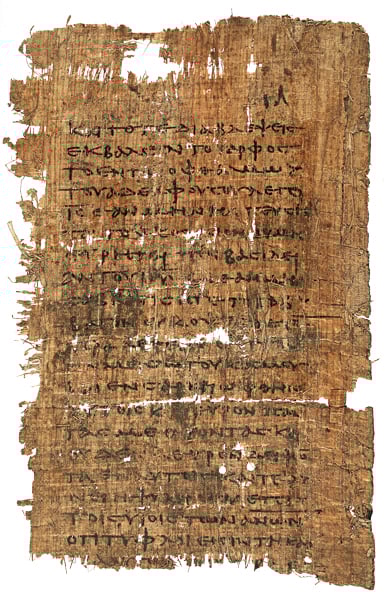 The authors suggested that the text might come from the lost Gospel of the Egyptians, and they drew comparisons with an equally lost Gospel of Eve known to have existed in ancient times. These new sayings, Logia, created a sensation, which became even greater with the appearance of a full-length book in 1904. To quote a Nation article from 1897, “The uppermost feeling of the Christian world seems to be an ardent hope that investigation may be pushed, and other of the lost logia brought to light.”
I have discussed one early manifestation of this enthusiasm at an earlier post. The key figure was the once-celebrated Presbyterian divine and Princeton academic Henry Van Dyke. A friend of Woodrow Wilson, he was famous and influential in his time, especially within his denomination, and he was a popular poet. His Christmas short story The Other Wise Man has often been reprinted. He was entranced by the new Logia. In 1900, Van Dyke published his The Toiling of Felix: A Legend On A New Saying Of Jesus, which is almost a hymn to the alternative gospels. (The poem is actually dated 1898). The poem describes the quest of the Egyptian seeker Felix, who is initially disappointed to find that Jesus taught such seemingly trivial words. He eventually finds their true significance, and realizes the mystical glories he has been ignoring:
“They who tread the path of labour follow where my feet have trod;
They who work without complaining do the holy will of God.
“Where the many toil together, there am I among my own;
Where the tired workman sleepeth, there am I with him alone.
“I, the peace that passeth knowledge, dwell amid the daily strife;
I, the bread of heaven, am broken in the sacrament of life.
“Every task, however simple, sets the soul that does it free;
Every deed of love and mercy, done to man, is done to me.
“Thou hast learned the open secret; thou hast come to me for rest;
With thy burden, in thy labour, thou art Felix, doubly blest.
“Nevermore thou needest seek me; I am with thee everywhere;
Raise the stone, and thou shall find me; cleave the wood, and I am there.”
Van Dyke’s popularity helped disseminate knowledge of the Oxyrhynchus fragment – of the Gospel of Thomas – which already before the First World War was very widely known in the US among quite ordinary readers. Just how well known? I have even found the fragment quoted in full in a book called The Story of Jesus: A Manual for Religious Instruction in the Intermediate Grades, by Florence Buck (1917). It is introduced, plausibly enough, as “a bit of Bible long lost,” which is not far off the mark.
On a personal note, my mother owned a copy of a miscellaneous and once-popular collection called The Bedside Book, edited by Arthur Stanley and published by Gollancz in 1932. She received her copy as a gift in 1942. The book included a decent selection from what we now know to have been the Gospel of Thomas, just three years before the full text was found in Egypt. How interesting that even in such a popular setting, the editor felt no need to explain the quite technical word “Logia”! The discoveries of 1897 cast a very long shadow.
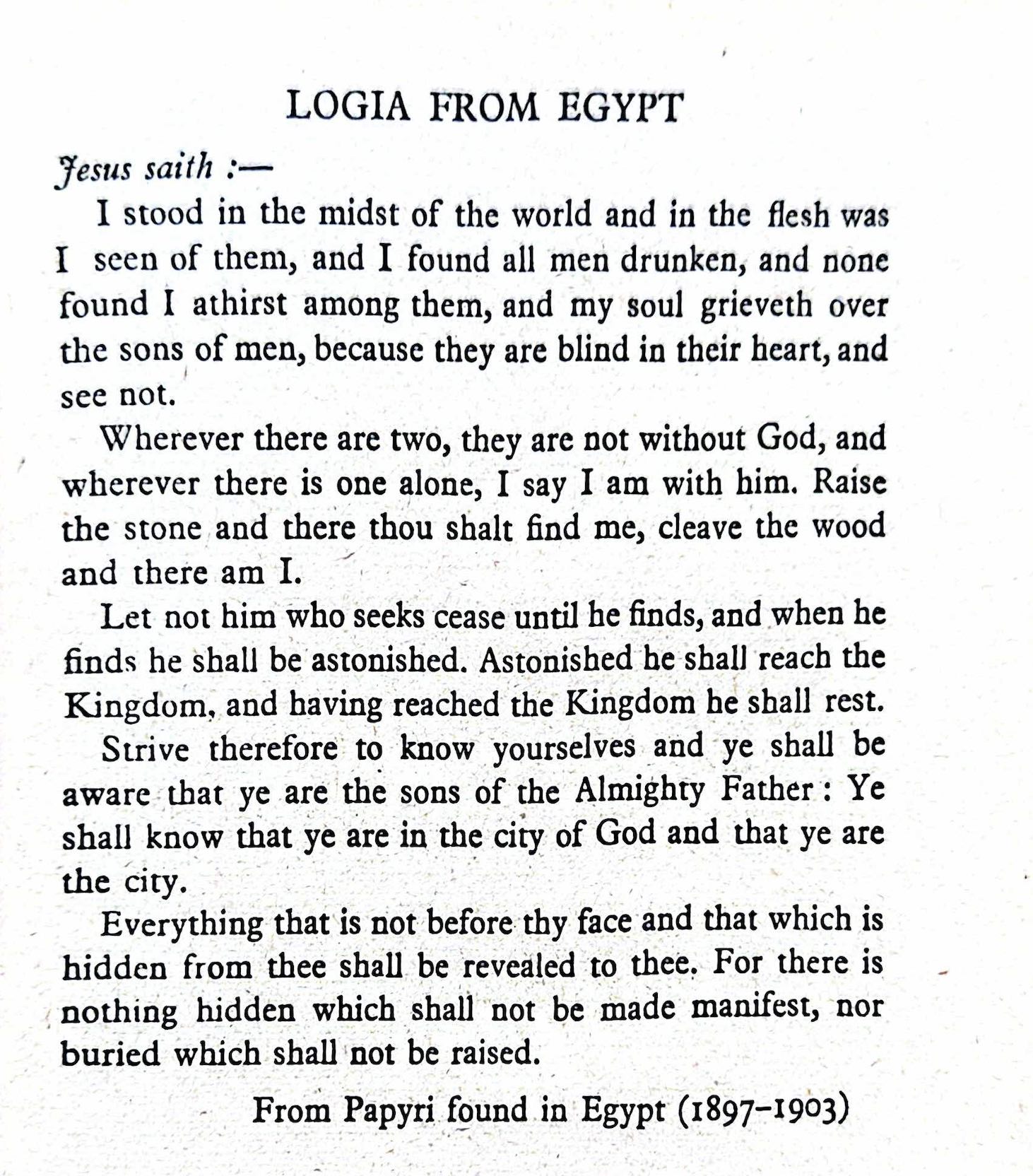
Whenever I read about the amazing finds at Nag Hammadi in 1945, and the revolutionary discovery of Thomas, I like to think of my mother happily reading that same text a couple of years previously.
More next time.










 Ad-Free & Subscriber Log-In