

Part II: 17-50 Romans Through Revelation
See Part I: 1-16:The Gospel and Acts
17) Romans 2:6-8 For he will render to every man according to his works: [7] to those who by patience in well-doing seek for glory and honor and immortality, he will give eternal life; [8] but for those who are factious and do not obey the truth, but obey wickedness, there will be wrath and fury.
Amen. Now those who have any evil work will be rendered accordingly. They will get hell, even if they have many good works which would merit heaven! We are agreed here. Now, what saves one from the hell that they deserve due to their bad deeds? Forgiveness of sin and sins. This is received only through faith. So, it is faith that saves people from the negative consequences of this judgement and rendering according to works. Good works can’t save you from what you are owed from your bad works.
Well-doing — not faith — is said to be the cause of eternal life. You mention faith, the Bible doesn’t. So you keep saying things that the Bible doesn’t say, in order to supposedly sum up what it says?! It’s classic textbook Protestant error.
18) Romans 2:9-10 There will be tribulation and distress for every human being who does evil, the Jew first and also the Greek, [10] but glory and honor and peace for every one who does good, the Jew first and also the Greek.
Amen. Let the good be rewarded and the evil be punished.
Yes, the “good” is said to be the cause of eternal life. That’s works, my friend.
Salvation from said punishment is through faith alone.
Then why doesn’t Paul use the word “faith” and speak like a Protestant? The only time the phrase “faith alone” appears in the Bible, it’s condemned (Jas 2:24: “You see that a man is justified by works and not by faith alone”).
The good deeds that merit salvation are literally a part of faith and so thoroughly connected to faith that they simply are faith.
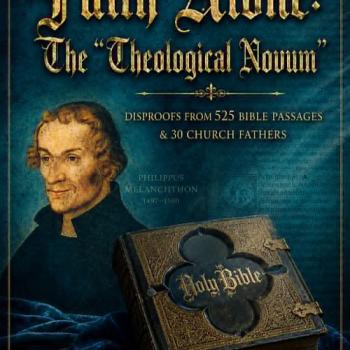
Here you virtually stumble into Catholic teaching. As I have said, grace-produced good works are organically connected to faith. You go even further and say that they “are faith.” Okay, so why, then, was Melanchthon the first Christian of note since at least Augustine (who also agrees with Catholics here) to separate works and faith and sanctification from justification? This is a man who didn’t even retain his belief in the Real Presence. I’ve interacted with his reasoning in several papers.
So, faith is rewarded, and faith saves us from punishment.
That ain’t what the text says, so why do you? It says that doing “good” is what is rewarded.
But if you want to separate the works from faith, then it is still the case that the only “salvation” that can happen (since a purely good person would not need to be saved from anything!) is from one’s bad deeds, sin, and the punishment that this deserves. This salvation is through forgiveness of sins received through faith. Sola Fide.
19) Romans 2:13-16 For it is not the hearers of the law who are righteous before God, but the doers of the law who will be justified. [14] When Gentiles who have not the law do by nature what the law requires, they are a law to themselves, even though they do not have the law. [15] They show that what the law requires is written on their hearts, while their conscience also bears witness and their conflicting thoughts accuse or perhaps excuse them [16] on that day when, according to my gospel, God judges the secrets of men by Christ Jesus.
Indeed. Aquinas and Luther have radically different interpretations of this verse. It is fun to compare and see how each one views Romans, in general. However, regarding Sola Fide, this does not say that one is saved from sin and damnation by good deeds. Obviously, that comes through forgiveness of sins that is received through faith in Jesus Christ.
I need only repeat part of the passage: “the doers of the law . . . will be justified.”
20) Romans 6:22 But now that you have been set free from sin and have become slaves of God, the return you get is sanctification and its end, eternal life.
Yes, “end,” in this context obviously refers to completion – as this word usually does in such ancient writings. The completion of sanctification is definitely eternal life!!! But obviously, even if I am wrong here, this does not address salvation from original sin nor salvation from individual sins. These things come from forgiveness, which is received by faith. Sola Fide.
The high significance of this passage is that it directly connects sanctification and eternal life: the very bond that is completely denied by Protestantism, following Melanchthon’s radical innovation. Melanchthon taught, according to an AI overview, “that good works, which are part of sanctification, were never considered a cause or condition for justification. He argued that works are the fruit of justification, not its basis.”
21) 1 Corinthians 13:2, 13 And if I have prophetic powers, and understand all mysteries and all knowledge, and if I have all faith, so as to remove mountains, but have not love, I am nothing. . . . [13] So faith, hope, love abide, these three; but the greatest of these is love.
Amen. Critical here, is his example of having faith to remove mountains. That sort of faith – which is a particular exercise of the broader faith that all Christians have – is not as important as love! Not nearly as important as love. But is the particular exercise of faith that can remove mountains – is that the entirety of faith itself! May such a thing never be said. The entirety of faith is therefore by no means considered less than love. Love, too, is an exercising of the faith in a similar way that “removing mountains by faith” is an exercise of faith. The one exercise (love) is greater than the other (removing mountains aka “faith” in this context). But it does not therefore follow that love is greater than the underlying faith of which it is an exercise.
But even if I am wrong in that regard, it does not follow that love, being greater than faith, is what receives the forgiveness of sins that save you from the damnation that both your sin and sins make you worthy of. Rather faith is what receives that forgiveness of sins that saves you. Therefore, salvation from hell is by or through faith and not love. Sola Fide.
My reasoning here is that if love is greater than faith, it can’t be less important in the scheme of salvation than faith is. It must be included. Faith, therefore, can’t be alone. I recently collected ten Bible passages concerning “salvation by love.”
22) 2 Corinthians 5:10 For we must all appear before the judgment seat of Christ, so that each one may receive good or evil, according to what he has done in the body.
Agreed. And without forgiveness of evil that has been done in the body, one will receive the evil of eternal damnation. What saves you from that? Forgiveness of sins received through faith. When this has been received, what remains is the good that one has done in the body – and yes, rewards are given for this.
If one has only done good in the body – and also, if one had no original sin – and if one did not even need original sin wiped away by Jesus – then one would not need to be saved from hell, at all. Such lack of a need for salvation from hell would not therefore imply that those who do need to be saved from hell are saved from hell by forgiveness of sins that is received through faith – aka Sola Fide.
You need — in order to refute this — to exegete the passages, not just reiterate a Protestant formula again and again. That proves nothing. The point in this verse is that we’re judged — again, for literally the 50th time — by what we have done: not solely by how much faith we had.
23) 2 Corinthians 13:5 Examine yourselves, to see whether you are holding to your faith. Test yourselves. Do you not realize that Jesus Christ is in you? — unless indeed you fail to meet the test!
Indeed. If one is not holding to their faith, then they will be severed from God in such a way that they cannot receive forgiveness of sins through that faith. With no reception of forgiveness of sins through their faith, they will not be saved! Therefore, it is important that, if you wish to receive forgiveness of sins through your faith (which is Sola Fide), you must test yourself to make sure that you indeed are holding to your faith and that Jesus Christ is in you. None of this contradicts the idea that you are saved through hell through forgiveness of sins granted through faith – or Sola Fide.
This one works better against Calvinists, who deny that one can fall away, so it’s relatively less compelling for non-Calvinist Protestants.
24) Galatians 5:14, 19-21 For the whole law is fulfilled in one word, “You shall love your neighbor as yourself.” . . . [19] Now the works of the flesh are plain: fornication, impurity, licentiousness, [20] idolatry, sorcery, enmity, strife, jealousy, anger, selfishness, dissension, party spirit, [21] envy, drunkenness, carousing, and the like. I warn you, as I warned you before, that those who do such things shall not inherit the kingdom of God.
Indeed. Anybody who does such things has lost the Holy Spirit – and faith – and therefore can no longer receive forgiveness of sins through their faith – unless they turn back to the Lord and are thusly renewed in their faith – and then their faith can receive forgiveness for these abominable deeds. Such forgiveness granted through faith to a heart that has turned back to the Lord (which turning only occurs by faith) is the very essence of Sola Fide. Nothing here has at all gone against Sola Fide. Only Protestants who believe you cannot lose your faith by mortal sin are in trouble by these verses. But since there are Protestants who believe you can lose your faith by mortal sin – and thus your salvation – and yet still believe that the forgiveness that saves you from hell is only given through faith – then it is clear that these verses do not harm Sola Fide.
You mention “faith” nine times and “fide” — which means “faith” — three more times. That’s twelve more times than this Bible passage ever mentions it (zero). Paul’s point is that love brings about salvation. All of these bad deeds can cause one to not attain it. So it’s another “un-Protestant passage.”
25) Galatians 6:7-9 Do not be deceived; God is not mocked, for whatever a man sows, that he will also reap. [8] For he who sows to his own flesh will from the flesh reap corruption; but he who sows to the Spirit will from the Spirit reap eternal life. [9] And let us not grow weary in well-doing, for in due season we shall reap, if we do not lose heart.
Indeed. We will reap rewards for our good deeds – but we will receive eternal damnation for our bad deeds. Just as this verse says.
It strongly implies that “well-doing” is what causes us to “reap” [eternal life]. The reward here is eternal life / salvation. It’s not merely talking about differential rewards in heaven for good deeds we have done. If “eternal life” weren’t in the text, you would have a much stronger case, but that sinks it.
The damnation can only be avoided if our bad deeds are forgiven – and if that forgiveness is received through faith alone. So, salvation from hell is by faith alone – Sola Fide. One who only does good deeds and is without original sin, as well, has no need of any sort of salvation from hell. If they needed such salvation from hell, it would be received through forgiveness of sins by faith – therefore, their salvation from hell would still be by forgiveness of sins, alone.
Once again, you’re talking about faith, whereas the text never does. Deeds — good and bad — again take center stage. Since faith isn’t mentioned in the passage, by definition you can’t be exegeting it. You’re merely reiterating Protestant talking-points. But that’s no argument and it’s not Bible commentary per se.
26) Philippians 2:12-13 Therefore, my beloved, as you have always obeyed, so now, not only as in my presence but much more in my absence, work out your own salvation with fear and trembling; [13] for God is at work in you, both to will and to work for his good pleasure.
Amen. This says nothing against Sola Fide. To make sure we have a faith that can receive forgiveness of sins – the forgiveness of sins that saves – we must make sure we are indeed in the faith!
This informs us that we have to not only “work out” our salvation, but the way to do it is to “work.” So it’s thoroughly opposed to faith alone.
27) Philippians 3:8-16 Indeed I count everything as loss because of the surpassing worth of knowing Christ Jesus my Lord. For his sake I have suffered the loss of all things, and count them as refuse, in order that I may gain Christ [9] and be found in him, not having a righteousness of my own, based on law, but that which is through faith in Christ, the righteousness from God that depends on faith; [10] that I may know him and the power of his resurrection, and may share his sufferings, becoming like him in his death, [11] that if possible I may attain the resurrection from the dead. [12] Not that I have already obtained this or am already perfect; but I press on to make it my own, because Christ Jesus has made me his own. [13] Brethren, I do not consider that I have made it my own; but one thing I do, forgetting what lies behind and straining forward to what lies ahead, [14] I press on toward the goal for the prize of the upward call of God in Christ Jesus. [15] Let those of us who are mature be thus minded; and if in anything you are otherwise minded, God will reveal that also to you. [16] Only let us hold true to what we have attained.
What a wonderful Sola Fide passage! As this passage says, the righteousness Paul desires is a righteousness through faith and that depends on faith. He merely states that the resurrection from the dead is not already his – and it is not. Who knows if he will remain faithful, at this point in his life? And he is not already perfect as he will be in that resurrection. But by faith, he tries to make this perfection found in the resurrection of the dead his own – and he does this by another faith-act – forgetting the past and pressing on toward the goal. That’s what faith does!
But even if I am wrong in my interpretation, nothing here speaks against the idea that salvation from hell is through forgiveness of sins and sin that is received through faith! Sola Fide.
At least this is one of the few that mention faith, but as I’ve explained, that is no refutation of our view, which always includes it in justification and salvation. This passage makes salvation dependent upon sharing Christ’s sufferings (3:10-11), which is a good work. It’s certainly against a one-time instant salvation notion, that, I understand, is not the much more nuanced Lutheran view, but is held by many millions of Protestants. As a Catholic apologist, I deal with Protestant errors wherever they’re found. All falsehood is spiritually harmful.
28) Colossians 3:20, 23-25 Children, obey your parents in everything, for this pleases the Lord. . . . [23] Whatever your task, work heartily, as serving the Lord and not men, [24] knowing that from the Lord you will receive the inheritance as your reward; you are serving the Lord Christ. [25] For the wrongdoer will be paid back for the wrong he has done, and there is no partiality.
Yes, the wrongdoer will be repaid, unless they receive forgiveness of their sins. That is their only path to salvation. And if somebody could live perfectly, they would have no need of any salvation from hell at all, because they did not do anything to deserve it. In either case, salvation from hell is received through forgiveness of sin and sins – and this is received through faith. There is nothing in this verse against that. Sola Fide.
The passage teaches us that obedience and working at tasks are worthy not only of receiving some kind of “merit badge” in heaven, but “the inheritance” and the “reward” of salvation. Hence, this is contrary to faith alone. The converse is also asserted. It’s implied that the damned are so because of the bad things they have “done” and for “wrongdoing.” Thus works are key in both determinations. And that simply ain’t faith alone, however one looks at it.
29) 1 Thessalonians 3:12-13 . . . may the Lord make you increase and abound in love to one another and to all men, as we do to you, [13] so that he may establish your hearts unblamable in holiness before our God and Father, at the coming of our Lord Jesus with all his saints. (cf. 4:1)
Amen. This says nothing about how we are saved from hell – and therefore, it says nothing about Sola Fide.
I think it does. It’s contrary to it, and is asserting once again that love is key. It leads to being “unblamable in holiness” on Judgment Day, so that one can be saved based — at least in part — on what they have done: exactly like the judgment of the sheep and goats in Matthew 25. As almost always, faith is not overtly included, though I would concede that it’s implied, and this doesn’t speak against that. Our point isn’t that these passages oppose faith. Rather, it’s that they include good works as one of the key determinants of who is saved and who isn’t. That’s what poses a severe difficulty in maintaining sola fide in light of fifty contrary passages, and a hundred more that I have preserved in another collection.
30) 2 Thessalonians 1:7-8 . . . when the Lord Jesus is revealed from heaven with his mighty angels in flaming fire, [8] inflicting vengeance upon those who do not know God and upon those who do not obey the gospel of our Lord Jesus. . . .
Amen. One must obey the gospel by returning to Jesus in faith. Either way, this says nothing about how we are saved from hell – which is through forgiveness of sins received by faith.
Obeying means doing the works that the gospel require. Disobedience is the direct cause of damnation here; thus we can conclude by common sense and logic that obedience is one of the indispensable causes of salvation. The text mentions neither faith nor forgiveness.
31) 2 Thessalonians 2:13 But we are bound to give thanks to God always for you, brethren beloved by the Lord, because God chose you from the beginning to be saved, through sanctification by the Spirit and belief in the truth.
Lovely. Obviously, this verse is not trying to imply that an increase in good works and holiness is what receives the forgiveness of sins that saves us from hell – that honor goes to faith!
That once again isn’t even mentioned . . .
The words “chose you from the beginning to be saved” are all one unit, here. And how does God so chose us (to be saved)? He so chooses us through the sanctification by the Spirit and belief in the truth. Every drop of sanctification we get from the Spirit is God saying to us “You are chosen.” He chooses us by his sanctification. Those he does not sanctify, he is not actively choosing.
However, even if I am wrong, this is not saying that we receive forgiveness of sins through means other than faith – and obviously, that is how we are saved from hell. Other types of salvation – salvation from our sin, etc. – could be through other means. This has no impact on Sola Fide.
You miss the point I draw from this, which is the key phrase, “saved, through sanctification.” Protestantism teaches that we’re not saved by that; that it has nothing to do with whether we are saved or not; only justification does. I found an article, “Sanctification in Lutheran Theology” by David P. Scaer (Concordia Theological Quarterly 49 [April-July 1985] no. 2-3:181-195). He writes:
Sanctification is defined in this essay as the Christian’s life in the world, i.e., good works. This is the definition of dogmatic theology and not the common Biblical use of the word, which describes the entire activity of the Spirit in the Church, e.g., sacraments, conversion, faith, and good works. The first reference to good works in the Augustana is made in the article on original sin where the Pelagian opinion is condemned that good works in some way contribute to the justification of sinners before God. Letting good works play any part in justification is said to be an affront to Christ as it detracts from and extinguishes the glory of His merits and benefits. . . .
The article on justification states unequivocally that works have no role in the justification of the sinner before God. (pp. 181-182)
Good works are not optional as they are commanded by God and are to conform to God’s will. With this said, this article immediately says that good works have no validity in the question of justification, i.e., how the sinner stands before God and that the remission of sins is apprehended through faith and not works. . . . The founders of Lutheranism were so concerned with a proper understanding of justification that they wanted to leave no doubt that works had nothing to do with it. (p. 182)
32) 1 Timothy 2:15 Yet woman will be saved through bearing children, if she continues in faith and love and holiness, with modesty.
Obviously, a woman is not saved from eternal fire by the act of bearing children!
That’s exactly what it says. It’s part of it, alongside faith, love, and holiness: precisely like what we say and expressly contrary to faith alone. Even when faith is mentioned, love and holiness are there in the same sentence.
There are many ways of interpreting this verse – including that one can be saved from the negative consequences of childbirth – saved during that process or through the process – from those negative consequences – if they are holy. Obviously, holy people can die in childbirth, and unholy people can survive it. But childbirth was more dangerous back then than it was now – so the idea of living well to obtain favor with God such that He might save you through this process – is a very nice idea for a desperate ancient woman to cling to. What kindness of God to give this verse to people!
However, I have no idea what this has to do with salvation from hellfire due to forgiveness of sin that can only be received through faith…
The Greek word here, sózó (Strong’s Greek word #4982) means, according to Thayer’s Greek Lexicon, “to make one a partaker of the salvation by Christ.”
33) 1 Timothy 4:8, 10 . . . godliness is of value in every way, as it holds promise for the present life and also for the life to come. . . . [10] For to this end we toil and strive, because we have our hope set on the living God, who is the Savior of all men, especially of those who believe. . .
Amen. This says nothing against Sola Fide for all of the reasons I have stated above.
Godliness (which entails good works) is directly connected to “the life to come.” We “toil and strive” for that life, which is a lot more than only faith.
34) 1 Timothy 4:12-16 Let no one despise your youth, but set the believers an example in speech and conduct, in love, in faith, in purity. [13] Till I come, attend to the public reading of scripture, to preaching, to teaching. [14] Do not neglect the gift you have, which was given you by prophetic utterance when the council of elders laid their hands upon you. [15] Practice these duties, devote yourself to them, so that all may see your progress. [16] Take heed to yourself and to your teaching; hold to that, for by so doing you will save both yourself and your hearers.
Amen. This verse says “… hold to that, for by so doing you will save both yourself and your hearers.” What is Timothy supposed to hold to? Well right beforehand, this verse says “Take heed to yourself and to your teaching: hold to that…” Now, is the “that” which Timothy is supposed to hold to his “heeding to himself.” No. “Hold to heed to yourself,” makes no sense here. He is supposed to hold to his teaching – that is what saves himself and his hearers. Because if he does not hold to his teaching, then that teaching cannot save. And what is that teaching? Well, this verse does not say! Obviously, I can give an answer based upon what I have said above, but I do grow weary of repeating myself…
Glad to hear you are weary of repetition! Typically of Protestants, you appear to only “see” the teaching; i.e., the “non-works” portion of the passage. You ignore all of the works here: speech, conduct, love and purity (demonstrated by good works), practicing “duties” and contributing to one’s own salvation (sounds an awful lot like merit!) and also to that of others. We’re far from sola fide here.
35) 1 Timothy 6:11-12 But as for you, man of God, shun all this; aim at righteousness, godliness, faith, love, steadfastness, gentleness. [12] Fight the good fight of the faith; take hold of the eternal life to which you were called when you made the good confession in the presence of many witnesses.
Wonderful. He tells him to take hold of the eternal life to which he was called. The other things mentioned are part of “fighting the good fight of faith” – implying they all fall under faith and the fighting the good fight of faith – and with this, he is to take hold of eternal life. Such taking hold of is a faith-act. But regardless, none of this addresses how we are saved from hell – which is through forgiveness of sins received by faith.
Once again, you hone right in on the faith parts and ignore the works: as if you are constitutionally — or “presuppositionally” — unable to see them. Also present in the passage are righteousness, godliness, love, steadfastness, and gentleness: all manifested and authenticated by good works. You categorize all of these “under” faith, but I don’t see that in the text. Paul could have said that if it were true, but he says the contrary in 1 Corinthians 13:13, where he places love higher in the scheme of things than faith (“faith, hope, love abide, . . .but the greatest of these is love”). Thus fighting “the good fight of the faith” (very Protestant-sounding!) includes in the immediate context, several works. Faith and works are intrinsically joined together, not separated, as always . . .
36) 1 Timothy 6:18-19 They are to do good, to be rich in good deeds, liberal and generous, [19] thus laying up for themselves a good foundation for the future, so that they may take hold of the life which is life indeed.
Do I need to repeat myself again about how we are saved from hell by forgiveness of sins – which is received through faith – and about how this verse isn’t even talking about salvation from hell but is instead talking about taking hold of eternal life (which is a faith-act anyway – one that is made easy when one has good works)? Oh, I guess I just repeated myself, anyway…
Unfortunately. You could have spent the time explaining to me and my readers how it is that doing “good” and being “rich in good deeds” and “generous” are all supposedly merely faith rather than good works, and how it is that these (again, “faith” doesn’t appear) are described as the “good foundation” of the eternal life that is “life indeed.” That’s Catholic and biblical and patristic soteriology, not Protestant.
37) Titus 3:5 He saved us, . . . by the washing of regeneration . . .
Agreed. Baptism must be grasped by faith and not rejected nor turned away from through unbelief.
Lutherans and some other Protestants (Anglicans, some Methodists, Churches of Christ, Disciples of Christ, etc.) agree with us here, so this isn’t a problem for you. But many Protestants do not, and it’s a big problem for them, if baptism “saves” and regenerates, and there is a sacrament or ritual (however it is conceived) beyond faith alone that brings about the reception of grace and many supernatural gifts, receiving the Holy Spirit, and salvation.
38) Hebrews 6:9-12 Though we speak thus, yet in your case, beloved, we feel sure of better things that belong to salvation. [10] For God is not so unjust as to overlook your work and the love which you showed for his sake in serving the saints, as you still do. [11] And we desire each one of you to show the same earnestness in realizing the full assurance of hope until the end, [12] so that you may not be sluggish, but imitators of those who through faith and patience inherit the promises.
Agreed – and if you read the passage above this, Hebrews is speaking of falling away. The reason the writer has confidence that they have not fallen away is because of God’s justice to not overlook their good deeds. But what does this have to do with how they escape damnation from their bad ones? That occurs through forgiveness of sins. That is received by faith.
Once again, as always, “work” and “love” exhibited by service and imitating the righteousness, including good works, of saintly and holy people, alongside faith, brings about the inheritance (i.e., eschatological salvation). It’s not faith alone. It’s faith with works and love.
39) Hebrews 10:10, 14 And by that will we have been sanctified through the offering of the body of Jesus Christ once for all. . . . [14] For by a single offering he has perfected for all time those who are sanctified.
Wonderful. I’m going to stop repeating myself.
Good! I wish it had been earlier. What I was aiming at by including this passage was the idea that sanctification appears to be a past event, like initial justification. It’s not separated and isolated as non-salvific. We “have been” and “are” sanctified already through the blood of Jesus on the cross, which implies simultaneity with justification, as opposed to the Protestant erroneous notion of sanctification as a lifelong process that comes from gratefulness for an already received justification.
40) James 1:12 Blessed is the man who endures trial, for when he has stood the test he will receive the crown of life which God has promised to those who love him.
Great.
Yes; all inspired Scripture is great. Here, endurance of a trial and a test is made a cause of eternal life. Not faith alone. But you have no comment. I guess I wouldn’t, either, if I believed in faith alone. It’s a constant uphill battle against Holy Scripture.
41) James 2:14, 17, 20, 22, 24, 26 What does it profit, my brethren, if a man says he has faith but has not works? Can his faith save him? . . . [17] So faith by itself, if it has no works, is dead. . . . [20] . . . faith apart from works is barren . . . [22] You see that faith was active along with his works, and faith was completed by works, . . . [24] You see that a man is justified by works and not by faith alone. . . . [26] . . . faith apart from works is dead.
Great! Even Thomas Aquinas recognizes multiple types of justification: By deeds, by cause, and by reputation.
That’s more than Protestants say, since it includes deeds in justification.
Obviously, I would say that this is God’s view of us. He does indeed acknowledge and declare us just based upon our faith and works. But such justification is not necessarily salvific, at all. Justification and salvation are not always the same thing. What saves us from hell is the forgiveness of sins that we receive through faith. That’s Sola Fide. Whatever justification this is does not have anything to do with the receiving of the forgiveness of sins that helps us escape from hell. And somebody who has perfect faith and works and no original sin would obviously not need that salvation. It would not change the fact that that salvation is through faith alone for those that need it.
This is a non-answer to perhaps the most devastating verses against faith alone in the New Testament. It requires a solid refutation from you and you provided none at all. This doesn’t suggest a robust confidence in faith alone, if you refuse to grapple with these ultra-relevant verses. I exegeted James at great length in two of my articles (among others):
Justification in the Book of James (Different from Paul?) [8-30-23]
Reply to James White’s Exegesis of James 2 in Chapter 20 of His Book, The God Who Justifies [10-9-13]
42) 1 Peter 3:21 Baptism . . . now saves you . . .
Amen. Martin Luther – the foremost advocate for Sola Fide – believed that baptism saved and is what faith clings to. He writes more about baptism’s salvific nature than most Catholic writers.
It’s only a problem for Protestants who reject baptismal regeneration. Luther is very strong with regard to baptism (and the Real Presence in the Holy Eucharist). I particularly admire those things about him.
43) 1 Peter 4:13 But rejoice in so far as you share Christ’s sufferings, that you may also rejoice and be glad when his glory is revealed.
Indeed!
More non-exegesis. Sharing in Christ’s sufferings (a good work) is directly linked to ultimate salvation.
44) 2 Peter 1:5-7, 10-11 For this very reason make every effort to supplement your faith with virtue, and virtue with knowledge, [6] and knowledge with self-control, and self-control with steadfastness, and steadfastness with godliness, [7] and godliness with brotherly affection, and brotherly affection with love. . . . [10] Therefore, brethren, be the more zealous to confirm your call and election, for if you do this you will never fall; [11] so there will be richly provided for you an entrance into the eternal kingdom of our Lord and Savior Jesus Christ.
Wonderful. If we fall (aka fall from faith – a mere bad deed could be forgiven), it is true that there will be no entrance into the kingdom of heaven for us! So, the last part of this tells us that if we never fall from faith, then we will get heaven. The first part is about how to not fall from faith. There is nothing against Sola Fide here. But even if I am wrong, this passage is still focused on gaining eternity in a positive sense – it is not focused on being saved from the hell that deprives us of that eternity. That only occurs through forgiveness of sins that is received through faith. This passage says nothing about that and therefore does not talk about Sola Fide.
I know I repeated myself again,
You would love the Rosary. That has a lot of repetition.
but what am I to do! I feel like Melanchthon in his Apology for the Augsburg Confession. However, I may be being more precise than him, since I have had the benefit of a) reading him and b) not having to defend such a diverse variety of positions.
Once again you pass over the obvious elements that caused me to include this in my list. Peter talks about how we must “supplement” our faith with regard to attaining final salvation. It’s the furthest thing from faith alone. How can it be “alone” if it’s accompanied by several “supplements”? The most obvious works mentioned are self-control, steadfastness, godliness, and love: all of which you completely ignore. These go alongside faith as ways to confirm our calling and election, and he says that if we “do this” we will assuredly make it to heaven. It couldn’t be more “Catholic” than it is.
45) 1 John 2:3-5 And by this we may be sure that we know him, if we keep his commandments. [4] He who says “I know him” but disobeys his commandments is a liar, and the truth is not in him; [5] but whoever keeps his word, in him truly love for God is perfected. By this we may be sure that we are in him: (cf. 2:10, 15)
Agreed! Keeping his commandments does truly give us certainty that we are in him! This has nothing to do with how we avoid hell, though.
Exactly! Yet you turn around and say that sola fide is true, even though works are required and are the things that prove that we are of the elect. How Protestants can make out that they still have “nothing” to do with salvation — with all of this massive counter-evidence in the Bible –, is the great mystery.
46) 1 John 2:17 And the world passes away, and the lust of it; but he who does the will of God abides for ever.
Amen! And if one did that will perfectly and had no original sin, they would not need to be saved from hell. Such a hypothetical person aside, and questions of who abides forever, aside – none of this has anything to do with how we are saved from hell, which is what salvation-by-faith-alone – or Sola Fide – deals with.
Of course it has to do with hell. All verses about how to attain salvation and heaven are also about hell; i.e., how to avoid it. The inability to realize that runs through some 70% or so of your replies. It’s the one who does God’s will who is saved in this verse. When you see a verse that makes faith the only stated cause, you assert faith alone as a result, even though that doesn’t follow, because other things are not expressly or logically excluded. As I noted before “faith alone” is never in the Bible except for one time, where it is declared to be false (Jas 2:24).
But when you see in a passage that works are the only thing mentioned as causes of salvation, you have a big problem. You have to act as if it doesn’t say what it does and that works have “nothing” to do with salvation. That’s utterly incoherent, and anyone who isn’t already fixed upon a prior position that they’ve been taught to hold and who tries to be objective about it, can, I think, readily see the big problem involved in dismissing all of this biblical data about good works and salvation. You haven’t provided cogent or superior interpretations, in my opinion. But you’ve written sola fide a hundred times. You keep repeating slogans and mantras; I’ll keep making exegetical and theological arguments.
47) 1 John 3:14 We know that we have passed out of death into life, because we love the brethren. He who does not love abides in death. (cf. 3:10, 17-19)
Indeed! We know we are in life if we love. And those who do not love are in death. However, this does not say that our love is the life we know we are in if we love. And this does not say that the lack of love is itself the death that one abides in if one does not love. And more importantly, none of this has anything to do with how we get forgiveness of sins (which pulls us out of death and into life!) – the forgiveness of sins that saves us from hell. That’s through faith! This passage has nothing to do with that.
This teaches that love plays a direct role in attaining eternal life and avoiding eternal death (hell). No faith alone advocate would write a verse like this, if they could go back in time and be St. John for a few hours: as is the case with most of my other passages.
48) 1 John 4:17 In this is love perfected with us, that we may have confidence for the day of judgment . . . (cf. 4:7-8, 11-12, 16, 20-21)
Indeed! Having love perfected in us does provide us with confidence in the day of judgement! Confidence regarding future events generally comes from signs and promises. Perfected love within us is not itself a promise. However, it is itself a sign of our closeness to God, who is love! That closeness and connection is established through faith. So, this all points back to faith.
But even if I am wrong, this passage does not state that the confidence in the day of judgement has anything to do with perfect love being a sort of thing that receives the forgiveness of sins that saves us from hell.
This is the same argument against faith alone that was present in the previous verse in the previous chapter.
49) Revelation 20:12-13 . . . And the dead were judged by what was written in the books, by what they had done. [13] . . . and all were judged by what they had done.
Indeed. Again, have you done both good and bad? I know I have. What can erase the bad? Forgiveness of sins. And what can receive that? Faith! Without this forgiveness of sins received through faith, then we will be judged negatively for our bad deeds in a way that overrides our good deeds. We will not see heaven then. What saves us from this hellish fate? Forgiveness of sin received through faith. Somebody who needs no forgiveness needs no salvation – so Sola Fide would not matter for them – and yes, they would then be judged very well! Salvation from hell – aka salvation – would be of no concern for them! Sola Fide would not matter!
Boilerplate talking points repeated yet again do not grapple with the issue. They were judged “by what they had done” and not by faith. If faith alone were true, it seems obvious to me that this verse would have read something like, “And the dead were judged by how much faith in Jesus they had, not by what they had done. None were judged by what they had done because that’s the false doctrine of merit and has nothing to do with salvation.”
50) Revelation 22:12 Behold, I am coming soon, bringing my recompense, to repay every one for what he has done.
Indeed. Now, you and I have done both good and bad. That hints at a non-heavenly destiny. Otherwise, we would need no salvation from hell. But those of us who need salvation from hell can only be saved from hell by having our sins forgiven – so we won’t receive that recompense for our bad deeds! That forgiveness that saves us from that recompense is received through faith alone. So, salvation is through faith alone. Sola Fide. Somebody who only has good deeds, has no sins, has no sin, and has no original sin, does not have to worry about salvation and will receive only good recompense. So, how you are saved does not matter for them. But for those of us who need salvation from hell, how we are saved does matter. How we are saved from hell involves being saved from this recompense. Being saved from this recompense occurs through forgiveness. Forgiveness is received through faith. Hence Sola Fide.
Again, this states the same truth and principle that was in 20:12-13, and once again you have not faced the issue head-on. But I appreciate the interaction! You’re in a very small number of Protestants who are willing to discuss Scripture with Catholics at all. I’m in a great position to know that, since I’ve been doing Catholic apologetics for 35 years; the last 30 online, and as a lover of debate and participant in well over a thousand of them, I know how most Protestants — even the apologists – react to possible debate with a Catholic. They head for the hills.
So you win my sincere respect for that, but in terms of convincing me, I’m afraid you have failed to do that. My Catholic soteriological position has been strengthened as a result of this exchange. May we all be led by the Holy Spirit into truth, no matter what it is and wherever it is found!











 Ad-Free & Subscriber Log-In