

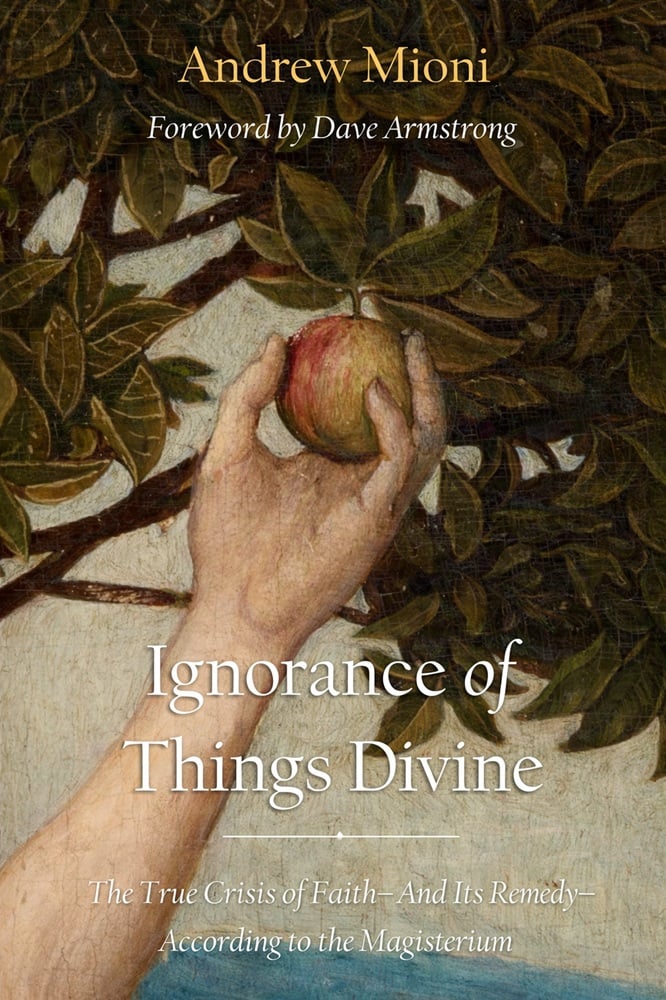
Published by En Route Books and Media, January 2026. This is my Foreword, written on 8 August 2025.
*****
Andrew Mioni is currently one of the most brilliant orthodox Catholic analysts of the ongoing controversies regarding the “traditionalist” wing of the Catholic Church and its troublesome radical offshoots, and the “roots” behind the current, very real crisis in the Church: one that no one denies. His superb book, Altar Against Altar: An Analysis of Catholic Traditionalism (En Route Books & Media, June 2024) was filled to the brim with helpful insights and hopeful solutions.
In this volume, he specifically refutes the simplistic and rather absurd allegation that the Second Vatican Council (1962-1965) was the primary cause of various serious difficulties and problems in the Catholic Church today. Historical causation (especially in matters of theology) is, however, always far more complex than that. Mioni notes Pope St. Pius X’s warning over a century ago that Modernism was “present almost in the very veins and heart of the Church” (Pascendi Dominici Gregis, 1907). This was not merely dissent from the Catholic Church outside her fold. It was already a serious problem inside the Church, indeed in her very “heart” according to this saint-pope and scourge of Modernism, particularly beloved by traditionalists and more radical reactionary Catholics.
In light of statements of that sort, we must go much further back and deeper into history to properly understand the destructive phenomenon that confronts us today, and Mioni conveniently provides the resources and framework to do this necessary work. In his Introduction he stresses the obvious but so often neglected starting-point of any such analysis: “I consulted the writings of the Magisterium and listened to what Holy Mother Church had said in her wisdom.” Amen! Back to basics . . .
The 18th century was a time of growing theological liberalism and rejection of existing Catholic tradition. Hence, Mioni cites Pope Pius VI’s 1775 encyclical Inscrutabile, where he stated that it was “a time when many plots are laid against orthodox religion” and that “confusion is spread wide by men maddened by a monstrous desire of innovation.” That has a familiar ring, doesn’t it?
It sounds like our own time because there have always been problems of heterodoxy and possible schism in the Church, from the beginning, as proven by St. Paul’s many scathing condemnations of divisiveness and lack of theological unity among the earliest Christians, in his epistles. Jesus thought it important enough to pray during the Last Supper for His disciples, and by extension, all of His followers throughout history, “that they may be one even as we are one, I in them and thou in me, that they may become perfectly one, so that the world may know that thou hast sent me” (Jn 17:22-23, RSV). At every turn, then, we find these problems, and this is what the book addresses, concentrating on more recent centuries. Mioni hits the nail on the head in his Chapter Three:
Thus it is clear that Modernism is rooted in the same errors that had been infecting the world; namely, a denial of revelation and an exclusion of God to make way for human reason. Naturally, the Modernist’s doctrines support the concept of religious indifferentism as well. As Pius X further wrote, “Indeed Modernists do not deny but actually admit, some confusedly, others in the most open manner, that all religions are true. . . .” . . .
These are compelling words from Pope Pius X, and should demonstrate beyond any doubt that this crisis of faith had already taken deep root in the world many years before Vatican II. [his italics; citation from Pascendi Dominici Gregis]
We mustn’t neglect the role of social media, either, in spreading morally and spiritually harmful material and false notions. Like all technologies and media, it can be used for great good (I have sought to do that, myself, these past 28 years) or great evil. Mioni cites Venerable Pope Pius XII in his encyclical Miranda Prorsus from 1957, where he virtually predicted the Internet and its huge ramifications in society:
Today the mounting technological advances in communicating pictures, sounds, and ideas must be subjected to the sweet yoke of the law of Christ if they are not to become a source of countless evils . . . here the issue is not real freedom, . . . but unchecked license to express oneself without regard for prudence, even though this be contrary to sound morals and liable to result in serious danger for souls.
Andrew Mioni helpfully documents from many popes, things that we foolishly think are either confined solely to our own age, or worse at present than they have ever been. Pope Leo XIII in Sapientiae Christianae (1890) referred to “the inertness and internal dissensions of Catholics” that “have contributed to the present condition of things.” In his encyclical, Octobri Mense (1891), he also lamented “that so many Catholics should be such in name only, and should pay to religion no honor or worship.” And Pope Pius XI echoed this opinion in Divini Redemptoris (1937): “Even in Catholic countries there are still too many who are Catholics hardly more than in name. . . . We know how much Our Divine Savior detested this empty pharisaic show . . .”
As King Solomon observed almost 3,000 years ago in Ecclesiastes 1:9: “what has been done is what will be done; and there is nothing new under the sun.” Philosopher George Santayana expressed a somewhat similar notion in his famous words from 1905, “Those who cannot remember the past are condemned to repeat it.” There were, indeed, relative “golden ages” in Church history, but assuredly they were never totally free of problems much like the ones we are plagued with today. The Catholic Church has always been in need of reform at all times (ecclesia semper reformanda est – as we say in Latin).
In his Chapter Seven, “The True Source of the Crisis,” Mioni documents how Pope Leo XII identified “the true source of all the evils” as “a dogged contempt for the Church’s authority” (Ubi Primum, 1824). Likewise, Pope Leo XIII believed that “the source of these evils lies chiefly . . . in this, that the holy and venerable authority of the Church, . . . has been despised and set aside” (Inscrutabili Deo Consilio, 1878). One might argue – and Mioni does – that this, along with a rejection of the full inspiration of the Bible, lies at the root of the premises behind Modernism and theological liberalism.
I fully agree with what Mioni asserted in the same chapter: “It is not that Vatican II caused the crisis, but that it revealed a crisis which had been simmering for centuries, . . . the popes had been warning the world for many years about it.” And also, “The fact that these evils came to light after the Council does not mean they came because of the Council.” The old logical fallacy, post hoc, ergo propter hoc (Latin for “after this, therefore because of this”) is as profoundly relevant today as it has always been. Making Vatican II the big bad boogeyman for every bad thing is a classic case of this type of illogical, shoddy thinking.
We see, clearly, then, that problems supposedly solely or primarily brought about by Vatican II are simply those that have always been present in the Church and in human hearts and souls, and are essentially identical to the sins and prominent strains of philosophical or nominal unbelief and lack of piety and virtue that run through all societies and religious groups and virtually all human beings at all times. Andrew Mioni’s book is crucial reading that will help any reader – particularly Catholic ones – become aware of what popes have authoritatively stated about these matters, and to have a much better grasp of the sources and background of present-day difficulties within the Catholic Church and by extension, the wider world.
Dave Armstrong
Author of Reflections on Radical Catholic Reactionaries (2002; rev. 2013 and 2023) and Mass Movements: Radical Catholic Reactionaries, the New Mass, and Ecumenism (2012)
Purchase
Photo credit: cover of the book from its publisher’s page at En Route Media and Books.
Summary: Andrew Mioni’s book, “Ignorance of Things Divine” is a very helpful & needed critique of the traditionalist Catholic antipathy towards Vatican II as the supposed “cause of all evils.”











 Ad-Free & Subscriber Log-In