


Allie Beth Stuckey is a Reformed Baptist mostly known as a conservative political commentator. Her YouTube channel has 712,000 subscribers. Today, we’re replying to part of her video entitled, “The Mary Debate: Did Jesus Have Siblings? & Other Dogmas” (7-30-25). It has over 85,000 views as of this writing, and more than 5,000 comments. First, let’s look at Allie’s comments on this topic:
5:40 What I’ve found, and I’ve talked about this a lot, is that — especially in the Bible Belt –, Protestants were not taught really anything about Catholicism.
10:50 This first dogma is that Mary is the mother of God. This means “God-bearer.” And as I said, this is a little bit layered. So let’s get into what this actually means. This is defined at the Council of Ephesus in 431 AD – a long time ago. This dogma declares that Mary is the Theotokos (God-bearer) because she bore Jesus, Who is fully God and fully human. And so the logic is there. If Jesus is fully God and Mary gave birth to Jesus, then the logic, the math goes that she is the mother of God. The Council of Ephesus was a formal assembly of bishops and church leaders to discuss and settle doctrinal matters. And they emphasized that Mary is not only the mother of Jesus. And then this was combating against this idea that was called Nestorianism at the time, and it tried to separate Jesus’s humanity from Jesus’s Godness [sic]. And so that is why the council of Ephesus at the time said, okay well because we have established this doctrine that Jesus was fully man and fully God which of course we agree with. Then we have to figure out was Mary just the mother of Jesus’s humanity or was she the mother of God himself and they decided that okay she is actually the mother of God.
12:48 all Christians agree with that: that Jesus is God and that Mary is Jesus’s mother.
40:30 Protestants agree that Mary is the mother of Jesus. So let’s go through these dogmas. Mother of God, Theotokos. Protestants agree that Mary is the mother of Jesus. We agree that Jesus is fully God and fully human. And thus we might affirm the title Theotokos. We would argue that at the council of Ephesus — when the transfer from Theotokos to Mother of God took place, that something else took place in that translation and transfer that has caused a lot of confusion, and it lies in an implication that Mary is being ascribed some level of divinity, because what we must be careful of is to not argue that God has a source because that would be heresy. I think even the Catholic Church would agree with [us on] that: [and deny that] that God was created or that He was initiated by Mary, that she was a part of God’s beginning.
41:51 We just want to make sure that we are drawing a distinction there, that Mary is not God’s source, which I hope my Catholic friends would agree with. So that’s more of just ensuring that we are really clear on that point.
Allie and Protestants who are confused about this need not worry at all. The Catholic Church never taught that Mary was a sort of goddess, from whom God Himself came. That’s blasphemous heresy. If we had taught it, it would be a simple matter of documenting it from this council or any other, or from some pope. But that’s never done, and it isn’t because it doesn’t exist. It’s simply asserted by many Protestants of the anti-Catholic variety, that Catholics think Mary is equal to God; therefore, when we use the language of “Mother of God” we are saying that we think God the Holy Trinity was somehow created by her. It’s all nonsense.
Allie herself doesn’t assert this, and she accurately explained why we use this title, and have made it a dogmatic requirement, in response to the Nestorian heresy. Bravo and kudos to her for doing so. But many Protestants do make ludicrous claims about what we supposedly believe about the title Mother of God, and it’s a case study of distorting and misrepresenting what a group believes, and what the Orthodox and a great many Protestants believe along with us, too.
Anyone can look up the decrees of the Council of Ephesus. We’ll provide a link to one of these sites. It was made very clear that the council wasn’t making Mary some kind of super-goddess, above God Himself. Here are three relevant statements from it:
He who existed and was begotten of the Father before all ages is also said to have been begotten according to the flesh of a woman, without the divine nature either beginning to exist in the holy virgin, or needing of itself a second begetting after that from his Father.
The holy fathers . . . dared to call the holy virgin, mother of God, not as though the nature of the Word or his godhead received the origin of their being from the holy virgin, but because there was born from her his holy body rationally ensouled, with which the Word was hypostatically united and is said to have been begotten in the flesh. (2nd letter of Cyril to Nestorius; from the Papal Encyclicals Online site)
Because the holy virgin bore in the flesh God who was united hypostatically with the flesh, for that reason we call her mother of God, not as though the nature of the Word had the beginning of its existence from the flesh (for “the Word was in the beginning and the Word was God and the Word was with God”, and he made the ages and is coeternal with the Father and craftsman of all things), but because, as we have said, he united to himself hypostatically the human and underwent a birth according to the flesh from her womb. (3rd letter of Cyril to Nestorius)
The Fourth Synod of Toledo from the year 633 likewise declared:
We say that the Father [was] neither made nor generated by anyone; we affirm that the Son [was] not made by the Father but generated; we truly profess that the Holy Spirit [was] neither created nor generated but proceeds from the Father and the Son. (Denzinger, Enchiridion symbolorum, 2012 edition, #485, p. 166)
Martin Luther (the founder of Protestantism) also made many affirming statements about Theotokos. Here are two of the most striking ones:
We, too, know very well that Christ did not derive his deity from Mary; but it does not follow that it must, therefore, be false to say, “God was born of Mary” and “God is Mary’s Son” and “Mary is God’s mother.”
Mary is the true, natural mother of the child called Jesus Christ, and the true mother and bearer of God . . . God and man are one Person, one Christ, one Son, one Jesus, not two persons . . . just as your son is not two sons . . . even though he has two natures, body and soul, — body from you, soul from God alone. (On the Councils and the Church, 1539)
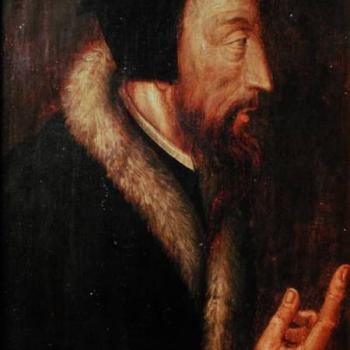
John Calvin agreed. He wrote:
She [Elizabeth] calls Mary the mother of her Lord This denotes a unity of person in the two natures of Christ; as if she had said, that he who was begotten a mortal man in the womb of Mary is, at the same time, the eternal God. (Harmony of the Synoptic Gospels, comment under Luke 1:43)
James Cardinal Gibbons, a great apologist in the early 1900s, brilliantly explained the doctrine of Theotokos:
But it may be said the Blessed Virgin is not the Mother of the Divinity. She had not, and she could not have, any part in the generation of the Word of God, for that generation is eternal; her maternity is temporal. He is her Creator; she is His creature. Style her, if you will, the Mother of the man Jesus or even of the human nature of the Son of God, but not the Mother of God.
I shall answer this objection by putting a question. Did the mother who bore us have any part in the production of our soul? Was not this nobler part of our being the work of God alone? And yet who would for a moment dream of saying “the mother of my body,” and not “my mother?” . . . . .
In like manner, . . . the Blessed Virgin, under the overshadowing of the Holy Ghost, by communicating to the Second Person of the Adorable Trinity, as mothers do, a true human nature of the same substance with her own, is thereby really and truly His Mother. . . .
In this sense, and in no other, has the Church called her by that title. (The Faith of Our Fathers, New York: P.J. Kenedy & Sons, revised edition, 1917, 137-138)
Source
“Council Of Ephesus – 431 A.D.” ( Papal Encyclicals Online)
Related Book
Theology of God: Biblical, Chalcedonian Trinitarianism and Christology (2012)
Web Page
Mary: The Blessed Virgin [section V]
*****
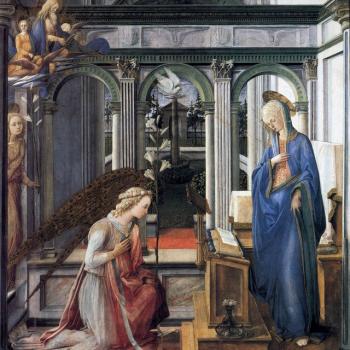
Photo credit: Adoration in the Forest (c. 1459), by Filippo Lippi (1406-1469) [public domain / Wikimedia Commons]
Summary: Protestant YouTuber Allie Beth Stuckey put out a pretty good video about Mary “Mother of God” (Theotokos). But I reiterate that Catholics don’t think she bore God the Father (!!)





 Ad-Free & Subscriber Log-In