


This is the initial transcript of the video, “Why Wes Huff (And Everyone Else) Should Be Catholic” (Catholic Bible Highlights, with Kenny Burchard, 6-5-26). Wes’s words from his video will be indented, with reference times indicated.
*****
Wes Huff is a Reformed Baptist apologist, currently working towards a doctorate in theological studies. He is the Central Canada Director for Apologetics Canada. He does a lot of great general apologetics work that Catholics would heartily agree with and appreciate. His YouTube channel has 972,000 subscribers. We’re replying to his video, “Six Reasons Why I’m Not Roman Catholic” (5-21-26). In its first 13 days, it had received 795,000 views and more than 12,000 comments. Let’s take a look at his reasoning. We’ll be playing several clips from his video. Here we go!
1:43 I get a lot of comments that say things like, “Wes, I can’t believe with all of your study of scripture and church history, you still remain Protestant.” And so I wanted to lay out the reasons why that is. The short answer is that it’s because of my study of scripture and church history that I am a convictional Protestant, . . .
And my quick reply is that it’s because of my study of Church history and the Bible that I am a Catholic, having formerly been an evangelical Protestant.
The Bible / Sola Scriptura
2:47 Scripture is ontologically unique. So though it contains both divine and human authorship scripture remains the speech of God. Nothing else we possess as a rule is akin to scripture. Likewise, scripture functions unrivaled in its authority. Nothing we possess as a rule does that. But both in what it does and in what it is, scripture is unique. And that uniqueness provides the basis for its sufficiency.
Catholics agree that Scripture is unique, but we point out that:
1) The Bible still needs to be interpreted, and this will necessarily have to be carried out by non-inspired persons.
2) There are other infallible authorities, according to the Bible itself, and sola Scriptura is the belief that the Bible is the only infallible authority in the Christian life.
3) The Bible never states the principle of sola Scriptura: certainly not explicitly, and – I would contend – not even indirectly, implicitly, or deductively. If indeed it doesn’t teach it, then sola Scriptura is merely a non-infallible tradition within Protestantism and hence could be denied by any Protestant.
***
5:30 Roman Catholics therefore operate with a two source of authority: Scripture and tradition.
Ultimately, they are one in the sense that:
1) the Bible teaches that this authoritative tradition exists,
2) the tradition is always harmonious with the Bible.
Hence, Dei Verbum, or Dogmatic Constitution on Divine Revelation, from Vatican II stated:
There exists a close connection and communication between sacred Tradition and sacred Scripture. For both of them, flowing from the same divine wellspring, in a certain way merge into a unity and tend toward the same end.
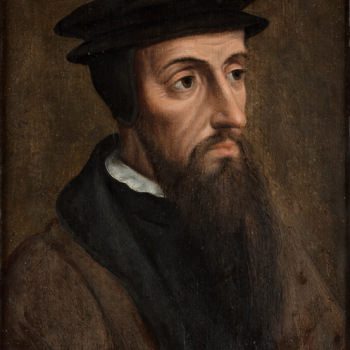
Every Christian has traditions, to varying degrees of adherence, whether they acknowledge it or not. One might say, for example, that Calvinists highly revere John Calvin’s Institutes of the Christian Religion, or his Commentaries, and believe that they are harmonious with Scripture, and excellent interpretations of it. So in a large sense, these are part of various Protestant extra-biblical traditions, and highly authoritative, though not held to be infallible. They function in a very similar way, as operational frameworks for how to approach theology and exegesis.
We’ll link to my book, 100 Biblical Arguments Against Sola Scriptura, and an article of mine where I compile 350 biblical arguments against sola Scriptura.
Sufficiency of Faith?
6:54 Protestant emphasis on salvation is that it comes through faith alone.
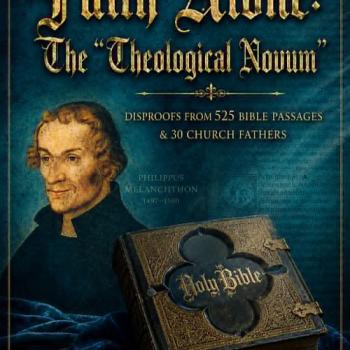
I don’t think this is a biblical doctrine, which is why I recently wrote my book entitled, Faith Alone: The “Theological Novum”: Disproofs from 525 Bible Passages & 30 Church Fathers. This belief literally began in the 1530s with Philip Melanchthon: Luther’s best friend and successor, and he departed in significant ways from various aspects of Luther’s conception of “faith alone.” We’ll link to that book. It’s free online, but if someone would like it in three different convenient formats as an e-book, it’s available for $9.99.
Justification, which is going to be a further point that I’m going to elaborate on a little bit later, is a definitive moment when God declares a person righteous and they enter the Christian life. This represents a judicial understanding. God pronounces the believer righteous based on faith in Christ.
This is the difference between imputed and imparted or infused justification. Protestants –following Melanchthon — separated sanctification from justification in a way that had never been done before. I’ll cite just two of scores and scores of Bible passages that go against this:
2 Thessalonians 2:13 (RSV) . . . God chose you from the beginning to be saved, through sanctification by the Spirit and belief in the truth.
I submit that Paul couldn’t and wouldn’t use the phrase, “saved, through sanctification” if in fact the latter has nothing directly to do with salvation. But his thought is harmonious with the Catholic view that sanctification and justification are organically connected.
Romans 6:22 But now that you have been set free from sin and have become slaves of God, the return you get is sanctification and its end, eternal life.
If the very “end” of sanctification is eternal life, then it obviously can’t be separated from it, as Protestants try to do. It can’t be dismissed as a non-cause of that same eternal life and salvation. So this appears to be a refutation of imputed justification and faith alone from the Apostle Paul.
9:45 salvation must originate entirely from Christ rather than from human effort.
I’m happy to note that Catholics and Protestants agree about the first stage of justification (what we call initial justification): in terms of God being the sole originator of it (what is called “monergism”). Human beings can’t bring that about on their own. The Council of Trent made this very clear and reaffirmed what had always been Catholic teaching. But Catholics also believe that the regenerated and initially justified person is commanded to perform grace-enabled and meritorious good works and to cooperate with God. We’re not entirely passive and we have a free will. Salvation is by grace alone through faith and works that organically flow from faith, and it’s a process.
13:07 Roman Catholicism treats grace almost as a substance dispensed through meritorious channels.
That is a biblical meaning, since grace is referred to in quantitative terms; for example, “great grace” (Acts 4:33); “grace abounded all the more” (Rom 5:20); “grace was given to each of us according to the measure of Christ’s gift” (Eph 4:7); “he gives more grace” (Jas 4:6); “May grace and peace be multiplied to you” (1 Pet 1:2; 2 Pet 1:2); “God’s varied grace” (1 Pet 4:10); “grow in the grace and knowledge of our Lord and Savior Jesus Christ” (2 Pet 3:18). Most English Bibles have “favored one” in Luke 1:28, but the literal translation of the Greek (as even the Baptist linguist A. T. Robertson noted) is “full of grace.”
8:28 It’s important to note that Catholic doctrine does not advocate works-based salvation.
I heartily thank Wes for accurately noting this. If I had a dime for every time I’ve heard a Protestant say the opposite, I’d be richer than Croesus. We believe in salvation by grace alone, through a grace-originated faith, which in turn produces grace-enabled good works, without which this faith is “dead”: as the book of James expresses over and over in many ways. We do not believe in salvation by works alone. That’s the heresy of Pelagianism.
8:58 Roman Catholicism joins justification with sanctification and regeneration, tying it to baptism and the sacrament, through which grace is infused, making justification a cooperative effort between God’s grace and human effort, . . .
11:28 The reformers distinguished their position from Rome’s claim that faith constitutes merely one component of justification alongside things like works and sacraments . . .
Many Protestants tie justification to baptism – as a sacrament — in a profound way; for starters, Martin Luther, the founder of Protestantism. The well-known book, The Theology of Luther, by Lutheran Paul Althaus (translated by Robert C. Schultz, Philadelphia: Fortress Press: 1966, from the German second edition of 1963) describes his view:
Baptism conveys all of salvation. The assertion of the Small Catechism that it “effects forgiveness of sins, delivers from death and the devil, and grants eternal salvation to all who believe” is constantly repeated in similar form by Luther. Through baptism, “I am promised that I shall be saved and have eternal life, both in body and in soul.” (pp. 353-354)
Luther thus places baptism in the center of the Christian life. His understanding of baptism exactly expresses his doctrine of justification. (p. 356)
The Lutheran Church – Missouri Synod, following this, teaches:
We believe (because of what the Bible says about Baptism) that when an infant is baptized God creates faith in the heart of that infant. (“FAQs about Doctrine”)
John Calvin — though he doesn’t use the word “justification” — appears to hold a very similar view:
The last advantage which our faith receives from baptism is its assuring us not only that we are ingrafted into the death and life of Christ, but so united to Christ himself as to be partakers of all his blessings. . . . Paul proves us to be the sons of God, from the fact that we put on Christ in baptism (Gal. 3:27). (Institutes, IV, 15:6)
God, regenerating us in baptism, ingrafts us into the fellowship of his Church, and makes us his by adoption, . . . (Ibid., 17:1)
We ought to consider that at whatever time we are baptised, we are washed and purified once for the whole of life. (Ibid., 15:3)
Likewise, John Wesley – citing his own Anglican beliefs — taught:
But “as by the offense of one, judgment came upon all men to condemnation, so by the righteousness of one, the free gift came upon all men, to justification of life.” And the virtue of this free gift, the merits of Christ’s life and death, are applied to us in baptism. . . . the ordinary instrument of our justification. Agreeably to this, our Church prays in the baptismal office that the person to be baptized may be “washed and sanctified by the Holy Ghost, and, being delivered from God’s wrath, receive remission of sins, and enjoy the everlasting benediction of his heavenly washing;” . . . (A Treatise on Baptism; 11 Nov. 1756)
This is one of many examples where Catholics and a majority of Protestants have more in common than many people seem to think. I think that’s good news. The more we agree on, the more we can respect each other and work together, even while continuing to have many honest disagreements.
13:15 you have the Mass, Eucharist, baptism, and the sacraments: all of these as a means of grace that improve and perfect the believer toward salvation. Protestants though in contrast understand grace as God’s sovereign transformative power that operates independently of human merit or institutional mediation.
Luther and Calvin both believed that the Holy Eucharist is a sacrament and instrumental in obtaining eternal life (just as Jesus taught in John 6). Here’s what Martin Luther says about it, in no uncertain terms:
My Lord has given me his body and blood in the bread and wine, . . . so that I may be certain . . . that I am to be free of death and hell, have eternal life, and be a child of God and an heir of heaven. (The Sacrament of the Body and Blood of Christ Against the Fanatics, 1526, tr. Frederick C. Ahrens; in Luther’s Works, Vol. 36)
The body is nourished with the body and blood of the Lord in order that it may live eternally, . . . (That These Words of Christ, “This Is My Body,” etc., Still Stand Firm Against the Fanatics, March 1527, tr. Robert H. Fischer; in Luther’s Works, Vol. 37)
He has not instituted the sacrament to act as a poison and to harm us, but to grant comfort and salvation. (Admonition Concerning the Sacrament of the Body and Blood of our Lord, Oct. 1530, tr. Martin E. Lehmann; in Luther’s Works, Vol. 38)
And John Calvin (perhaps surprisingly to some) said this:
The very flesh in which he resides he makes vivifying to us, that by partaking of it we may feed for immortality. “I,” says he, “am that bread of life;” “I am the living bread which came down from heaven;” “And the bread that I will give is my flesh, which I will give for the life of the world” (John 6:48, 51) . . . . by this food believers are reared to eternal life. (Institutes, IV, 17:8)
Now, who sees not that the communion of the flesh and blood of Christ is necessary to all who aspire to the heavenly life? (Ibid., 17:9)
The true and substantial communication of the body and blood of the Lord, . . . are received not by the imagination or intellect merely, but are enjoyed in reality as the food of eternal life. (Ibid., 17:19)
There never can be a sacrament without a promise of salvation. (Ibid., 18:19)
That’s sacramental grace, and it’s a thing that we do (a work, if you will) that contributes to our salvation.
13:42 Romans 11:6 establishes that if salvation is by grace cannot simultaneously rest on works since grace would otherwise cease being grace.
Here is that verse:
Romans 11:6 But if it is by grace, it is no longer on the basis of works; otherwise grace would no longer be grace.
Is Paul referring to the entire life of believers, and how we attain salvation, or is he referring to election? When we consult context, it’s clearly the latter, because we have three clues:
Romans 11:2 God has not rejected his people whom he foreknew. . . .
Romans 11:5 So too at the present time there is a remnant, chosen by grace.
Romans 11:7 What then? Israel failed to obtain what it sought. The elect obtained it, but the rest were hardened,
Catholics and Protestants are in total agreement that the elect are predestined. Paul’s point here was that the group of the elect will include a “remnant” of individual Jews, and that God foreknew and decreed this from all eternity. It’s referring to initial justification. The Council of Trent, accordingly, cites this verse in its Decree on Justification, Chapter 8:
And whereas the Apostle saith, that man is justified by faith and freely, those words are to be understood in that sense which the perpetual consent of the Catholic Church hath held and expressed; to wit, that we are therefore said to be justified by faith, because faith is the beginning of human salvation, the foundation, and the root of all Justification; without which it is impossible to please God, and to come unto the fellowship of His sons: but we are therefore said to be justified freely, because that none of those things which precede justification-whether faith or works-merit the grace itself of justification. For, if it be a grace, it is not now by works, otherwise, as the same Apostle says, grace is no more grace.
So Romans 11:6 – rightly understood — is not relevant to the debate over faith alone. What Wes needs to grapple with are the many Pauline statements that refer to works being necessary for salvation alongside grace and faith. Here are ten:
Romans 2:7 For he will render to every man according to his works: [7] to those who by patience in well-doing seek for glory and honor and immortality, he will give eternal life;
Romans 2:10 but glory and honor and peace for every one who does good, the Jew first and also the Greek.
Romans 2:13 For it is not the hearers of the law who are righteous before God, but the doers of the law who will be justified.
Romans 8:17 . . . heirs of God and fellow heirs with Christ, provided we suffer with him in order that we may also be glorified with him.
Philippians 2:12-13 . . . as you have always obeyed, . . . work out your own salvation with fear and trembling; [13] for God is at work in you, both to will and to work for his good pleasure.
Colossians 3:23-25 Whatever your task, work heartily, as serving the Lord and not men, [24] knowing that from the Lord you will receive the inheritance as your reward; you are serving the Lord Christ. [25] For the wrongdoer will be paid back for the wrong he has done, and there is no partiality.
1 Thessalonians 3:12-13 . . . may the Lord make you increase and abound in love to one another and to all men, as we do to you, [13] so that he may establish your hearts unblamable in holiness before our God and Father, at the coming of our Lord Jesus with all his saints.
1 Timothy 4:15-16 Practice these duties, devote yourself to them, so that all may see your progress. [16] Take heed to yourself and to your teaching; hold to that, for by so doing you will save both yourself and your hearers.
1 Timothy 6:11-12 But as for you, man of God, shun all this; aim at righteousness, godliness, faith, love, steadfastness, gentleness. [12] Fight the good fight of the faith; take hold of the eternal life to which you were called . . .
1 Timothy 6:18-19 They are to do good, to be rich in good deeds, liberal and generous, [19] thus laying up for themselves a good foundation for the future, so that they may take hold of the life which is life indeed.
***
My Related Books
100 Biblical Arguments Against Sola Scriptura (Paperback at Amazon) / EBook ($9.99)
Faith Alone: The “Theological Novum”: Disproofs from 525 Bible Passages & 30 Church Fathers (EBook: $9.99)
My Related Articles
350 Bible Passages vs. Sola Scriptura
Bible vs. “Faith Alone”: 120 NT & 30 OT Proofs
*****
Photo credit: copyright 2026 by Catholic Bible Highlights.
Summary: We reply in the first part of two installments to prominent Protestant apologist Wes Huff’s video as to why he isn’t a Catholic, with in-depth biblical Catholic apologetics.











 Ad-Free & Subscriber Log-In