

Contra Reformed Baptist Apologist Gavin Ortlund; Including the Opinions of Protestant Historians Philip Schaff and Jaroslav Pelikan; Similarity to the Veneration of Relics
This is a follow-up to my video with Kenny Burchard, Gavin Ortlund’s “No Evidence” Claim on Early Icons—REFUTED!! (8-9-25). There, I was responding to a remarkably false statement from Gavin, that he made in a video dated 3-15-24 (the relevant portion of which was “triumphally” tweeted by someone else the next day):
All the evidence that we have favors the view that any sort of cultic use of images was resoundingly rejected by Christians for the first 500 years of Church history . . . it’s everybody; it’s everywhere. It’s resounding, it’s clear, it’s bright. . . . If there’s anything we know about the early Church, we know that’s not what was happening. That is as clear as anything about the early Church. Can you name any advocate of icon veneration before 500 AD, . . . [who] says anything remotely positive about it?
First I’ll recount the patristic evidence I provided in the video, contrary to this “universal negative” claim, then provide additional commentary from Protestant Church historians.
St. John Chrysostom (c. 345-407) is one of the three great “Holy Hierarchs” of Eastern Christianity, and is universally regarded as one of the greatest Church fathers and doctors. In his Homily 12 on First Corinthians, commenting on 1 Corinthians 4:10 (section 14), he rather casually describes Christians as “worshippers of the Cross”. The Schaff standard translation of the Church fathers even provides in parentheses the Greek words he used: ton stauron proskyousi — literally, “they worship the cross.”
This provides a bridge to biblical language. Strong’s Greek word #4352: proskuneó appears 60 times in the New Testament, always in reference to worship of God. Its use in the Old Testament in the Greek Septuagint was much more broad, incorporating what we would call veneration. It was usually translating the Strong’s Hebrew word #7812: shachah. That’s what is going on in passages such as Genesis 19:1 and 42:6, and Daniel 2:46. St. John Chrysostom could either have meant that Christians were venerating the cross, or that the cross represented God Himself and He was worshiped through it. This is how Catholics and Orthodox view icons.
Tertullian (c. 160-c. 225) likewise verifies that non-Christians viewed Christians as those who “render superstitious adoration to the cross” (Apology, ch. 16).
Methodius of Olympus (d. c. 311) is a Church father included in the standard 38-volume collection, edited by Philip Schaff . He stated:
The images of God’s angels, which are fashioned of gold, the principalities and powers, we make to His honour and glory. (From the Discourse on the Resurrection, Part 2)
Epiphanius (c. 315-403) was a strong opponent of images; what is called an iconoclast. But as a “hostile witness” he proved that the practice was very widespread in the 4th century, since in his Letter to Emperor Theodosius, he stated:
I have often advised those who are reputed to be wise — bishops, doctors, and concelebrants — to take down those things. Not everyone paid attention to me, actually only a few.
Moreover, he wrote in another treatise, later titled Against Those Who, Following an Idolatrous Practice, Make Images with the Intention of Reproducing the Likeness of Christ, the Mother of God, the Angels and the Prophets:
But you will say to me, “The fathers detested the idols of the nations, but we make images of the saints in their memory, and we prostrate ourselves in front of them in their honor.” Precisely by this reasoning, some of you have had the audacity, after having plastered a wall inside the holy house, to represent the images of Peter, John, and Paul with various colors, . . .
Eminent Protestant Church historian Philip Schaff (1819-1893), in his History of the Christian Church, vol. 2 (devoted to the period of 100-325 AD), section 80 (as a “hostile witness”), stated:
Previous to the time of Constantine [r. 306-337], we find no trace of an image of Christ, properly speaking, except among the Gnostic Carpocratians, . . . the entire silence of the Gospels about it, and the Old Testament prohibition of images, restrained the church from making either pictures or statues of Christ, until in the Nicene age [Dave: i.e., after 325] a great change took place, though not without energetic and long-continued opposition. [my bolded italics] [link]
In the next section 81, he writes about images of Mary:
It was formerly supposed that no picture of the Virgin existed before the Council of Ephesus (431), which condemned Nestorius and sanctioned the theotokos, thereby giving solemn sanction and a strong impetus to the cultus of Mary. But several pictures are now traced, with a high degree of probability, to the third, if not the second century. From the first five centuries nearly fifty representations of Mary have so far been brought to the notice of scholars, most of them in connection with the infant Saviour. . . .
Nearly all the representations in the catacombs keep within the limits of the gospel history. But after the fourth century, and in the degeneracy of art, Mary was pictured in elaborate mosaics, and on gilded glasses, as the crowned queen of heaven, seated on a throne, in bejewelled purple robes, and with a nimbus of glory, worshipped by angels and saints. [my bolded italics]
Likewise, in his History of the Christian Church, vol. 3 (devoted to the period of 311-600 AD) he states in section 1, as a “hostile witness”:
From the time of Constantine . . . Worship appears greatly enriched and adorned; for art now comes into the service of the church. A Christian architecture, a Christian sculpture, a Christian painting, music, and poetry arise, favoring at once devotion and solemnity, and all sorts of superstition and empty display. The introduction of religious images succeeds only after long and violent opposition.” [link] [my bolded italics]
In section 34, he criticizes monasticism as follows (bearing witness to widespread image-veneration):
It favored the idolatrous veneration of Mary and of saints, the worship of images and relics, and all sorts of superstitious and pious fraud. [link] [my bolded italics]
And in section 110:
On the one side, the prejudices of the ante-Nicene period against images in painting or sculpture continued alive, through fear of approach to pagan idolatry, or of lowering Christianity into the province of sense. But generally the hostility was directed only against images of Christ. . . [link] [my bolded italics]
About the middle of the fifth century, just when the doctrine of the person of Christ reached its formal settlement, the first representations of Christ Himself appeared, even said by tradition to be faithful portraits of the original. From that time the difficulty of representing the God-Man was removed by an actual representation, and the recognition of the images of Christ, especially of the Madonna with the Child, became even a test of orthodoxy, as against the Nestorian heresy of an abstract separation of the two natures in Christ. In the sixth century, according to the testimony of Gregory of Tours, pictures of Christ were hung not only in churches, but in almost every private house. [link] [my bolded italics]
Likewise, Jaroslav Pelikan (1923-2006), at the time a renowned Lutheran scholar, in his volume,
Those who behold them [relics] embrace, as it were, the living body itself in its full flower. They bring eye, mouth, ear, all their senses into play. And then, shedding tears of reverence and passion, they address to the martyr their prayers of intercession as though he were alone and present. [from In Praise of Blessed Theodore, the Great Martyr, c. 386 (PG 46:740)]
It is not a long step from this veneration of relics to the veneration of images; Gregory also described his feelings at viewing an image portraying Abraham’s sacrifice of Isaac. (p. 104)
Jaroslav Pelikan, I should note, later converted to Orthodoxy, but that occurred 24 years after he wrote this book (in 1998), so I submit that “confessional bias” isn’t a factor in his scholarly analysis. Even if it was, however, the patristic facts are what they are. His comparison of the conceptual closeness of the veneration of relics to the veneration of images is a further argument that could be pursued. The veneration of relics is a belief of the Church fathers that developed more rapidly than veneration of images, and can be thoroughly traced. Hence, the following articles:
St. Augustine and Holy Relics [Reginald de Piperno, 1-26-10]
The Early Church Fathers on Relics (StayCatholic)
Church Fathers: Relics (Original Sinner)
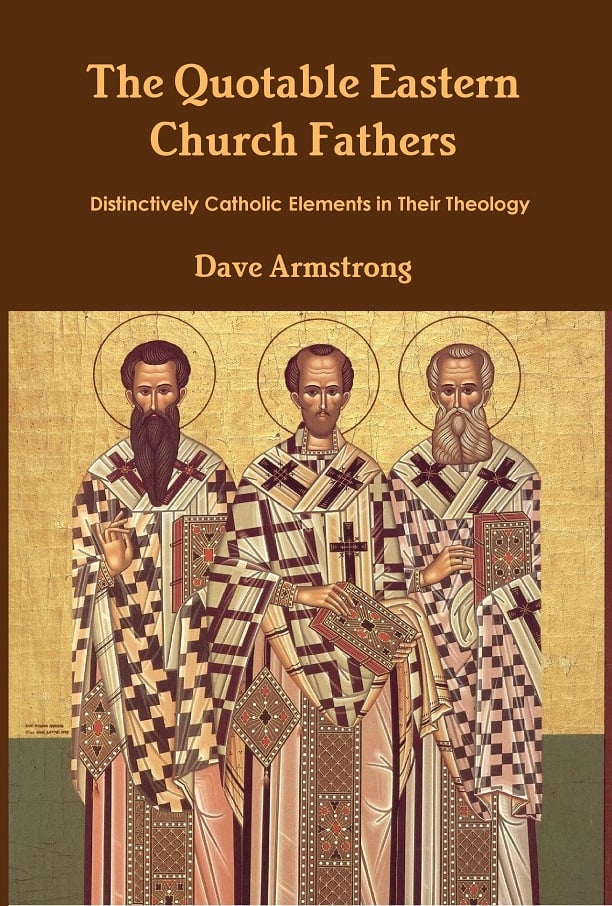
In my book, The Quotable Eastern Church Fathers: Distinctively Catholic Elements in Their Theology (July 2013), I offer four pages of patristic citations prior to 500, from St. John Chrysostom, St. Basil the Great (c. 330-379), St. Gregory Nazianzen (c. 330-c. 390), and St. Ephraem (c. 306-373). I provide an additional three pages of citations, from The Confessions, The City of God, and Epistle 212, in my volume, The Quotable Augustine: Distinctively Catholic Elements in His Theology (Sep. 2012).
Philip Schaff takes note of the early Christian practice of veneration of relics, in his section 27: “Rise of the Worship of Martyrs and Relics” in his Volume 2 (which covers the period of 100-325). He states, in his characteristic “theologically hostile but historically accurate” way:
In thankful remembrance of the fidelity of this “noble army of martyrs,” in recognition of the unbroken communion of saints, and in prospect of the resurrection of the body, the church paid to the martyrs, and even to their mortal remains, a veneration, which was in itself well-deserved and altogether natural, but which early exceeded the scriptural limit, and afterwards degenerated into the worship of saints and relics. The heathen hero-worship silently continued in the church and was baptized with Christian names. (p. 82)
The veneration thus shown for the persons of the martyrs was transferred in smaller measure to their remains. (p. 83)
The friends of Cyprian [c. 210-258] gathered his blood in handkerchiefs, . . . (p. 84)
In his vol. 3 (devoted to 311-600), he noted:
Even Chrysostom did not rise above the spirit of the time, lie too is an eloquent and enthusiastic advocate of the worship of the saints and their relics. (p. 439)
But back to Pelikan’s observations:
A younger contemporary of Gregory’s, Paulinus of Nola [c. 354-431], gives evidence that images of Christian saints were already being set up in Christian churches . . . he [gave] consent to the installation of an image of Martin of Tours [316 or 336-397] in a baptistery. The reason was that “he bore the image of the heavenly man by his perfect imitation of Christ,” and therefore this “portrait of a heavenly soul worthy of imitation” was an appropriate subject for men to look at . . . [N.Ep. 30.2, CSEL 29:262-263]
At about the same time, the devotees of Simeon Stylites [c. 390-459] were putting up images of him at the entrances of their workshops for protection — and this apparently while he was still alive. (p. 104)
He makes an interesting point about iconoclasts (opposers of veneration of images) and symbols of the cross:
Iconoclastic doctrine does appear to have made at least one exception to this rule against images and symbols: the holy cross. Quoting the words of the apostle Paul in praise of the cross as the only thing in which he was willing to glory [Gal 6:14; 1 Cor 1:18], the iconoclasts asked: “Where is there anything written about the image to compare with what is written here about the cross? . . . we worship the symbol of the cross on account of him who was fastened to it.” (p. 110)
“In the Church of the West,” says Neander [renowned 17th c. German Calvinist historian], “this moderate policy, holding to the mean between unconditional repudiation of images and their worship, maintained itself into the next period, as we see from the example of the Roman bishop, Gregory the Great [r. 590-604].” (p. 502; citing Neander’s work, Kirchengeschichte [General History of the Christian Religion and Church], Vol. 3, 412; Vol. 2, 293-294 in English).
At Rome, the names of the apostles Peter and Paul being often coupled together as martyrs, and the memory of both celebrated on the same day, it came about, that the figure of Christ, attended by these two apostles, was painted on the walls; . . . Images of martyrs, venerated monks, and bishops, were dispersed far and wide. The Antiochians had the likeness of their deceased bishop Meletius [r. 360-381] engraven on their signets, and painted on cups, goblets, and on the walls of their chambers. (p. 288; see further primary references there)*At the same time, we should take pains to distinguish the different points of view in which images were regarded by individual church teachers. If they opposed the use of images in the church, because they feared it would degenerate into an idolatrous veneration; if they strove to elevate the religion of the senses to that of the spirit; if they especially rejected the images of Christ on the score of some particular principle of doctrine, yet we are not warranted for these reasons to conclude that they condemned, in general, all representations of religious objects.*Against images of Christ in particular, there might be the more decided opposition, inasmuch as the whole tradition of the church witnessed that no genuine likeness of Christ existed: . . . (p. 289)*In the course of the fourth century, men began, by degrees, to decorate the churches also with images – a practice, however, which did not become general until near the close of this century. (p. 291)
Julian the Apostate [r. 355-363] reproached the Christians with adoring the wood of the cross and the painted images on the walls of their houses, which obviously supposes veneration of some kind. (p. 479; citing St. Cyril of Alexandria [c. 376-444], Contra Julian, 6; PG 48, 826)
About the same time Asterius of Amasea [c. 350-c. 410] describes pictures that represented St. Euphemia [d. c. 303], . . . (p. 479; citing In Laud. S. Euphem., PG 40)
Emblems, such as the dove, the fish, the anchor, vine, lamb, etc., engraved on seals, formed the first step; then came paintings representing Biblical events, saints or martyrs, etc., which were placed in the vestibule of the church. Yet this practice was unfavorably regarded by the synods of the 4th century. When, however, in the same century, Christianity was proclaimed the religion of the state, many distinguished persons embraced it, and its ceremonial became more imposing; and in the 5th century the use of painting, sculpture, and jewelry became general for the decoration of the churches. This resulted in the adoption of a regular system of symbolic religious images. Paulinus of Nola (q.v.) was chiefly instrumental in introducing these practices in the West, . . . as the teachers of the Church became gradually more accommodating in their relations with the heathen, holding out greater privileges to them, and allowing them to retain their old usages while conforming to the outward forms of Christianity, the worship of images became so general that it had to be repeatedly checked by laws. In the 6th century it had grown into a great abuse, especially in the East, where images were made the object of especial adoration: they were kissed, lamps were burned before them, incense was offered to them, and, in short, they were treated in every respect as the heathen were wont to treat the images of their gods.*Neander describes the origin of the use of images in churches as follows: “It was not ‘in the Church, but in the family, that religious images first came into use among the Christians. In their daily intercourse with men, the Christians saw themselves everywhere surrounded by the objects of pagan mythology, or, at least, by objects offensive to their moral and Christian sentiments. Representations of this sort covered the walls in shops, and were the ornaments of drinking-vessels and seal rings, on which the pagans frequently had engraved the images of their gods, so that they might worship them when they pleased. It was natural that, in place of these objects, so offensive to their religious and moral sentiments, the Christians should substitute others more agreeable to them. Thus they preferred to have on the goblets the figure of a shepherd carrying a lamb on his shoulder, which was the symbol of our Savior rescuing the repentant sinner, according to the Gospel parable. . . . Yet religious emblems passed from domestic use into the churches perhaps as early as the end of the 3rd century. The walls of them were painted in this manner. The Council of Elvira, in the year 303, opposed this innovation as an abuse, and forbade ‘the objects of worship and adoration to be painted on the walls'” (Neander, Church History, 1, 292). . . .*The admission of images into the church in the 4th and 5th centuries was justified on the theory that the ignorant people could learn the facts of Christianity from them better than ‘from sermons or books. But the people soon lost sight of this use of the images, and made them the objects of adoration. This took place earlier in the East than in the West; but the abuse gained ground in the latter region in a short time.
All the evidence that we have favors the view that any sort of cultic use of images was resoundingly rejected by Christians for the first 500 years of Church history . . . it’s everybody; it’s everywhere. It’s resounding, it’s clear, it’s bright. . . . If there’s anything we know about the early Church, we know that’s not what was happening. That is as clear as anything about the early Church. Can you name any advocate of icon veneration before 500 AD, . . . [who] says anything remotely positive about it?
3) Methodius of Olympus (d. c. 311): “The images of God’s angels, which are fashioned of gold, the principalities and powers, we make to His honour and glory.”
4) Protestant Church historian Philip Schaff (1819-1893) asserted that “Previous to the time of Constantine [r. 306-337], we find no trace of an image of Christ, . . . until in the Nicene age [Dave: i.e., after 325] a great change took place, . . .” Schaff further noted: several pictures are now traced, with a high degree of probability, to the third, if not the second century. From the first five centuries nearly fifty representations of Mary have so far been brought to the notice of scholars, . . . after the fourth century, . . . Mary was pictured in elaborate mosaics, . . . as the crowned queen of heaven, seated on a throne, in bejewelled purple robes, and with a nimbus of glory, worshipped by angels and saints.” He noted that monasticism “favored the idolatrous veneration of Mary and of saints, the worship of images and relics, . . .” he also makes an important qualification: “the prejudices of the ante-Nicene period against images in painting or sculpture continued alive, . . . But generally the hostility was directed only against images of Christ. . .”
5) Julian the Apostate [r. 355-363] reproached the Christians with adoring the wood of the cross and the painted images on the walls of their houses, which obviously supposes veneration of some kind.
6) Neander noted that “The Antiochians had the likeness of their deceased bishop Meletius [r. 360-381] engraven on their signets, and painted on cups, goblets, and on the walls of their chambers.” And he stated that “In the course of the fourth century, men began, by degrees, to decorate the churches also with images – a practice, however, which did not become general until near the close of this century.”
described his feelings at viewing an image portraying Abraham’s sacrifice of Isaac.
8) Epiphanius (c. 315-403), the opponent of images (iconoclast), complained that he had “often advised those who are reputed to be wise — bishops, doctors, and concelebrants — to take down those things. Not everyone paid attention to me, actually only a few.”
9) St. John Chrysostom (c. 345-407) describes Christians as “worshippers of the Cross.”
10) Asterius of Amasea [c. 350-c. 410] describes pictures that represented St. Euphemia [d. c. 303].
11) Paulinus of Nola [c. 354-431], gives evidence that images of Christian saints were already being set up in Christian churches . . . he [gave] consent to the installation of an image of Martin of Tours [316 or 336-397] in a baptistery.
12) Devotees of Simeon Stylites [c. 390-459] were putting up images of him at the entrances of their workshops for protection — and this apparently while he was still alive.
13) McClintock‘s and Strong‘s Cyclopedia of Biblical, Theological, and Ecclesiastical Literature is another “hostile witness”: “In the 5th century the use of painting, sculpture, and jewelry became general for the decoration of the churches. This resulted in the adoption of a regular system of symbolic religious images. . . . the worship of images became so general that it had to be repeatedly checked by laws. In the 6th century it had grown into a great abuse, especially in the East, where images were made the object of especial adoration: they were kissed, . . . The admission of images into the church in the 4th and 5th centuries was justified on the theory that the ignorant people could learn the facts of Christianity from them better than ‘from sermons or books. But the people soon lost sight of this use of the images, and made them the objects of adoration.”
*













 Ad-Free & Subscriber Log-In