

Featuring Massively Unbiblical “Faith Alone” & St. Augustine’s Opposition to Imputed Justification: Just One Part of His Thoroughly Catholic Soteriology
Nathan Rinne is a “Lutheran layman with a theology degree” and member of Clam Falls Lutheran Church in Wisconsin. This congregation is part of the American Association of Lutheran Churches (AALC), which is a small traditional Lutheran denomination (56 congregation and about 16,000 members), but in association with Missouri Synod Lutheranism (which has about 1.7 million members). Well-known YouTube apologist Rev. Jordan Cooper is also a member. Nathan and I engaged in several substantive and cordial dialogues in 2011. I have always regarded those exchanges with great fondness. He responds very slowly, but when he does, there is always a lot of substance.
Nathan has written a treatise called Response to Dave Armstrong to His Responses to My Reformation Day Sermon. I had written a fairly long critique of his sermon (preached on 10-26-25) in Facebook messages. In 2023 I had offered a very lengthy critique of another of his — apparently yearly — “Reformation” celebratory sermons (never replied to, as far as I know). I often quote every single word of the person I am debating, but Nathan’s reply is 40 pages long, so I’ll have to be selective and concentrate on the “meat”, lest this go on forever and exhaust weary readers (my response is in two parts and over 18,000 words as it is). His words will be in blue. My words that he cites from my private critique will be in green. I use RSV for Bible citations.
*****
I very much like the full-time Roman Catholic apologist Dave Armstrong, who is not only a good guy, but a great guy to interact with about theology, at the very least for someone of my own particular disposition. . . . I think that Dave often presents some extremely challenging blog posts that most people who are Protestant or Lutheran do not give enough thought to.
I thank Nathan for the kind words. I think he’s a class act, and I’ve always admired and respected the fact that he can engage in passionate dialogue with theological opponents, minus the slightest hostility, vitriol, or rancor. And he says, “I am full of zeal”: which I always appreciate, too. I’ll always be willing to dialogue with him for that reason, as well as his obvious skill in debate.
I fear he is under a massive and powerful satanic delusion, that – like the proverbial frog in the kettle – ever so gradually pulls him away from the true Jesus of the holy scriptures.
Always good to receive a vote of confidence and affirmation like that! Nathan is nothing if not blunt! This is far more melodramatic than I would ever be in describing a Protestant. I simply call them esteemed brothers and sisters in Christ, with whom I have honest disagreements. All falsehood has some relation to Satan, the father of lies, I suppose.
My hope is that the responses here in this blog post will also gradually take root and become things that Dave is unable to get out of his mind, until the Holy Spirit persuades him of the truth.
Likewise. I believe that Catholicism is the fullness of theological and spiritual truth, so I hope — with the necessary aid of God’s grace and the Holy Spirit’s promptings — to persuade anyone of it, in its entirety. And — all glory to God — by reports that I receive, probably at least 500 people by now (after 33 years of being published and 30 years online) have become Catholics or returned to the Catholic faith partially as a result of reading my materials.
And yes, I, too, say that that’s because of the inherent power of “truth” — not because of me being anything significant in the scheme of things. May the man with the most truth (whoever he is) prevail in this debate! I changed from evangelical to Catholic. I can and will change again if I am persuaded. But I haven’t had the slightest inclination to do that these past 35 years. The weakness of opposing arguments only ever strengthens my existing beliefs.
First, we need to be saved from sin, which precedes justification.
Of course we do. There is no disagreement here between Catholics and Lutherans. We’re neither Pelagians nor semi-Pelagians, despite being constantly characterized as one or the other by Lutherans and other Protestants for 500 years. We need not wrangle over areas of complete agreement.
Nathan quotes Catholic (?) scholar Jesse Couenhoven contending that Augustine thought concupiscence was a sin (“he obstinately calls it sin”). I edited a book called The Quotable Augustine (2012). In it I cite his work, On Marriage and Concupiscence, from the year 420:
In the case, however, of the regenerate, concupiscence is not itself sin any longer, whenever they do not consent to it for illicit works, and when the members are not applied by the presiding mind to perpetrate such deeds. (I, 25 [XXIII] )
Augustine Through the Ages: An Encyclopedia (General editor, Allan D. Fitzgerald, Grand Rapids, Michigan: Eerdmans Pub. Co., 1999; 902 large pages and in my own library), in its three-page entry, “Concupiscence” notes in agreement:
Augustine’s mature position, then, is that by virtue of baptism the concupiscence in the soul ceases to be eternally disastrous; it no longer has the power, by itself, to be sin and so to make the person guilty, but it remains in the soul and is still a disorder and a ready (not, in principle, a necessary) cause of sin . . . (p. 224)
Concupiscence . . . is, in both the crucial aspects, not sin: it is not actual sin but rather is described as something that is likely to lead to it; and, since its loss of complete control over the human soul is now part of its definition, it is no longer original sin either . . . (p. 225)
Regarding justification, it was only later on, certainly post-1530 – and I think quite a bit later still – when the Lutherans stopped giving the impression that justification was the exact same thing as regeneration.
Yes, because it was Melanchthon who changed the doctrine of justification by separating sanctification from it, contrary to all previous Christian soteriological tradition from Augustine on, according to Anglican Church historian Alister McGrath in his acclaimed book Iustitia Dei, that I just received last Christmas. He wrote on p. 212 (4th edition, 2020):
By the mid-1530s, Melanchthon was becoming increasingly open about a divergence between the Wittenberg theology and Augustine over the issue of justifying righteousness . . .
For Osiander, the emerging Melanchthonian concept of justification as ‘declaring righteous’ was unacceptable . . . We see here an unequivocal reassertion of a fundamentally Augustinian understanding of the nature of justification, especially in relation to the real interior transformation of an individual through the indwelling of God.
Then McGrath noted on p. 213 that “The Formula of Concord (1577) . . . generally presents justification in strongly extrinsic terms.” I happened to have noted recently that Luther himself kept justification and baptismal regeneration close together, if not identical. D. Patrick Ramsey, pastor of Christ Presbyterian Church (OPC) in London, Kentucky, examined the issue in his article, “Sola Fide Compromised? Martin Luther and the Doctrine of Baptism” (Thermelios, Vol. 34, Issue 2, July 2009), and observed (against his own opinion, by the way):
One of the main burdens of Jonathan Trigg’s recent book on Luther’s theology of baptism, which is based upon his doctoral dissertation, is to demonstrate that “the doctrine of justification by faith is intimately related to—indeed predicated upon—Luther’s understanding of the abiding covenant of baptism” [Baptism in the Theology of Martin Luther (Leiden: Brill, 2001), p. 2]. Although it may appear that there are tensions in his thought, “Luther’s baptismal doctrine, properly understood, is one of his sharpest expressions of justification by faith” [Ibid., 226; see also 151]. Similarly, Paul Althaus maintains that Luther’s “doctrine of baptism is basically nothing else than his doctrine of justification in concrete form.” [The Theology of Martin Luther (trans. Robert C. Schultz; Philadelphia: Fortress, 1966), 356].
I was pointing out similar things about Luther 16 years ago in my articles, Luther on Theosis & Sanctification [11-23-09] and Martin Luther: Faith Alone is Not Lawless Antinomianism [2-28-10].
That was a later development and I’d suggest not one that necessarily had to happen, strictly speaking…
I agree, because it was a further departure from the soteriology of Augustine and the fathers, medieval tradition, and the Bible. But it appears to have been endorsed in the Book of Concord.
Again, I submit it is very likely that the distinction between justification and regeneration would not have been seen as necessary by the Lutherans had a man like Benedict been at the helm.
An error is an error; a falsehood is a falsehood. One can’t blame a theological opponent (not even Big Bad Boogeyman / Whore of Babylon “Rome”!) for their own decisions to adopt error. Everyone is responsible for their own creeds and confessions. Melanchthon was basically a chameleon and a weak reed. He was, for example, at one point in favor of capital punishment for the denial of the Real Presence in the Eucharist: a position he later adopted himself! Luther was too undisciplined in language and unskilled at systematic thinking to write a normative theology, and so left it to Melanchthon, to the detriment of Lutheranism, in my opinion.
Faith alone but not alone[?]. Then why say it’s alone at all then? Why not just say what we and the Church fathers say: faith and works are organically connected?
Of course they are organically connected! We can and do say this in the proper context. After all, in 1st Corinthians 13, the Apostle Paul says that love always trusts, and trust is a critical part of faith. Faith, or trust, naturally grows into love, and then love always trusts, meaning trust as fierce loyalty.
The reason that a distinction needs to be made here at times is because though the law is fulfilled in love, the Apostle Paul – as Chemnitz first talked about in his Examination of the Council of Trent – nevertheless uses exclusive particles like “alone”, “freely”, “without works”, “apart from works”, “not of works”, “faith is counted as righteousness”, etc. to remove all human merit, works, and dignity from the act of justification before God, that is, being able to stand before him in his presence in peace.
Most if not all of those refer to monergistic initial justification, in conjunction with baptism. The rest are explained by the New Persective on Paul. What Nathan needs to grapple with are the many Pauline statements that contradict Protestant faith alone. I drew these twenty from my article, 50 Unanswerable NT Passages Against “Faith Alone” [2-21-26]:
Romans 2:6-8 For he will render to every man according to his works: [7] to those who by patience in well-doing seek for glory and honor and immortality, he will give eternal life; [8] but for those who are factious and do not obey the truth, but obey wickedness, there will be wrath and fury.
Romans 2:9-10 There will be tribulation and distress for every human being who does evil, the Jew first and also the Greek, [10] but glory and honor and peace for every one who does good, the Jew first and also the Greek.
Romans 2:13-16 For it is not the hearers of the law who are righteous before God, but the doers of the law who will be justified. [14] When Gentiles who have not the law do by nature what the law requires, they are a law to themselves, even though they do not have the law. [15] They show that what the law requires is written on their hearts, while their conscience also bears witness and their conflicting thoughts accuse or perhaps excuse them [16] on that day when, according to my gospel, God judges the secrets of men by Christ Jesus.
Romans 6:22 But now that you have been set free from sin and have become slaves of God, the return you get is sanctification and its end, eternal life.
1 Corinthians 13:2, 13 And if I have prophetic powers, and understand all mysteries and all knowledge, and if I have all faith, so as to remove mountains, but have not love, I am nothing. . . . [13] So faith, hope, love abide, these three; but the greatest of these is love.
2 Corinthians 5:10 For we must all appear before the judgment seat of Christ, so that each one may receive good or evil, according to what he has done in the body.
2 Corinthians 13:5 Examine yourselves, to see whether you are holding to your faith. Test yourselves. Do you not realize that Jesus Christ is in you? — unless indeed you fail to meet the test!
Galatians 5:14, 19-21 For the whole law is fulfilled in one word, “You shall love your neighbor as yourself.” . . . [19] Now the works of the flesh are plain: fornication, impurity, licentiousness, [20] idolatry, sorcery, enmity, strife, jealousy, anger, selfishness, dissension, party spirit, [21] envy, drunkenness, carousing, and the like. I warn you, as I warned you before, that those who do such things shall not inherit the kingdom of God.
Galatians 6:7-9 Do not be deceived; God is not mocked, for whatever a man sows, that he will also reap. [8] For he who sows to his own flesh will from the flesh reap corruption; but he who sows to the Spirit will from the Spirit reap eternal life. [9] And let us not grow weary in well-doing, for in due season we shall reap, if we do not lose heart.
Philippians 2:12-13 Therefore, my beloved, as you have always obeyed, so now, not only as in my presence but much more in my absence, work out your own salvation with fear and trembling; [13] for God is at work in you, both to will and to work for his good pleasure.
Philippians 3:8-16 Indeed I count everything as loss because of the surpassing worth of knowing Christ Jesus my Lord. For his sake I have suffered the loss of all things, and count them as refuse, in order that I may gain Christ [9] and be found in him, not having a righteousness of my own, based on law, but that which is through faith in Christ, the righteousness from God that depends on faith; [10] that I may know him and the power of his resurrection, and may share his sufferings, becoming like him in his death, [11] that if possible I may attain the resurrection from the dead. [12] Not that I have already obtained this or am already perfect; but I press on to make it my own, because Christ Jesus has made me his own. [13] Brethren, I do not consider that I have made it my own; but one thing I do, forgetting what lies behind and straining forward to what lies ahead, [14] I press on toward the goal for the prize of the upward call of God in Christ Jesus. [15] Let those of us who are mature be thus minded; and if in anything you are otherwise minded, God will reveal that also to you. [16] Only let us hold true to what we have attained.
Colossians 3:20, 23-25 Children, obey your parents in everything, for this pleases the Lord. . . . [23] Whatever your task, work heartily, as serving the Lord and not men, [24] knowing that from the Lord you will receive the inheritance as your reward; you are serving the Lord Christ. [25] For the wrongdoer will be paid back for the wrong he has done, and there is no partiality.
1 Thessalonians 3:12-13 . . . may the Lord make you increase and abound in love to one another and to all men, as we do to you, [13] so that he may establish your hearts unblamable in holiness before our God and Father, at the coming of our Lord Jesus with all his saints. (cf. 4:1)
2 Thessalonians 1:7-8 . . . when the Lord Jesus is revealed from heaven with his mighty angels in flaming fire, [8] inflicting vengeance upon those who do not know God and upon those who do not obey the gospel of our Lord Jesus. . . .
2 Thessalonians 2:13 But we are bound to give thanks to God always for you, brethren beloved by the Lord, because God chose you from the beginning to be saved, through sanctification by the Spirit and belief in the truth.
1 Timothy 2:15 Yet woman will be saved through bearing children, if she continues in faith and love and holiness, with modesty.
1 Timothy 4:8, 10 . . . godliness is of value in every way, as it holds promise for the present life and also for the life to come. . . . [10] For to this end we toil and strive, because we have our hope set on the living God, who is the Savior of all men, especially of those who believe. . . .
1 Timothy 4:12-16 Let no one despise your youth, but set the believers an example in speech and conduct, in love, in faith, in purity. [13] Till I come, attend to the public reading of scripture, to preaching, to teaching. [14] Do not neglect the gift you have, which was given you by prophetic utterance when the council of elders laid their hands upon you. [15] Practice these duties, devote yourself to them, so that all may see your progress. [16] Take heed to yourself and to your teaching; hold to that, for by so doing you will save both yourself and your hearers.
1 Timothy 6:11-12 But as for you, man of God, shun all this; aim at righteousness, godliness, faith, love, steadfastness, gentleness. [12] Fight the good fight of the faith; take hold of the eternal life to which you were called when you made the good confession in the presence of many witnesses.
1 Timothy 6:18-19 They are to do good, to be rich in good deeds, liberal and generous, [19] thus laying up for themselves a good foundation for the future, so that they may take hold of the life which is life indeed.
No Protestant has answered these yet (and I have 150 in a larger collection). One Lutheran guy attempted it but after a few of them he mostly repeated — over and over — the same platitudes as “replies.” Then he became angry with me after I counter-replied. If you guys want to live by Scripture alone as your rule of faith, by all means do it. But to do so, you can’t just ignore or rationalize away 150 relevant passages. I routinely cited 5, 10, 15 or more times more Scripture than my Protestant opponents in any given debate. And they routinely ignore them. That isn’t gonna impress any neutral or open-minded observer.
Luther, of course, was the same way, concerned greatly with the politics, culture, even issues of nationality as well!: Rome’s deep corruption and its taking advantage of Germany. The intense lack of trust is palpable.
Sure. He also expressed outrage about the state of affairs in his own ranks, as I have documented (and this was a brand-new, supposedly oh-so-spiritually superior “reform” movement):
Martin Luther: “Our manner of life is as evil as is that of the papists” [12-29-07]
Luther on Early Lutherans: “Ingrates” Who Deserve God’s “Wrath” [2-28-10]
Luther on Early Lutheran Degeneracy & Bad Witness [3-2-10]
Luther: Monks & Priests More “Earnest” Than Lutherans [11-10-11]
Luther: I Was a Better Christian as a Catholic [6-5-24]
Luther Feared Lutherans “Even Worse Than Papists” [7-10-24]
Pope Benedict, the former Cardinal Ratzinger, at least seemed like a breath of fresh and fair air to many, and I think really did begin to win some trust among the many of even the most conservative Lutherans.
I hate to disappoint Nathan, but he was not all that different from any other pope (though they all have their emphases and strengths and weaknesses). Remember, he was the guiding force behind the document from the Congregation for the Doctrine of the Faith, that he led at the time: Dominus Iesus (6 August 2000). Here are some excerpts that I don’t think Nathan would be very excited about:
16. . . . The Catholic faithful are required to profess that there is an historical continuity – rooted in the apostolic succession53 – between the Church founded by Christ and the Catholic Church: “This is the single Church of Christ… which our Saviour, after his resurrection, entrusted to Peter’s pastoral care (cf. Jn 21:17), commissioning him and the other Apostles to extend and rule her (cf. Mt 28:18ff.), erected for all ages as ‘the pillar and mainstay of the truth’ (1 Tim 3:15). This Church, constituted and organized as a society in the present world, subsists in [subsistit in] the Catholic Church, governed by the Successor of Peter and by the Bishops in communion with him”.54 With the expression subsistit in, the Second Vatican Council sought to harmonize two doctrinal statements: on the one hand, that the Church of Christ, despite the divisions which exist among Christians, continues to exist fully only in the Catholic Church, and on the other hand, that “outside of her structure, many elements can be found of sanctification and truth”,55 that is, in those Churches and ecclesial communities which are not yet in full communion with the Catholic Church.56 But with respect to these, it needs to be stated that “they derive their efficacy from the very fullness of grace and truth entrusted to the Catholic Church”.57
17. Therefore, there exists a single Church of Christ, which subsists in the Catholic Church, governed by the Successor of Peter and by the Bishops in communion with him.58 The Churches which, while not existing in perfect communion with the Catholic Church, remain united to her by means of the closest bonds, that is, by apostolic succession and a valid Eucharist, are true particular Churches.59 Therefore, the Church of Christ is present and operative also in these Churches, even though they lack full communion with the Catholic Church, since they do not accept the Catholic doctrine of the Primacy, which, according to the will of God, the Bishop of Rome objectively has and exercises over the entire Church.60
On the other hand, the ecclesial communities which have not preserved the valid Episcopate and the genuine and integral substance of the Eucharistic mystery,61 are not Churches in the proper sense; however, those who are baptized in these communities are, by Baptism, incorporated in Christ and thus are in a certain communion, albeit imperfect, with the Church.62 Baptism in fact tends per se toward the full development of life in Christ, through the integral profession of faith, the Eucharist, and full communion in the Church.63
“The Christian faithful are therefore not permitted to imagine that the Church of Christ is nothing more than a collection – divided, yet in some way one – of Churches and ecclesial communities; nor are they free to hold that today the Church of Christ nowhere really exists, and must be considered only as a goal which all Churches and ecclesial communities must strive to reach”.64 In fact, “the elements of this already-given Church exist, joined together in their fullness in the Catholic Church and, without this fullness, in the other communities”.65 “Therefore, these separated Churches and communities as such, though we believe they suffer from defects, have by no means been deprived of significance and importance in the mystery of salvation. For the spirit of Christ has not refrained from using them as means of salvation which derive their efficacy from the very fullness of grace and truth entrusted to the Catholic Church”.66
Catholics believe we can have a moral assurance if we have examined ourselves and we are free of unrepentant mortal sin, but not absolute assurance. And we believe this because of the Bible….
In a YouTube video talking about Romans 2, Dave talked about how nobody could know for sure unless they had a revelation from God – even if they are faithful men and women fully committed to the Church of Rome.
I’m glad to hear him say this, because I don’t often hear what I believe is this genuine Roman Catholic teaching put so plainly: you can have a moral assurance, but there is no way you can know for sure. It is interesting to think about what our lives would be like if we had this kind of understanding about all of our other close relationships! What if a young child does not have the peace and assurance that he may stand in the presence of his father without fear that a separation is looming?
The problem with this analysis is that St. Paul disagrees with it. Here are 23 passages from him:
Romans 11:20-22 . . . They were broken off because of their unbelief, but you stand fast only through faith. So do not become proud, but stand in awe. [21] For if God did not spare the natural branches, neither will he spare you. [22] Note then the kindness and the severity of God: severity toward those who have fallen, but God’s kindness to you, provided you continue in his kindness; otherwise you too will be cut off.
1 Corinthians 9:27 but I pommel my body and subdue it, lest after preaching to others I myself should be disqualified.
1 Corinthians 10:5-6 Nevertheless with most of them God was not pleased; for they were overthrown in the wilderness. [6] Now these things are warnings for us, not to desire evil as they did.
1 Corinthians 10:12 Therefore let any one who thinks that he stands take heed lest he fall.
2 Corinthians 13:5 Examine yourselves, to see whether you are holding to your faith. Test yourselves. Do you not realize that Jesus Christ is in you? — unless indeed you fail to meet the test!
Galatians 1:6 I am astonished that you are so quickly deserting him who called you in the grace of Christ and turning to a different gospel
Galatians 3:1-4 O foolish Galatians! Who has bewitched you, before whose eyes Jesus Christ was publicly portrayed as crucified? [2] Let me ask you only this: Did you receive the Spirit by works of the law, or by hearing with faith? [3] Are you so foolish? Having begun with the Spirit, are you now ending with the flesh? [4] Did you experience so many things in vain? — if it really is in vain.
Galatians 4:9 but now that you have come to know God, or rather to be known by God, how can you turn back again to the weak and beggarly elemental spirits, whose slaves you want to be once more?
Galatians 5:1 . . . stand fast therefore, and do not submit again to a yoke of slavery . . .
Galatians 5:4 You are severed from Christ, you who would be justified by the law; you have fallen away from grace.
Galatians 5:7 You were running well; who hindered you from obeying the truth?
Ephesians 6:10-13 Finally, be strong in the Lord and in the strength of his might. [11] Put on the whole armor of God, that you may be able to stand against the wiles of the devil. [12] For we are not contending against flesh and blood, but against the principalities, against the powers, against the world rulers of this present darkness, against the spiritual hosts of wickedness in the heavenly places. [13] Therefore take the whole armor of God, that you may be able to withstand in the evil day, and having done all, to stand.
Philippians 3:11-13 that if possible I may attain the resurrection from the dead. [12] Not that I have already obtained this or am already perfect; but I press on to make it my own, because Christ Jesus has made me his own. [13] Brethren, I do not consider that I have made it my own; . . .
Colossians 1:22-23 he has now reconciled in his body of flesh by his death, in order to present you holy and blameless and irreproachable before him, [23] provided that you continue in the faith, stable and steadfast, not shifting from the hope of the gospel which you heard, . . .
2 Thessalonians 2:3 Let no one deceive you in any way; for that day will not come, unless the rebellion [KJV: “a falling away”] comes first, and the man of lawlessness is revealed, the son of perdition,
1 Timothy 1:19 . . . By rejecting conscience, certain persons have made shipwreck of their faith,
1 Timothy 4:1 Now the Spirit expressly says that in later times some will depart from the faith by giving heed to deceitful spirits and doctrines of demons.
1 Timothy 5:15 For some have already strayed after Satan.
1 Timothy 6:10 For the love of money is the root of all evils; it is through this craving that some have wandered away from the faith and pierced their hearts with many pangs.
2 Timothy 1:15 You are aware that all who are in Asia turned away from me, and among them Phy’gelus and Hermog’enes.
2 Timothy 2:12 . . . if we deny him, he also will deny us;
2 Timothy 2:16-18 Avoid such godless chatter, for it will lead people into more and more ungodliness, [17] and their talk will eat its way like gangrene. Among them are Hymenae’us and Phile’tus, [18] who have swerved from the truth by holding that the resurrection is past already. They are upsetting the faith of some.
2 Timothy 4:3-4 For the time is coming when people will not endure sound teaching, but having itching ears they will accumulate for themselves teachers to suit their own likings, [4] and will turn away from listening to the truth and wander into myths.
For many more passages, see: Falling Away (Apostasy): 150 Biblical Passages (+ Catalogue of Sixty Traits That Apostates Formerly Possessed When They Were in God’s Good Graces) [11-19-24].
The analysis is straightforward from these scriptural and Pauline premises: we don’t know the future. We’re limited, finite creatures. Paul says that people have fallen away and that believers could possibly do so in the future: even his readers, and so he warns them to be vigilant and persevering by God’s grace so that this doesn’t happen. Hence, Catholic theology holds to a moral assurance of salvation: we examine ourselves to make sure we are not in any mortal sin. If we aren’t, we can have a high assurance that we are in God’s good graces, and will be saved if we continue to be free from such serious sins. If we are in serious sin, we repent, confess, receive absolution and proceed forward. Venial sins can be confessed directly to God if one prefers, and every Mass has general absolution for those sins, too.
So, just what exactly is “a moral assurance”? It does not sound very strong to me and it sounds like it’s based on something in me instead of God’s promise of forgiveness in Jesus Christ.
I explain all this — with much biblical support — in my articles, What the Bible Says About Moral Assurance of Salvation [National Catholic Register, 11-13-24] and Examination of Conscience: Biblical (Pauline) Evidence [7-14-08]. I contend that Catholics are or can be as sure of their eventual salvation as any Protestant, because no one has absolute assurance, since we can’t know the future. If God intended that every Christian should have absolute assurance, based on their baptism and/or justification, then all of the above passages would be superfluous and unnecessary, wouldn’t they? I don’t think they would be in the Bible at all. But there they are! And the book of Hebrews is even more clear and graphic about this.
Why not simply use the language that the Bible uses to talk about this, having real peace with God, and knowing we have eternal life?
I deny that it teaches absolute certainty. But we can have a very high assurance (which is quite sufficient). See:
“Certainty” of Eternal Life? (1 Jn 5:13 & Jn 5:24) [5-8-02]
Absolute Assurance of Salvation?: Debunking “Prooftexts” [Oct. 2010]
Biblical “Hope” & Catholic Moral Assurance of Salvation [2-11-25]
From my article above:
We observe St. Paul being very confident and not prone to a lack of trust in God at all. He had a robust faith and confidence, yet he still had a sense of the need to persevere and to be vigilant. He didn’t write as if it were a done deal — that he got “saved” one night in Damascus and signed on the dotted line, made an altar call and gave his life to Jesus, saying the Sinner’s Prayer or reciting John 3:16. . . .
The biblical record gives us what is precisely the Catholic position — neither the supposed “absolute assurance” of the evangelical Protestant or Calvinist, nor the legalistic, Pharisaical, mechanical caricature of what outsider, non-experienced critics of Catholicism think Catholicism is, where a person lives a “righteous” life for 70 years, then falls into lust for three seconds, gets hit by a car, and goes to hell (as if either Catholic teaching or God operate in such a superficial fashion).
One can have a very high degree of moral assurance and trust in God’s mercy. St. Paul shows this. He doesn’t appear worried at all about his salvation, but on the other hand, he doesn’t make out that he is absolutely assured of it and has no need of persevering. He can’t “coast.” The only thing a Catholic must absolutely avoid in order to not be damned is a subjective commission of mortal sin that is unrepented of. We have to be vigilant to avoid falling into serious sins that will bar us from heaven (1 Corinthians 6:9-11; Galatians 5:19-21; Ephesians 5:3-6; Revelation 21:8; 22:15).
But for Paul, vigilance and perseverance are not antithetical to hope and a high degree of assurance and joy in Christ. He refers to “our hope of sharing the glory of God” (Romans 5:2), but doesn’t assert that we are absolutely assured of this salvation at all times, or that we can never lose it. He teaches that we are saved “provided that” we “continue in the faith, stable and steadfast, not shifting from the hope of the gospel” (Colossians 1:23), and that we are “heirs of God and fellow heirs with Christ, provided we suffer with him in order that we may also be glorified with him” (Romans 8:17). It’s not a one-time, instant salvation that can never be lost. . . .
We see, then, that Holy Scripture backs up Catholic claims at every turn. We have a very strong assurance and faith and hope, yet this is understood within a realistic paradigm of perseverance and constant vigilance in avoiding sin, that could potentially lead us to damnation.
Really, I can’t put into words how much this teaching of the Roman Catholic Church disturbs me. I firmly believe that Dave is reading all of the Bible passages that he shared with me on this topic with the wrong lenses. The reason that the Apostle Paul writes about humility and perseverance and striving the way he does in passages like 1 Corinthians 10:12, 1 Corinthians 9:27, Colossians 1:22-23, and Philippians 3:11-14, is because he is a forgiven child of God, at peace with God, knows he is a Christian! This is precisely what gives him the strength that he needs to live the Christian life!
That doesn’t — anywhere near — accurately describe the full scope and nature of what Paul is communicating in these passages. He writes that he himself could possibly be “disqualified” (1 Corinthians 9:27) and he warned, “Let anyone who thinks that he stands take heed lest he fall” (1 Corinthians 10:12). He also urged Christians to “stand fast therefore, and do not submit again to a yoke of slavery” (Galatians 5:1), and even chided some of the Galatians, writing: “You are severed from Christ, you who would be justified by the law; you have fallen away from grace” (Galatians 5:4).
He uses tentative language about these matters: “If possible I may attain the resurrection from the dead. Not that I have already obtained this … but I press on to make it my own” (Philippians 3:11-12). He casually assumes the possibility of any Christian possibly falling away, or committing apostasy: “Some will depart from the faith” (1 Timothy 4:1); “some have already strayed after Satan” (1 Timothy 5:15). God gives us the strength and grace to do what we have to do if we follow Him wholeheartedly. But we still have to do it. There are no guarantees or “get out of jail free” tickets to heaven. Jesus made the way; we have to participate with Him and not just sit on our butts and only appeal back to our baptism and/or when we devoted our lives to Christ as adults (as I did at age 18).
The scripture speaks clearly not just of “a moral assurance” but real knowledge.
We can have that regarding our being on the road to heaven now: with a good examination of conscience. If a Protestant evangelist came up to us after such a self-examination and asked if we would go to heaven if we died, we could and should say “yes.” We just can’t have “real knowledge” for all points in the future. To pretend that everyone does or can do that is pure fantasy, self-delusion, and not what the Bible teaches. This sort of thing and the separation of sanctification from salvation altogether is precisely what can potentially and sometimes actually lead to nominalism and antinomianism.
I’m baffled why Nathan fights so hard against this when The Formula of Concord agrees with what I am saying:
Thus many receive the Word with joy, but afterwards fall away again, Luke 8:13. But the cause is not as though God were unwilling to grant grace for perseverance to those in whom He has begun the good work, for that is contrary to St. Paul, Phil. 1:6; but the cause is that they willfully turn away again from the holy commandment [of God], grieve and embitter the Holy Ghost, implicate themselves again in the filth of the world, and garnish again the habitation of the heart for the devil. With them the last state is worse than the first, 2 Pet. 2:10, 20; Eph. 4:30; Heb. 10:26; Luke 11:25. (Solid Declaration of the Formula of Concord, Article XI: Election, 42)
See the “Scriptural Apology for Apostasy” on the The Confessing Lutheran blog, that looks a lot like the collection I provided above, and my 150 Bible passages altogether.
I have nothing to add regarding the possibility of atheist salvation to my video on the topic, addressed by Nathan (see the transcript of it’s initial presentation), and the arguments in my two articles, Are Atheists “Evil”? Multiple Causes of Atheist Disbelief and the Possibility of Salvation [2-17-03] and New Testament on God-Rejecters vs. Open-Minded Agnostics [10-9-15].
Dave goes so far to say the following, which I have not heard from a Roman Catholic before: “…initial justification…. is monergistic and 100% grace”
See: Initial Justification & “Faith Alone”: Harmonious? [5-3-04] and Monergism in Initial Justification is Catholic Doctrine [1-7-10]. This was explicitly taught at the Council of Trent.
Catholic Encyclopedia, “Original Sin” (1911) provides a good definition:
Original sin is the privation of sanctifying grace in consequence of the sin of Adam. This solution, which is that of St. Thomas, goes back to St. Anselm and even to the traditions of the early Church, as we see by the declaration of the Second Council of Orange (A.D. 529): one man has transmitted to the whole human race not only the death of the body, which is the punishment of sin, but even sin itself, which is the death of the soul [Denz., n. 175 (145)]. As death is the privation of the principle of life, the death of the soul is the privation of sanctifying grace which according to all theologians is the principle of supernatural life. Therefore, if original sin is “the death of the soul”, it is the privation of sanctifying grace.
The Council of Trent, although it did not make this solution obligatory by a definition, regarded it with favour and authorized its use (cf. Pallavicini, “Istoria del Concilio di Trento”, vii-ix). Original sin is described not only as the death of the soul (Sess. V, can. ii), but as a “privation of justice that each child contracts at its conception” (Sess. VI, cap. iii). But the Council calls “justice” what we call sanctifying grace (Sess. VI), and as each child should have had personally his own justice so now after the fall he suffers his own privation of justice.
It is only after we have been regenerated that we can become God’s “fellow workers”, when we can then “synergize” with our new Master who bids us to walk with him in the true and right paths, that is to live in His good freedom…
Indeed.
We do stuff, to be sure, but only after being justified, regenerated, converted and [initially] sanctified.
Exactly! That’s when we can “synergize” with God, as Nathan says. But at first it’s a monergistic process. Hence, Trent on justification:
CANON I.-If any one saith, that man may be justified before God by his own works, whether done through the teaching of human nature, or that of the law, without the grace of God through Jesus Christ; let him be anathema.
CANON III.-If any one saith, that without the prevenient inspiration of the Holy Ghost, and without his help, man can believe, hope, love, or be penitent as he ought, so as that the grace of Justification may be bestowed upon him; let him be anathema.
Even John Calvin, in his Antidote to Trent, replied to Canons I-III with “Amen.”
Grace comes first, causing conversion. Man is “moved by grace.” At that point it is monergistic. Catechism of the Catholic Church:
1992 Justification has been merited for us by the Passion of Christ who offered himself on the cross as a living victim, holy and pleasing to God, and whose blood has become the instrument of atonement for the sins of all men. Justification is conferred in Baptism, the sacrament of faith. . . .
1996 Our justification comes from the grace of God. Grace is favor, the free and undeserved help that God gives us to respond to his call to become children of God, adoptive sons, partakers of the divine nature and of eternal life.
1998 This vocation to eternal life is supernatural. It depends entirely on God’s gratuitous initiative, for he alone can reveal and give himself. It surpasses the power of human intellect and will, as that of every other creature.
2022 The divine initiative in the work of grace precedes, prepares, and elicits the free response of man. Grace responds to the deepest yearnings of human freedom, calls freedom to cooperate with it, and perfects freedom.
2027 No one can merit the initial grace which is at the origin of conversion. . . .
1250 . . . The sheer gratuitousness of the grace of salvation is particularly manifest in infant Baptism. . . .
1727 The beatitude of eternal life is a gratuitous gift of God. It is supernatural, as is the grace that leads us there.
Yes, it is man who believes, but the point is that even this is something that we receive . . . Again, until we have received, until God completely changes us with His love and makes us righteous and holy through his Son, we simply cannot respond in any way.
Yep. That’s the 2nd Council of Orange in 529 and Trent a thousand years later. Nathan wrote in his recent exchanges with me on Facebook Messenger that he agreed that Catholics aren’t Pelagians, so why does he keep bringing up this elementary stuff that we don’t need to debate? Baptismal regeneration is enough to get the ball rolling. We agree on that, too. Luther’s view on the effects of baptism was even stronger than ours, and Nathan says above that it’s identical to justification.
So we’re in complete agreement about this initial justification, except for our scriptural point that justification as well as salvation can be lost, and that justification can occur multiple times, as Abraham’s example shows clearly (he was justified at least twice by works and once by faith). I had a big book-length debate on justification with a Brazilian Calvinist, Francisco Tourinho, who is one of very few Protestants who has been willing to go head-to-head with me for more than one round (even the “great” James White has refused to do that since 1995 when we debated by mail whether Catholicism is Christian, and he prematurely departed even that exchange). We came to respect each other. He was blown away by this argument about Abraham and didn’t even try to refute it. He practically admitted this himself. I first saw that argument in a Jimmy Akin article, but I did develop and expand upon it a bit.
So, the point is that no response from us is forthcoming. We need to be born again, regenerated, raised from the dead, transferred from the kingdom of darkness into the kingdom of light. Jesus chooses us, finding the lost and spiritually dead sheep and putting it on his shoulders! Then there is life.
Amen! Nathan is preaching to the choir again.
As Dave rightly points out, baptism is not only about some pleasant and tender picture that it conveys to us, but about reality: something happens to us, is suffered, is done to us.
Yep. This is what we believe about “baptismal graces”: from Fr. John A. Hardon’s Modern Catholic Dictionary (1980). He was my mentor and received me into the Church:
The supernatural effects of the sacrament of baptism. They are: 1. removal of all guilt of sin, original and personal; 2. removal of all punishment due to sin, temporal and eternal; 3. infusion of sanctifying grace along with the theological virtues of faith, hope, and charity, and the gifts of the Holy Spirit; 4. incorporation into Christ; and 5. entrance into the Mystical Body, which is the Catholic Church; 6. imprinting of the baptismal character, which enables a person to receive the other sacraments, to participate in the priesthood of Christ through the sacred liturgy, and to grow in the likeness of Christ through personal sanctification. Baptism does not remove two effects of original sin, namely concupiscence and bodily mortality. However, it does enable a Christian to be sanctified by his struggle with concupiscence and gives him the title to rising in a glorified body on the last day.
I think Nathan knows that we believe that all Protestants who are baptized with a trinitarian formula receive all these gifts and graces as well, and are incorporated into the Body of Christ as Christians, having received this true sacrament. We also regard marriage between two lifelong Protestants as sacramental.
It is not that regeneration and sanctification are not an “organic part of justification” – these things are indeed connected and related just like two sides of a coin are related. This is rather about being raised to life, initial conversion, regeneration. This is the heart of Augustine.
Again, this is no issue. Nathan even uses the term “initial conversion.” Good! We say initial justification. We can quote Augustine back-and-forth all day long. He did not believe in faith alone as Protestants do. Alister McGrath in Iustitia Dei devotes a 17-page chapter to Augustine’s soteriology and — [sarcasm alert] what a surprise! — it turns out that his views are identical to ours. Near the end of the chapter, McGrath sums up his outlook (I’m so glad I have this book to cite from in this debate!):
Augustine’s ethics presuppose that humans’ destiny is determined by merit or demerit, which together in turn presuppose — at least for Augustine — that humans possess free will. ‘If there is no such thing as God’s grace, how can he be the saviour of the world? And if there is no such thing as free will, how can he be its judge?’ [Contra duas epistolas Pelagianorum III, viii, 24] . . . (p. 55)
God operates upon the bad desires of the liberum arbitrium captivatum to allow it to will good, and subsequently co-operates with the liberum arbitrium liberatum to actualise that good will in a good action. Or, to put this another way, God operates to initiate humanity’s justification, in that humans are given a will capable of desiring good, and subsequently co-operates with that good will to perform good works, to bring that justification to perfection. (pp. 55-56)
For Augustine, on account of the Fall, the free will of humans is weakened and incapacitated, though not destroyed. (p. 56)
McGrath made several other “Catholic-friendly” descriptions of Augustine’s soteriology earlier in the chapter:
Augustine tends to understand faith primarily as an adherence to or confidence in the Word of God . . . Faith alone is merely assent to revealed truth, itself inadequate to justify. For Augustine, we must speak of ‘faith working through love’ . . . a term which would dominate western Christian thinking on the nature of justifying faith for the next thousand years. The process by which Augustine arrives at this understanding of the nature of justifying faith illustrates his desire to do justice to the total biblical view on the matter, rather than a few isolated Pauline gobbets. (p. 45)
Augustine understands the Latin term iustificare . . . as meaning ‘to make righteous’ . . . (p. 46)
There is thus no hint in Augustine of any notion of temporal justification purely in terms of ‘reputing as righteous’ or ‘treating as righteous’, as if this state of affairs could come into being without or apart from the moral or spiritual transformation of humanity through grace. (p. 48)
The righteousness which God bestows upon humanity in justification is regarded by Augustine as inherent rather than imputed, to anticipate the vocabulary of the sixteenth century, which is not used by Augustine. (p. 49)
All of this is exactly as Catholicism holds (Augustine being a thoroughgoing Catholic, not any kind of proto-Protestant)! Because of this “Catholic” nature of St. Augustine’s soteriology, we would expect to see Luther clash with him, and this is indeed what occurred, according to McGrath’s account, in his chapter on Luther:
It is widely agreed that one [of] the most distinctive features of Luther’s later theology of justification is his explicit criticism of Augustine . . . which focusses on the concept of iustitia Christi aliena . . . (p. 200)
We see Luther’s and Melanchthon’s ambivalent and increasingly negative feelings towards St. Augustine (and seemingly also equivocation) amply reflected in Melanchthon’s letter to Johann Brenz in May 1531:
Avert your eyes from such a regeneration of man and from the Law and look only to the promises and to Christ . . . Augustine is not in agreement with the doctrine of Paul, though he comes nearer to it than do the Schoolmen. I quote Augustine as in entire agreement, although he does not sufficiently explain the righteousness of faith; this I do because of public opinion concerning him. (in Hartmann Grisar, Luther, six volumes, translated by E.M. Lamond, edited by Luigi Cappadelta, London: Kegan Paul, Trench, Trubner & Co., 2nd edition, 1914, Vol. IV, 459-460; primary documentation: Luthers Briefwechsel, 9, p. 18. This eleven-volume work was edited by L. Enders: Frankfurt & Stuttgart, 1884-1907; also 12 volumes, edited by G. Kawerau, Leipzig, 1910)
Grisar, on p. 459, states that “The letter was written by Melanchthon to Johann Brenz, but it had the entire approval of Luther, who even appended a few words to it. While clearly throwing overboard Augustine, it is nevertheless anxious to retain him.” Grisar also cited Julius Köstlin (a well-known Protestant Luther scholar and biographer):
Luther could, indeed, appeal to St. Augustine in support of the thesis that man becomes righteous and is saved purely by God’s gracious decree and the working of His Grace and not by any natural powers and achievements, but not for the further theory that man is regarded by God as just purely by the virtue of faith . . . Only gradually did the fundamental difference between the Augustinian view, his own and that of Paul become entirely clear to Luther. (Grisar, ibid., Vol. IV, 458; citing Köstlin’s Martin Luther. Sein Leben und seine Schriften, 5th ed., continued after his death by G. Kawerau, 2 volumes, Berlin, 1903; quotation from Vol. 1, 138)
Köstlin’s Life of Luther (English translation, 1911) is available online for free. He commented on Luther’s dissent from Augustine’s thought concerning justification:
St. Paul taught him to understand that belief somewhat differently to St. Augustine. To Luther it was not merely a recognition of objective truths or historical facts. What he understood by it, with a clearness and decision which are wanting in St. Augustine’s teaching, was the trusting of the heart in the mercy offered by the message of salvation, the personal confidence in the Saviour Christ and in that which He has gained for us. With this faith, then, and by the merits and mediation of the Saviour in whom this faith is placed, we stand before God, we have already the assurance of being known by God and of being saved, and we are partakers of the Holy Spirit, who sanctifies more and more the inner man. According to St. Augustine, on the contrary, and to all Catholic theologians who followed his teaching, what will help us before God is rather that inward righteousness which God Himself gives to man by His Holy Spirit and the workings of His grace, or, as the expression was, the righteousness infused by God.
The good, therefore, already existing in a Christian is so highly esteemed that he can thereby gain merit before the just God and even do more than is required of him. But to a conscience like Luther’s, which applied so severe a standard to human virtue and works, and took such stern count of past and present sins, such a doctrine could bring no assurance of forgiveness, mercy, and salvation. It was in faith alone that Luther had found this assurance, and for it he needed no merits of his own. The happy spirit of the child of God, by its own free impulse, would produce in a Christian the genuine good fruit pleasing in God’s sight. It was a long time before Luther himself became aware how he differed on this point from his chief teacher amongst theologians. But we see the difference appear at the very root and beginning of his new doctrine of salvation; and it comes out finally, based on apostolic authority, clear and sharp, in the theology of the Reformer. (pp. 69-70)
For more on St. Augustine’s — and the consensus of Church fathers’ — opposition to “faith alone” as understood by the early Protestant leaders, see:
St. Augustine (354-430) Vs. “Faith Alone” [4-26-24]
Faith Alone: Development of Church Fathers & St. Augustine? [11-24-00]
St. Augustine, Calvin, and Calvinists Regarding Total Depravity [1-7-14]
Sola Fide (Faith Alone) Nonexistent Before the Protestant Revolt in 1517 (Geisler & McGrath) [Catholic365, 10-31-23]
Church Fathers vs. “Faith Alone”: Handy Capsule Proofs [4-8-24]
16 Church Fathers vs. Faith Alone [National Catholic Register, 4-23-24]
14 More Church Fathers vs. Faith Alone [National Catholic Register, 4-30-24]
[see much documentation for individual fathers’ views on this matter on my Fathers of the Church web page, section XXIV: second from the end]
As Jesse Couenhoven notes, Augustine has a “lack of emphasis on consent”
I have three pages devoted to “Free Will” in my Quotable Augustine. But I won’t cite them now. McGrath’s Protestant scholarly summary, already noted, is sufficient. I’m not sure Couenhoven is a Catholic (as Nathan has stated). I’d like to see how Nathan determined that to be the case. I’ve been searching and can’t find anything to definitively verify his affiliation. At first glance, at least, he seems to me more likely to be a Protestant of some sort.
To summarize: When God’s grace in Christ Jesus is first received this is not something that we could properly say we cooperate with, but God himself completely creates and drives everything, giving to us the repentance and faith that gives forgiveness, life, and salvation in Jesus Christ, the Lamb of God who takes away the sin of the world! Even in the evil man who does not work! (Rom. 4:5-8). He alone receives the glory that we believe and receive Him!
That’s absolutely true regarding initial justification and baptismal regeneration. After those occur we have to cooperate with God, “stand firm” (1 Cor 16:13; 2 Cor 1:24; Phil 1:27; 4:1; 2 Thess 2:15), persevere (Eph 6:18; Heb 12:1; Jas 1:25) and be “watchful” (1 Cor 16:13; Col 4:2; 1 Pet 5:8). We can’t simply rest on those things and not progress forward. It makes no sense that we are encouraged to be vigilant in this way, if our salvation is absolutely assured. If I knew, for instance, without any shadow of a doubt, that I could successfully swim across Lake Michigan, then I wouldn’t have the slightest worry about possibly drowning, would I? No one would have to exhort me to be “watchful” or to “persevere”: as if a bad thing happening in the future were a live possibility.
But even the great Apostle Paul doesn’t rule out the possibility of himself being “disqualified” in the final analysis (1 Cor 9:27). Words — especially biblical words — mean things. And he makes being “heirs of God and fellow heirs with Christ” directly dependent upon (“provided”) whether “we suffer with him in order that we may also be glorified with him” (Rom 8:17). Four verses earlier he had written, “if by the Spirit you put to death the deeds of the body you will live.” None of this is harmonious with faith alone, to put it mildly and gently.
*****
Go to Part 2 [link to be posted on 4-18-26]
***
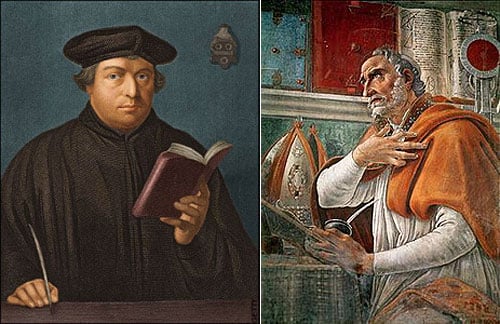
Photo credit: Martin Luther & St. Augustine [Augnet page: “Luther and Augustine”]
Summary: Critique of a Lutheran “Reformation Day” sermon: Part 1 focusing on soteriology, faith alone, St. Augustine’s views & how they differ from Luther’s, and assurance of salvation.










 Ad-Free & Subscriber Log-In