2018-01-15T15:56:29-04:00

Catholics believe their Church is the one true one (i.e., contains the “fullness”). The Congregation for the Doctrine of the Faith has released a document (on 6-29-07) called Responses to Some Questions Regarding Certain Aspects of the Doctrine on the Church. It has caused some consternation among some Protestants. I have tried to clarify some things, in reply to Reformed Protestant apologist Michael Patton, in a thread on his blog. His words will be in blue. My older cited words will be in green, and... Read more
2018-01-15T16:02:07-04:00

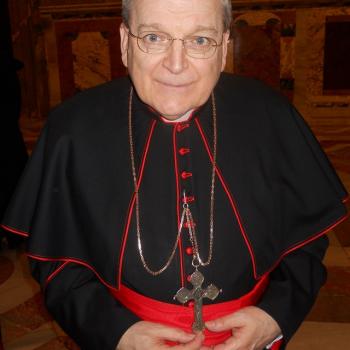
It seemed clear enough to me that he did, but in today’s “hyper-charged” atmosphere regarding anything papal, there must be controversy, and several of my friends have strongly disagreed. Karl Keating asked me: “just what is it you suspect Cardinal Burke to be saying? Be plainspoken about it. Don’t nod toward it without naming it.” I’m happy to oblige! As always, I try to have reasons for why I believe anything, and (being an author and professional apologist) to provide them in... Read more

2018-01-12T13:38:20-04:00

A series of ruminations, from correspondence about this general topic . . .* * *Sophism: a clever and plausible but fallacious argument or form of reasoning, whether or not intended to deceive. Sophistry: unsound or misleading or specious but clever, plausible, and subtle argument or reasoning. Many (most?) anti-Catholics are sophists, pure and simple, and sophists ought not be granted the dignity of a public debate. Sure, we can always say that as a result, a few people will become... Read more

2018-01-16T14:35:15-04:00

All Christians are to identify with Christ in His sufferings on our behalf. This is quite biblical. A statement made by a bishop about Pope St. John Paul II is being seized upon as an alleged proof that popes think they are God, and that Catholics agree with such blasphemous nonsense. It was published in Zenit (9-20-04): Auckland Bishop Says Pope Presides From the Cross [. . . ] In a statement in the wake of the New Zealand prelates’... Read more

2018-01-11T13:03:59-04:00

Lutherans deny this, but it’s evident in Luther’s “Bondage of the Will.” I recently re-posted my 2010 paper, “Luther: God Predestines Reprobation of the Damned.” Nathan Rinne, a Lutheran apologist with whom I have engaged in several constructive dialogues, showed up in the combox, disagreeing with my take, and writing: I’ve been reading and re-reading The Bondage of the Will. I think its a great, and greatly misunderstood, book. . . . Hope you might consider giving Schurb, a good scholar,... Read more

2018-01-12T11:09:14-04:00

Martin Luther: “a thing is not destroyed simply by being misused.” Ex opere operato is the notion that the Eucharist, provided the proper words of consecration are uttered, is valid and real whether the priest celebrating the Mass is wicked or a perfect saint. This sort of error (the denial of the above) is what made the Donatists split off of the Catholic Church, as schismatics. St. Augustine opposed that vigorously, and Luther the Augustinian, follows his (and the Catholic... Read more

2018-01-10T15:36:25-04:00

Will anyone dare to accuse a Doctor of the Church of irreverence? [or so it sure seems . . . if so, how will that go over with those who think any reception other than on the tongue (my own practice in my parish, by the way) is inherently irreverent or at the least greatly inferior? This is one of the greatest saints and mystics ever (she even criticized popes: which certain folks are obsessed about!). Nor can anyone argue that... Read more

2018-01-10T15:04:11-04:00

Questions are good! Apologists are happy to answer, as best we can. The words of the Protestant inquirer will be in blue. *** The Eucharist, as taught today by Catholics was not present in the early days. The Eucharist was instituted at the Last Supper and became the central focus of early church gatherings: Luke 24:35 (RSV) Then they told what had happened on the road, and how he was known to them in the breaking of the bread. Acts 2:42,... Read more

2018-01-09T15:25:44-04:00

Luther: “he damns the undeserving, . . . they cannot prevent themselves from being ungodly.” *** All the cited words below are Luther’s own, from various translations of The Bondage of the Will (his own favorite work). Sources are non-Catholic ones: with one noted Catholic exception. * * * * * Summary of English Versions of The Bondage of the Will (Luther Treatise of 1525) Translation by J. I. Packer and O. R. Johnston, Grand Rapids, Michigan: Fleming H. Revell, 1957. Translation by Phillip Watson (based... Read more

2018-01-10T11:30:11-04:00

Martin Luther struggled with accepting God’s grace, his entire life.   “CPA” (a Lutheran historian) wrote a piece: “How Do I Get a Gracious God?” in the Intertestamental Era (5-29-06). I also replied to comments of his in discussion, in my paper, Luther’s Projection of His Depression & Crises Onto St. Paul. Presently, I wish to reply to some of the biblical texts that CPA sets forth in order to show that Martin Luther’s own spiritual experience is normative, or, at any rate,... Read more

Follow Us!


TAKE THE
Religious Wisdom Quiz

What does Paul tell Timothy to do with myths and old wives' tales?

Select your answer to see how you score.


Browse Our Archives