Last updated on: November 25, 2021 at 2:06 am By GFA Staff Writer
WILLS POINT, TX – Gospel for Asia (GFA World and affiliates like Gospel for Asia Canada) founded by Dr. K.P. Yohannan – Discussing widowed mother Chamudi, the sickness and hunger, sheer hopelessness unto thoughts of suicide, and the encounter with one of our pastors that God use to bring life.
Suicide. The thought pulsed in Chamudi’s mind as relentlessly as the hunger that gnawed in her stomach. Completely broken at the thought of her children’s suffering, Chamudi decided today was the day to end it all—for herself and for her children.
A Hole in the Broken Heart of a Widowed Mother
Twice in 10 years, illnesses turned Chamudi’s world upside down. First, her husband died from a brain tumor, thrusting her into the life of a single mother in a culture that often looked down upon widows. Second, Chamudi received terrible news: She had a hole in her heart.
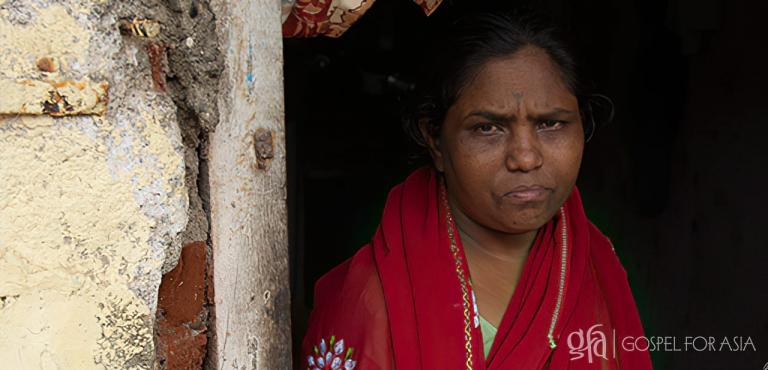
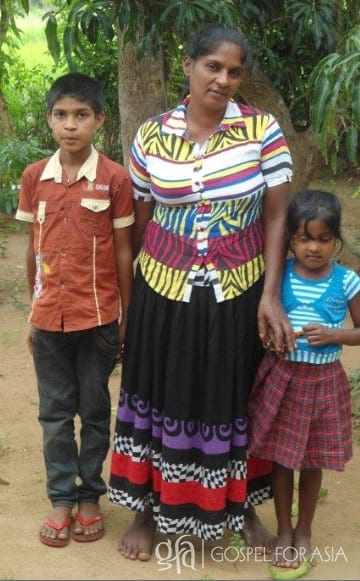
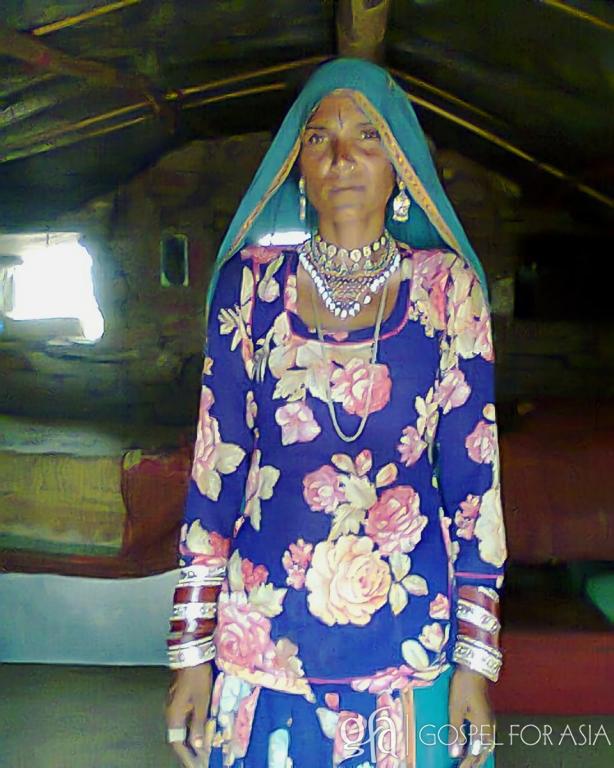
Chamudi, like this widow, could not provide food for her children. Her heart broke over the suffering of her children.
The doctors told her she should not do hard labor or get tired, and unless she received an operation, she would soon die. Desperate for a way to provide for her children, but severely limited in what she could do, Chamudi searched for any light work she could find. She washed dishes and served as a maid, but hunger crept into her home and became a consistent part of life. If she was unable to regularly put food on the table for her precious children, then there was no way she could buy medication to help her condition.
Chamudi was in turmoil. She was going to die, and misery would taint however many more days she had left. Her stomach ached unbearably. She thought of her young children—if enduring hunger caused such agony for her, a grown woman, how much more difficult it must be for her young, confused children? And once she was gone, her children would suffer even more. They would be alone, vulnerable against any who would seek to exploit them.
As bleak as the present was, the future looked even worse to Chamudi.
Buying Death
One morning, Chamudi again found no food for her children’s breakfast and could bear it no longer. She knew of only one way to end all their pain—suicide. If she couldn’t help her children live with peace, she could give them peace through death.
They would drink poison and be free from pain together. Yes, that was the solution. She found no help from her gods, and she had no one to turn to. Better to end it all now, she thought.
Rather than face slow starvation, Chamudi decided suicide would be a better end for herself and her children.
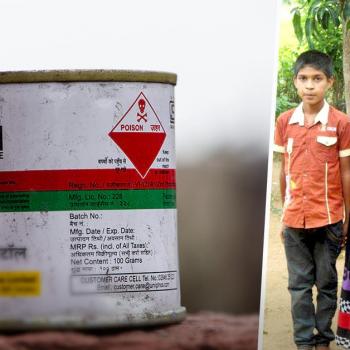
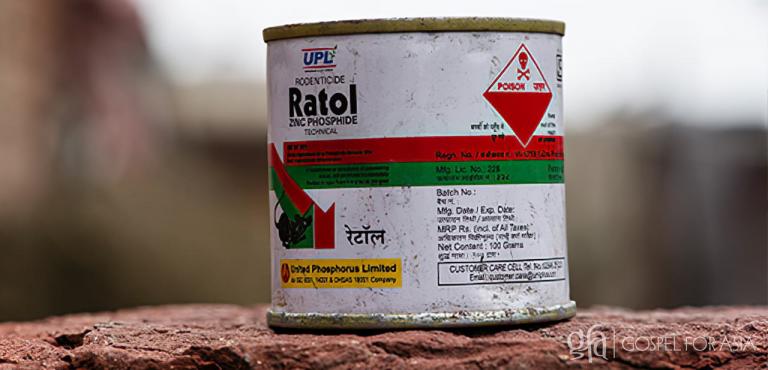
Through her cloud of hopelessness, she realized she didn’t even have money to buy poison. Chamudi slumped onto the only bench she had in her house and thought about how she could earn enough to bring about her family’s death.
Life Comes Knocking
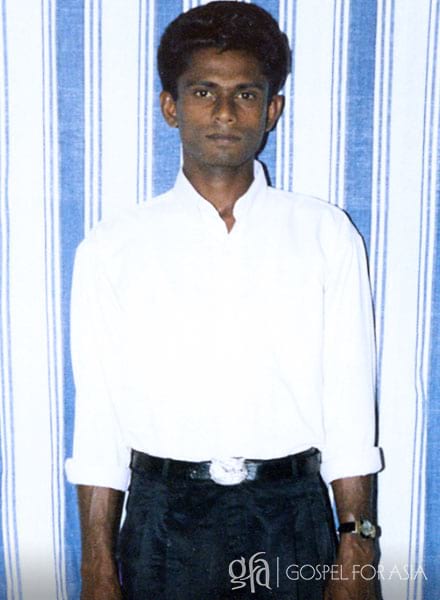
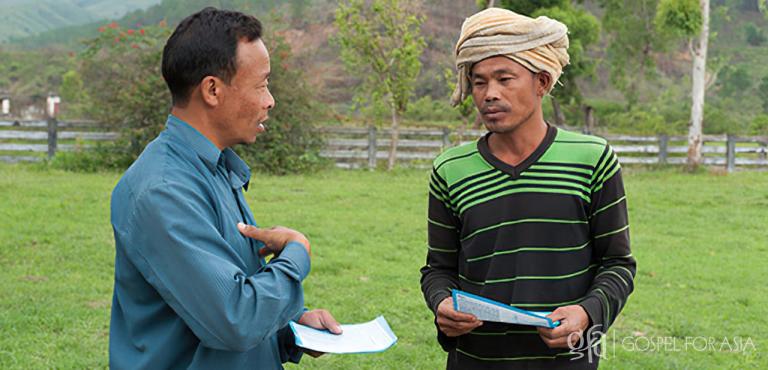
When our pastor Alak visited Chamudi’s home, she revealed her decision to commit suicide that very day. Pastor Alak (pictured here during his early days of ministry nearly 20 years ago) spoke to her broken heart and encouraged her to seek peace from Jesus.
From her position on her bench, Chamudi watched in surprise as a man dressed in black pants and a white shirt came walking toward her house. She didn’t recognize the middle-aged stranger. Rising from her seat, Chamudi curiously approached him.
He introduced himself as Alak, the Gospel for Asia (GFA) pastor of a local congregation. He offered the disheartened woman some literature, which sparked a conversation about Jesus and the new life Christ offers.
As they talked, Chamudi shared about her poverty and hopeless situation, and she eventually disclosed to him her intention of killing herself and her children that very day. Taking the timely opportunity God provided to minister to Chamudi, Pastor Alak prayed earnestly for her and encouraged her to trust in Jesus.
Chamudi’s religious convictions forbad her from going to a Christian worship service, but as she learned more about God’s redeeming love and listened to Pastor Alak’s prayer, peace entered her heart. She found a dose of hope that day, and she decided to learn more about the One who sent someone to her to keep her from death.
The Restoring Power of God
Touched by God’s mercy and kindness, Chamudi and her children (pictured) underwent complete transformation at the hand of God.
Chamudi and her children started visiting Pastor Alak’s congregation, bringing their troubles and sorrows to the Lord. Soon, Chamudi found a small business she could run from her home! She received cloth from a factory and sewed children’s clothing. The work was gentle, and her new income enabled her to feed her children.
Hope filled Chamudi’s heart, as well as love for the God who provided for her family. She continued learning about the Lord through the local church, and her love for Jesus impelled her to ask Him to adopt her into His family and give her new life.
Finding work was just the beginning of the answers to prayer Chamudi received. When Chamudi went to the hospital to buy medication with her new earnings, the doctors said her condition had improved! And just as the Lord sent Pastor Alak to Chamudi’s house on the day she planned to die, He later sent another man to impact Chamudi’s life—except this one married her. Athula, who worked at the factory where Chamudi received her cloth, linked his life with Chamudi and her children, helping support them and walking alongside them as they journey closer to Jesus together as a family.
*Names of people and places may have been changed for privacy and security reasons. Images are Gospel for Asia stock photos used for representation purposes and are not the actual person/location, unless otherwise noted.
Last updated on: May 17, 2022 at 12:39 pm By KP Yohannan
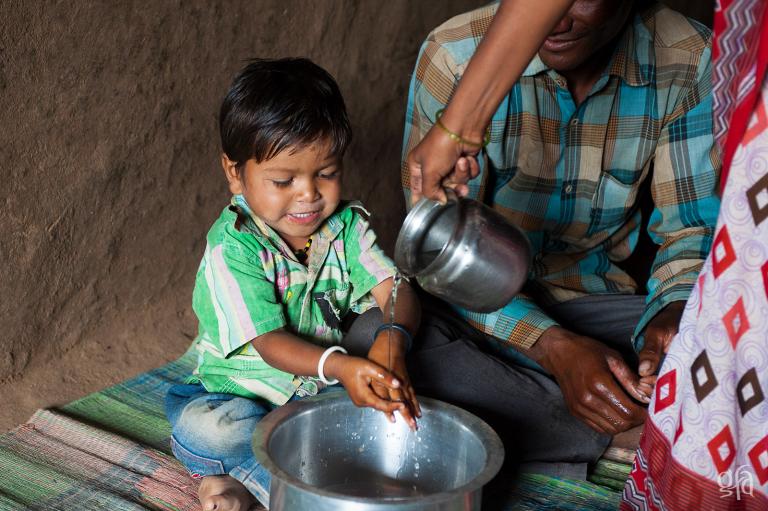
WILLS POINT, TX – Gospel for Asia (GFA World) founded by Dr. K.P. Yohannan – Hundreds of millions of people around the world can’t take the most basic precaution against the coronavirus or other diseases — because they don’t have clean water or soap to wash their hands, mission agency Gospel for Asia (GFA World) warned recently.
HANDWASHING CRISIS: Hundreds of millions of people around the world can’t take the most basic precaution against coronavirus — because they don’t have clean water or soap to wash their hands, warns mission agency Gospel for Asia (GFA) on the eve of World Water Day, March 22.
Experts say one of the most effective ways to halt the deadly virus — which has killed almost 8,000 people worldwide so far — is to wash hands regularly with soap for at least 20 seconds.
“Many people are terrified and living in fear right now,” said Gospel for Asia (GFA World) founder Dr. K.P. Yohannan, to mark World Water Day, March 22, an annual awareness event. “But with more than 2,000 people—mostly kids—who die every day from diarrhea alone, simply because they don’t have access to clean water to drink or wash their hands, that helps put things in perspective.
“For hundreds of millions of people, the coronavirus, though dangerous, is the least of their problems.”
The coronavirus — known as COVID-19 and declared a global pandemic — has spread to more than 160 countries and every U.S. state, with numbers climbing daily.
Stepping up its campaign to promote handwashing as the “frontline defense” against the coronavirus, the Global Handwashing Partnership, a coalition of health agencies, said handwashing with soap could reduce acute respiratory infections like the coronavirus by nearly 25 percent.
“Handwashing with soap is easy and saves lives,” the coalition said.
But for more than half the world’s population, “handwashing with soap and clean water is not easy at all,” said Yohannan. “It’s a problem we as a ministry have been actively helping to combat for years.”
According to the United Nations, 4.2 billion people around the world lack basic sanitation, including handwashing facilities that many in developed nations take for granted.
Under ‘Water Stress’
To make matters worse, the UN reports two billion people worldwide — one in every four people on the planet — live in regions experiencing “high water stress” or acute water shortages, primarily in South Asia and Africa. And a quarter of Earth’s major cities face a water crisis too, as detailed by Gospel for Asia (GFA) in The Global Clean Water Crisis.
“While we simply turn on a tap and press a soap dispenser, countless millions of people have to trek miles on foot to a communal well if they’re fortunate — or to a dirty watering hole if they’re not,” said Yohannan, whose Texas-based mission has helped the extreme poor in Asia for four decades, providing thousands of clean water pumps called Jesus Wells that supply entire villages.
In Asia’s slums, Gospel for Asia (GFA)-supported Bridge of Hope centers teach tens of thousands of children how to protect themselves against viruses like COVID-19 by practicing safe hygiene habits such as frequent handwashing.
“Gospel for Asia (GFA) applauds the efforts of agencies and governments around the world to promote handwashing and stop the coronavirus,” Yohannan said. “As our ministry serves the poorest of the poor in the name of Jesus, we also want to draw attention to the fact that, as we mark World Water Day, millions upon millions of people are unable to even properly or safely wash their hands — and we have to change that.”
About Gospel for Asia
Gospel for Asia (GFA World, and affiliates like Gospel for Asia Canada) is a leading faith-based mission agency, bringing vital assistance and spiritual hope to millions across Asia, especially to those who have yet to hear the “good news” of Jesus Christ. In GFA’s latest yearly report, this included more than 70,000 sponsored children, free medical camps conducted in more than 1,200 villages and remote communities, over 4,000 clean water wells drilled, over 11,000 water filters installed, income-generating Christmas gifts for more than 200,000 needy families, and spiritual teaching available in 110 languages in 14 nations through radio ministry. For all the latest news, visit our Press Room at https://press.gfa.org/news.
Last updated on: June 28, 2022 at 2:08 pm By Karen Mains
WILLS POINT, TX – Gospel for Asia (GFA World) founded by Dr. K.P. Yohannan issues an extensive Special Report on the deadly diseases brought by the mosquito and the storied impact of faith-based organizations on world health, fighting for the Kingdom to “come on earth as it is in heaven.”
This is Part Two of a Three-Part Series on FBO Initiatives to Combat Malaria and Other World Health Concerns. Go here to read Part 1 and Part 3.
Faith-Based Organizations as Seen Through the Bite of the Mosquito
Let’s look at that mosquito again, the anopheles that carries some form of the genus Plasmodium, which is the genesis of several strains of potentially deadly malaria parasites. In addition to malaria, the bite of various mosquitoes can also transmit dengue and yellow fever as well as the Zika, West Nile and African Sleeping Sickness viruses. The long battle against the lone mosquito multiplied by millions of its kind presents a simulacrum through which an enormous topic—modern medicine outreaches as influenced by faith—can be viewed.
One of the specific health ministries Gospel for Asia (GFA) initiated in 2016 was to participate in World Mosquito Day, observed every August 20 to raise awareness about the deadly impact of mosquitoes. This global initiative encourages local governments to help control malaria outbreaks, and it also raises funds from large donor organizations and national governments to underwrite worldwide eradication efforts. Discovering and applying means of mosquito control in overpopulated areas of the world is essential, but the task is so large and the enemy so canny that planners have discovered they must rely on a combination of efforts that activate local communities and the leaders in those communities, non-governmental organizations (NGOs), faith-based organizations (FBOs) and faith-based development organizations (FBDOs).
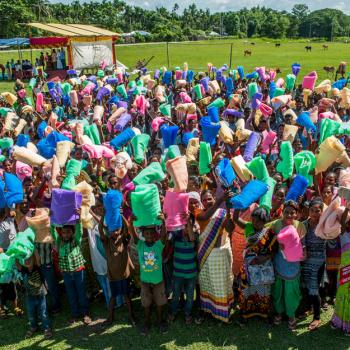
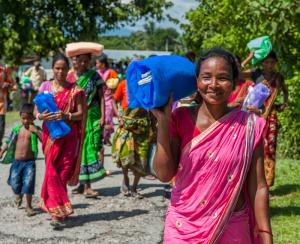
At a Gospel for Asia (GFA)-supported gift distribution, these villagers were grateful to receive a mosquito net.
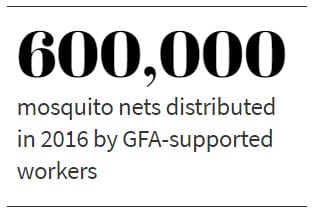
In 2016, workers collaborating with Gospel for Asia (GFA) distributed some 600,000 mosquito nets, many of which were given to people living in districts where there are high malaria risks and high poverty levels. Due to poverty, these folks were unable to procure the simplest of means to prevent mosquito-borne diseases. In addition to the nets, which were given away without charge, Gospel for Asia (GFA) conducted disease-awareness training in order to heighten understanding about preventive measures.
[su_qoute]In the majority of rural areas, there are no clinics, no hospitals, no medical professionals and no treatment protocols.[/su_quote]
This effort was compatible with the movement back to a primary health care emphasis as delineated in the 1978 Alma-Ata Declaration encouraged by the World Health Organization, which proclaimed the principles of what was meant by the concept of primary health care and the overreaching need for it. While a few populations in developing countries have access to tertiary health care—hospitals and clinics and professionals trained in medical schools, drugs and diagnostic equipment—the vast majority of the rest of the populace can access extremely limited or next-to-no available health care. In the majority of rural areas, for instance, there are no clinics, no hospitals, no medical professionals and no treatment protocols. (This medical desert is also becoming a problem in the United States; as rural populations shrink, hospitals and clinics cannot afford to stay open.)
The Alma-Ata conference recommended a redirection of approaches to what is termed primary health care. Charles Elliott, an Anglican priest and development economist, summarized the suggested changes as follows:
An increasing reliance on paraprofessionals (often referred to as community health workers) as frontline care givers;
The addition of preventive medicine to curative approaches;
A noticeable shift from vertical, disease-specific global health initiatives to integrated, intersectoral programs;
A willingness to challenge the dominant cost-effectiveness of analysis, particularly as it was used to justify a disproportionate distribution of health care resources for urban areas; and
A heightened sensitivity to the practices of traditional healing as complementary rather than contradictory to the dominant Western medical model.
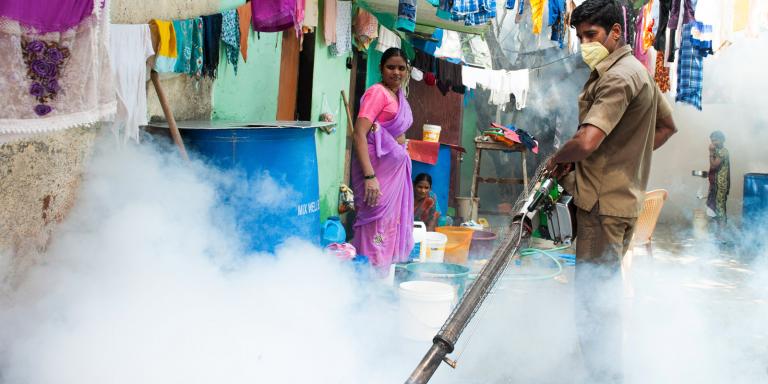
The government working is spraying mosquito repelling smoke in a Mumbai slum to prevent malaria and other mosquito-spread diseases.
India’s Progress in Combating Malaria
In 2015, the World Health Organization set a goal of a 40 percent reduction in malaria cases and deaths by 2020 and estimated that by that deadline, malaria could be eradicated in 11 countries. The first data reports were extremely encouraging, but attrition began to set in, due to what experts feel is a lag in the billions of donor funds needed to combat the disease. The 2018 World Malaria Report health data now indicate a slowing in the elimination of the disease and even growth in disease incidents and deaths. This slide is disheartening to world health officials, particularly since early reports gave evidence of real impact against morbidity.
India, however, according to the 2018 report, is making substantial progress: “Of the 11 highest burden countries worldwide, India is the only one to have recorded a substantial decline in malaria cases in 2017.”
The report goes on to state that the country, which accounted for some 4 percent of global malaria cases, registered a 24 percent reduction in cases over 2016. The country’s emphasis has been to focus on the highly malarious state of Odisha. The successful efforts were attributed to a renewed government emphasis with increased domestic funding, the network of Accredited Social Health Activists (ASHAs)—an intended 900,000 women assigned to every village with a population of at least 1,000—and strengthened technological tracking, which allowed for a focus on the right mix of control measures. The aim of India’s National Vector Borne Disease Control Programme is the eradication of malaria.
Of the 11 highest burden countries worldwide, India is the only one to have recorded a substantial decline in malaria cases in 2017.
Remember the ever-present mosquito? Studies conducted by WHO released the findings of a major five-year evaluation reporting that people who slept under long-lasting insecticidal nets had significantly lower rates of malaria infection than those who did not use a net.
In coordination with this national effort, Gospel for Asia (GFA)-supported workers distributed nets to villagers, in student hostels, among workers in the tea-growing district of Assam and many other areas while at the same time leading disease-awareness programs to tea-garden employees.
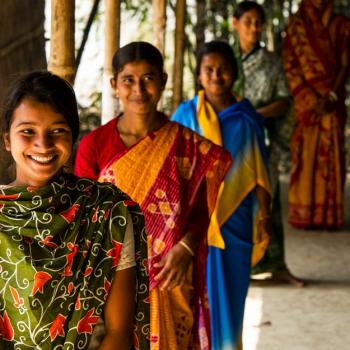
These women were happy to receive a free mosquito net for their families from GFA-supported workers.
Imagine a dusty village filled with women wearing vibrant-colored clothing. Little children dance around or stand intrigued, their huge brown eyes open. Nets are placed into outstretched hands. Women smile; gifts are always appreciated. Men listen carefully to the reasons why bed nets are essential and why it is necessary to spray the home and rooms. People bow their heads; they raise pressed hands to their faces. “Namaste,” they say giving thanks.
Envision a room at night with six to eight buzzing, dive-bombing mosquitoes and give thanks that there are organizations around the world that pass out the free gift of bed nets that not only keep humans from being stung but also prevent them from becoming wretchedly ill.
Historical Cooperation
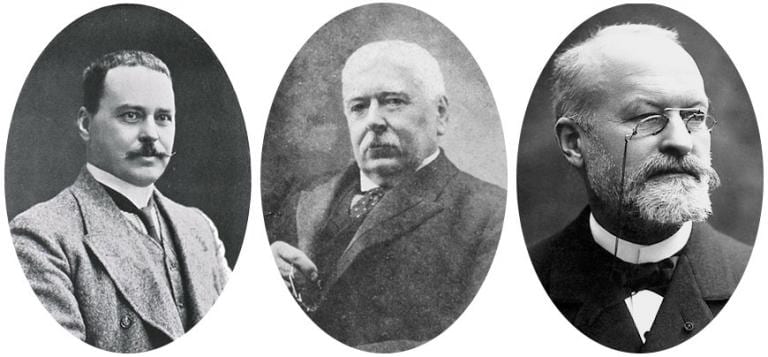
The possibility of eradicating malaria rests in the efforts of Dr. Ronald Ross, born in Almora, India, in 1857 to Sir C.C.G. Ross, a Scotsman who became a general in the Indian Army. Reluctant to go into medicine, the son nevertheless bowed to his father’s wishes to enter the Indian Medical Service.
At first, Ross was unconvinced that mosquitoes could possibly be carriers of malaria bacteria, yet his painstaking, mostly underfunded laboratory discoveries eventually convinced him that the hypothesis of a mentor, Patrick Manson, an early proponent of the mosquito-borne malaria theory, was correct. (Manson is also considered by many to be the father of tropical medicine.) Another contemporary, the French Army doctor Alphonse Laveran, while serving at a military hospital in Algeria, had observed and identified the presence of parasitic protozoans as causative agents of infectious diseases such as malaria and African Sleeping Sickness.
From left to right: Dr. Ronald Ross, Patrick Mason, Alphonse Laveran
On August 20, 1897, in Secunderabad, Ross made his landmark discovery: the presence of the malaria parasite in humans carried by the bite of infected mosquitoes. (For obvious reasons, Ross was also the founder of World Mosquito Day.) Disease can’t be combated unless its source is identified, nor can it be optimally controlled. Certainly, without this knowledge, it can’t be eradicated. In 1902, Ronald Ross was awarded the Nobel Prize in Medicine.
Here again, through the bite of the mosquito, we see the collaborative effort that undergirds progress. Three doctors intrigued with conquering the morbidity of disease take painstaking efforts to prove their theories, and each one builds on the discoveries of the other, with eventual dramatic results.
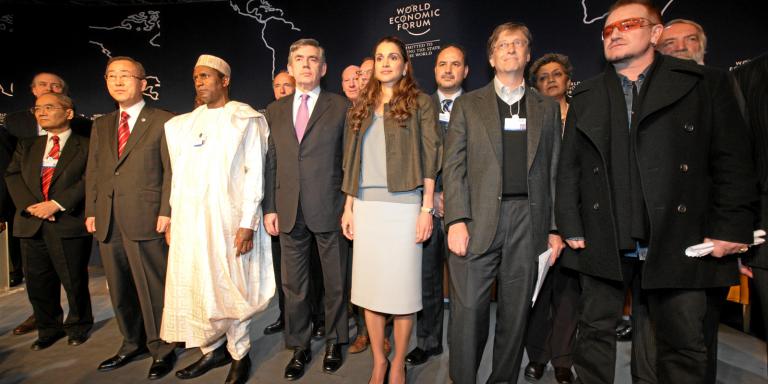
Government leaders, among others, came together during the Annual Meeting 2008 of the World Economic Forum for the “Call to Action on the Millennium Development Goals.” Photo by World Economic Forum on Wikipedia / CC BY-SA 2.0
Change Involves Everyone
Progress is not possible without collaborative work. Statisticians, medical teams and universities, as well as local village training centers, governments of developing countries and local leadership in towns and cities must all work together. The job requires donations from wealthy donor nations as well as from national local budgets. We need the skills of technological gurus, engineers and the extraordinary capabilities of highly trained health care professionals and sociologists. In addition, we also need the involvement of those who care about the soul of humans and who have insisted, because their lives are driven and informed by a compassionate theology, that every human is made in the image of God.
Gospel for Asia (GFA), through its mosquito net distribution—and its many other ministries—stands central in the contemporary initiatives of health-based, community-centered, preventive health care.
Progress is not possible without collaborative work.
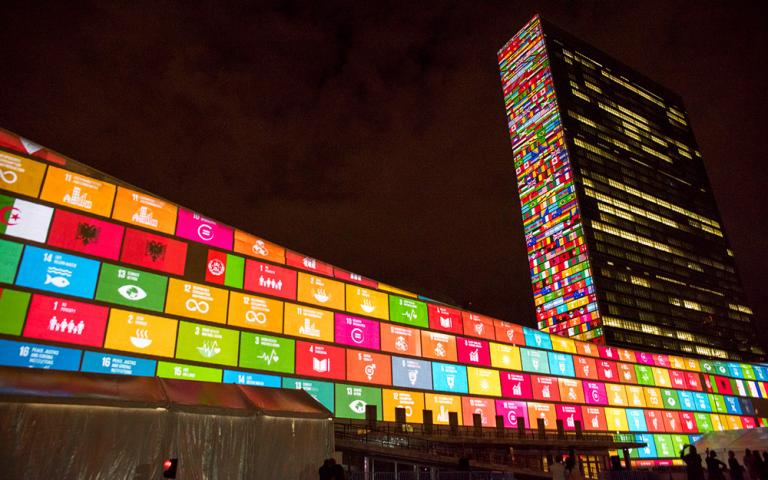
These are some of the strategic players who must all be involved, and stay involved, if the MDGs, now the Millennium Sustainable Development Goals, are to be reached.
This model of interactivity, whether present-day players realize it or not, intriguingly stems from a decades-old initiative stimulated by the World Council of Churches (WCC) in the last century, based in a carefully crafted theological understanding by the Christian Medical Commission (CMC), which concurrently and cooperatively developed the meaning of health that simultaneously contributed to the WHO’s significant 1978 Declaration of Alma-Ata. This resulted in a focus on primary care as a more just and egalitarian way to distribute resources in order to treat a larger proportion of the world’s population.
The United Nations Building in New York in 2015, displaying the UN’s development goals and the flags of the 193 countries that agreed to them. Photo by Amaral.andre on Wikipedia / CC BY-SA 4.0
This forgotten story needs to be resurrected because it demonstrates the power of intentional intersectoral cooperation between secular and religious health outreaches. It also exemplifies a more holistic redefinition of the meaning of health that has the potential to positively impact disease-ridden environments in the many populations that are generally minimally treated or completely untreated in developing countries. In a day when Western technologically centered medicine, driven by what some in health communities are starting to call the “industrial medical complex,” is beginning to wane in its understanding of the meaning of superior patient-centered care, this model needs to be adapted to what we think of as the more sophisticated treatment approaches in health care.
Our Friends, the Critics (Because Their Criticism Makes Us Think)
Let’s first take a quick look at what critics of faith-based medical outreaches have to say. Instead of delving into the academic literature, which though informative often provides a tedious plod through footnotes and specialized terminology, let’s look at the growing field of “opinion” journalism.
After the 2014 Ebola outbreak in Liberia, Africa, an article appeared in Slate Magazine by Brian Palmer, a journalist who covers science and medicine for the online magazine. This periodical represents an admittedly liberal perspective, and that bias, though the author attempts to play fair, is shown even in the headline to his report: In Medicine We Trust: Should we worry that so many of the doctors treating Ebola in Africa are missionaries?” Great lead line; it certainly caught the attention of my friends and colleagues who work in medical missions.
Palmer summarizes his basic critique in this paragraph: “There are a few legitimate reasons to question the missionary model, starting with the troubling lack of data in missionary medicine. When I write about medical issues, I usually spend hours scouring PubMed, a research publications database from the National Institutes of Health, for data to support my story. You can’t do that with missionary work, because few organizations produce the kind of rigorous, peer-reviewed data that is required in the age of evidence-based medicine.”
Although PubMed is a worthy venue for medical specialists as well as the generalist writing in the field—with some 5.3 million archived articles on medical and health-related topics—it alone may be a truncated resource for the kind of information that could have more richly framed this article. Interviews with at least a few boots-on-the-ground, living faith-based medical professionals who have given their lives to wrestling with the health care needs in countries far afield from Western medical resources, might also have been a better means of achieving a professional journalistic approach. In addition, there is a whole body of evidence-based research that a superficial treatment such as this did not access.
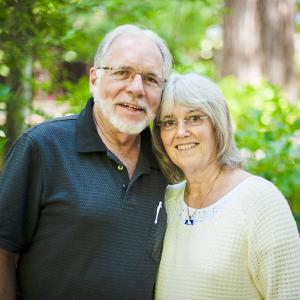
Dr. Bill and Sharon Bieber Photo credit Healing Lives.
Sharon Bieber of Medical Ambassadors International responds to the Slate article out of a lifetime of framing health care systems with her husband, Dr. Bill Bieber, in mostly underdeveloped nations in the world. It is important to note the Canadian government awarded these “medical missionary types” the Meritorious Service Medal—an award established by Her Majesty Queen Elizabeth II to be given to extraordinary people who make Canada proud—for their work of establishing the Calgary Urban Project Society. The Calgary Urban Project Society became the model across all Canada for helping those most in need (many of them homeless) by providing health care, education and housing—all this long before the concept of holistic treatment or an integrated approach engaging mind, body and spirit was part of the common literacy of health professionals. This, to be noted, was accomplished by the Biebers while on an extended furlough while their children finished high school—an interregnum before the two headed back to the South China Seas to fulfill their lifetime calling of working with national governments to establish primary health care systems along with improving tertiary systems in the countries where they landed.
Bieber writes, “Author Brian Palmer even queries the reliability of the mission doctors, who work in adverse and under-resourced conditions. The lack of trust seems to be justifiable, he infers, because they rarely publish their accomplishments in the ivory towers of academia! When they explain to patients they are motivated by the love of Jesus rather than financial gain, somehow that is ‘proselytizing.’ Would it be nobler, I wonder, if doctors were to tell them that the danger pay was good or that they desire adventure or fame? These are unproductive and unfounded arguments by critics who clearly have their own axes to grind, and at a time when the world crisis calls for everyone to roll up their sleeves and get to work in solving the problems facing us all.
“Surely the relief and development organizations that are out there in the world can come to the same conclusion on this one thing—everybody is needed in order to fight diseases such as Ebola, HIV/AIDS or tuberculosis; every agency has strengths that will add to the synergy of the whole. Whether faith-based, local and national government or secular NGO, all have been trained in similar techniques and scientific method. Collaboration is what is needed in order for groups that are stronger to support those that are less resourced to achieve a common goal.”
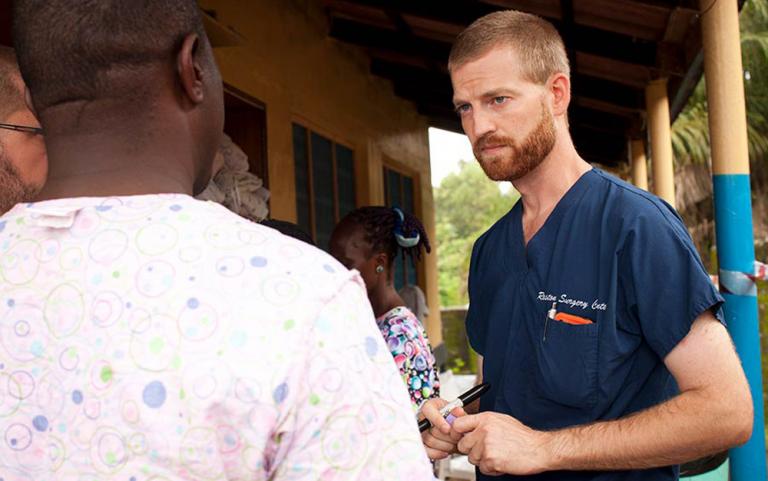
Dr. Kent Brantly contracted Ebola while minstering in Liberia. He recovered and was featured on Time Magazine’s cover, representing Ebola fighters—Time’s “People of the Year.” Photo credit Facing Darkness
To be fair, the Slate journalist admits to being conflicted. After listing the flaws of medical mission approaches, Palmer writes, “And yet, truth be told, these valid critiques don’t fully explain my discomfort with missionary medicine. If we had thousands of secular doctors doing exactly the same work, I would probably excuse most of these flaws. ‘They’re doing work no one else will,’ I would say. ‘You can’t expect perfection.’ ”
At least he admits to bias. Knowing my share of medical missionaries, many of whom I consider truly heroic and who are radicalizing the health care systems of the countries in which they serve for the undeniable betterment of those societies, Palmer’s approach seems a tad unprofessional as far as journalism goes. He concludes, “As an atheist, I try to make choices based on evidence and reason. So until we’re finally ready to invest heavily in secular medicine for Africa, I suggest we stand aside and let God do His work.”
“Through partnership with faith organizations and the use of health promotion and disease-prevention sciences, we can form a mighty alliance to build strong, healthy, and productive communities.”
A deeper search in PubMed, driven admittedly by my own bias, led me to the excellent data-informed article utilizing research on the topic from both the scientific, theological and academic sectors by Jeff Levin, titled “Partnerships between the faith-based and medical sectors: Implications for preventive medicine and public health.”
Levin concludes with a quotation that complements his conclusion: “Former U.S. Surgeon General David Satcher, a widely revered public health leader, has made this very point: ‘Through partnership with faith organizations and the use of health promotion and disease-prevention sciences, we can form a mighty alliance to build strong, healthy, and productive communities.’ There is historical precedent for such an alliance, and informed by science and scholarship, it is in our best interest for this to continue and to flourish.”
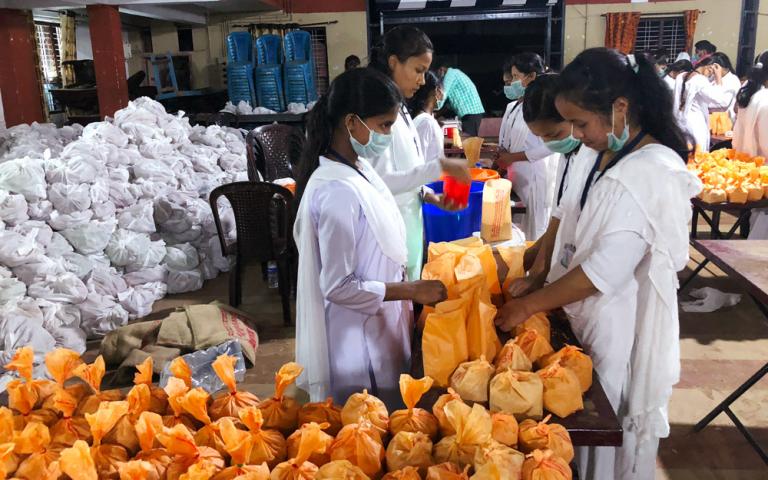
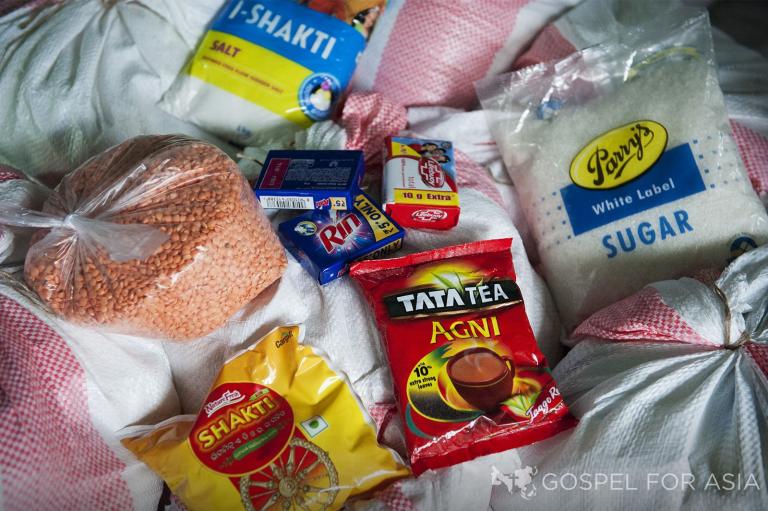
Gospel for Asia (GFA)-supported workers assisted government relief efforts after the Kerala flooding in August 2018. Here they are assembling packages of food items and other essential supplies to distribute to flood victims.
How many of us in the faith-based sector have wrestled with the theological meaning of health? What is the history of the impact of faith (particularly Christian faith because that is the bias from which I write) on the ongoing movement of medicine in these modern centuries? Why does it matter?
I recently experienced a small snapshot of current industrialized medicine. Last year I underwent a hiatal repair laparoscopic surgery. The best I can ascertain from the Medicare summary notice, which included everything administered the day of the procedure through an overnight stay in the hospital for observation with a release the next day, was the bill.
In addition, I experienced watching a son die at age 41 (Jeremy, the son who accompanied me to Mexico, leaving behind a wife and three small children, then ages 6, 4 and six months), not only from a rare lymphoma that kept him in a superior hospital in Chicago for more than five months but also from the side effects and complications of the aggressive cancer treatments. This all has given me additional perspective on medical approaches.
It Takes Only One Mosquito — to lead to remarkable truths about faith-based organizations and world health:Part 1 | Part 3
Last updated on: September 17, 2022 at 6:18 am By GFA Staff Writer
WILLS POINT, TX – Gospel for Asia (GFA) – Discussing the poverty that hinders millions of women to have an education, and the missionaries who reach these women through literacy classes to be able to tackle life’s hurdles.
“Give a man a fish, feed him for a day. Teach a man to fish, feed him for a lifetime.”
Habiba poses for a picture as a student of the Sisters of Compassion literacy class.
While Gospel for Asia (GFA)-supported Sisters of Compassion don’t teach villagers how to fish, they do teach them something quite necessary to thrive in life: how to read and write.
For one mother, this old proverb stands true as the sisters’ lessons are satisfying her lifelong dream to learn to read and write.
Unfulfilled Dreams of an Education, Literacy
Habiba, 40, lives in a slum village with her husband, 10-year-old daughter and 7-year-old son. Growing up, Habiba had the desire to attend school and learn to read and write, but she never had the opportunity because of her family’s poverty. Still, it was a dream she clung to even after getting married.
When Habiba’s children were born, she desperately wanted them to receive an education. Unfortunately, her husband was also uneducated and, therefore, unable to teach the children, and school fees were too expensive for them to afford. Habiba grieved that her children would grow up illiterate like she did, but it seemed her dreams for their education were equally out of reach.
Hope Born
One day, Sister Tamanna and a few other Sisters of Compassion supported by Gospel for Asia (GFA) visited Habiba’s home and shared the Good News of Jesus’ love. They also explained to Habiba and her family they were starting a literacy class for the women and children of the village.
Not surprisingly, Habiba rejoiced to learn about the class and that the lessons would be offered for free. It renewed hope that her dreams of an education for herself and for her children could finally become a reality.
“I want to become an educated lady,” Habiba excitedly explained to Sister Tamanna, “and my desire will surely come true through this class.”
Starting School
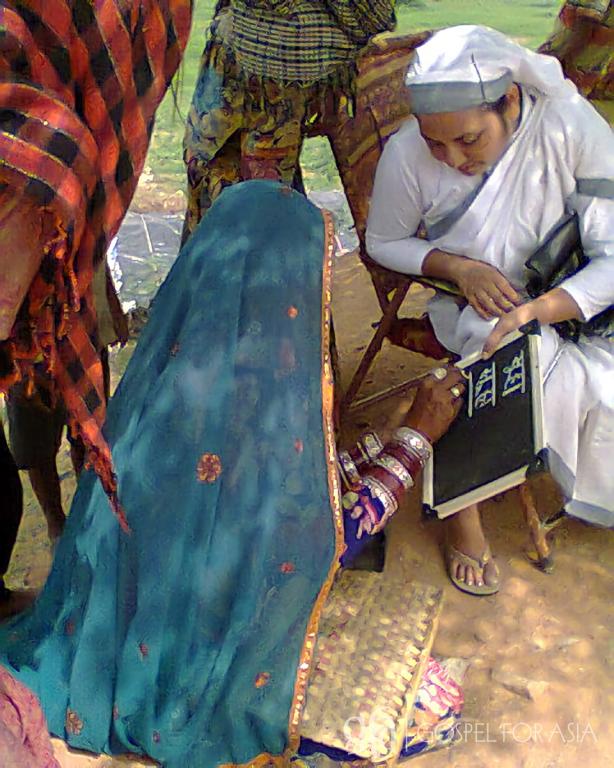
Habiba practices writing with Tamanna during literacy class.
When the literacy class began in her village, Habiba and her children were among its students. One year after Habiba started her lessons, her hard work paid off. She learned to write and speak her local language’s alphabet and numbers. She was also able to write her name and the names of her husband and children.
Meanwhile, Habiba’s children found success in their literacy classes as well.
In addition to learning their A-B-Cs, some of their lessons include learning God’s Word and how to pray.
Though Habiba may not have realized it yet, this literacy class was just one demonstration of God’s love for her and her family. Through the Sisters of Compassion and their literacy ministry, God is the One making Habiba’s dreams come true.
Habiba isn’t the only mother for whom literacy is an important dream. Read Parmila’s story, and learn how attending Gospel for Asia (GFA)-supported literacy classes became an answer to her prayers.
*Names of people and places may have been changed for privacy and security reasons. Images are Gospel for Asia stock photos used for representation purposes and are not the actual person/location, unless otherwise noted.
Learn more about the Women’s Literacy Program. There are over 250 million women in Asia who are illiterate. Even if they want to read, there is no way to learn . . . until now. With your help, women in Asia can learn to read and will be equipped to tackle life’s hurdles.
Click here, to read more blogs on Patheos from Gospel for Asia.
Last updated on: September 23, 2022 at 2:57 pm By GFA Staff Writer
WILLS POINT, TX – Gospel for Asia (GFA) – Discussing International Day of Charity, the misconceptions perceived on what charity is, and what the Bible teaches is the true picture of charity – involving not just giving, but sacrifice.
And now abides faith, hope, charity, these three;
but the greatest of these is charity.
September 5 was set aside by the United Nations General Assembly in 2012 to be observed as the International Day of Charity. The date was selected to coincide with the anniversary of Mother Teresa’s death on September 5, 1997. The native of Macedonia spent most of her adult life working in the slums of Calcutta, India, loving and caring for destitute people for whom no one else evidenced concern.
What Charity Is Not
The concept of charity has become so watered down that we generally think of “charity” as an organization that provides necessities of life to people who are suffering from perpetual poverty or trying to survive in the wake of a disaster.
While not entirely wrong, neither is the concept of an organized institution altogether correct. In fact, thinking of charity in this context can lull people into a lazy paradigm that leaves charitable work up to an “institutional other” to which they donate goods or funds as a way to “do our part.” Charity may then be perceived as a person or a group with their hand out seeking donations for their cause.
The thought process is based on determining what we own that we are willing to give to help. We are careful to account for what we offer because we mistakenly believe it to be ours.
What Charity Is
When we say that the concept of charity has been watered down, we refer to 1 Corinthians 13:13 where the Apostle Paul said, “And now abides faith, hope, charity, these three; but the greatest of these is charity.”
The word translated as “charity” here is “agape,” a love that places the interest and good of others above our own. Note that it is not limited to either their current or chronic needs but to their overall well-being at all times and in all circumstances.
This perspective is based upon understanding that we own nothing, that all we have is a gift from God and is intended to be used for Him and His purposes. True charity — agape love — moves our giving from the realm of mere donation to the higher plain of sacrifice.
Charity at Gospel for Asia
Whether in Asia or at any of the Gospel for Asia (GFA) administrative offices across the globe, Gospel for Asia (GFA) staff have their hearts set, individually and corporately, on loving the unloved and the unlovely, serving the unserved, offering hope to the hopeless, feeding the hungry, encouraging the downtrodden, and becoming the hands and feet that demonstrate the love of Jesus.
Yes, it takes financial support to accomplish GFA’s purposes, but our prayer is that the gifts given always flow from hearts that give in agape love. This is what charity truly is, taking our minds off ourselves to be a blessing to others.
About Gospel for Asia
Gospel for Asia (GFA) is a leading faith-based humanitarian and mission agency, bringing vital assistance and spiritual hope to millions across Asia, especially to those who have yet to hear the “good news” of Jesus Christ. In 2018, this included more than 70,000 sponsored children, free medical camps conducted in more than 1,100 villages and remote communities, over 4,700 wells drilled, over 11,400 water filters installed, income-generating Christmas gifts for more than 240,000 needy families, and spiritual teaching available in 110 languages in 14 nations through radio ministry. Gospel for Asia celebrated its 40th anniversary on July 3, 2019.
Click here, to read more blogs on Patheos from Gospel for Asia.
Last updated on: September 29, 2022 at 6:21 pm By GFA Staff Writer
Dr. Leroy Pennell recently celebrated 40 years of pastoring Heritage Baptist Church in Barrie, Ontario, Canada. Someone asked him, “How can a man pastor the same church for 40 years?”
He replied with only three words: “Never, never quit.”
What did it take to get started? A calling and vision from the Lord to share the love of Jesus with millions of people halfway around the globe with.
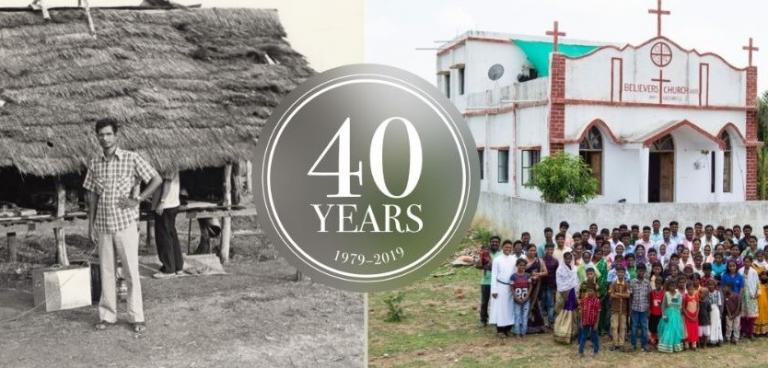
What did it take for Gospel for Asia (GFA) to arrive at its 40th anniversary? It took 14,600 days of commitment to the call, 14,600 days of never quitting—all through the grace of God.
In 1952, John W. Peterson, the most prolific composer of Christian music at the time, wrote “It’s Not an Easy Road,” a song that describes 40 years of ministry.”
It’s not an easy road we are traveling to heaven,
For many are the thorns on the way.
It’s not an easy road, but the Savior is with us,
His presence gives us joy every day.
It’s not an easy road; there are trials and troubles,
And many are the dangers we meet.
But Jesus guards and keeps so that nothing can harm us.
And smooths the rugged path for our feet.
No, no, it’s not an easy road. But Jesus walks beside me and brightens the journey, And lightens every heavy load.
Dr. Yohannan was attempting to fulfill the Lord’s expectations when he and fellow believers mobilized Gospel for Asia (GFA) on July 3, 1979. Jesus was quite clear when He told potential disciples that “No one, having put his hand to the plow, and looking back, is fit for the kingdom of God.”
We cannot begin to imagine what the Lord has planned for the next 40 years as we continue to share the love of Christ in word and deed with people in Asia.
There would be no looking back. During the past 40 years, there have been days filled with difficulties, seasons of stress, and periods of predicaments. But, trusting the Lord who called us, we chose not to quit.
Gospel for Asia (GFA)-supported missionaries have served the Lord in places where no one had ever heard of Jesus, often because there was no one willing to go to the misery of the slums or leprosy colonies or the widows’ islands. No one was willing to trek to remote tribal villages where people lived, often in unreachable locations and in extreme poverty.
As Gospel for Asia (GFA) staff and the Gospel for Asia (GFA)-supported workers in Asia have refused to quit, tens of thousands have come to faith in Jesus Christ through national missionaries and pastors, compassion services, Bridge of Hope centers for school-age children, women’s ministries, Jesus Wells, and literacy classes, which transforms villages, and empowers men, women, and children to lead productive lives.
We could never have imagined what Gospel for Asia (GFA) would grow to be and how the Lord would use it as a tool to transform so many lives. The thousands of individuals God has brought together with the same passion and purpose of declaring His loving kindness, especially to those who have not yet heard, is a beautiful partnership. Each one is doing their part to serve the Lord – from donors and sponsors in the U.S. and other Western countries to the Mission Support Team serving behind the scenes to the thousands of workers on the field.
We look back only for a moment, out of thanksgiving for all the Lord has done. We commit to keeping our hand on the plow. We cannot begin to imagine what the Lord has planned for the next 40 years as we continue to share the love of Christ in word and deed with people in Asia.
To God be the glory; great things He has done! We look forward to the road ahead.
Click here, to read more blogs on Patheos from Gospel for Asia.
Last updated on: October 29, 2022 at 5:18 am By GFA Staff Writer
WILLS POINT, TX – Gospel for Asia (GFA) – Discussing about the behind-the-scenes missionaries who, although they are far from the mission field, are vital to make ministry possible in Asia.
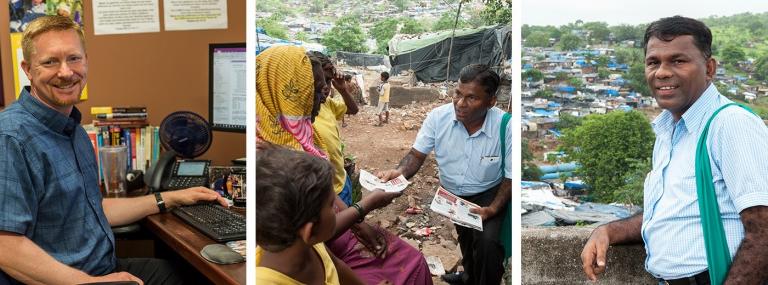
The morning sun shines over the Mumbai slums. It is the beginning of a new day, and Gospel for Asia (GFA)-supported pastor Marty reaches into his bag and pulls out some literature. He scans the dirty faces of slum dwellers and realizes today might be the day they could understand how completely they are loved by God. Across the globe, as the sun shines on the small town of Wills Point, Texas, Jonathan stares at his computer in front of him.
He glances over at the pictures on his office wall and remembers the masses around the world who are waiting to know they are loved. Both men have completely different tasks and roles, but they understand something profound—they couldn’t do their job without each other.
Living a Fairly ‘Normal’ Christian Life
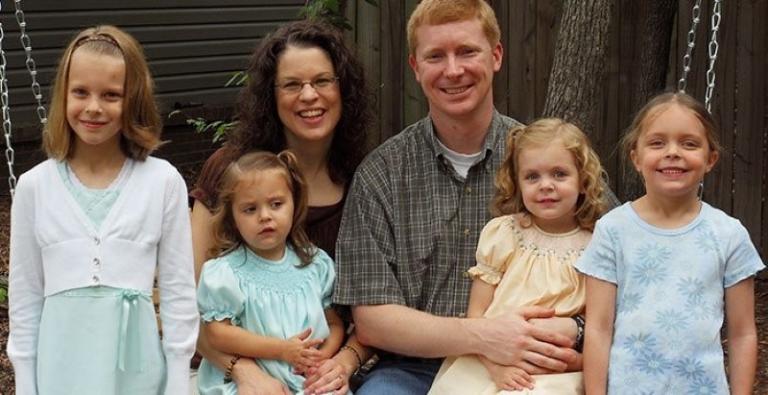
When the eldest of their four daughters was 4 years old, they welcomed Gospel for Asia (GFA)-supported Bridge of Hope children and missionaries into their lives through prayer and sponsorship. Jonathan and Erica wanted their children to grow up understanding the needs of others.
Ever since their four beautiful daughters were young, Jonathan and Erica have led their family in pursuit of serving the Lord together.
“They were familiar with the idea,” Jonathan says, “that there are people outside of [their] own little world who have a totally different set of challenges, and people who don’t know about Christ.”
This worldview found its way into their family’s everyday life and holidays, shaping rich family traditions. When the Christmas season came around each year, their daughters would pour over the pages of GFA’s Christmas Gift Catalog, flipping through the pages filled with pictures of chickens, goats, Bibles and blankets. Their house stirred with excitement as each bright-eyed girl got to choose an item to bless a person or family in Asia.
A Change in the Norm
As the Lord continued to press missions on Jonathan’s heart, a revelation struck him: Why not serve in the place where they had already been investing for the past nine years?
After raising monthly support for their livelihood, Jonathan and his family packed up their home and moved to Texas to join GFA’s staff as behind-the-scenes missionaries. They were ready to serve the Lord together once again and in an even greater capacity.
A Beautiful Link Between Two Worlds
With passion and excitement, Jonathan started serving in the IT department at the Gospel for Asia (GFA) office in Wills Point, Texas. Through his work, he was able to equip his fellow behind-the-scenes missionaries with the computer systems they needed to accomplish their jobs in helping missionaries in Asia, like Pastor Marty.
As Jonathan helped equip the Texas office with the systems needed to communicate with donors and sponsors, Pastor Marty and many other Gospel for Asia (GFA)-supported workers talked with broken families about the love of Jesus. With Jonathan and the other behind-the-scenes missionaries doing their part in their work, Pastor Marty and fellow ministry workers could more effectively do their part.
Much the Same, yet So Different
Although Jonathan worked with people and computers as he had in his secular job, the differences of working in a ministry impacted his walk with the Lord. Whereas before he never thought to pray for a broken computer server or start a meeting in prayer, he now found himself doing these very things.
Once, when Jonathan had broken the entire office’s email system, it disabled the behind-the-scenes missionaries for several hours. To his amazement, Jonathan didn’t receive the same kind of treatment he would have experienced in the business world, with his bosses telling him how much money and time he was wasting. Instead, people stopped by his office to encourage and reassure him that they were praying for him. When Jonathan finally got the system working again, a slew of emails filled his inbox. They were from folks around the office thanking him for all his hard work on getting the problem fixed.
It was this kind of grace that Jonathan had never experienced before, and it occurred to him that the Gospel for Asia (GFA) office had a completely different atmosphere. Instead of pressures to do everything correctly the first time, there was love and grace shown by his coworkers. Instead of stress, there was peace as problems were brought to the Lord in prayer.
“I realized I am in a different world here,” Jonathan says.
“Everything matters so much more, but mistakes are handled with so much more grace. And both are tied to the heart and the attitude behind it.”
Serving Together in Joy and Hardship
But serving the Lord is not always simple or pleasant, and ministry is no easy journey. Just as Jesus warned His disciples about the trials and troubles that would come their way if they followed Him, Jonathan and his family have experienced this reality as they have labored with Gospel for Asia (GFA). National workers like Marty have experienced trials and troubles, too. Although persecution may look different in Asia, brothers and sisters around the world face opposition together, knowing that serving the Lord does not come without a heavy price at times.
“It had never occurred to me,” Jonathan reflects,
“That when you give your life at a ministry, you are not just doing the glorious and admirable thing of becoming a missionary, and everyone is going to applaud you. You are joining yourself to a ministry that will, at some point, be the target of criticism, and when it is, you also will be the target of criticism. … That was both the hardest thing for me to swallow and the source of most growth for me. … I had to learn, it’s more about obeying God and trusting Him to bring fruit out of it than it is the applause of people.”
The Eternal Purpose
With an understanding of their calling and a commitment to the Lord, Jonathan, Erica and their family stand together as one with Pastor Marty and other missionaries around the world, serving others for the sake of Christ.
“It’s more of a lifestyle and less of a job,” Jonathan says.
Even when they feel tired, weak and unworthy or when criticism comes their way, Jonathan and Erica remain faithful to where God has led them.
“We are here because we are about the business of allowing people who have never heard the hope of Christ to hear of Christ,” Jonathan states.
“We are also here specifically because this is the place that God connected us to 13 years ago and kept us connected to and specifically led us to. So, it’s both the eternal purpose and the specific circumstances working together. But it’s not a matter of preference, or we wouldn’t last.”
When you link your life with behind-the-scenes missionaries, you get the opportunity to stay more connected with the Lord’s work in Asia. Someday in heaven, we all will worship the Lamb of God together, and we will see fully how Christ has connected our lives with our brothers and sisters around the world!
Last updated on: August 12, 2022 at 10:26 pm By GFA Staff Writer
WILLS POINT, TX – Gospel for Asia (GFA) Part#3 Special Report on the aftermath of acute gender imbalance: Discussing the horrendous reality of 100 million missing women worldwide.
A Little Girl’s Future Transformed
A beautiful story from Gospel for Asia’s archives tells about the day a cook at a Gospel for Asia (GFA)-supported Bridge of Hope center noticed an elderly woman begging on the street. The cook was distressed because the older woman had a little girl, filthy and dressed in rags, in tow.
Knowing that adult beggars will often use children as bait to receive monies, then pocket the funds and do nothing for the child, the cook challenged the older woman, “Why are you exploiting this child?”
To the cook’s surprise, the older woman broke into tears and wept.
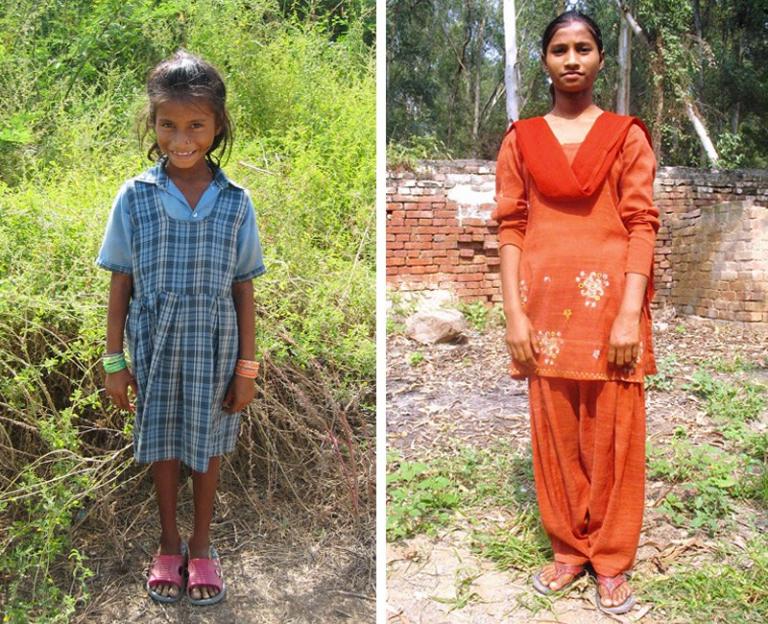
Daya, pictured at age 8 and age 15. Once among beggars in the street, she is now a thriving teen finding her place in this world and walking in her faith.
She wasn’t a professional beggar at all, but the grandmother of the little girl, Daya, who had been abandoned by both her mother and father. Without income and desperate, the grandmother had begun begging at bus stops, train stations and on the streets. With a change of heart, the cook invited the grandmother to enroll Daya in the Bridge of Hope center, which was in a building wedged between a railway station and a slum, conveniently available to children without a future.
The little girl was enrolled in the center but was so filthy that other parents complained. The Bridge of Hope staff conducted an intensive scrub session to relieve the child of dirt and germs and to replace the same filthy clothes she wore each day with clean clothes. They introduced her to soap and taught her to use it when she washed.
As the report states, “Daya’s future hung in the balance. If rejected from the Bridge of Hope center, she would return to the streets as one of the hundreds of thousands of child beggars in Asia. At some point, she would likely join the 20 to 30 million other boys and girls who are exploited as child laborers.”
The staff was determined to see that Daya thrived in Bridge of Hope, and she grew up to be an educated young woman. However, millions of other children never get that chance.
In a fact sheet on girls’ education, UNESCO (United Nations Educational, Scientific and Cultural Organization) explains:
Some 31 million girls of primary-school age are not in school. Seventeen million of these are expected to never enter school.
Some 34 million female adolescents are missing from secondary schools, which often offer vocational skills that are essential for procuring future jobs.
Two-thirds of the 774 million illiterate people in the world are female.
Thousands of these children can’t go to school because they are caught in bonded labor.
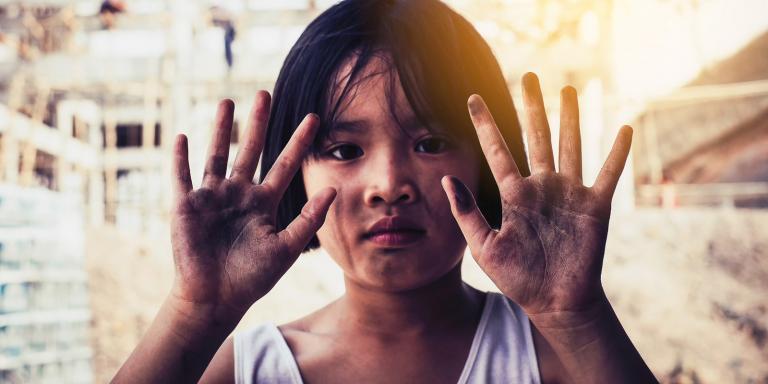
“It is doubtful they’ve ever held a toothbrush or a bar of soap; they’ve probably never eaten an ice-cream cone or cradled a doll,” Gospel for Asia (GFA) states. “The child laborers of Asia toil in fireworks, carpet and match factories; quarries and coal mines; rice fields, tea plantations and pastures; and even brothels. Because they are exposed to dust, toxic fumes, pesticides and disease, their health is compromised, and their bodies can be crippled from carrying heavy weights.”
Worse still, these children could be entrapped in prostitution.
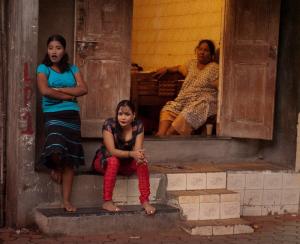
These young women are prostitutes in the red-light district; some most likely entrapped since childhood.
Prostitution is not illegal in India so the chances of victimization are mind-blowing. In addition, many impoverished families sell their daughters to opportunists who promise a better life for their children.
ABC News reports, “Aid organizations estimate that 20 to 65 million Indians have already passed through the hands of human traffickers at one point in their lives. Ninety percent of them remain within India’s national borders, and the majority are female and under the age of 18.”
One social worker, Palavi, explained, “Human trafficking works because the victims are afraid and cannot communicate. … Many of them have children who live in constant danger of also being sold or sexually abused. They grow up under the beds where their mothers were robbed of their dignity.”
When census data is gathered, these women, mothers and little girls are not in their villages, local communities or urban settlements. They are hidden by sex slave traders (but made available to the men who seek them out).
Let me ask again the question Jesus asked Simon the Pharisee, “Do you see this woman (or child, or little girl or teenager)?”
I have a granddaughter named Eliana who is 10 years old. Four mornings a week, I pick up Eliana and her brother, Nehemiah (8), to drive them to school. Their younger sister, Anelise (5), is picked up by the preschool bus. My driving effort is to help out their mother, who was married to our son Jeremy Mains. Our son, her husband and the children’s father, died five years ago at age 42 of blastic mantle cell lymphoma.
Angela, my daughter-in-law, is raising the children by herself while holding a full-time job as the director of a local community-outreach organization. She has just completed her dissertation and received a doctorate in adult education. Nevertheless, even with remarkable mothers, studies show that children raised without fathers are vulnerable. So my husband and I live close, are on call when babysitters fall through and try to do a lot of one-on-ones with our grandchildren.
Though I watch these grandchildren grow with an attentive heart, I am certain my granddaughter Eliana will never worry about entering bonded labor or be forced to go begging on the streets. It is impossible for me, even for the sake of achieving a frightening empathy, to impose through my imagination the horror of the lives of some 20 to 65 million trafficked females on these precious little girls I love.
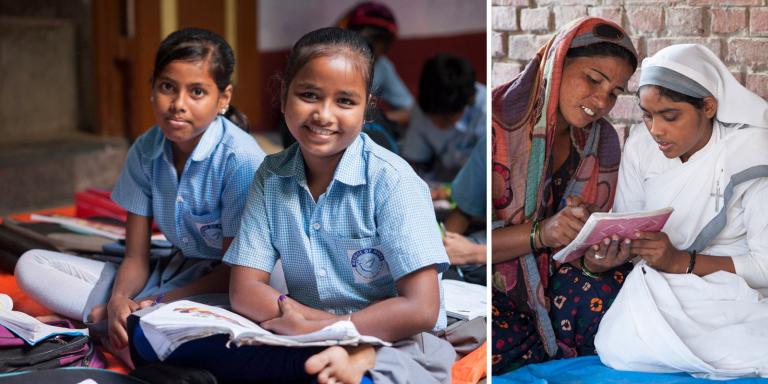
These Bridge of Hope students look happy during class time at GFA’s Bridge of Hope program. Education can protect a girl from exploitation—and redirect her future. This is a primary solution to begin changing the statistics of 100 million missing women.
Education as a Deterrent
Education can protect a girl from exploitation—and redirect her future. An educated girl can read. She can find work. She can get training to become a teacher, a doctor or a policewoman, for instance. She can tutor other children. A social system begins to change slowly, very slowly, one educated girl by one educated girl.
The latest statistics regarding GFA’s supported work with women in 2018 include:
290,753
women received free health care training
8,812
sewing machines distributed as a means to obtain work as a seamstress
61,880
illiterate women learned to read and write
11,000+
women desperate for jobs received vocational training
The World Bank stresses that girls’ education goes beyond getting into school. It is also about ensuring they learn and feel safe in school. One research study in Haiti indicated, “One in three Haitian women (ages 15 to 49) has experienced physical and/or sexual violence, and that of women who received money for sex before turning 18 years old, 27 percent reported schools to be the most common location for solicitation.”
What Can We Do? How Can We Conquer the Horrific 100 Million Missing Women Statistic?
What can we—those of us who have hearts that beat with concern about the unbelievable evils of this world—do about the 100 million missing women worldwide who face discrimination and violence? How can anyone make a dent in a problem with such magnified proportionality? How can that horrific statistic—100 million missing women—be conquered, overcome, defeated, reduced or even eliminated?
Well, there are some things we can do, small as they seem, but mighty nevertheless in their possibility:
We can sponsor girls (and boys) so they get educated through programs like GFA’s Bridge of Hope Program. And if $35 a month is too much for you (and it is for some compassionate people), invite your small group, Sunday School class, men’s softball league, neighborhood coffee-klatch or members of your extended family to pool funds.
Think about this question: Why do more people not see this inequality and neglect, not grieve for the 100 million missing women and girls who have experienced such hardships and take action to be part of the solution? Then read the book of Luke and think about the societal shift that begins with women’s encounters with Jesus.
Remind yourself of Christ’s question: “Do you see this woman?” Write it out on a card, and then use it as a bookmark in the books you read or paste it on your bathroom mirror. Write out a prayer, like the one I included in the beginning of this article, but adapt it to this horrific dilemma: Lord, what do You want me to do about the masses of women? And if you are not a praying person, send some discontented energy into the atmosphere any way you feel fit. Just don’t forget.
Let us conclude by going back to Jesus, except now He is not eating at the table of the VIPs. He is bloody, tortured, hanging from a cross and nearing death. The Gospel of John describes the inhumanity of the Roman soldiers and the crowds standing beneath the cross.
“Now there stood by the cross of Jesus His mother, and His mother’s sister, Mary the wife of Clopas, and Mary Magdalene. When Jesus therefore saw His mother, and the disciple whom He loved standing by, He said to His mother, ‘Woman, behold your son!’ Then He said to the disciple, ‘Behold your mother!’ And from that hour the disciple took her to his own home.”
Concern for the widow. Concern for the women.
“Look at this woman. Do you now see your mother?”
So, let us also be about this work in the world.
Oh, Lord, help us to care for every human with hearts that beat like Your heart beats for them. And help us, please help us, no matter our gender, to see the women.
Last updated on: October 29, 2022 at 5:35 am By GFA Staff Writer
WILLS POINT, TX – Gospel for Asia (GFA) Part#2 Special Report on the aftermath of acute gender imbalance: Discussing the horrendous reality of 100 million missing women worldwide.
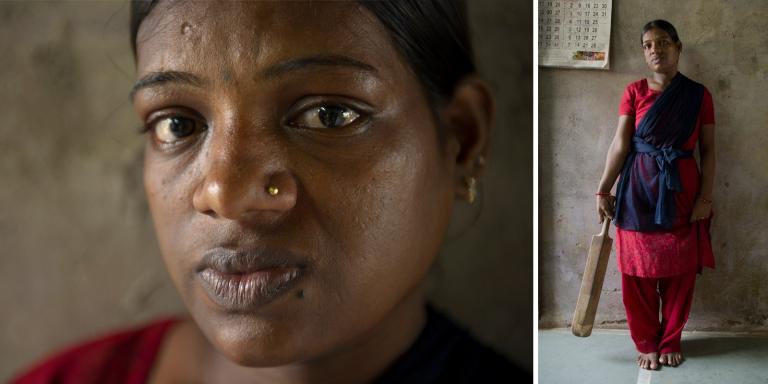
Geeta’s husband used to come home drunk and beat her with the wooden cricket bat pictured. Violence against women is a major public health problem in Asia and a violation of women’s human rights. The majority of this violence is intimate-partner violence, estimated to be 30 percent worldwide.
Intimate-Partner Violence Against Women Contributes to Gender Imbalance
One of the greatest contributors to this missing-women / gender imbalance factor is violence against women—both sexual violence and violence by their own intimate partners. According to the World Health Organization, “Violence against women—particularly intimate partner violence and sexual violence—is a major public health problem and a violation of women’s human rights.”
Global estimates indicate that about 1 in 3 women worldwide (35 percent) have been victims of physical and/or sexual violence, sometimes inflicted by their own intimate partners, in their lifetimes.
“As many as 38 percent of murders of women are committed by a male intimate partner.”
“Violence can negatively affect women’s physical, mental, sexual and reproductive health, and may increase the risk of acquiring HIV in some settings.”
“Men are more likely to perpetrate violence if they have low education, a history of child mistreatment, exposure to domestic violence against their mothers, harmful use of alcohol, gender imbalance norms including attitudes accepting of violence, and a sense of entitlement over women.”
A conclusion about the above data is, obviously, that intimate-partner violence is an undeniable contributor to the missing-women dilemma. In case there is any doubt as to what exactly is meant by all this, the United Nations defines violence against women as “any act of gender-based violence that results in, or is likely to result in, physical, sexual or psychological harm or suffering to women, including threats of such acts, coercion or arbitrary deprivation of liberty, whether occurring in public or in private life.”
The Coequal Value Seen in Genesis
The extraordinary message of the Christian Scriptures, beginning with the first book of the Old Testament, Genesis, affirms the value of men and women: “So God created man in His own image, in the image of God He created him; male and female He created them.”
Biblically faithful Christianity has always been confronted by this theological premise: Man and woman are created in the image of God. It’s a huge bump in the road for those who might mistreat the female sector within its following and is a premise worthy of the moans and groans of those who hear a sermon pointing out their misconduct. How we treat one another, in Christendom, is evidence of the reality and depth of our faith.
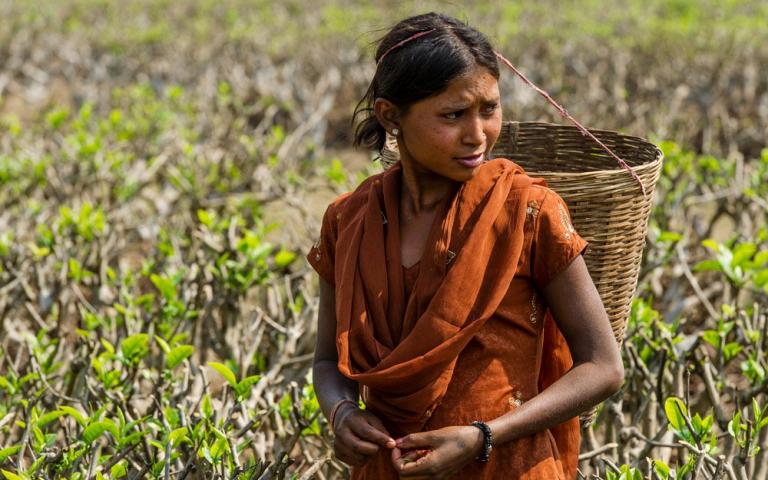
This young woman, Maloti, was kidnapped from the tea farm she worked on as a day laborer and recently married to someone of a higher caste. Her in-laws, disgusted by her being of a lower caste, hated her so much that they poisoned her. Their murderous attempt failed and Maloti survived, but suffered damage to her vocal cords.
Do You See This Woman?
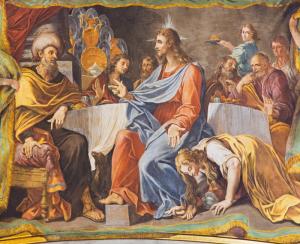
Let’s summarize again that story from Luke that began this article, “And behold, a woman in the city who was a sinner … brought an alabaster flask of fragrant oil, and stood at His feet behind him weeping; and she began to wash His feet with her tears, and wiped them with the hair of her head; and she kissed His feet and anointed them with the fragrant oil.”
The important religious leader, a Pharisee named Simon, was appalled by this woman who, uninvited, crashed his dinner party. In his heart he thought Jesus could not possibly be who He said He was, or He would know what kind of woman she was. Simon certainly thought he knew what kind of woman she was—an emotional type, obviously; a town prostitute, probably. A woman of bad manners and of lower class, which was not his type of person, certainly.
Jesus tells a parable about two debtors, one who owed a creditor little and one who owed the same man much. Both of their debts were forgiven. Jesus asks his host, Simon, which one he thinks loved the creditor the most—the one with little debt forgiven or the one with much debt forgiven? The answer is obvious, even to those of us reading the story many years removed from the dinner-party incident. We agree with the Pharisee’s answer: the one who was forgiven much.
At the risk of being redundant, it is here that Christ asks the question that resounds through the centuries, one that should be considered by any hostile intimate partner and any theologian or churchgoer who has a twisted, misogynies theology: “Simon, do you see this woman?”
This photo tells a story from the book of Luke: An uninvited woman, seen as a sinner, a woman of lower class who wanted to wash a religious leader’s feet with her own tears. The owner of the house was appalled by her, but Jesus “saw this woman”, intervened and provided protection, illustrating how to advocate for those longing for forgiveness.
Do you see this woman? Christ saw the woman, not her bad reputation, not her past misdeeds, not her wayward lifestyle. He saw her best potential self. He saw her broken heart. He saw the gratefulness she felt that any man could think she was something other than the role the community had assigned to her.
Jesus saw the women. If you want to conduct a study as to Jesus’ attitude toward women in a time when they were considered lower than second class, look through the stories collected in the Gospel of Luke. Here we see a man who loved women, advocated for them, healed them and welcomed them as companions in His earthly ministry.
We, too, need to see the women of the world. We need to turn our energies toward helping countries change and cure the great harms that have contributed to the extraordinary demographic imbalance of some 110 males for every 100 women. Indeed, many developing countries consider elevating women from underclass to an educated class as a means of increasing the capacity of the country to function competitively in a global economy.
Let us grieve for these who have suffered such hardships, deprivation, bondage, violence, societal disfavor or low self-esteem brought on by the scornful esteem of the men in one’s social circle. Let us form a solidarity of concern and do what we can to change the capacity of others, either men or women, but for the purposes of this article, particularly women, for the 100 million missing women and fight the aftermath of gender imbalance.
In 1980, I went on a sponsored survey trip for Food for the Hungry to write about that organization’s work in the disaster areas of the world. It was an extraordinary global journey and an extraordinary exposure to the needs and crises of humanity worldwide as well. At the start of the trip, on April 1 in Hong Kong, I had time to do a study of Christ’s ministry as recorded in the Gospel of Matthew, and I wrote out all the verses to remind myself of how dramatic His healing, teaching and miracle-filled ministry must have been to the masses.
Something about Christ’s response to the needy women who were part of all those crowds touched me deeply, and I wrote:
Lord, I praise You that while You are also God of the individual, You are also God of the masses. What did you have in mind for me to write about these masses of women?
Those who with little household aids, nevertheless, keep their houses (huts or tents) clean?
Those who demonstrate industry weaving or knitting?
Those who work in gardens, hoeing with homemade instruments or digging in the soil with sharpened sticks?
Those who run sidewalk cafés—little set-up carts?
Those who pour cool drips of the water have walked miles to gather over the bodies of their sweaty and dirty children?
Those who are painstakingly learning English in order to better themselves with foreigners?
Those who are raising pigs in piggeries?
Those in refugee camps who have nothing profitable to do afternoon after afternoon after afternoon?
Those who have willingly offered me their babies because the past is horrendous, their husbands are no longer alive and the future looks hopeless?
Those with wholesome, plain faces who volunteer their lives to serve the missionaries who bring some sensibility of promise into nonsensical and unpromising conditions?
Those who plant flowers in front of their settlement housing (canvas tents or ramshackle shelters)?
There is something about actually seeing the masses of needy and desperate yet often-courageous women struggling just to survive in the resettlement housing in Hong Kong, in the refugee camps in Thailand (those fleeing the Pol Pot massacres in Cambodia), in the canvas villages with dirt paths, in the milk-and-food lines provided by development organizations, or in the old abandoned ammo depots now housing a population of 20,000.
Last updated on: November 5, 2022 at 4:31 pm By GFA Staff Writer
Reflections on the 40-year Ministry of Gospel for Asia
The world has yet to see what God can do with and for and through and in and by the man who is fully and wholly consecrated to Him. I want to be that man.D.L. Moody
No doubt that statement by the great American evangelist D.L. Moody is still true, although the Lord used him mightily.
We have surely seen “what God can do with and for and through and in” by the likes of Billy Graham, Luis Palau, Tim LaHaye, Jerry Falwell, Chuck Smith, Greg Laurie and many others. But we still don’t know if we have seen the fulfillment of the desire of Moody’s heart that each of these men shared.
The amazing thing about the people God uses most effectively is that they seek no glory for themselves, they spend hours in prayer, and they yield all that they are and all they possess to serve the Lord in whatever way He directs their paths.
Rarely, when these men were young, did they anticipate a day 40 or more years into the future when they would look back in amazement at what the Lord had empowered and enabled them to do.
They did not set out to make a name for themselves or to establish an empire. They simply made themselves available as vessels separated and set aside for the Lord’s use. They, and others like them, can look back and stand in awe of how an Almighty God has blessed their ministries abundantly and beyond imagination.
I know a man exactly like that. His name is Dr. K.P. Yohannan. He is one of the humblest and most dedicated men I have ever known. Forty years ago, he responded to God’s call to minister to the millions of people in Asia. Little did he know that in 2019 he would be able to look back at the remarkable things the Lord did over the past 40 years.
How will the Lord do with these men?
Make no mistake, this is not a story about Dr. K.P. Yohannan. This is a story of what the Lord has done with and for and through and in him. The greatest ability we can give to the Lord is “availability.” All that young man had to offer the Lord in 1979 was a willing and obedient heart.
The Lord used that available vessel to begin Gospel for Asia (GFA) and to lead the ministry with a singular focus: to take the love of Christ to people who have never heard His name before.
In a newly released video, Dr. Yohannan invites us to join Gospel for Asia (GFA) in celebrating “the 40 years of this incredible journey with our Lord.” In the video, he reminisces with effervescence because of the numerous healthy congregations the Lord has established through GFA-supported workers serving in more than 16 countries.
He shares an overview of the numbers of children that have been able rescued from lives of abandonment on the streets and in the slums, many of whom have had to beg on the streets or dig through garbage dumps simply to live another day of desperation.
“The amazing thing about the people God uses most effectively is that they seek no glory for themselves, they spend hours in prayer, and they yield all that they are and all they possess to serve the Lord in whatever way He directs their paths.”
Gospel for Asia helps provide education, meals, school supplies and health care for more than 70,000 of these children through its Bridge of Hope program—all because of a willing heart and the prayers and financial gifts of godly men and women and churches around the world.
Dr. K.P.’s vision is for the Lord to open the doors to be able to minister to half-a-million children who are trapped in the same circumstances in the developing countries of Asia.
He speaks in the video about the multitudes of women who have been rescued from poverty, prostitution and physical abuse. GFA-supported workers share the love of Christ with them and help them to find a way out of their plight, offering them literacy education and vocational training.
Who would have dreamed 40 years ago that the Lord would use the generosity of Gospel for Asia (GFA) supporters to establish a radio broadcasting system that millions of people listen to in 110 different languages and dialects across the entire subcontinent?
As Dr. K.P. says in the video, “God can do anything,” but He almost always uses us to accomplish His purposes. Alone, we are nothing. Even together, we cannot do the Lord’s work without His leading and empowerment.
I want to share this video with you so that you, personally, can hear Dr. K.P. share his thanks for your prayers and support of Gospel for Asia (GFA) over the years. It is your trust in the Lord and in the mission of Gospel for Asia (GFA) that has made the amazing ministry possible.
Check out the video and join us in celebrating 40 years of God’s amazing and abundant blessings.
Gospel for Asia has been serving the “least of these” in Asia since its beginning in 1979, often in places where no one else is serving. GFA supports national workers who are serving as the hands and feet of Christ by ministering to people’s needs so they can understand the love of God for them for the first time. GFA is engaged in dozens of projects, such as caring for poor children, slum dwellers and widows and orphans; providing clean water by funding wells; supporting medical missions; and meeting the needs of those in leprosy colonies. Through GFA’s Bridge of Hope Program, tens of thousands of children are being rescued from the generational curses of poverty and hopelessness.
Click here, to read more blogs on Patheos from Gospel for Asia.


 One of the specific health ministries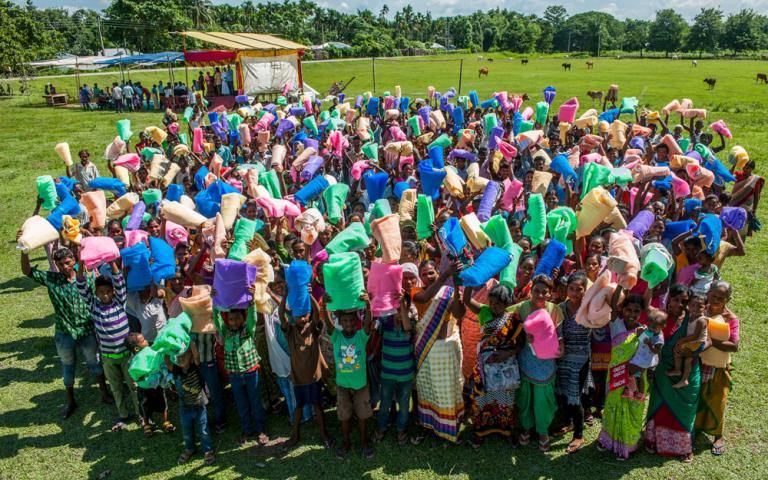

 We can sponsor girls (and boys) so they get educated through programs like GFA’s Bridge of Hope Program. And if $35 a month is too much for you (and it is for some compassionate people), invite your small group, Sunday School class, men’s softball league, neighborhood coffee-klatch or members of your extended family to pool funds.
 Think about this question: Why do more people not see this inequality and neglect, not grieve for the 100 million missing women and girls who have experienced such hardships and take action to be part of the solution? Then read the book of Luke and think about the societal shift that begins with women’s encounters with Jesus.
 Remind yourself of Christ’s question: “Do you see this woman?” Write it out on a card, and then use it as a bookmark in the books you read or paste it on your bathroom mirror. Write out a prayer, like the one I included in the beginning of this article, but adapt it to this horrific dilemma: Lord, what do You want me to do about the masses of women? And if you are not a praying person, send some discontented energy into the atmosphere any way you feel fit. Just don’t forget.








 Ad-Free & Subscriber Log-In