

I draw wholly (without a single word of comment, beyond this introduction) from the document, Mater Populi Fidelis: Doctrinal Note on Some Marian Titles Regarding Mary’s Cooperation in the Work of Salvation, which was released on 4 November 2025, by the Dicastery for the Doctrine of the Faith (Víctor Manuel Card. Fernández, Prefect) and “approved” by Pope Leo XIV, who “ordered its publication.”
To me, this aspect was the most fascinating part of the document and perhaps (?) the most important, and a fairly “new” (?) development of Mariology. I won’t include full footnotes right after the citations this time, in order to foster a better “flow” of the text. All of that can be found in my article, Mater Populi Fidelis: Themes & Highlights, from which these excerpts are entirely drawn. But I will indicate the source of direct citations, in brackets and blue font.
Passages at the end, after the three asterisks, represent the most specific as to the fine points of how Mary’s mediation works or functions.
*****
Saint Augustine calls the Virgin “cooperator” in Christ’s Redemption, thereby emphasizing both Mary’s action at Christ’s side as well as her subordination to him, . . . [9]
The cooperation of the Mother with her Son in the work of Salvation has been taught by the Magisterium of the Church. As the Second Vatican Council states, “rightly, therefore, the holy Fathers see Mary not merely as a passive instrument in the hands of God, but as freely cooperating in the work of human salvation through faith and obedience.” [Lumen Gentium; henceforth “LG”] [13]
The Second Vatican Council’s terminology regarding mediation primarily refers to Christ; it sometimes also refers to Mary, but in a clearly subordinate manner. In fact, the Council preferred to use a different terminology for her: one centered on cooperation or maternal assistance. [27]
The Second Vatican Council affirmed that “the unique mediation of the Redeemer does not exclude but rather gives rise to a manifold cooperation which is but a sharing in one source.” [LG] For this reason, “the content of this participated mediation should be explored more deeply, but must remain always consistent with the principle of Christ’s unique mediation.” [CDF, Dominus Iesus] [28]
Mary’s participation in Christ’s work becomes evident when one begins from the conviction that the risen Lord promotes, transforms, and enables believers to collaborate with him in his work. . . . What must be emphasized in this case is that when Christ allows us to accompany him and — under the impulse of his grace — to give our very best, it is ultimately his power and his mercy that are glorified. [29]
Christ’s mediation, which in some respects can be “inclusive” or shared, is in other respects exclusive and incommunicable. [33]
Mary’s maternal cooperation is in Christ, and it is, thus, participatory. In other words, it involves “a sharing in the one unique source that is the mediation of Christ himself.” [Pope St. John Paul II] . . . Her maternal role “in no way obscures or diminishes this unique mediation of Christ, but rather shows its power. All the Blessed Virgin’s salutary influence” on us springs from the “the superabundance of the merits of Christ, rests on his mediation, depends entirely on it and draws all its power from it.” [LG] [37]
Mary’s motherhood in the order of grace must be understood as a help in preparing us to receive God’s sanctifying grace. [46]
Mary listens, decides, and acts to help us open our lives to Christ and to his grace, because it is God alone who works in our innermost being. [49]
Indeed, only God reaches our innermost center to bring about elevation and transformation when he gives himself as a Friend, and thus, “no creature can confer grace.” . . . “only God produces the interior effect of the sacrament: first, because God alone can enter the soul wherein the sacramental effect takes place (and no agent can operate immediately where it is not): secondly, because the grace that is an interior effect of the sacrament comes from God alone.” [St. Thomas Aquinas] [50]
No human person — not even the Apostles or the Blessed Virgin — can act as a universal dispenser of grace. Only God can bestow grace, . . . [53]
She cooperates in the economy of salvation by a derived and subordinate participation. Therefore, any expression about her “mediation” in grace must be understood as a distant analogy to Christ and his unique mediation. [53]
One should avoid any description that would suggest a Neoplatonic-like outpouring of grace by stages, as if God’s grace were descending through various intermediaries (such as Mary) while its ultimate source (God) remained disconnected from our hearts. Such interpretations carry a negative impact on a proper understanding of the intimate, direct, and immediate encounter that grace effects between the Lord and the believer’s heart. . . . It does not honor Mary to attribute to her any mediation in the accomplishment of this work that belongs exclusively to God. [55]
We must reflect on how Mary fosters our “immediate union” [LG] with the Lord — which the Lord himself produces by conferring grace and which we can receive only from God — and not think of our union with Mary as being more immediate than our union with Christ. This risk is present, above all, in the notion that Christ gives us Mary as an instrument or as a secondary and perfecting cause in the communication of his grace. . . . The Second Vatican Council highlighted that “the Blessed Virgin’s salutary influence on men originates not in any inner necessity but in the disposition of God.” [LG] . . . it is not acceptable to present Mary’s action as if God needed her to accomplish salvation. [65]
***
In Mary’s case, this mediation takes place in a maternal way, just as she did at Cana and as was confirmed at the cross. [34]
She, who received in her womb the power of the Holy Spirit and became the Mother of God, by that same Spirit, becomes Mother of the Church. Because of this singular union in motherhood and in grace, her prayer for us has a value and an efficacy that cannot be compared to any other intercession. Saint John Paul II connected the title “Mediatrix” with this role of maternal intercession, noting that Mary “puts herself ‘in the middle,’ that is to say, she acts as a mediatrix not as an outsider, but in her position as mother. She knows that, as such, she can point out to her Son the needs of mankind.” [38]
Mary is sometimes portrayed as if she possessed a repository of grace separate from God. In such a notion, it is not so clear that it is the Lord who — in his generous and free omnipotence — willed to associate her with the sharing of that divine life which springs forth from the sole center that is the Heart of Christ, not that of Mary. She is also frequently portrayed or imagined as a fountain from which all grace flows. If one considers the fact that the Trinitarian indwelling (uncreated grace) and our participation in the divine life (created grace) are inseparable, we cannot think that this mystery depends on a “passage” through Mary’s hands. Such notions elevate Mary so highly that Christ’s own centrality may disappear or, at least, become conditioned. [45]
In the perfect immediacy between a human being and God in the communication of grace, not even Mary can intervene. Neither friendship with Jesus Christ nor the Trinitarian indwelling can be conceived of as something that comes to us through Mary or the saints. In any case, what we can say is that Mary desires this good for us and she asks for it, together with us. . . . the liturgy of the Solemnity of the Immaculate Conception states that she became an “advocate of grace” [The Roman Missal] — that is, she intercedes by asking God that we might receive the gift of grace. [54]
Mary does not supplant the Lord in any action he has not already done (i.e., she does not take anything away from him) nor does she supplement him (i.e., she does not add to him). Since she does not add anything to Christ’s salvific mediation in the communication of grace, she should not be regarded as the instrumental agent of that free bestowal. . . . being associated with Christ, Mary is the recipient of a gift from her Son that places her beyond herself, a gift that enables her to accompany the Lord’s work with her maternal character. [65]
Through her intercession, Mary can implore God to grant us those internal impulses of the Holy Spirit that are called “actual graces.” These are the aids given by the Holy Spirit that operate even in sinners to prepare them for justification, and that encourage those already justified by sanctifying grace to further growth. It is in this specific sense that the title “Mother of Grace” must be understood. She humbly cooperates so that we may open our hearts to the Lord, who alone can justify us through the action of sanctifying grace: that is, when God pours his Trinitarian life into us, dwells in us as a Friend, and makes us sharers in his divine life. This is exclusively the Lord’s own work. At the same time, it does not preclude the possibility that the words, images or various prompts that we receive through Mary’s maternal intercession might help us to persevere in life, to prepare our hearts for the grace that the Lord infuses, or to grow in the life of grace that we have freely received. [69]
“Mary, the first disciple, is Mother.” On the Cross, Christ entrusts us to Mary, and so “he brought us to her because he did not want us to journey without a mother.” [Pope Francis] She is the believing Mother who has become the “Mother of all believers”; [Pope Benedict XVI] . . . “Our Mother Mary always wants to walk at our side, to remain close to us, to help us with her intercession and her love.” [Pope Leo XIV] She is the Mother of the Faithful People of God, who “moves in the midst of her people by tender and loving care; she makes her own their anxieties and troubles.” [Pope Francis] [76]
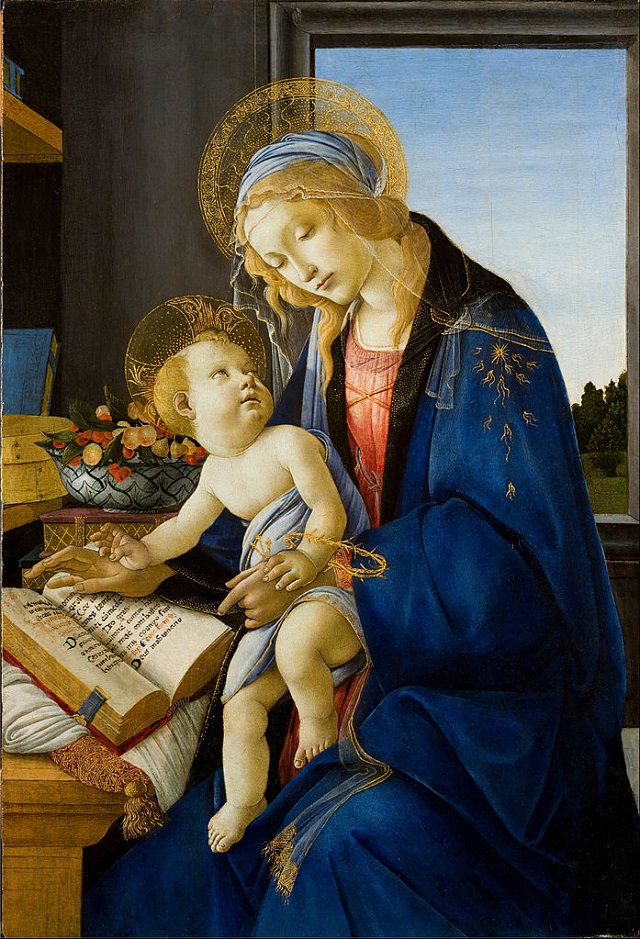
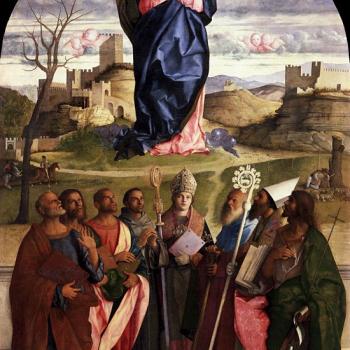
Photo credit: The Virgin and Child (The Madonna of the Book) (1480), by Sandro Botticelli (1445-1510) [public domain / Wikimedia Commons]
Summary: Analysis in the document, Mater Populi Fidelis (11-4-25) of how Mary’s mediation works: perhaps the most fascinating part & the most important (?) development of Mariology.








 Ad-Free & Subscriber Log-In