

Reformed Baptist and YouTube apologist Dr. Gavin Ortlund stated in his video, “The 5 Minute Case for Protestantism” (6-8-23) at 39 seconds in: “Throughout the medieval era, pretty much all the Roman Catholics think that the non-Catholics are damned . . . and those views find their way into the highest levels of magisterial teaching.” This is untrue, and I thoroughly refuted it (only to be utterly ignored by Dr. Ortlund, as usual). If we want to find massive consigning of other Christians — Protestants — to hell, we have to examine the early Protestant leaders. I massively document this below.
Yet Dr. Ortlund has, as of late, contended in books and videos that Protestantism is where true catholicity and ecumenism is to be found. One would never conclude that, reading all of the mutual anathematizing below. And, ironically, Dr. Ortlund, as a believer in adult baptism, very well could have been executed as a seditious heretic, with the approval of Martin Luther and his successor Philip Melanchthon, whereas they only banished Catholics, at worst.
This one will not hear of baptism, and that one denies the sacrament, . . . some say this, some say that: there are as many sects and creeds as there are heads. No yokel is so rude but when he has dreams and fancies, he thinks himself inspired by the Holy Ghost and must be a prophet. (Martin Luther, Letter to the Christians of Antwerp, early 1525; see German primary sources De Wette, vol. III, p. 61 / Weimar edition, vol. 18, p. 547 / Erlangen edition, vol. 53, p. 342)
I see that schisms and errors are increasing proportionately with the passage of time, and that there is no end to the rage and fury of Satan. (Martin Luther, Confession Concerning Christ’s Supper, Feb. 1528, in LW, Vol. 37, p. 360)
All the sectaries think they are a hundred times wiser than I, and do not listen to me; I am more at war with them than with the Pope, and they do more harm. (Martin Luther to William Pravest, 14 March 1528; in Luther’s Correspondence and Other Contemporary Letters, Vol. II: 1521-1530; translated and edited by Preserved Smith and Charles M. Jacobs, Philadelphia: The Lutheran Publication Society: 1918)
The wicked take occasion from our dissensions to speak evil, and the weak are only perplexed by our unintelligible disputations. Nor in truth, is it of little importance to prevent the suspicion of any difference having arisen between us from being handed down in any way to posterity; for it is worse than absurd that parties should be found disagreeing on the very principles, after we have been compelled to make our departure from the world. (John Calvin to Philip Melanchthon, 28 November 1552, from Selected Works of John Calvin: Tracts and Letters: Letters, Part 2, 1545-1553, vol. 5 of 7; edited by Jules Bonnet, translated by David Constable; Grand Rapids, Michigan: Baker Book House, 1983; reproduction of Letters of John Calvin, vol. 2 [Philadelphia: Presbyterian Board of Publication, 1858]; pp. 376-377)
*****
1 Ulrich Zwingli vs. Lutherans: he compared “worshiping the consecrated bread” with the worship of the golden calf at Dan (I Kings 12:28 f.). (Letter to Matthew Alber, published in 1525. C.R. 90, 342; St. L. 17, 1520; cited in Luther’s Works [“LW”], Vol. 37, p. 22, footnote 24)
2 Ulrich Zwingli vs. Martin Luther: not led by the same Spirit. Corpus Reformatorum [“C. R.“], 95, 317; 5 April 1525; cited in LW, Vol. 37, p. 21; footnote 19.
3 Martin Luther vs. Andreas Karlstadt: Dr. Karlstadt has fallen from the kingdom of Christ and has suffered shipwreck with respect to faith. . . . Dr. Karlstadt . . . has lost Christ. (Against the Heavenly Prophets in the Matter of Images and Sacraments, 1525; in LW, vol. 40, pp. 79 ff.; this quote from pp. 139-140)
4 Martin Luther vs. Andreas Karlstadt: . . . a vengeful devil, by which indeed Dr. Karlstadt is possessed. (Against the Heavenly Prophets . . ., 1525; in LW, vol. 40, p. 204)
5 Ulrich Zwingli vs. Lutherans: he ridiculed the Lutherans’ “edible, impanated, baked, roasted, ground-up God.” (Reply to Urban Rhegius, 1526; C.R. 91, 934; cited in LW, Vol. 37, p. 22, footnote 24)
6 Martin Luther vs. John Oecolampadius and Urbanus Rhegius: Pray Christ to guide my pen so as to refute Satan successfully. . . . I am grieved that that estimable man Oecolampadius has fallen into the mire through such childish nonsensical ideas. Satan urges him on. May God save him! Urbanus Rhegius also inclines the same way, or has fallen in. (To Nicolas Hausmann, 1 Jan. 1527; in The Letters of Martin Luther, selected and translated by Margaret A. Currie, London: Macmillan & Co., Ltd., 1908)
7 Ulrich Zwingli vs. Martin Luther: [a] fanatic, fool, bumpkin, yes a devil, murderer, and corrupter of souls who blasphemes the holy and venerable sacrament of our Lord Jesus Christ. (That These Words . .. Will Always Retain Their Ancient, Single Meaning. Ulrich Zwingli’s Christian Answer, 1527, Corpus Reformatorum [“C. R.“], 92, 831; St. L. 20, 1139; cited in LW, Vol. 37, p. 18, footnote 14)
8 Martin Bucer vs. Martin Luther: Let Luther acknowledge that he is being led by a spirit far different from that of Christ. (Preface, 1527. St. L. 17, 1601; cited in LW, Vol. 37, p. 21, footnote 19)
9 Ulrich Zwingli, Martin Bucer, and John Oecolampadius vs. Martin Luther: [according to Luther]: they regard us as “un-Christians” whom the Spirit of God has forsaken . . . (. . . Against the Fanatics, 1527, LW, vol. 37, 21)
10 Ulrich Zwingli, Martin Bucer, and John Oecolampadius vs. Martin Luther: [according to Luther]: Since we “un-Christians” and unforbearing heathen, I say, must suffer such horrible slander and shameful vilification from them, they, as the holy Christians . . . they regard me as full of devils. (. . . Against the Fanatics, 1527, LW, vol. 37, 23)
11 Martin Luther vs. the “Sacramentarian Fanatics” (primarily Ulrich Zwingli, Martin Bucer, and John Oecolampadius): Our adversary says that mere bread and wine are present, not the body and blood of the Lord. If they believe and teach wrongly here, then they blaspheme God and are giving the lie to the Holy Spirit, betray Christ, and seduce the world. One side must be of the devil, and God’s enemy. There is no middle ground. . . . These fanatics demonstrate forthrightly that they regard the words and works of Christ as nothing but human prattle . . . (That These Words of Christ, “This is My Body,” Etc., Still Stand Firm Against the Fanatics (published in English translation in Luther’s Works [“LW”], Vol. 37, p. 13 ff.; dated March 1527; this excerpt from p. 26).
12 Martin Luther vs. the “Sacramentarian Fanatics”: they are clearly found to be entertaining such devilish ideas and advising things which make for the despising, blaspheming, and disgrace of God and our eternal death and destruction . . . (. . . Against the Fanatics, 1527, LW, vol. 37, 27)
13 Martin Luther vs. the “Sacramentarian Fanatics”: we intend to shun, condemn, and censure them, as idolaters, corrupters of God’s Word, blasphemers, and liars . . . (. . . Against the Fanatics, 1527, LW, vol. 37, 27; footnote 33 on the German for the word “idolater”: “Luther’s manuscript here reads ketzer — ‘heretics’; the printed version, probably revised by Luther himself, reads götzer.”)
14 Martin Luther vs. the “Sacramentarian Fanatics”: . . . they bring so many souls into the everlasting fire of hell . . . (. . . Against the Fanatics, 1527, LW, vol. 37, 28)
15 Martin Luther vs. John Oecolampadius: This is Oecolampadius’ “spirit” . . . that human fancy and unbelief shall prevail over God’s Word and form the basis of our faith. . . . How profoundly can Satan mislead such people? (. . . Against the Fanatics, 1527, LW, vol. 37, 50)
16 Martin Luther vs. John Oecolampadius: shameful, dreadful blasphemies . . . what shall I say of the outrageous audacity of this hellish Satan? (. . . Against the Fanatics, 1527, LW, vol. 37, 127)
17 Martin Luther vs. the “Sacramentarian Fanatics”: he who deliberately denies, blasphemes, and desecrates Christ in one subject or article cannot correctly teach or honor him at any other point; it is sheer hypocrisy and deception, . . . one either loses Christ completely, or has him completely. (. . . Against the Fanatics, 1527, LW, vol. 37, 131)
18 John Oecolampadius vs. Martin Luther: [Luther] starts with the devil and spews out devils in all his words . . . (That Dr. Luther’s Misunderstanding . . . is Untenable, 1527; cited in LW, vol. 37269; footnote 171)
19 Martin Luther vs. Ulrich Zwingli: Such dissension and factionalism cannot and does not come from the Holy Spirit. It certainly comes from the very devil himself . . . (Confession Concerning Christ’s Supper, Feb. 1528, in LW, Vol. 37, 161 ff.; this citation from p. 163)
20 Martin Luther vs. Zwingli, Oecolampadius, and Schwenkfeld: . . . heretics, fanatics, deceivers . . . (Confession Concerning Christ’s Supper, Feb. 1528, in LW, Vol. 37, 169)
21 Martin Luther vs. Ulrich Zwingli: beware of Zwingli and sun his books as the prince of hell’s poison. For the man is completely perverted and has entirely lost Christ. . . . this man never publishes a book without spewing out new errors, more and more all the time. (Confession Concerning Christ’s Supper, Feb. 1528, in LW, Vol. 37, 206-207)
22 Martin Luther vs. Ulrich Zwingli: We in turn raise a hue and cry against them for separating the person of Christ as though there were two persons [the heresy of Nestorianism]. (Confession Concerning Christ’s Supper, Feb. 1528, in LW, Vol. 37, 212; Zwingli had falsely accused Luther of the heresy of Monophysitism)
23 Martin Luther vs. Ulrich Zwingli: one who denies a common article of faith is to be shunned as a manifest heretic. Now Zwingli not only denies this most exalted and necessary article, that the Son of God died for us; he actually blasphemes it, saying it is the most outrageous heresy that ever existed. . . . he leaves us no other Christ than a mere man who died for us and redeemed us. . . . This teaching altogether rejects and condemns the entire Christian faith and the whole world’s salvation. . . . I regard Zwingli as un-Christian, with all his teaching, for he holds and teaches no part of the Christian faith rightly. He is seven times worse than when he was a papist . . . (Confession Concerning Christ’s Supper, Feb. 1528, in LW, Vol. 37, 230-231)
24 Martin Luther vs. Ulrich Zwingli: I do not argue whether the wine remains wine or not. It is enough for me that Christs blood is present; let it be with the wine as God wills. Sooner than have mere wine with the fanatics, I would agree with the pope that there is only blood. (Confession Concerning Christ’s Supper, Feb. 1528, in LW, Vol. 37, 317)
25 Zwingli vs. Luther: May I be lost if he does not surpass Faber in foolishness, Eck in impurity, Cochlaeus in impudence [all three, Catholics], and to sum it up shortly, all the vicious in vice. (Letter to Conrad Sam of Ulm, 30 August 1528; in Hartmann Grisar, Luther, translated by E. M. Lamond, edited by Luigi Cappadelta, six volumes, London: Kegan Paul, Trench, Trubner & Co., 1915, Vol. III, 277)
26 Martin Luther vs. Ulrich Zwingli: We are now seeing God’s judgments for the second time — . . . on Zwingli. I prophesied that God would not long suffer such blasphemies, calling us cannibals, blood-drinkers, and other horrible names. They have brought it upon themselves. (To Wenzel Link, 3 Jan. 1532; in Currie, ibid.)
27 Philip Melanchthon and Martin Luther vs. Anabaptists: In a memorandum, written in 1536 by Melanchthon and agreed-to and signed by Luther, no distinction is made between peaceful and a small minority of violent Anabaptists:
That seditious articles of doctrine should be punished with the sword needed no further proof. For the rest, the Anabaptists hold tenets relating to infant baptism, original sin, and inspiration which have no connection with the Word of God, and are indeed opposed to it. . . . For think what disaster would ensue if children were not baptized; what would be the final outcome but thoroughly heathenish existence? Item, infant baptism rests on such sure foundations that the Anabaptists have no legitimate grounds for rejecting it. . . . it becomes clear that the secular authorities are bound to suppress blasphemy, false doctrine, and heresy, and to inflict corporal punishment on the offenders. . . . Also when it is a case of only upholding some spiritual tenet, such as infant baptism, original sin, and unnecessary separation, then, because these articles are also important. . . we conclude that in these cases also the stubborn sectaries must be put to death. (cited in Johannes Janssen, History of the German People from the Close of the Middle Ages, 16 volumes, translated by A.M. Christie, St. Louis: B. Herder, 1910 [orig. 1891]; Vol. X, 222-223; see also: Roland Bainton, Here I Stand: A Life of Martin Luther, New York: Mentor, 1950, 376-378)
28 John Calvin vs. Martin Luther: if Luther has so great a lust of victory, he will never be able to join along with us in a sincere agreement respecting the pure truth of God. For he has sinned against it not only from vainglory and abusive language, but also from ignorance and the grossest extravagance. For what absurdities he pawned upon us in the beginning, when he said the bread is the very body! And if now he imagines that the body of Christ is enveloped by the bread, I judge that he is chargeable with a very foul error. What can I say of the partisans of that cause? Do they not romance more wildly than Marcion respecting the body of Christ? . . . (Letter to Martin Bucer, January 12, 1538; in John Dillenberger, editor, John Calvin: Selections From His Writings, Garden City, New York: Doubleday & Co. [Anchor Books], 1971, 47)
29 Heinrich Bullinger vs. Martin Luther: Everyone must be astonished at the harsh and presumptuous spirit of the man . . . The opinion of posterity will be that Luther was . . . a man ruled by criminal passions. . . . Luther’s rude hostility might be allowed to pass would he but leave intact respect for Holy Scripture . . . What has already taken place leads us to apprehend that this man will eventually bring great misfortune upon the Church. (Letter to Martin Bucer, December 8, 1543; in Grisar, Luther, Vol. V, 409 and Vol. III, 417)
30 Martin Luther vs. Zwingli, Andreas Karlstadt, John Oecolampadius, and Caspar Schwenkfeld: In his work, Luther calls these men -– and by implication those who believe as they do — an “accursed faction of fanatics, Zwinglians and the like” (p. 287), who adhere to a “blasphemous and deceitful heresy” (p. 288) (Brief Confession Concerning the Holy Sacrament, Sep. 1544, in LW, vol. 38; see page numbers above)
31 Martin Luther vs. Zwingli and Oecolampadius: I had to be very concerned about their souls [both were deceased by then] because they were still steeped in error and would thus perish in their sins. (Brief Confession . . ., 1544, in LW, vol. 38, p. 289)
32 Martin Luther vs. Ulrich Zwingli: “a full-blown heathen” (Brief Confession . . ., 1544, in LW, vol. 38, p. 290)
33 Martin Luther vs. Zwingli, Andreas Karlstadt, John Oecolampadius, and Caspar Schwenkfeld: “murderers of souls” who “possess a bedeviled, thoroughly bedeviled, hyper-bedeviled heart and lying tongue . . . no one among Christians should and can pray for the fanatics or receive them. They have incurred their penalty and are committing ‘sin which is mortal’ . . . may the dear Lord Christ deliver the poor people who are among them from such murderers of souls” (Brief Confession . . ., 1544, in LW, vol. 38, p. 296)
34 Martin Luther vs. Zwingli, Andreas Karlstadt, John Oecolampadius, and Caspar Schwenkfeld: “blasphemers and enemies of Christ” (Brief Confession . . ., 1544, in LW, vol. 38, p. 302)
35 Martin Luther vs. Ulrich Zwingli: “I am certain that Zwingli, as his last book testifies, died in a great many sins and in blasphemy of God” (Brief Confession . . ., 1544, in LW, vol. 38, pp. 302-303)
36 Martin Luther vs. Zwingli, Andreas Karlstadt, John Oecolampadius, and Caspar Schwenkfeld: “What Christian heart can or even wants to believe that the Holy Spirit, and not rather the loathsome devil, is continually at work in them . . . I would have to condemn myself into the abyss of hell together with them if I should make common cause with them or have fellowship with them . . .” (Brief Confession . . ., 1544, in LW, vol. 38, p. 305)
37 John Calvin vs. Lutheranism: In their madness they even drew idolatry after them. For what else is the adorable sacrament of Luther but an idol set up in the temple of God? (Letter to Martin Bucer, June 1549; in Jules Bonnet, editor, John Calvin: Selected Works of John Calvin: Tracts and Letters: Letters, Part 2, 1545-1553, volume 5 of 7; translated by David Constable; Grand Rapids: Baker Book House, 1983; reproduction of Letters of John Calvin, volume II [Philadelphia: Presbyterian Board of Publication, 1858], p. 234)
38 John Calvin vs. [Lutheran] Joachim Westphal: With regard to Westphal and the rest, it was difficult to follow your advice and be calm. You call those “brothers,” who, if that name be offered to them by us, do not only reject, but execrate it. And how ridiculous should we appear in bandying the name of brother with those who look upon us as the worst of heretics! (Letter to William Farel in August, 1557, cited in The Life of John Calvin: Compiled from Authentic Sources, Thomas Henry Dyer, London: John Murray, 1850, p. 407)
39 John Calvin vs. Joachim Westphal: he mournfully deplores that I have treated him more harshly than the Anabaptists, Libertines, and Papists. (Last Admonition of John Calvin to Joachim Westphal, Who, if He Heeds it Not, Must Henceforth be Treated in the Way Which Paul Prescribes for Obstinate Heretics, 1557, pp. 346 ff.)
40 John Calvin vs. Lutheranism: I am carefully on the watch that Lutheranism gain no ground, nor be introduced into France. The best means, believe me, for checking the evil would be that confession written by me . . . (Letter to Heinrich Bullinger, 2 July 1563, in John Dillenberger, editor, John Calvin: Selections From His Writings, Garden City, New York: Doubleday & Co. [Anchor Books], 1971, 76 / Letters of John Calvin, Compiled from the Original Manuscripts and Edited with Historical Notes, Volume 4, edited by Jules Bonnet, translated by Marcus Robert Gilchrist, Philadelphia: Presbyterian Board of Publication, 1858, p. 322)
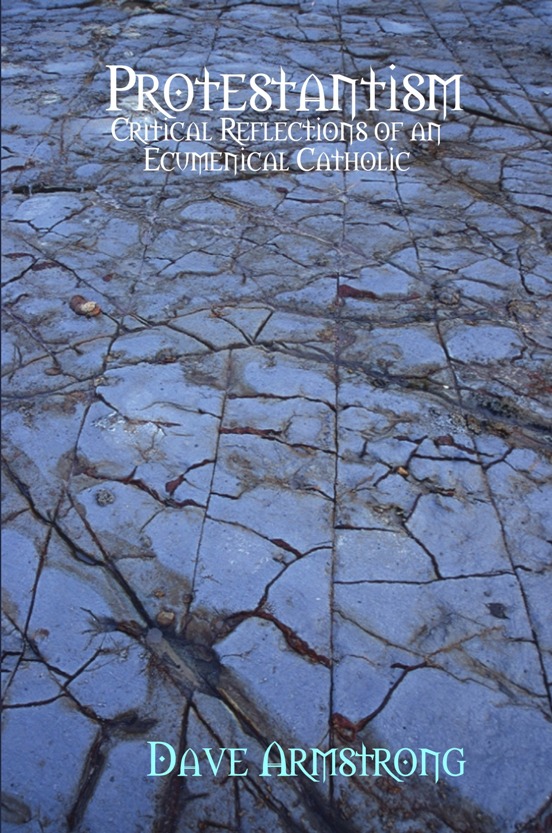
Photo credit: self-designed cover of my 2007 book.
Summary: Collection of forty examples of early Protestant leaders (from 1520-1563), classifying fellow Protestants (often equally influential) as heretics or non-Christians or damned.









 Ad-Free & Subscriber Log-In