2017-12-22T16:07:26-04:00

The Judaizers were Christians who took a different approach to law and grace than the Church at length decided to take. *** The New International Dictionary of the Christian Church (edited by J. D. Douglas, Grand Rapids, Michigan: Zodervan, 1978, “Judaizers”, p. 554), states about the Judaizers: A party of Christians in the early church who thought it was necessary that Gentile converts to Christianity should be circumcised and observe the Jewish law — in fact that they should become... Read more

2017-12-22T13:53:40-04:00

“In the last two decades of Pentateuchal scholarship, the source-critical method has come under unprecedented attack; in many quarters it has been rejected entirely. . . . [various factors] have led scholarship to the brink of abandoning the four sources, J, E, P and D. ” — The Tam Institute for Jewish Studies at Emory University (Spring 2009 Calendar of Events) Catholic Deconstructing the Documentary Hypothesis (Phillip Campbell, Unam Sanctam Catholicam) Crisis in Scripture Studies (William G. Most) Critique of the... Read more

2017-12-21T15:06:26-04:00

Biblical examples clearly indicate the general principle that offices are not annihilated by sinful occupants. *** A Protestant (words in blue below) asked me: In your section on ‘Rome’ you note that it suffered, ‘periodic moral decadence, a few weak or immoral popes..’ Yet you are not bothered that the holder of an ‘infallible’ office ( yes I know it’s only at ‘times’), can be ‘immoral’? I don’t just mean falls into sin like everyone does sometimes, but actually ‘immoral’... Read more

2017-12-21T13:42:36-04:00

King David was quite a sinner himself, yet God made an eternal covenant with him, knowing he would commit adultery and murder. *** [Reformed Protestant Anti-Catholic polemicist John Bugay’s words will be in blue] *** Why did I know this would happen? I was watching coverage of the Joe Paterno / Penn State tragedy last night, on a sports show, and I just knew that this would cause many folks (especially anti-Catholics like John Bugay) to go right back to blasting the... Read more

2017-12-20T15:21:08-04:00

Luther accepted confirmation as a sacramental rite like, e.g., holy water, but not as a Scripture-attested sacrament. [Luther’s words will be in blue] *** Lutherans have differed on the question through the centuries, with some observing it and others not doing so (and with different understandings of it). We again find Luther, characteristically, refusing to disallow it, and he preached on at least one occasion that he would not find fault: . . . if every pastor examines the faith of the children... Read more

2017-12-20T14:08:04-04:00

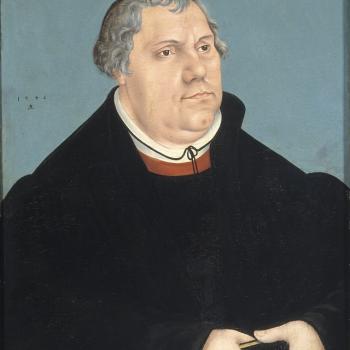
A Lutheran apologist says Luther wasn’t “agonized” over rampant sectarianism; I document that he was. This whole “tempest in a teapot / mountain out of a molehill” pseudo-controversy came about as a result of Lutheran blogger Edward Reiss going on and on about one appendix of one obscure book of mine. In my 2007 volume, Protestantism: Critical Reflections of an Ecumenical Catholic, I described a set of quotations from Luther as evidences of Luther’s “Agony Over the State of Early Protestantism.” Fellow “reformers”... Read more

2017-12-20T12:07:59-04:00

Documentation of Luther’s opinion of the early Lutherans, during the first period of Protestantism. I think causes of historical events are always extraordinarily complex, just as causes of human behavior in general are. That has always been my position, as long as I can remember. I despise simplistic attempts of positing single causes for things as obviously complex as our topic of the social / theological situation of Germany in the 16th century. All the cited words below are Luther’s... Read more

2017-12-19T13:13:41-04:00

Why do Catholics “pray to saints”? Is this “worship”? Does it imply that departed saints have “godlike” powers? These are some of the questions dealt with in a friendly dialogue with two Protestant friends, on my Facebook page. Bethany Kerr’s words will be in blue; Mike Grubb’s in green. *** It doesn’t bother me to have beautiful artwork depicting biblical figures (or even Christ). It’s just hard for me to understand what seems to be the cognitive dissonance of people... Read more

2017-12-19T11:16:56-04:00

Luther never said that the “Reformation” as a whole was a failure, or shouldn’t have happened, but he said quite a bit about how the new Protestants were miserably failing in manifesting the  superiority of their system over Catholicism. The following is taken from the book by Henry O’Connor, S. J.: Luther’s Own Statements Concerning His Teaching and Its Results (New York: Benzinger Brothers, 1884, second edition). The author provides a wealth of information, straight from Luther’s primary works in German (translated... Read more

2017-12-19T11:18:57-04:00

Catholics hold that Scripture is a fairly clear document and able to be understood by the average reader, but also that the Church is needed to provide a doctrinal norm (an overall framework) for determining proper biblical interpretation (specifically, for “vetoing” that interpretation which is erroneous because it leads to doctrinal error). Both Luther and Calvin underemphasize the guidance of the Church in understanding the Bible and assert the perspicuity, or clearness, and self-interpreting nature of Scripture, in terms of... Read more

Follow Us!


TAKE THE
Religious Wisdom Quiz

In the Parable of the Wedding Banquet, who accepts the invitation?

Select your answer to see how you score.


Browse Our Archives