

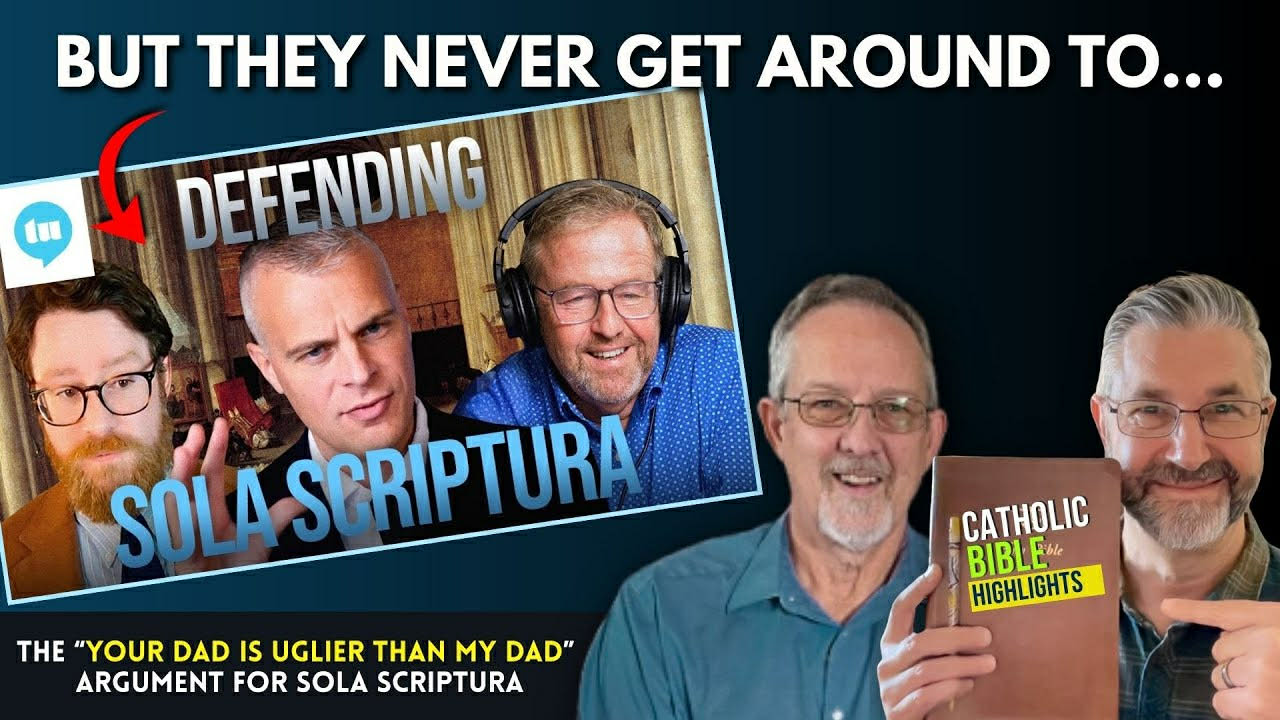
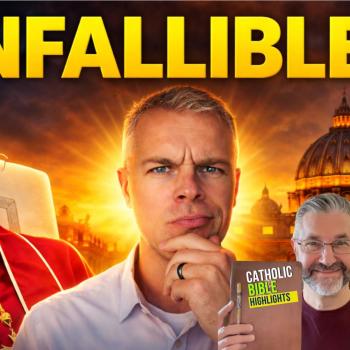
We did a video called, “Ortlund Cooper and Horton try to Prove Sola Scriptura [and Fail!]” (Catholic Bible Highlights with Kenny Burchard, 12-14-25). In the combox on 12-22-25, one “@RJPatten” made a lengthy critique, which I will now counter-reply to (every word of his is included). His words will be in blue.
***
[title] REFORMED RESPONSE TO “Ortlund, Cooper, and Horton Try to Prove Sola Scriptura [and Fail!]”
Thanks for your lengthy and articulate reply. It’s rare to receive those anymore from folks who disagree. I will be counter-responding to it, point-by-point, and we may also do that in a future video.
The video asserts: —Sola Scriptura fails because no biblical text explicitly states that “Scripture alone is the only infallible rule of faith,” and because Protestant defenders allegedly spend their time attacking Catholic doctrines instead of making a positive biblical case.
It’s a manifest and evident fact (not “alleged”) that their video never really defended sola Scriptura, properly speaking, and only attacked various Catholic doctrines. This happens all the time, which is why I decided it was high time to expose the silly and utterly illogical tactic.
This critique fundamentally misunderstands what Sola Scriptura claims, how doctrinal norms function in Scripture, and what counts as a valid biblical argument.
What else is new? I don’t think I’ve ever critiqued sola Scriptura without receiving the claim back that I misunderstand what it is. It’s untrue. I have thoroughly documented what it means from good Protestant sources: current and historical, for many years now, and have written four books on it and used to zealously hold the same position myself. I know full well what it is.
I. The Central Category Error: “Explicit Statement” ≠ “Biblical Doctrine”. Dave Armstrong’s controlling assumption is: If a doctrine is true, Scripture must explicitly state it in propositional form. But this rule itself is not found in Scripture. By this standard, the following doctrines would also collapse:
—The Trinity (no verse says “God is one essence in three co-equal persons”)
—The hypostatic union
—The canon of Scripture itself
—The cessation of apostles
—Even papal infallibility, which is nowhere stated as such in Scripture
Um, sorry to disappoint you , but this is not my argument. “Explicit” appeared once in the video, and it was in my description of something Jordan Cooper said in an earlier video (starting at 12:06):
Dr. Cooper would probably go on to say that even though sola Scriptura isn’t explicitly stated, it can still be deduced or indirectly derived from various statements in scripture. I vigorously disagree and I continue to maintain that if indeed it can’t be found in the Bible at all. And if contrary statements are in the Bible, we must conclude that it’s self-defeating and a fatally flawed premise regarding the rule of faith.
My position is that sola Scriptura is not only absent explicitly from the Bible, but absent altogether, no matter what form of argument for it is presented. My view about biblical proofs in general is not a whit different from what you express above, and I can easily prove that from many statements of mine in past articles and books (the advantage of having so much material out there, as I do). For example:
It is not our view that every tenet of the Christian faith must appear whole, explicit, and often, in the pages of the Bible. . . . A belief implicitly biblical is not necessarily anti-biblical or unbiblical. But we maintain that the Protestant principle of sola Scriptura, on the other hand, is incoherent and – I dare say – quite unbiblical. In fact, many doctrines accepted by Protestants are either not found in the Bible at all (for example, sola Scriptura and the canon of Scripture), are based on only a very few direct passages (for example, the virgin birth), or are indirectly deduced from many implicit passages (for example, the Trinity, the Two Natures of Jesus, many attributes of God such as His omnipresence and omniscience).”
The Bible speaks only implicitly of many things which Protestants strongly believe, such as the proper mode of baptism (immersion, sprinkling, or pouring?). The Immaculate Conception is entirely possible within scriptural presuppositions. (from my first book, A Biblical Defense of Catholicism, finished in May 1996, published in 2003, pp. xv and 178)
I believe that all Catholic doctrines can be found in Scripture, either explicitly or implicitly or indirectly. (article from June 1996).
All true Christian doctrines can be found in Scripture, explicitly or implicitly, or clearly deduced from biblical evidences. (article from 2003).
There are such things as “implicit” and deductive proofs from Scripture or at least indications. (article from 2007).
As in Bible interpretation, there are explicit statements and there are implicit ones, as well as plausible or sensible deductions from either kind of statement. (article from March 2024, replying to Gavin Ortlund).
So I’ve been writing about this same thing — documented online and in my first book — for more than 29 years. Therefore, this accusation of yours is completely directed to a straw man and not to my view.
Biblical doctrine is frequently established by: —pattern —function —divine logic —negative exclusion —redemptive-historical structure Sola Scriptura belongs to this category.
Those are simply descriptive words. I’d have to see examples of each of these arguments, to adequately respond. I suspect that I have already done so here and there, once you explain exactly what each one means, and how it is relevant to sola Scriptura.
II. What Sola Scriptura Actually Claims (and Does NOT) The video attacks a strawman.
Quite the opposite: you are attacking straw men (this is now your second one).
Sola Scriptura does not claim: – That Scripture is the only authority
I never said that it did. If you claim otherwise, by all means document it with the minute mark on the video. You can read the transcript in writing. Otherwise, you need to retract these egregious misrepresentations of my position: repeatedly made ultra-clear in my many critiques of sola Scriptura.
– That tradition has no value
For Protestants, Scripture alone, or sola Scriptura, is the source and rule of the Christian faith. As such, it is superior to, and judges all tradition. It is sufficient in and of itself for a full exposition of Christianity and for the attainment of salvation.*The concept of sola Scriptura, it must be noted, is not in principle opposed to the importance and validity of Church history, tradition, ecumenical councils, or the authority of Church fathers and prominent theologians. The difference lies in the relative position of authority held by Scripture and Church institutions and proclamations. In theory, the Bible judges all of these, since, for the evangelical Protestant, it alone is infallible, and the Church, popes, and councils are not. (pp. 3-4; citing Luther, Calvin, and R. C. Sproul in the footnotes to back up my definition)
III. The Positive Biblical Case (Which the Video Claims Does Not Exist)
That’s correct. I claim this all the time. Thanks for describing my view accurately for a change.
1. Scripture Is God-Breathed in a Way Nothing Else Is
It’s unique, but there are other inspired / God-breathed utterances: most notably, prophesies and the Holy Spirit agreeing with the proceedings of the Jerusalem Council (Acts 15:28), making it infallible, contrary to the claim of sola Scriptura.
2 Timothy 3:16–17 “All Scripture is God-breathed … that the man of God may be complete, equipped for every good work.”
Every time: the ubiquitous alleged “prooftext” . . . Of course the passage is true, like all of the Bible. Scripture is inspired. No one disputes that. But citing this is irrelevant to the sola Scriptura debate because Paul doesn’t deny that there are other infallible organs of authority, which is the sola Scriptura claim.
Key observations: —Scripture uniquely proceeds from God’s breath —Scripture is sufficient to fully equip —No parallel claim is ever made for councils, bishops, or tradition This is not merely inspiration—it is functional sufficiency tied to divine origin.
Why, then, does Paul mention a host of similar things in Ephesians 4, but never cite Scripture?:
Ephesians 4:11-16 (RSV) And his gifts were that some should be apostles, some prophets, some evangelists, some pastors and teachers, [12] to equip the saints for the work of ministry, for building up the body of Christ, [13] until we all attain to the unity of the faith and of the knowledge of the Son of God, to mature manhood, to the measure of the stature of the fulness of Christ; [14] so that we may no longer be children, tossed to and fro and carried about with every wind of doctrine, by the cunning of men, by their craftiness in deceitful wiles. [15] Rather, speaking the truth in love, we are to grow up in every way into him who is the head, into Christ, [16] from whom the whole body, joined and knit together by every joint with which it is supplied, when each part is working properly, makes bodily growth and upbuilds itself in love.
I commented on this in my first book, p. 16:
If the Greek artios (RSV, complete / KJV, perfect) proves the sole sufficiency of Scripture in 2 Timothy, then teleios (RSV, mature manhood / KJV, perfect) in Ephesians would likewise prove the sufficiency of pastors, teachers and so forth for the attainment of Christian perfection. Note that in Ephesians 4:11-15 the Christian believer is “equipped,” “built up,” “brought into unity and mature manhood,” “knowledge of Jesus,” “the fulness of Christ,” and even preserved from doctrinal confusion by means of the teaching function of the Church. This is a far stronger statement of the perfecting of the saints than 2 Timothy 3:16-17, yet it doesn’t even mention Scripture.
Therefore, the Protestant interpretation of 2 Timothy 3:16-17 proves too much, since if all nonscriptural elements are excluded in 2 Timothy, then, by analogy, Scripture would logically have to be excluded in Ephesians. It is far more reasonable to synthesize the two passages in an inclusive, complementary fashion, by recognizing that the mere absence of one or more elements in one passage does not mean that they are nonexistent. Thus, the Church and Scripture are both equally necessary and important for teaching. This is precisely the Catholic view. Neither passage is intended in an exclusive sense.
I’ve made other arguments against 2 Timothy 3:16-17 as a supposed proof of sola Scriptura, too:
Sola Scriptura, 2 Tim 3:16-17, & “Man of God” [1-27-12]
2. Jesus Treats Scripture as the Final Court of Appeal Repeatedly, Christ answers theological disputes with: “It is written.” He rebukes: —Pharisaical tradition (Mark 7:6–13) —Interpretive errors (Matt 22:29) —Satan himself (Matt 4)
It is the final court of appeal, just not exclusively so. The Church and tradition are also that, and they are always in harmony with Scripture.
Even when disputing teachers of the Law, Jesus never appeals to an infallible magisterium—only Scripture.
This is untrue:
Matthew 23:2-3: The scribes and the Pharisees sit on Moses’ seat; [3] so practice and observe whatever they tell you, but not what they do; for they preach, but do not practice.
“Moses seat” isn’t an Old Testament concept. It’s a tradition. It’s like referring to a “chairman” of a company or committee. He occupies the “chair,” therefore he has authority. No one thinks he has the authority only when he sits in a certain chair reading the corporation charter or the Constitution or some other official document.
Because they had the authority, it would follow that Christians were, therefore, bound to elements of Pharisaical teaching that were not only non-scriptural, but based on oral tradition, for this is what Pharisees believed. They fully accepted the binding authority of oral tradition (the Sadducees were the ones who were the Jewish sola scripturists and liberals of the time).
The Oxford Dictionary of the Christian Church notes in its article on the Pharisees:
Unlike the Sadducees, who tried to apply Mosaic Law precisely as it was given, the Pharisees allowed some interpretation of it to make it more applicable to different situations, and they regarded these oral interpretations as of the same level of importance as the Law itself. (F. L. Cross and E. A. Livingstone, editors, Oxford: Oxford University Press, 2nd edition, 1983; 1077)
It was precisely the extrabiblical (especially apocalyptic) elements of Pharisaical Judaism that New Testament Christianity adopted and developed for its own: doctrines such as: resurrection, the soul, the afterlife, eternal reward or damnation, and angelology and demonology (all of which the Sadducees rejected; see Acts 23:7-8). The Old Testament had relatively little to say about these things, and what it did assert was in a primitive, kernel form. But the postbiblical literature of the Jews (led by the mainstream Pharisaical tradition) had plenty to say about them. Therefore, this was another instance of Christianity utilizing non-biblical literature and traditions in its own doctrinal development.
What the passage clearly demonstrates, I think, is that there is authoritative tradition outside of the Bible, and even outside of the apostles, who were alive at the time this encounter took place, and soon to appear on the scene with great zeal, after Jesus’ Resurrection. Jesus could easily have said that the Pharisees’ authority was to shortly be superseded by the apostles but He did not, and even Paul called himself a Pharisee and recognized the authority of the high priest. The salient point is whether this was a binding authority not based on solely the letter of the Old Testament. If so, sola Scriptura is in deep trouble.
Many Protestants read the accounts of Jesus’ conflicts with the Pharisees and get the idea that He was utterly opposed to all tradition whatsoever. This is false. A close reading of passages such as Matthew 15:3-9 and Mark 7: 8-13 will reveal that He only condemned corrupt traditions of men, not tradition per se. He uses qualifying phrases like “your tradition,” “commandments of men,” “tradition of men,” as opposed to “the commandment of God.” St. Paul draws precisely the same contrast in Colossians 2:8: “See to it that no one makes a prey of you by philosophy and empty deceit, according to human tradition, according to the elemental spirits of the universe, and not according to Christ.”
For much more on this, see my article, “Pharisees, “Moses’ Seat”, Tradition & Catholicism”.
There are many other examples of Jesus citing oral Torah. He preached in the Sermon on the Mount, “You have heard that it was said to the men of old, ‘You shall not kill; whoever kills shall be liable to judgment.’ But I say to you that everyone who is angry with his brother shall be liable to judgment…” (Matthew 5:22). In other words, his point was that sin starts in the heart and the intent, before we commit an act, and that the intent is as blameworthy as the act that flows from it. Murder starts in anger, which then can become malice, up to and including murder, if it’s unchecked. Is this an entirely new ethical insight of Jesus? No. Many Jews would have been familiar with the oral tradition later written in the Talmud, in Bava Mezia 58b: “He who publicly shames his neighbor is as though he shed blood.”
Likewise, Jesus said shortly after the above, “Everyone who looks at a woman lustfully has already committed adultery with her in his heart” (Matthew 5:28). Again, arguably he drew from the continually developing oral Torah. A sentiment similar to this is found in Leviticus Rabba 23:12: “Not only is he who sins with his body considered an adulterer, but he who sins with his eye is also considered one.”
Jesus’ teaching, “Do not resist one who is evil … if anyone strikes you on the right cheek, turn to him the other also” (Matthew 5:39) is often thought to be a radically innovative — if not altogether new and unique — moral teaching. But this idea was present in Jewish oral tradition (eventually written down) as well. A person struck in this way is urged to forgive even if the offender didn’t ask forgiveness (Tosefta Baba Kanima 9:29) and people were commanded to cheerfully submit to suffering (Yoma 23a).
Likewise, his similar maxim, “Love your enemies and pray for those who persecute you” (Matthew 5:44) was alluded to in the Talmud: Yoma 23a, Gitin 36b and Shabat 88b. This reliance on what was originally Jewish oral tradition, later written down outside of the Old Testament, may have been used by Jesus when discussing the true nature of prayer: “In praying do not heap up empty phrases as the Gentiles do; for they think that they will be heard for their many words” (Matthew 6:7). Berachot 55a states: “If one draws out his prayer and expects therefore its fulfillment, he will in the end suffer vexation of heart…”
Jesus famously observed about anxiety and worry about basic needs and the future: “Therefore I tell you, do not be anxious about your life, what you shall eat or what you shall drink. … Is not life more than food? … Do not be anxious about tomorrow…” (Matthew 6:25, 34). Sotah 48b may have drawn from a similar oral tradition when it stated: “Rabbi Eliezer the Great declares: Whoever has a piece of bread in his basket and says, ‘What shall I eat tomorrow?’ belongs only to them who are little in faith.”
Jesus declared, “Thou hast hidden these things from the wise and understanding and revealed them to babes” (Matthew 11:25). The Talmud stated, in Bava Batra 12b: “Rabbi Johanan said: Since the Temple was destroyed, prophecy has been taken from prophets and given to fools and children.”
The early Christians at the Jerusalem Council held views about proper eating, (or, kashrut) – see Acts 15:20, 29; 21:25 — that must have come from the oral Torah. The notions of not eating things sacrificed to idols [Mishnah Avodah Zorah 2:3 in the Jewish Talmud], or things strangled [Mishnah Chullin 1:2] are not found in the written Torah. Jesus, in Revelation 2:14, 20 chides the churches in Pergamum and Thyatira for not observing the ban on eating food sacrificed to idols.
Jesus taught His disciples not to “heap up empty phrases” or use “many words” when they prayed (Mt 6:7), and to not give up or lose heart praying for something they really needed (Lk 18:1-6). Calculating and babbling were forbidden by the oral Torah [Babylonian Talmud, Berekhot 32b], and like Jesus advising His disciples to keep asking God for righteous requests in prayer, the oral Torah likewise stated, “If a man realizes that he has prayed and not been answered, he should pray again” [Babylonian Talmud, ibid.].
Here’s another passage where Jesus refers to the authority of the Church (not only the Bible):
Matthew 18:15-17 “If your brother sins against you, go and tell him his fault, between you and him alone. If he listens to you, you have gained your brother. [16] But if he does not listen, take one or two others along with you, that every word may be confirmed by the evidence of two or three witnesses.[17] If he refuses to listen to them, tell it to the church; and if he refuses to listen even to the church, let him be to you as a Gentile and a tax collector.
So in Matthew 23:2-3 Jesus commanded His disciples to follow the instructions of the Pharisees, and here to follow the authority of the Church. Remember, all of this refutes the claim, “Jesus never appeals to an infallible magisterium—only Scripture.”
3. Apostolic Authority Is Temporary and Non-Transmissible
The apostles: —Are eyewitnesses (Acts 1:21–22) —Are foundational (Eph 2:20) —Are unrepeatable (Rev 21:14)
All agree that the apostles themselves disappeared from history c. 100. Catholics assert, however, that they passed on their authority to others (apostolic succession), through a variety of biblical arguments that I won’t repeat here, but link to:
Biblical Arguments for Apostolic Succession [9-9-09]
Apostolic Succession: More Biblical Arguments [1-6-17]
Apostolic Succession as Seen in the Jerusalem Council [National Catholic Register, 1-15-17]
Answers to Questions About Apostolic Succession [National Catholic Register, 7-25-20]
A New Biblical Argument for Apostolic Succession [National Catholic Register, 4-23-21]
Once the apostolic witness is inscripturated, the Church does not inherit apostolic infallibility—it inherits apostolic teaching. That teaching now exists objectively in Scripture.
The whole notion of “inscripturation” is a groundless and unbiblical Protestant myth and man-made tradition. It simply is never taught in Scripture, whereas apostolic succession clearly is: as seen in the reasoning of my five articles above. This is why we rarely if ever see Protestant apologists even attempting to make any sort of biblical argument for it. What we get instead — as presently — is the bald assertion, as if everyone is supposed to accept that as Gospel TRVTH because Protestant Apologist X (in this case, an anonymous person we know nothing whatever about) proclaimed it, minus the slightest biblical evidence.
Readers will note all of the Bible I am bringing to the table, all the way through this discussion. The contrast in the level and mode of argumentation could hardly be any greater. I’ve written about this issue, too:
Dialogue on “Perspicuous Apostolic Teaching” (vs. James White) [May-June 1996]
The One-Legged Stool Called ‘Inscripturation’ is Not Taught in the Bible [National Catholic Register, 3-15-21]
4. Scripture Judges the Church — Not Vice Versa. Repeat: scripture judges the church.
V. Protestant Disagreement Is Not an Argument Against Sola Scriptura
The video repeatedly argues: “Three Protestants disagree with one another—therefore Sola Scriptura fails.”
This is a non sequitur.
But it greatly concerns us to cherish faithfully and constantly to the end the friendship which God has sanctified by the authority of his own name, seeing that herein is involved either great advantage or great loss even to the whole Church. For you see how the eyes of many are turned upon us, so that the wicked take occasion from our dissensions to speak evil, and the weak are only perplexed by our unintelligible disputations. Nor in truth, is it of little importance to prevent the suspicion of any difference having arisen between us from being handed down in any way to posterity; for it is worse than absurd that parties should be found disagreeing on the very principles, after we have been compelled to make our departure from the world. I know and confess, moreover, that we occupy widely different positions; still, because I am not ignorant of the place in his theatre to which God has elevated me, there is no reason for my concealing that our friendship could not be interrupted without great injury to the Church . . .And surely it is indicative of a marvellous and monstrous insensibility, that we so readily set at nought that sacred unanimity, by which we ought to be bringing back into the world the angels of heaven. Meanwhile, Satan is busy scattering here and there the seeds of discord, and our folly is made to supply much material. At length he has discovered fans of his own, for fanning into a flame the fires of discord. I shall refer to what happened to us in this Church, causing extreme pain to all the godly; and now a whole year has elapsed since we were engaged in these conflicts. . . (Selected Works of John Calvin: Tracts and Letters: Letters, Part 2, 1545-1553, vol. 5 of 7; edited by Jules Bonnet, translated by David Constable; Grand Rapids, Michigan: Baker Book House [Protestant publisher], 1983, 454 pages; reproduction of Letters of John Calvin, Vol. 2 (Philadelphia: Presbyterian Board of Publication, 1858; the letter in question is numbered as CCCV [305] and is found on pp. 375-381; the portion above is from pp. 376-377)
1) it’s exponentially less than Protestant internal dissensions,and2) it’s not institutionalized as it is in Protestantism, where differences are actually celebrated on a certain level and the self-understanding is that this is a marvelously tolerant system that we should admire and respect as better than all those “dogmatic” Catholics and Orthodox, who actually believe that all theological truth can be discovered and maintained in an authoritative and infallible Church and tradition, in harmony with an infallible and inspired Bible.
Photo credit: copyright 2025 by Catholic Bible Highlights.
Summary: I respond to a lengthy critique of our video from a Reformed Protestant. To his credit, he later retracted two major aspects of his critique, and so the dialogue is still in progress.









 Ad-Free & Subscriber Log-In