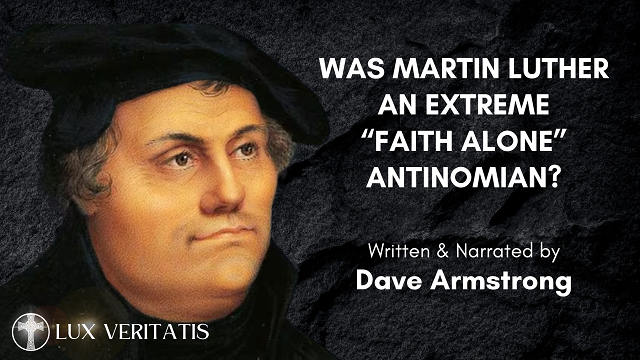
Luther: Extreme “Faith Alone” Antinomian?

Luther: Extreme “Faith Alone” Antinomian? 2026-04-07T16:17:26-04:00

Photo Credit: copyright Lux Veritatis, 2025.


This is the transcript of my video, What did Martin Luther REALLY teach about GOOD WORKS? [Lux Veritatis, 7 minutes, 5-8-25]. Luther’s words will be in blue.

*****

Antinomianism is the view that Christians are not bound to follow the moral law contained in the Ten Commandments and that faith alone guarantees eternal security in heaven regardless of what one does. Critics rightly call this view a license to sin or cheap grace. Is this the outlook of Martin Luther, the founder of Protestantism? It is not. In fact, Luther is said to have coined the term as he opposed the views of Johannes Agricola, the key figure in the revival of this serious heresy in 1525. And in 1539, Luther wrote a treatise called Against the Antinomians, found in the 55-volume Luther’s Works, Volume 47, on pages 107 to 119. To his credit, Agricola repented of his errors as a result. Luther is often greatly misunderstood on this point and his faith alone view is often not properly comprehended in its fine points and nuances.

He believed that works do not save us, and this is perfectly harmonious with Catholic teaching, over against the heresy of Pelagianism or works salvation. It doesn’t follow, however, that he did or ever would deny the necessity of works in the Christian life. In fact, he thought that they were an inevitable manifestation of an authentic and genuine faith. This view was also held by John Calvin, and is mainstream Protestant opinion. Catholics and Protestants agree that faith is absolutely necessary for salvation, and that we are clearly commanded by God to do good works. Many on either side think that the other side denies one of these principles. In fact, however, at the level of creeds and doctrinal statements, both sides completely concur.

We mustn’t minimize theological divisions, but we also ought not exaggerate or mischaracterize them. Honesty and charity demand no less. It’s wrong and unethical to unfairly characterize, caricature, or distort the viewpoints of those who differ from us or use cynically selective citations taken out of context, in order to do so, as happens all too often in Catholic circles when dealing with Luther. We must tell the truth. Bearing false witness or lying about others is a serious, grave sin. Luther’s words in particular also need to be very carefully interpreted, and those who want to criticize him must do four things:

#1: Examine the historical context of his statements if at all possible.
*
#2: Determine the purpose of any given writing.
*
#3: Understand, if able to do so through various scholarly resources, his overall teaching on the subject at hand.
*
#4: Realize that Luther often utilized extreme sarcasm and hyperbole and often toyed with adversaries, etc.
People need not rely on my word for Luther’s opinion on works in the Christian life. I’ll prove it from ten examples of his own words: all of which can be found with full documentation in two of my articles and one work of Luther’s that I link to below. So I won’t provide full references excepting the work and year of every statement. So everything that follows is from Luther himself.
*
#1 Large Catechism (1529): If we wish to be Christians, we must practice the things that make for Christianity.
*
#2 God . . . teaches fully what we should do if we wish to perform truly good works. And by commanding them, he shows that they please Him.
*
#3 Here we have again the Word of God whereby He would encourage and urge us to true, noble, and sublime works. . . .
*
#4 There are comprehended therefore in this commandment quite a multitude of good works which please God most highly. . . .
*
#5 Disputation Concerning Justification (1536): Faith which lacks fruit is not an efficacious but a feigned faith.
*
#6 Smalcald Articles (1537): good works follow such faith, renewal and forgiveness.
*
#7 If good works do not follow, faith is false and not true.
*
#8 On the Councils and the Church (1539): The Lord Jesus has obtained not only grace for us but also the gift of the Holy Spirit that we may receive not only
remission of sins but likewise a renunciation of sins. Whoever therefore does not cease from sin but cleaves to his former evil courses must take up another Christ along with the Antinomians, who is certainly no real savior. . . . The Antinomians do not perceive that they preach the the Savior without and against the Holy Spirit as they allow the people to remain in their old course and yet pronounce them to be saved. For according to the result, a Christian ought to receive the Holy Spirit and lead a new life or to be sure and certain that he possesses no savior. . . . 
*
#9 Sermon on 1 John 4:16 ff. (1545): Faith takes sins away and puts them to death so that you should live not in them but in righteousness. Therefore demonstrate by your works and by your fruits that you have faith. . . . Love follows true faith.
*
#10 Preface to Romans (1546): It is a living, busy, active, mighty thing, this faith. It is impossible for it not to be doing good works incessantly.
*
***

My Related Articles

*
*
Related Luther Treatise

Martin Luther, On the Councils and the Church (1539), translated by C. B. Smith (London: William Edward Painter, 1847), pp. 152-153 cited. 

My Books on Martin Luther

Martin Luther: Catholic Critical Analysis and Praise (my book, April 2008, 264 pages; available in paperback or for only $2.99 as an e-book)

The “Catholic” Luther : An Ecumenical Collection of His “Traditional” Utterances (my book, Dec. 2014, 166 pages; available only as an e-book, for $3.99; see details at the link)

My Web Pages on Martin Luther & Lutheranism
*
*
*
*
***
*

Photo Creditcopyright Lux Veritatis, 2025.

Summary: While rejecting works-based salvation, Martin Luther passionately affirmed that genuine faith must produce good works, and he fiercely opposed the heresy of antinomianism.

"That's perfectly legitimate and sound. We just have to show that they're alive, capable of ..."

Invocation of Dead Saints: 100 Biblical ..."
"I have recently came up with an argument for the intercession of the saints, and ..."

Invocation of Dead Saints: 100 Biblical ..."
"Part 7:2 Peter 1: 5-7, 10-11"5 For this very reason, make every effort to supplement ..."

50 Unanswerable NT Passages Against “Faith ..."
"Part 6:James 1: 12"12 Blessed is the man who remains steadfast under trial, for when ..."

50 Unanswerable NT Passages Against “Faith ..."

Browse Our Archives

Follow Us!


TAKE THE
Religious Wisdom Quiz

Who said: "Behold, I stand at the door and knock. If anyone hears My voice and opens the door, I will come in"?

Select your answer to see how you score.