

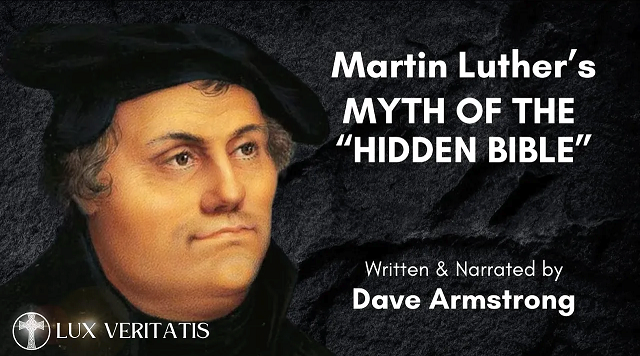
This is the transcript of my video, Did The Catholic Church Really Ban The Bible? [Lux Veritatis, 11 minutes, 5-6-25]. Luther’s words will be in blue.
*****
Up to this time, the idea that the ley should read the Scriptures has been treated with derision. For in this the devil has hid on a fine trick to tear the Bible out of the hands of the laity; and he has thought thus: If I can keep the laity from reading the Scriptures, I will then turn the priests from the Bible to Aristotle and so let them gossip as they will. The laity must hear just what they preach; while if the lady should read the Scriptures, the priests would have to study them, too, in order that they might not be detected and overcome.
One of the most persistent inaccuracies regarding the European Middle Ages, both among the general public and even among scholars, is the notion that the Roman church forbad or banned the reading of the Bible in the vernacular. . . . Despite the immense literature on medieval German Bibles, many (non-specialist scholars still see Luther’s Bible as a radical novelty and break with the “medieval” past . . . Vernacular Bibles circulated and were read widely . . . all through the later Middle Ages. . . .*In 1927, the prolific Bible scholar Hans Vollmer . . . wrote, . . . “It is quite common in Protestant circles to underestimate the knowledge of biblical texts among late medieval Christians,” . . .
In 2001, Owen Chadwick noted in a book addressed to a larger readership that there were many printed editions of the Bible before Luther. . . . In fact, there were 22 Germanic editions by 1518. . . .*In the later 15th and early 16th centuries, biblical material was widespread, popular, and well known among literate towns people, clerics, and nobles alike, especially in the Empire. . . .*As Hans Rost demonstrated in 1939 in a lengthy and detailed chapter, biblical piety and knowledge of the Bible were central to public, iconic, dramatic, literary, musical, liturgical, and architectural culture in the Middle Ages in general. . . .
In 1939, Rost announced that the research of the previous two centuries had conclusively shown how dependent Luther was on earlier Bible translations.
The magisterial reformation initially seems to have allowed that every individual had the right to interpret Scripture, but the Peasants’ Revolt of 1525 appears to have convinced some such as Luther, that individual believers, especially German peasants, were simply not capable of interpreting Scripture. It is one of the ironies of the Lutheran Reformation that a movement which laid such stress upon the importance of Scripture should subsequently deny its less educated members direct access to that same Scripture for fear that they might misinterpret it (in other words, reach a different interpretation from that of the magisterial reformers).
For example, the school regulations of the Duchy of Wurttemburg laid down that only the most able school children were to be allowed to study the New Testament in their final years, and even then only if they studied it in Greek or Latin. The remainder — presumably the vast bulk –, were required to read Luther’s Lesser Catechism instead. The direct interpretation of Scripture was thus effectively reserved for a small privileged group of people. The principle of the “clarity of Scripture” appears to have been quietly marginalized in the light of the use made of the Bible by the more radical elements within the Reformation. Similarly, the idea that everyone had the right and ability to interpret Scripture faithfully became the sole possession of the radicals.
*****
Was the Catholic Church Historically an “Enemy” of the Bible? [9-11-15]
Did Luther Rescue the Bible in German from Utter Obscurity? [National Catholic Register, 10-30-17]
Luther’s “Table Talk”: How Historically Accurate Is It? [4-7-25]
Videos in The Martin Luther Series on Lux Veritatis
Martin Luther Support the DEATH PENALTY for Heretics? [Lux Veritatis, 5-1-25]
13 Reasons Luther Was Excommunicated from the Catholic Church [Lux Veritatis, 5-2-25]
The MYTH of Luther’s “Snow-Covered Dung Hills” [Lux Veritatis, 5-3-25]
Martin Luther and the Protestant Reformation: Shocking Divisions Revealed! [Lux Veritatis, 5-4-25]
What Did Martin Luther REALLY BELIEVE About Mary’s Immaculate Conception? [Lux Veritatis, 5-5-25]
Luther’s Mythical Catholic “Ban” of the Bible [Lux Veritatis, 5-6-25]
Was Martin Luther an Extreme “Faith Alone” Antinomian? [Lux Veritatis, 5-8-25]
Photo Credit: copyright Lux Veritatis, 2025.
Summary: One of the more curious beliefs of Luther (among many) is his insistence that the Bible was essentially “buried” or hidden prior to his revolt. It ain’t true, as I thoroughly prove.










 Ad-Free & Subscriber Log-In