

I looked up “faith alone” in the index for the 55-volume set, Luther’s Works [“LW” henceforth], that sits in my living room, and almost all the references it gave were to The Judgment of Martin Luther on Monastic Vows: second edition of June 1522 (Vol. 44, pp. 245-400). These provide the most basic, bare-bones statements of the position, and so serve as a good introduction to our topic. Founder of Protestantism, Martin Luther’s words will be in blue throughout this article / chapter:
Faith alone saves. (p. 264)
Faith alone is necessary and of any avail. (p. 281)
They [Catholics] teach justification and salvation by works, and depart from faith. (p. 285)
A man’s own faith is essential and all that is required for the remission of sins and for salvation. Faith brings Christ to us . . . We live as justified men solely because of his blood and merits, and we shall live redeemed in eternity, without any works of our own or the works of others. (p. 286)
The doctrine of God teaches faith . . . you cannot teach works unless you hurt faith, since faith and works stand at opposite extreme in the matter of justification. (p. 289)
Let him be anathema who teaches anything else but that justification and salvation are in faith alone. (p. 292)
To sun the whole matter up: works and vows can be taught and recommended only if you can say they are wholesome and useful to salvation and justification. . . . Yet to have taught that they are useful to salvation is devilish and apostasy, since only faith is necessary and only faith saves. (p. 292)
It seems clear enough thus far (agree or disagree), but there is a great deal of nuance and complexity, and even tension and possible self-contradiction in Luther’s view, the deeper we dig into it (and we will). My main guide in that effort is German Lutheran theologian Paul Althaus (1888-1966) and his book, The Theology of Luther (translated by Robert C. Schultz, Philadelphia: Fortress Press: 1966, from the German second edition of 1963) [“TL” henceforth]. We’ll go through many citations from Luther that Althaus selected as prime examples of each sub-idea he wrote about in his book, and others drawn from my own research through the years. Althaus sums up Luther’s position:
The doctrine of justification is nothing else than faith in Christ . . . It excludes all self-trust in matters of salvation. (TL, 225)
Luther uses the terms “to justify” [justificare] and “justification [justificatio] in more than one sense. From the beginning, justification most often means the judgment of God with which he declares man to be righteous . . . In other places, however, this word stands for the entire event through which a man is essentially made righteous (a usage which Luther also finds in Paul, Romans 5), that is, for both the imputation of righteousness to man as well as man’s becoming actually righteous.. Justification in this sense remains incomplete on earth and is first completed on the Last Day. . . . he uses “justification” in both senses at the same time, sometimes even shortly after each other in the same text. (TL, 226)
We are completely passive in this process . . . Something happens to us; and we can only let it happen to us, without being actively involved in it in any way. (TL, 228)
The two effects of faith in Christ are: It receives the forgiveness of sins and therewith the imputation of righteousness; it also establishes a new being and makes a man righteous in himself. These two effects of faith are inseparably joined together in Luther’s theology. . . . the righteousness imputed for Christ’s sake, and man’s transformation to a new obedience. “Justification” in the full sense of the word consists in both of these together. (TL, 235)
Luther . . . says that good works, the “works of grace,” are necessary. At the same time, he refuses to characterize them as necessary for salvation of for justification. . . . The expression “works are necessary to salvation” is thus equivocal and to be avoided in theology as improper, (TL, 249-250
Althaus also discusses the relationship of baptism to justification and salvation in Luther:
Baptism conveys all of salvation. The assertion of the Small Catechism that it “effects forgiveness of sins, delivers from death and the devil, and grants eternal salvation to all who believe” is constantly repeated in similar form by Luther. Through baptism, “I am promised that I shall be saved and have eternal life, both in body and in soul.” . . . The total gift of baptism is meaningful throughout the Christian’s life and remains constantly valid until he enters into eternity. He lives from no other grace than from that promised and conveyed to him through baptism, and he never needs new grace. (TL, 353-354)
Luther thus places baptism in the center of the Christian life. His understanding of baptism exactly expresses his doctrine of justification. (p. 356)
His doctrine of baptism is basically nothing else than his doctrine of justification in concrete form. (p. 356)
Anglican Church historian Alister McGrath, in his book, Iustitia Dei: A History of the Christian Doctrine of Justification (Cambridge University Press, 4th edition in one volume, 2020) agrees with Althaus on Luther’s multiple and sometimes confusedly “mixed” definitions of “justification”:
Luther does not use a single definition of justification, but tends to understand and express this in a number of different modalities . . . We thus find relational, juridical and participatory approaches being used in justification, apparently without any sense of a need to correlate these approaches, or resolve any tensions or inconsistencies that might seem to arise between them. (p. 207)
McGrath also confirmed a motif that is constantly annoying and tedious for Catholics — and apologists like myself — to be confronted with: the widespread Protestant talking point that the Catholic Church is supposedly Pelagian or Semi-Pelagian (i.e., belief in works-salvation and salvation attainable without the necessary aid of God’s grace), which is utterly untrue. This seems to be the insinuation of much of Luther’s antipathy to works having anything to do with salvation at all. Hence, McGrath observed:
The doctrine of justification which he propounded was to cause him to reject the papacy and the church of his day, not on the basis of any direct ecclesiological argument, but upon the basis of his conviction that the church of his day had compromised its identity by allowing itself to be shaped by doctrines of justification which were essentially Pelagian. . . . This is a questionable judgment . . . it is necessary to treat Luther’s generalisations concerning the theology . . . of the late medieval church with a degree of caution. (pp. 199-200)
See my articles:
Semi-Pelagianism and Arminianism: An Introduction [1997 and 12-4-02]
John Calvin Misunderstood Trent’s Doctrine of Grace [2-28-03]
Council of Trent: Canons on Justification (with a handy summary of Tridentine soteriology) [12-29-03]
2nd Council of Orange: Sola Gratia vs. Total Depravity [1-5-09]
Grace Alone: Biblical & Catholic Teaching [12-1-15]
Semi-Pelagianism & Catholicism (vs. Francisco Tourinho) [8-5-22]
I always cite these Canons on Justification from the Council of Trent (1545-1563), lest anyone doubt our view:
CANON I.-If any one saith, that man may be justified before God by his own works, whether done through the teaching of human nature, or that of the law, without the grace of God through Jesus Christ; let him be anathema.
CANON III.-If any one saith, that without the prevenient inspiration of the Holy Ghost, and without his help, man can believe, hope, love, or be penitent as he ought, so as that the grace of Justification may be bestowed upon him; let him be anathema.
Even John Calvin, in his Antidote to Trent, had no reaction to these except “Amen.”
Ironically, it was Luther who had Pelagian tendencies in his earlier views on justification (whereas Catholicism had condemned it from the start, following St. Augustine and the 2nd Council of Orange in 529), as McGrath noted about his outlook in 1513-1514:
Luther understands humans to be capable of making a response towards God without the assistance of special grace, and that this response of iustitia fidei is the necessary precondition . . . for the bestowal of justifying grace. (p. 196)
Now the gift of grace surpasses every capability of created nature, since it is nothing short of a partaking of the Divine Nature, which exceeds every other nature. And thus it is impossible that any creature should cause grace. For it is as necessary that God alone should deify, bestowing a partaking of the Divine Nature by a participated likeness, as it is impossible that anything save fire should enkindle. (Summa Theologica, First Part of the Second Part, Q. 112: The Cause of Grace, Art. 1: Whether God Alone is the Cause of Grace)
Also relentlessly misunderstood by many on both sides is the convergence of the Catholic view of “initial justification” and Protestant justification. There is little difference. God does all at that stage, whether it is through baptism or some sort of profound repentance and conversion experience. But Catholics go on to say that after this is done, the regenerated, [initially] justified person goes on to participate (“working together with” God) in his ongoing justification and hopeful final salvation by performing good and meritorious works.
We don’t deny the necessity of grace to do anything good, nor the necessity of personal faith. The “good works” that we do are always caused by and soaked in grace, and proceed from faith as well, which is originated by God’s grace as well. Protestantism more or less totally rejects all of that, concerning the post-regeneration experience, but thankfully we agree at the point of a person’s first experience with justification. See my articles:
Trent Doesn’t Utterly Exclude Imputation (Kenneth Howell) [July 1996]
Initial Justification & “Faith Alone”: Harmonious? [5-3-04]
Monergism in Initial Justification is Catholic Doctrine [1-7-10]
Catholics & Justification by Faith Alone: Is There a Sense in Which Catholics Can Accept “Faith Alone” and/or Imputed Justification (with Proper Biblical Qualifications)? [9-28-10]
Additionally, I address in my writings a thing that is vastly misunderstood about Luther among Catholics: the fact that he firmly and continually advocated the necessity of good works in the Christian life (contra antinomianism):
Martin Luther: Good Works Prove Authentic Faith [4-16-08]
Martin Luther: Faith Alone is Not Lawless Antinomianism [2-28-10]
Luther: Extreme “Faith Alone” Antinomian? [5-8-25]
A third area that is a constant theme in these debates is the meaning of the Pauline phrase “works of the law.” Protestant — particularly Anglican — scholarship in recent decades has reached large agreement with Catholics in this regard, and agree that Luther’s exegesis was in error in this respect. See my articles:
N. T. Wright and the “New Perspective” on St. Paul: Did Luther Misinterpret Paul’s Soteriology? [Facebook, 5-5-04]
Luther’s Error Concerning Justification (N. T. Wright) [Facebook, 5-19-04]
With all of that noted and clarified, we now move on to a survey of various fascinating and even surprising facets of Luther’s view of justification.
Faith Alone / Separation of Works from Salvation / Imputed Justification
One does not become righteous by doing righteous deeds. (Lectures on Galatians, Chapters 1-6 [1519], LW, Vol. 27, 224)
35. Just as good fruits do not make the tree good, so good works do not justify the person. (Theses Concerning Faith and Law, August 1535, LW, Vol. 34, 111)
29. Therefore, faith alone justifies without our works, for I cannot say, “I produce Christ or the righteousness of Christ.” (The Disputation Concerning Justification, October 1536, LW, Vol. 34, 153)
This most excellent righteousness, the righteousness of faith, which God imputes to us through Christ without works . . . is a merely passive righteousness . . . here we work nothing, render nothing to God; we only receive and permit someone else to work in us, namely, God. (Lectures on Galatians [1535], LW, Vol. 26, 4-5)
Good Works and Bad Works
The works of the law “which man’s will does apart from faith under the pressure and motivation of the law” are distinguished from the works of grace “which the regenerated will of a man does in faith under the motivation of the Holy Spirit.” (TL, 241, fn 77, from WA 391 I, 202)
Christ and my own works cannot tolerate each other in my heart; I can, therefore, not put my trust in both of them, but one of them must be expelled — either Christ or my own activity. (TL, 225, fn 6; from the primary German source Weimar Ausgabe [“WA”] 37, 46, cf. 37, 48)
[In] works of grace . . . the spirit of grace is nevertheless victorious . . . (Lectures on Galatians, Chapters 1-6 [1519], LW, Vol. 27, 224)
What Augustine says is true, “He who created you without you will not save you without you.” Works are necessary to salvation, but they do not cause salvation, because faith alone gives life. . . . Works save outwardly, that is, they show evidence that we are righteous . . . (The Disputation Concerning Justification, October 1536, LW, Vol. 34, 165)
Justification is Not a One-Time Event, But a Process
Our justification is not yet finished. It is in the process of being made; it is neither something which is actually completed nor is it essentially present. It is still under construction. It shall, however, be completed in the resurrection of the dead. (TL, 237, fn 63 and 245, fn 96, from WA, 39 I, 252)
This life . . . is not godliness but the process of becoming godly, not health but getting well, not being but becoming, not rest but exercise. We are not now what we shall be, but we are on the way. The process is not yet finished, but it is actively going on . . . everything is being cleansed. (Defense and Explanation of all the Articles, March 1521, LW, Vol. 32, 24)
Christians increase daily in spiritual stature . . . (On Psalm 68, May 1521, LW, Vol. 13, 20)
23. For we perceive that a man who is justified is not yet a righteous man, but is in the very movement or journey toward righteousness. (The Disputation Concerning Justification, October 1536, LW, Vol. 34, 152)
For Christ is constantly formed in us and we are formed according to his own image while we live here. (TL, 245, fn 95, from WA 39 I, 204)
We are justified daily by the unmerited forgiveness of sins and by the justification of God’s mercy. Sin remains, then, perpetually in this life, until the hour of the last judgment comes and then at last we shall be made perfectly righteous. (The Disputation Concerning Justification, October 1536, LW, Vol. 34, 153)
Closeness of Justification to Sanctification / Synergy (?)
It is thus an alien holiness and yet it is still our own holiness . . . (TL, 228, fn 22; from WA 37, 57)
In the life to come, we shall be perfectly formed as righteous men. In this life we are in the process of becoming. (TL, 245, fn 94, from WA39 I, 251)
Holiness has begun and is increasing daily. (TL, 245, fn 94, from WA 30 I, 190)
This is a peculiar righteousness; it is strange indeed that we are to be called righteous or to possess a righteousness which is really no work, no thought, in short, nothing whatever in us but is entirely outside of us in Christ and yet becomes truly ours by reason of His grace and gift, and becomes our very own, as though we ourselves had achieved and earned it. (Sermons on the Gospel of John [1537], LW, Vol. 24, 347)
Paul embraces two parts on justification, according to Romans 5 [:15-17], grace and the free gift, Accordingly, it is not only necessary for us to be justified, but also that a new obedience be begun in us. (The Licentiate Examination of Heinrich Schmedenstede, July 1542, LW, Vol. 34, 320)
He has begin to be justified and healed . . . Meanwhile, however, while he is being justified and healed, the sin that is left in his flesh is not imputed to him. (Lectures on Galatians, Chapters 1-6 [1519], LW, Vol. 27, 227)
35. The start of a new creature accompanies this faith and the battle against the sin of the flesh, which this same faith in Christ both pardons and conquers. (The Disputation Concerning Justification, October 1536, LW, Vol. 34, 167)
Faith . . . is a divine work in us which changes us and makes us to be born anew of God, John 1 [:12-13]. It kills the old Adam and makes us altogether different men, in heart and spirit and mind and powers; and it brings with it the Holy Spirit. (Preface to Romans [1522; rev. 1546], LW, Vol. 35, 370)
Through faith a man becomes free from sin and comes to take pleasure in God’s commandments. (Preface to Romans [1522; rev. 1546], LW, Vol. 35, 371)
Theosis / Divinization / Indwelling
God pours out Christ His dear Son over us and pours Himself into us and draws us into Himself, so that He becomes completely humanified [vermzenschet] and we become completely deified [gantz und gar vergottet, “Godded-through”] and everything is altogether one thing, God, Christ, and you. (Sermon from 1926, WA, 20:229-30 and following, cited in Werner Elert, The Structure of Lutheranism, volume 1 [St. Louis: Concordia Publishing House, 1962], 175-176; cited and partially retranslated by Kurt E. Marquart, “Luther and Theosis,” Concordia Theological Quarterly, Vol. 64:3, July 2000)
The fanatical spirits today speak about faith in Christ in the manner of the sophists. They imagine that faith is a quality that clings to the heart apart from Christ. This is a dangerous error. Christ should be set forth in such a way that apart from Him you see nothing at all and that you believe that nothing is nearer and closer to you than He. For He is not sitting idle in heaven but is completely present with us, active and living in us as chapter two says (2:20): “It is no longer I who live, but Christ who lives in me,” and here: “You have put on Christ.” (Lectures on Galatians [1535], LW, Vol. 26, 356)
Hence the speculation of the sectarians is vain when they imagine that Christ is present in us “spiritually,” that is, speculatively, but is present really in heaven. Christ and faith must be completely joined. We must simply take our place in heaven; and Christ must be, live, and work in us. But He lives and works in us, not speculatively but really, with presence and with power. (Lectures on Galatians [1535], LW, Vol. 26, 356)
But faith must be taught correctly, namely, that by it you are so cemented to Christ that He and you are as one person, which cannot be separated but remains attached to Him forever and declares: “I am as Christ.” And Christ, in turn, says: “I am as that sinner who is attached to Me, and I to him. For by faith we are joined together into one flesh and one bone.” Thus Ephesians 5:30 says: “We are members of the body of Christ, of His flesh and of His bones,” in such a way that this faith couples Christ and me more intimately than a husband is coupled to his wife. (Lectures on Galatians [1535], LW, Vol. 26, 168)
And that we are so filled with “all the fulness of God,” that is said in the Hebrew manner, meaning that we are filled in every way in which He fills, and become full of God, showered with all gifts and grace and filled with His Spirit, Who is to make us bold, and enlighten us with His light, and live His life in us, that His bliss make us blest, His love awaken love in us. In short, that everything that He is and can do, be fully in us and mightily work, that we be completely deified [vergottet], not that we have a particle or only some pieces of God, but all fulness. Much has been written about how man should be deified; there they made ladders, on which one should climb into heaven, and much of that sort of thing. Yet it is sheer piecemeal effort; but here [in faith] the right and closest way to get there is indicated, that you become full of God, that you lack in no thing, but have everything in one heap, that everything that you speak, think, walk, in sum, your whole life be completely divine [Gottisch]. (Sermon of 1525, WA 17 1:438; cited in Marquart, ibid.]
In sum, we see that Luther’s soteriology and conception of justification and even faith alone itself has many points of similarity with Catholic soteriology: more so than the Protestant leaders who followed him. Catholic say that good works are part and parcel of faith and hence also justification and salvation (both being necessarily caused and enabled by God’s grace at every stage). Luther says, “Works are necessary to salvation” and “righteousness . . . becomes truly ours by reason of His grace and gift, and becomes our very own, as though we ourselves had achieved and earned it” and “Our justification is not yet finished” and “we become completely deified”: all of which are close or even identical to the Catholic view.
What I’ve always claimed — from an ecumenical perspective — with regard to Catholic and Protestant views on faith and works is that both sides (rightly understood) agree on the following:
1) Grace is absolutely necessary for salvation and even any individual righteous act.
2) Grace-enabled faith is absolutely necessary to be a disciple of Jesus.
3) Grace-enabled post-regeneration good works done by the person who possesses grace-enabled faith are absolutely necessary in the Christian life.
We completely agree on these three points. So there is a sense in which we should all rejoice in this agreement and proceed to do loving, self-sacrificial acts, so that we are a witness to the fallen world. Let the theologians (and yes, apologists like me) iron out all of the fine points of what exactly brings about salvation, and how that causation works. We have this massive agreement. But the devil wants us always arguing and misrepresenting each other, so that our effectiveness in the world is greatly diminished.
Protestants frequently deny that Catholic Church teaches #1 and sometimes also #2, but in fact it teaches both, and always has. Catholics frequently deny that Protestants deny #3 and teach a radical antinomianism (or what Dietrich Bonhoeffer called “cheap grace”), whereby the believer rests on his one-time justification and couldn’t care less about going out and doing good works, and thinks he will be saved no matter how they act. But in fact they don’t believe that (except for a few fringe wackos here and there), and it was so from the beginning: made quite clear by Luther and Calvin (i.e., they repeatedly emphasized that good works authenticate genuine faith, as I documented on my blog 18 years ago).
So if we would stop these massive lies and calumnies and bearing of false witness on both sides, we’d all be a lot better off. Yes, have the discussions in honest disagreement (nothing wrong with that; I’ve been doing it for 45 years), but do so with mutual respect and a willingness to listen and learn and to retract when shown to be in error (particularly regarding our opinions of the other side). That can’t possibly be done within an anti-Catholic or anti-Protestant mindset and mentality, so those two outrages need to be ditched as well.
*****
[13 pages]
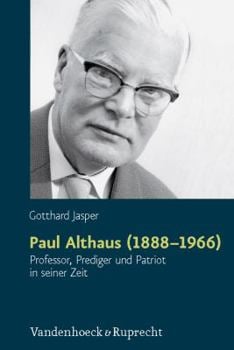
Photo credit: German Lutheran theologian Paul Althaus, from a ThriftBooks page containing his German language biography by Gottfried Jasper.
Summary: Analysis of the views of the founder of Protestantism, Martin Luther (1483-1546) regarding justification, salvation, & “faith alone”, including agreements with Catholicism.













 Ad-Free & Subscriber Log-In