

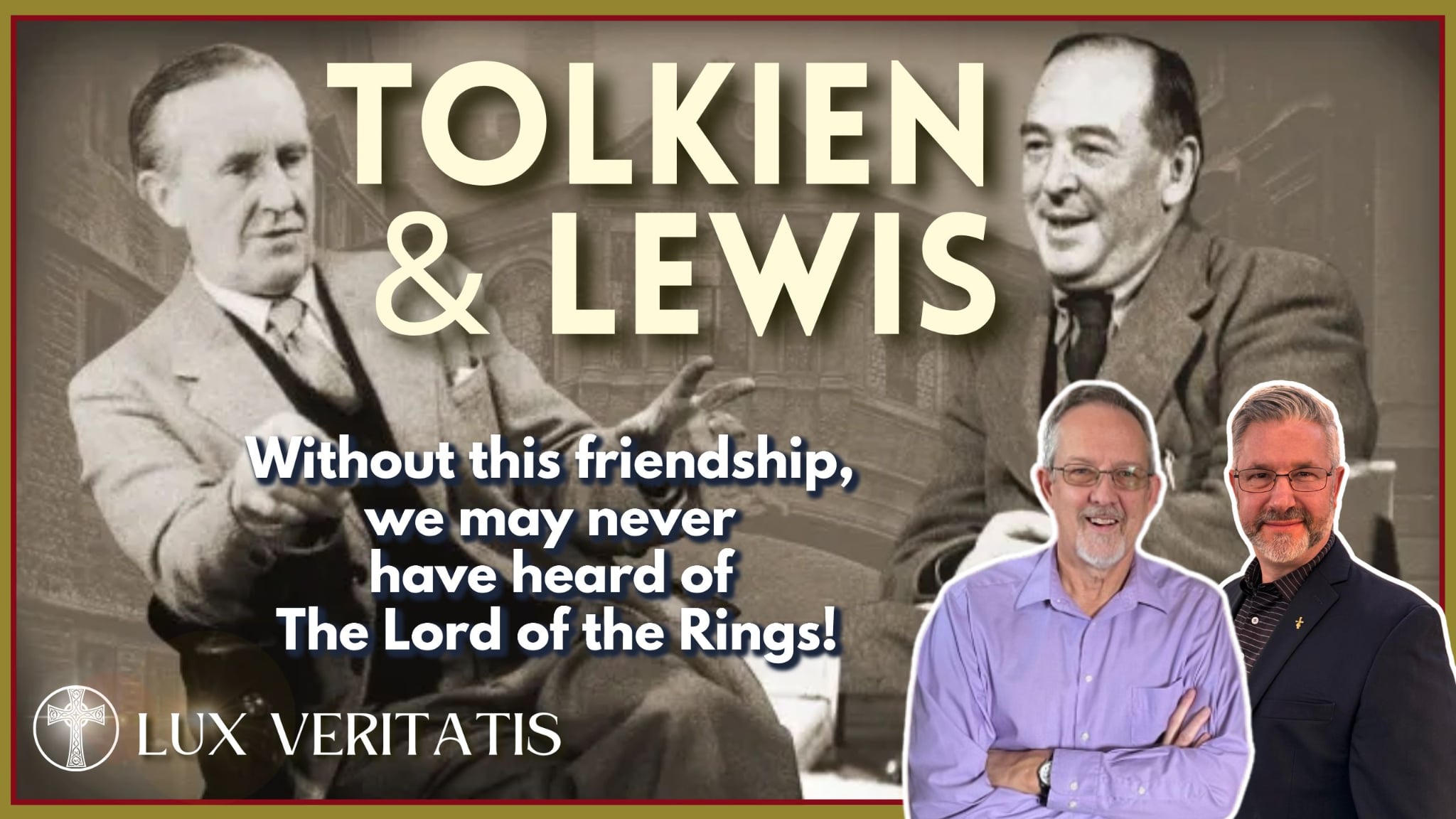
This is the transcript (minus the discussion afterwards) of the video, “The Friendship that SAVED The Lord of the Rings!! – C.S. Lewis & Tolkien” (Lux Veritatis, 8-24-25, with Kenny Burchard). Lewis’ words will be in blue; Tolkien’s in green.
*****
J. R. R. Tolkien (1892-1973) was a professor of linguistics and the history of texts and words, at Oxford, and author of The Hobbit and the three-volume fantasy, The Lord of the Rings. The latter is perhaps the most popular and best-selling book of the last seventy years, and Tolkien’s influence as the “father of modern fantasy” is seen in the recent movies based on these works.
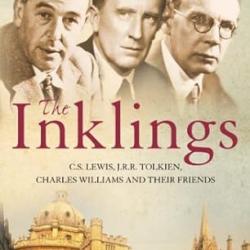
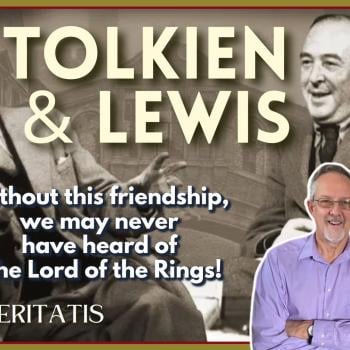
C. S. Lewis (1898-1963), the great Anglican apologist, author of The Problem of Pain and The Screwtape Letters and the fantasy series, Chronicles of Narnia was very good friends with Tolkien at Oxford and the two were key members of the famous literary discussion group known as the Inklings. Tolkien also played a very important role in Lewis’ return to Christianity in 1931.
Here’s how Tolkien expressed it:
I have never had much confidence in my own work, and even now when I am assured (still much to my grateful surprise) that it has value for other people, I feel diffident, reluctant as it were to expose my world of imagination to possibly contemptuous eyes and ears. But for the encouragement of C.S.L. I do not think that I should ever have completed or offered for publication The Lord of the Rings. [The Letters of J. R. R. Tolkien, selected and edited by Humphrey Carpenter, Boston: Houghton Mifflin Co.: 1981; to Clyde S. Kilby, 18 December 1965, 366]
Three months earlier here’s what he said,
The unpayable debt I owe to him was not ‘influence’ as it is ordinarily understood, but sheer encouragement. He was for long my only audience. Only from him did I ever get the idea that my ‘stuff’ could be more than a private hobby. But for his interest and unceasing eagerness for more I should never have brought The Lord of the Rings to a conclusion. [Letters, 362; to Dick Plotz, 12 September 1965]
Anglican historian Alister McGrath noted:
Every writer needs encouragement to write, both in terms of discernment of possibilities and getting the job done . . .
Tolkien had the same problem. He was a man of immense creativity who nevertheless needed someone to affirm him in what he was writing – and, more important, persuade him to finish it. . . .
Lewis showed considerable personal commitment to encouraging Tolkien in his literary endeavors . . . [C. S. Lewis: A Life, Carol Stream, Illinois: Tyndale House Pub., Inc.: 2013, 197, 199]
Lewis mentioned that he had visited Tolkien at his home in December 1939 and recorded that “We had a very pleasant evening . . . reading our recent chapters to each other – his from his new Hobbit and mine from the ‘Problem of Pain’.” [The Collected Letters of C. S. Lewis, Volume II: Books, Broadcasts, and the War 1931-1949, edited by Walter Hooper, HarperSanFrancisco: 2004, 302; to Warnie Lewis, 3 Dec. 1939] But Lewis had been encouraging Tolkien’s writings as early as eight years before. In late 1931, according to Tolkien biographer, Humphrey Carpenter,
Lewis and Tolkien continued to see much of each other. Tolkien read aloud to Lewis from The Silmarillion, and Lewis urged him to press on and finish writing it. [Tolkien: A Biography, Boston: Houghton Mifflin Co., 1977, 148]
By the end of 1937 Tolkien reported that Lewis was reading the still-developing Lord of the Rings – begun in that year. [The Inklings, Humphrey Carpenter, New York: Ballantine Books, 1978, 71]
In March 1938, Tolkien wrote that Lewis thought early drafts of The Lord of the Rings were better than The Hobbit [Letters, 32, 34; to Stanley Unwin, 4 March 1938]. By December 1942, Lewis had read, by Tolkien’s report, the still incomplete Lord of the Rings many times [Letters, 58; to Stanley Unwin, 7 December 1942].
In 1944 Tolkien had reached a roadblock in writing his new book, and once again, it was Lewis who encouraged him to continue: “C.S.L. . . . is putting the screw on me to finish . . . I needed some pressure, & shall probably respond” [Letters, 68; to Christopher Tolkien, 30 March 1944]. A month later, he was manifesting significant renewed effort on the book: “I read my second chapter, Passage of the Dead Marshes, to Lewis . . . It was approved” [Letters, 73; to Christopher Tolkien, 23 April 1944].
He read another chapter to Lewis eleven days later [Letters, 77; to Christopher Tolkien, 4 May 1944]. Then a week after that, he happily announced, “I completed my fourth new chapter . . . which received fullest approbation from C.S.L.” [Letters, 79; to Christopher Tolkien, 11 May 1944]. Twelve days later, he wrote this:
I worked very hard at my chapter – it is most exhausting work . . . I wrote and tore up and rewrote most of it a good many times; but I was rewarded this morning, as both C.S.L. and C.W. [Charles Williams] thought it an admirable performance, and the latest chapters the best so far. Gollum continues to develop into a most intriguing character. [Letters; to Christopher Tolkien, 23 May 1944]
Lewis was even more impressed by the next installment, and wrote about it to his son. Here’s what he wrote:
I . . . read the last two chapters . . . to C.S.L. on Monday morning. He approved with unusual fervor, and was actually affected to tears by the last chapter, so it seems to be keeping up. [Letters; to Christopher Tolkien, 31 May 1944]
Lewis proclaimed about the still-nameless Lord of the Rings five months later:
Tolkien . . . is most important. The Hobbit is merely the adaptation to children of part of a huge private mythology of a most serious kind: the whole cosmic struggle as he sees it but mediated through an imaginary world. The Hobbit’s successor, which will soon be finished, will reveal this more clearly. . . . This is the private world of a Christian. He is a very great man. His published works (both imaginative & scholarly) ought to fill a shelf by now: but he’s one of those people who is never satisfied with a MS [manuscript] [Collected Letters, Vol. 2, 631; to Charles A. Brady, 29 Oct. 1944]
Tolkien kept working and by October 1949, The Lord of the Rings was finished (but was published in 1954-1955). C. S. Lewis ecstatically expressed his friend:
I have drained the rich cup and satisfied a long thirst. . . . the steady upward slope of grandeur and terror . . . is almost unequalled in the whole range of narrative art known to me. In two virtues I think it excels: sheer sub-creation . . . Also, in gravitas. No romance can repel the charge of ‘escapism’ with such confidence. . . .
I congratulate you. All the long years you have spent on it are justified. [Collected Letters, Vol. 2, 990-991; to J. R. R. Tolkien, 27 Oct. 1949]
Upon its acceptance for publication, Tolkien wrote to Lewis, and he replied like this:
Just a note to tell you with what agreeable warmth and weight your yesterday’s good news lies on my mind – with an inward chuckle of deep content. Foremost of course is the sheer pleasure of looking forward to having the book to read and re-read. . . . And I am of course very glad on your account too. I think the very prolonged pregnancy has drained a little vitality from you; there’ll be a new ripeness and freedom when the book’s out. [The Collected Letters of C. S. Lewis, Volume III: Narnia, Cambridge, and Joy 1950-1963, edited by Walter Hooper, HarperSanFrancisco: 2007, 249-250; to J. R. R. Tolkien, 13 Nov. 1952]
Lewis continued enthusiastically recommending and promoting The Lord of the Rings in the years after that. In letters to various people, he described it as a “great romance” and “immensely worth reading” [Collected Letters, Vol. 3, 371; 13 Oct. 1953], and wrote to the publisher,
I would willingly do all in my power to secure for Tolkien’s great book the recognition it deserves . . . I can’t tell you how much we think of your House for publishing it.
It would be almost safe to say that no book like this has ever been written. . . . No imaginary world has been projected which is at once so multifarious and true to its own inner laws . . . none so relevant to the actual human situation . . . [Collected Letters, Vol. 3, 383; 4 Dec. 1953]
On the same day he wrote to a friend, “Wouldn’t it be wonderful if it really succeeded (in selling, I mean)? It would inaugurate a new age. Dare we hope?” [Collected Letters, Vol. 3, 384; 4 Dec. 1953]. He calls it “glorious” [Collected Letters, Vol. 3, 570; 27 Feb. 1955] and “the book we have all been waiting for” [Collected Letters, Vol. 3, 774; 2 Aug. 1956], and “magnificent” [Collected Letters, Vol. 3, 1125; 21 Jan. 1960] and re-read it again [Collected Letters, Vol. 3, 784; 29 Aug. 1956]. He refers to “the glorious sea of Tolkien . . . three volumes and nearly as long as the Bible and not a word too long . . .” [Collected Letters, Vol. 3, 980-981; 14 Oct. 1958].
C. S. Lewis summed up Tolkien with regard to criticisms of his work:
No one ever influenced Tolkien . . . We listened to his work, but could affect it only by encouragement. He has only two reactions to criticism: either he begins the whole work over again from the beginning or else takes no notice at all. [Collected Letters, Vol. 3, 1049; 15 May 1959]
Anyone who loves The Lord of the Rings – and many tens of millions do — must be eternally grateful to Lewis, for his endless enthusiasm and encouragement of Tolkien to both write and finish it. If he had been mostly critical, it may very well never have appeared, since they were good friends and highly valued and respected each other’s literary opinions. Lewis, writing just two months before his death, accurately described his role with regard to Tolkien’s masterpiece:
I don’t think Tolkien influenced me. I am certain I didn’t influence him. That is, didn’t influence what he wrote. My continual encouragement, carried to the point of nagging, influenced him very much to write at all with that gravity and at that length. In other words I acted as a midwife, not as a father. [Collected Letters, Vol. 3, 1458; 23 Sep. 1963]
RELATED LINKS
The REAL REASON C.S. Lewis never became Catholic [in his own words] (our very popular video on this channel, from 5-12-25)
Romantic and Imaginative Theology: Inklings of Heaven (my web page)
C. S. Lewis: 20th-Century Christian Knight (my links page; no longer active, but massive resources, and many of the old links still work)
My Collected Writings About C. S. Lewis (last section [XX] of my web page, Calvinism & General Protestantism: Catholic Critique.
Photo Credit: copyright 2025 by Lux Veritatis.
Summary: The biggest fan of J. R. R. Tolkien’s fantasy masterpiece, The Lord of the Rings was his friend and fellow academic at Oxford, C. S. Lewis. I document their letters back and forth.









 Ad-Free & Subscriber Log-In