

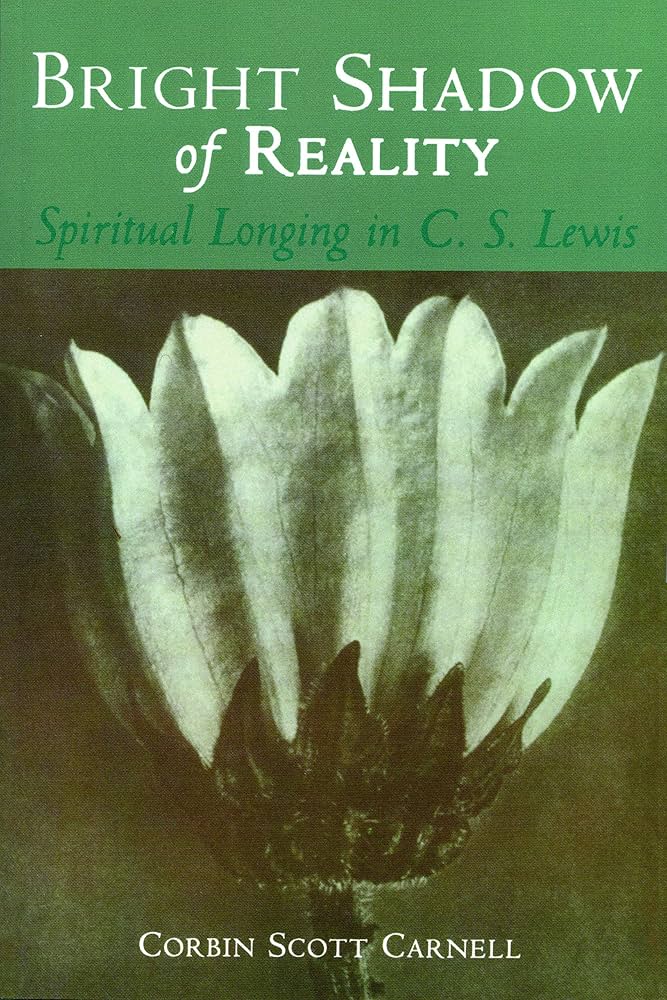
C. S. Lewis, the popular author of The Chronicles of Narnia and other works of fantasy-fiction, and widely considered the most influential defender of Christianity in the 20th century, thought that this experience of ecstasy, that he called “joy” in a particular sense, was of the utmost importance in his life, and indeed – when all is said and done — in everyone’s. We know that because he gave his autobiography the title, Surprised by Joy. It had a double meaning, referring to this ecstasy and also to his wife. And in that book, he wrote that “in a sense the central story of my life is about nothing else.”
Before we examine his thoughts about this intriguing topic, let’s first take a look at the Bible’s many statements about longing or desire for God. Here are fifteen of them:
Job 19:25-27 (RSV) For I know that my Redeemer lives, . . . [26] . . . from my flesh I shall see God, [27] . . . my eyes shall behold, and not another. My heart faints within me! (NIV, NKJV, “yearns”; NABRE: “my inmost being is consumed with longing”)
Psalm 27:4 (NIV) One thing I ask from the Lord, this only do I seek: that I may dwell in the house of the Lord all the days of my life, to gaze on the beauty of the Lord and to seek him in his temple.
Psalm 42:1-2 (RSV) As a hart longs for flowing streams, so longs my soul for thee, O God. [2] My soul thirsts for God, for the living God. When shall I come and behold the face of God?
Psalm 63:1 (NIV) You, God, are my God, earnestly I seek you; I thirst for you, my whole being longs for you, in a dry and parched land where there is no water.
Psalm 73:25 (RSV) . . . there is nothing upon earth that I desire besides thee.
Psalm 84:2 (NIV) My soul yearns, even faints, for the courts of the Lord; my heart and my flesh cry out for the living God.
Psalm 119:20 (NIV) My soul is consumed with longing for your laws at all times.
Psalm 145:19 (RSV) He fulfils the desire of all who fear him, . . .
Ecclesiastes 3:11 (RSV) . . . he has put eternity into man’s mind . . .
Isaiah 26:9 (NIV) My soul yearns for you in the night; in the morning my spirit longs for you.
Romans 8:18 (RSV) I consider that the sufferings of this present time are not worth comparing with the glory that is to be revealed to us.
1 Corinthians 2:9-10 (RSV) But, as it is written, “What no eye has seen, nor ear heard, nor the heart of man conceived, what God has prepared for those who love him,” [10] God has revealed to us through the Spirit. For the Spirit searches everything, even the depths of God.
2 Corinthians 5:2 (RSV) Here indeed we groan, and long to put on our heavenly dwelling,
Philippians 1:21, 23 (RSV) For to me to live is Christ, and to die is gain. . . . [23] . . . My desire is to depart and be with Christ, for that is far better.
Hebrews 11:16 (RSV) . . . they desire a better country, that is, a heavenly one . . . .
Perhaps this provides a clue as to the ultimate origin of the longings and desires of Lewis (and those of all of us, at a deep level)? In his autobiography, Lewis reports that
Once in those very early days my brother brought into the nursery the lid of a biscuit tin which he had covered with moss and garnished with twigs and flowers so as to make it a toy garden or a toy forest. That was the first beauty I ever knew.
But the really fascinating thing is how he described a memory of this toy garden that came later, between the ages of six to eight, as he recalled:
As I stood beside a flowering currant bush on a summer day there suddenly arose in me without warning, and as if from a depth not of years but of centuries, the memory of that earlier morning . . . when my brother had brought his toy garden into the nursery. It is difficult to find words strong enough for the sensation which came over me; Milton’s “enormous bliss” of Eden . . . comes somewhere near it. It was a sensation, of course, of desire; but desire for what? not, certainly, for a biscuit-tin filled with moss, . . . before I knew what I desired, the desire itself was gone, the whole glimpse withdrawn, the world turned commonplace again, or only stirred by a longing for the longing that had just ceased. It had taken only a moment of time; and in a certain sense everything else that had ever happened to me was insignificant in comparison.
Then Lewis described the related “idea of Autumn” that hit him like a thunderbolt:
The second glimpse came through Squirrel Nutkin; through it only, though I loved all the Beatrix Potter books. . . . It troubled me with what I can only describe as the Idea of Autumn. It sounds fantastic to say that one can be enamoured of a season, but that is something like what happened; and, as before, the experience was one of intense desire. And one went back to the book, not to gratify the desire . . . but to re-awake it. And in this experience also there was the same surprise and the same sense of incalculable importance. It was something quite different from ordinary life and even from ordinary pleasure; something, as they would now say, “in another dimension”.
The third thing in his early childhood that provoked these feelings of wonder and intense longing was his introduction, through poetry, to “northernness”. This developed into his love of Norse mythology and Richard Wagner’s operas that explored this deep well of fantasy and fairy tale, anticipating Lewis’ good friend J. R. R. Tolkien’s Lord of the Rings in many respects. Lewis summed up these three episodes in his life as:
an unsatisfied desire which is itself more desirable than any other satisfaction. I call it Joy, . . . Joy (in my sense) has indeed one characteristic, and one only, in common with them; the fact that anyone who has experienced it will want it again. . . . I doubt whether anyone who has tasted it would ever, if both were in his power, exchange it for all the pleasures in the world.
Young Lewis was no ordinary child, but was he tapping into something common to all people, or at least the more imaginative ones? It seems so. What he describes is what was known in early 19th century German romanticism as sehnsucht [pronounced zeen-zoked]. Lewis used this word to describe his experience. He grew up in Belfast, which is surrounded by the beautiful Castlereagh Hills, 1568 feet, or 478 meters at their highest, whereas the lower areas of Belfast are at sea level. These played a role in the spiritual ecstasies of Lewis as well. He wrote about his early childhood:
Every day there were what we called “the Green Hills”; that is, the low line of the Castlereagh Hills which we saw from the nursery windows. They were not very far off but they were, to children, quite unattainable. They taught me longing . . .
Interestingly, Van Morrison, my favorite singer, who is also from Belfast, wrote in a similar way about these hills and how they made him feel, in his song, On Hyndford Street, from 1991:
Going up the Castlereagh hills . . . and coming back . . . feeling wondrous and lit up inside with a sense of everlasting life . . .
And in the quietness we sank into restful slumber in silence and carried on dreaming in God.
In Surprised by Joy, Lewis recounted another extraordinary experience along these lines that he had at around age 14:
The authentic “Joy” . . . had vanished from my life: so completely that not even the memory or the desire of it remained. . . . Joy is distinct not only from pleasure in general but even from aesthetic pleasure. It must have the stab, the pang, the inconsolable longing.
This long winter broke up in a single moment, . . . Someone must have left in the schoolroom a literary periodical: The Bookman, . . . My eye fell upon a headline and a picture, carelessly, expecting nothing. A moment later, as the poet says, “The sky had turned round.”
What I had read was the words Siegfried and the Twilight of the Gods. What I had seen was one of Arthur Rackham’s illustrations to that volume. I had never heard of Wagner, nor of Siegfried. . . . Pure “Northernness” engulfed me: a vision of huge, clear spaces hanging above the Atlantic in the endless twilight of Northern summer, remoteness, severity… and almost at the same moment I knew that I had met this before, long, long ago . . . And with that plunge back into my own past there arose at once, almost like heartbreak, the memory of Joy itself, the knowledge that I had once had what I had now lacked for years, . . . a single, unendurable sense of desire and loss, which suddenly became one with the loss of the whole experience, which, as I now stared round that dusty schoolroom like a man recovering from unconsciousness, had already vanished, had eluded me at the very moment when I could first say It is. And at once I knew (with fatal knowledge) that to “have it again” was the supreme and only important object of desire.
Lewis repeatedly referred back to this theme and even developed it into a longing for heaven or argument from desire: a proposed proof for God’s existence and also of the reality of heaven. Writing to his good friend Arthur Greeves when he was an atheist on 21 March 1916, Lewis proclaimed:
I know quite well that feeling of something strange and wonderful that ought to happen, and wish I could think like you that this hope will someday be fulfilled . . .
C. S. Lewis became convinced of Christianity on 19 September 1931, after discussions with Tolkien and Hugo Dyson. On 24 October 1931 he wrote the following remarks in a letter to his brother Warnie:
It certainly seems to me that the ‘vague something’ which has been suggested to one’s mind as desirable, all one’s life, in experiences of nature and music and poetry . . . and which rouses desires that no finite object even pretends to satisfy, can be argued not to be any product of our own minds.
Lewis wrote in his 1933 novel, The Pilgrim’s Regress, his first Christian book:
“Romanticism” . . . was a particular recurrent experience which dominated my childhood . . . inanimate nature and marvellous literature were among the things that evoked it. I still believe that the experience is common, commonly misunderstood, and of immense importance . . .
The experience is one of intense longing . . . This hunger is better than any other fullness . . .
Later in the same book he describes it as “Something possessed, if at all, only in the act of desiring it, and lost so quickly that the craving itself becomes craved . . .” Revisiting the topic in his 1940 book, The Problem of Pain, in chapter 10, Lewis states:
You have never had it. All the things that have ever deeply possessed your soul have been but hints of it—tantalising glimpses, promises never quite fulfilled, echoes that died away just as they caught your ear . . . We cannot tell each other about it. It is the secret signature of each soul, the incommunicable and unappeasable want . . .
In his sermon, “The Weight of Glory,” preached in the Church of St. Mary at Oxford, on June 8, 1941, he tied sehnsucht directly to heaven:
The books or the music in which we thought the beauty was located will betray us if we trust to them; it was not in them, it only came through them, and what came through them was longing. . . .
Our lifelong nostalgia, our longing to be reunited with something in the universe from which we now feel cut off, to be on the inside of some door which we have always seen from the outside, is no mere neurotic fancy, but the truest index of our real situation. And to be at last summoned inside would be both glory and honour beyond all our merits and also the healing of that old ache. . . .
We do not want merely to see beauty, . . . We want something else which can hardly be put into words–to be united with the beauty we see, to pass into it, to receive it into ourselves, to bathe in it, to become part of it.
He elaborated further in the Preface to the 1943 edition of The Pilgrim’s Regress:
It appeared to me . . . that if a man diligently followed this desire, pursuing the false objects until their falsity appeared and then resolutely abandoning them, he must come out at last into the clear knowledge that the human soul was made to enjoy some object that is never fully given . . . The dialectic of Desire, faithfully followed, would retrieve all mistakes, . . . and force you not to propound, but to live through, a sort of ontological proof.
Lewis summed up his ecstatic experiences of what he called “joy” in a letter dated 19 March 1955:
My own experience is rather ‘devastating desire’ – desire for that-of-which-the-present-joy-is-a-Reminder. All my life nature and art have been reminding me of something I’ve never seen: saying ‘Look! What does this – and this – remind you of?’
The thinking of C. S. Lewis along these lines, and the experiences he so brilliantly describes, provide a fruitful avenue of inquiry and hope during a time of loss of faith, millions never having had faith at all, and leading lives of meaninglessness and despair.
My Related Articles
On Sehnsucht & Longing (C. S. Lewis & the Romantics) [11-13-01]
The Relationship of Romanticism to Christianity and Catholicism in Particular (Dave Armstrong) [2001, at Internet Archive]
My Related Web Pages
Romantic and Imaginative Theology: Inklings of Heaven
C. S. Lewis: 20th-Century Christian Knight [no longer active, but the scores of links are either available online or, if defunct, usually at Internet Archive]













 Ad-Free & Subscriber Log-In