

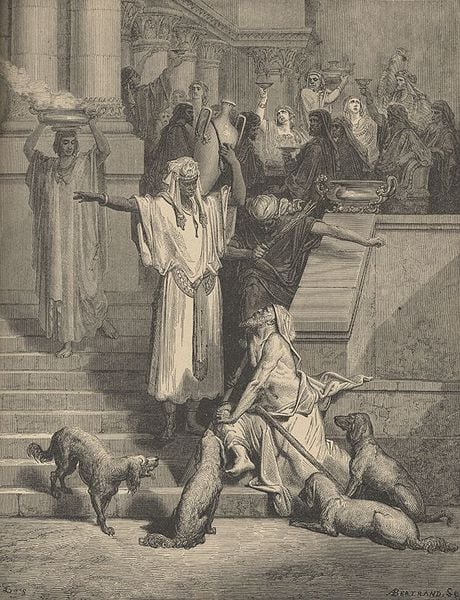
This exchange took place in the combox of our video, “Can Catholics Pray to Saints? YES! This Bible Passage Proves It!” (2-6-26), about Luke 16 and the rich man praying to Abraham, with a Protestant who went by the nickname, @danielhaas9469. All of his words appear, in blue. I have made a few minor changes — clarifications or improvements — to my words and have corrected some grammatical elements in his. Words of a second Protestant commenter are in green, and of a third Protestant, in purple.
*****
*
*
All of this has been dealt with many times over, and you still don’t grapple with all that we set forth. But at least you put up some level of fight.
*
Okay great :) let’s then discuss those other areas that you have dealt with. I haven’t watched every video you have posted but I am certainly willing to listen so long as we can do this with respect. I did post another response of yours when you said something like Jesus sanctioned praying to death as well and I made some other insights. Let’s discuss :)
*
Another interesting question from me to you is: I agree, there are bad arguments; necromancy is not a good argument, because, you in our physical body/ tent conjure up a spirit or spirits to gain information from the dead ones. If such a person were to do this, especially under the Old Covenant which was expressly forbidden was primarily in trusting solely upon the LORD. It is the LORD who cares for us; It is the LORD who hears us; It is the LORD who saves us. Moving forward to praying to saints in the way that I have experienced it and in the way you seem to profess you are still not solely relying upon the LORD in those cases. Why? Because if you ask Mary to help you with a certain or to help you find your car keys (saints have certain alleged attributes to ask them to do various things), pray to this saint under [insert question]. So in these you truly are not relying upon the LORD who cares for you and will answer you because He promises you He would.
*
I have read prayers to Mary that ask her because through her all graces flow in which case you redirect all of your concerns to her instead of Jesus. Even for YOUR salvation prayers exists to Mary that says that by a word from Mary you would be saved. This no longer solely relies upon the LORD who is our Redeemer. It is literally about who are we putting our trust in and if we put our trust solely upon the LORD I am convinced wholeheartedly that I can ask of Him and He will answer me and help me. See the trust that I have here? I am not being arrogant or boastful in myself but I boast in the LORD who can save me and will save me and not just me but anybody who calls upon the name of the LORD.
*
Yeah, of course you can pray directly to God whenever you want. That said, the Bible also teaches that the wise spiritual person can — if they wish — find the holiest person that they can find and ask them to pray for their intention, because “the prayer of the righteous man availeth much” (James 5:16, I believe). I collected no less than 42 Bible passages that teach that.
*
I mostly address direct responses to the actual arguments I made in these videos. That’s what the comboxes are supposed to be (but rarely are online). But once again we’re off down various rabbit trails. Have a nice hike! :-) But stick around. It looks like we can have some good discussions, long as they are on-topic! I like to interact with serious thinkers (and you are that).
*
Okay, fair enough, if you think I went down a rabbit hole. So at timestamp marker of 20:12 or so either you or your co-host asked why was God never mentioned in the whole story? Well, its because that is not the point our LORD is making with respect to the shepherds in His day. Notice, in the OT before the Messiah comes, the shepherd’s / rulers of Israel would be corrupt, breaking Gods covenant honoring with their lips but their hearts are far from [Him]. I am not going to list all the prophets in full, but certainly see Isaiah starting at around [chapter] 40, that when He comes all His adversaries will be crushed. We need to be ever so careful when reading God’s word without some type of theological filter like (systematic theology or some other abstraction) that pulls you away from the point that God is making.
*
See also Malachi about the coming messenger YHWH will send and will be sent in judgement against the shepherds. See also Haggai whom God explicitly calls them wicked and corrupt and will leave their house desolate. This is precisely what Jesus is speaking of in Luke and exposing the corruption of the leaders of His day, just as the prophets spoke saying would happen when the Messiah comes many would not be falling the Law many would be leading others astray. So these teachings are not about some abstraction of praying to saints, but rather exposing the Jews/Jewish religious orders that they are corrupt; they claim to follow the Law but are hypocrites; they parade themselves out to be holy and righteous to His people but are whitewashed tombs.
*
When you compare Luke 15 all the way through Luke 16, that is the context. Jesus is hammering them over their ungodliness even though they claim to be operating within God’s law when they are not. So anytime we see Jesus exposing the religious leaders and or ruling class of His day this is to fulfil what was spoken of when the Messiah came. Therefore, the reason why Jesus never mentions praying to God rather than to Abraham, is because Jesus is exposing their wickedness.
*
*
This also fits perfectly well within Mathew’s Gospel starting in [chapter] 23, when Jesus really hammers the religious body and is exposing their wicked ways. Luke and Mathew here are in alignment: that when the Messiah comes the shepherds would be corrupt and the Messiah would use parables in order to communicate to them as what was foretold concerning Him when He came. So when we read even the synoptic Gospels we must read them with respect to the prophets and what the political and religious shepherds who were in charge of the care of God’s sheep would be like. All of this was foretold and came to pass, just as the Lord said it would even up to the destruction of the Temple in 70 AD because God said “if you break any letter of the Law I will destroy you.” God is faithful to His word and did exactly what He said He would do if the Jews broke the covenant.
*
That’s all fine and dandy, and is likely true. But it’s irrelevant to our argument. As an analogy, it would be like Jesus preaching the Sermon on the Mount and throwing in at the end a tidbit about unicorns actually existing, and (as a bonus) saying that 2 + 2 = 5. Those things wouldn’t be the essence of the sermon at all, but if they were there, there would be a problem, whatever the point of the sermon was, because Jesus cannot and would not ever teach any error.
*
That’s the difficult spot that Protestants are in with Luke 16. Jesus teaches a terrible error, according to their existing (false) views about the invocation and intercession of departed saints and the broader issue of the nature and scope of prayer itself, so what do they do about it? There are only so many choices:
*
1. Deflect and ignore the problem (that’s the “solution” of all the vocally critical Protestants so far in this thread).*2. Start playing the theological liberal game of claiming that this aspect was an addition to the text and not genuine (Jesus didn’t actually say it). This is completely arbitrary and based on no evidence.*3. Start believing that the Bible itself contains errors (questioning its inspired and inerrant status).*4. Start believing that Jesus could commit errors because He’s not in fact God in the flesh.*5. Or admit that we — and Jesus, as it were — are right and that asking dead saints to intercede is biblical teaching and good and true, and face the consequences (it may mean in the long run having to become Catholic, in order to have a coherent, self-consistent view).
*
I believe that #5 is the key to the whole thing, and easily explains relentless Protestant behavior and rabbit-trail non sequiturs in this combox. If someone feels they can’t answer, but they can’t concede the point because of the scary implications, then that’s a very difficult place. So they ignore and deflect. But Luke 16 is what it is, and anyone who accepts the inspiration of Holy Scripture and the divinity of our Lord Jesus Christ has to seriously grapple with it, wherever it might lead, and get beyond the pat, tired, irrelevant “replies”.
*
We’re here to assist anyone who is starting to travel the road of conversion to the Catholic Church. Me and Kenny — and our wives — have experienced that (their conversion was much more recent), and he works with The Coming Home Network, that helps people cope with these sorts of tensions and new, annoying questions that have to be adequately addressed for the sake of spiritual well-being.
*
My job as an apologist is to explain and defend Catholic beliefs and to show that they are more biblical, historical, and logical than other Christian or secular views that are contrary to them. Apologetics helps people to be confident and whole-hearted in what they believe, because they know why they do, and can understand it and explain it to others without fear or anxiety (due to not knowing these things).
*
I notice now that you did directly address one of our arguments: “you assume the idea that Abraham could do something about the Richman’s state that is not what you read from the text. Abraham tells them that his brothers have the Law and the Prophets – moreover Abraham tells him that since they won’t listen to the Law and the Prophets nor will they listen to a man raised from death. See the point?”
*
I don’t see it, because you are assuming that a non-answer to a prayer means that Abraham is not able to receive prayer, or do anything about it, and that the fact that they could learn from the Law and the prophets somehow has a bearing on whether Abraham can do those things (logically, it doesn’t). This breaks down, because it would apply to God also, Who also many times refuses our prayer requests in cases where they go against His will. And God oftentimes tells us or puts the thought in our minds that we can figure something out without His direct guidance (what job to take; what girl to go out with, etc.).
*
I think the most reasonable interpretation of the whole exchange is that the prayers aren’t answered because they are against God’s will (i.e., the same reason God refuses some prayer requests). If indeed Abraham couldn’t answer petitions (as God’s representative), then it’s most reasonable to believe that he would have said so (as we argued): something like, “why are you asking me? Don’t you know you can only ask God for these things, and must always pray directly to Him, and that I can’t do anything about this, as a mere man?!” That’s what he would have had to say and/or what Jesus would have pointed out, if Protestant objections are correct.
*
If Jesus were against such prayers, I submit that He would have never — in a million years — told this story in the first place, with seeming perfect agreement with it. It makes no sense at all, because He would be telling a story about prayer (among other things), and if it must only be to God, why is it that Jesus teaches that prayer to Abraham is fine and dandy, and God is never mentioned at all? It’s the very last way to teach that we ought to only pray to God. That’s why it cannot be force-fit into Protestantism — no way no how –, and why all the Protestant objections in this combox miss the very heart and essence of the force of our argument. It’s not dealt with because it cannot be, from Protestant premises.
*
It would be very difficult to face this as a Protestant. I understand that. It’s very difficult to change one’s mind in deep matters of God and theology. But we have to follow Jesus wherever He leads us, no?
*
When dealing with context, we must strive to reduce the amount of assumptions based on our presuppositions that Jesus IS speaking about prayer in this story/event. We must first understand why Jesus even speaks to them in the first place, correct? In “chapter 15” (Though a different topic we must not forget that chapter breaks were not original nor mean to be a the source of a break of an event). So in chapter 15 the Pharisees are upset with Jesus who consistently is being seen with sinners. Jesus then tells them that would you not find the lost sheep, the lost coin etc. As he uses these allegories to force the shepherds into rethinking about how they are treating “sinners” poorly.
*
Then we move to chapter 16 where he explains to His disciples about a rich man etc. Notice how the Pharisees — being rich themselves — are again deriding Jesus. But Jesus says, you claim to be righteous but God knows your hearts and what they deem to be of high stature is an abomination to God. Notice now Jesus then uses the Law and the Prophets and then exposing the Pharisees for breaking the Law and writing a bill of divorce, and Jesus quotes the Law as the Pharisees themselves broke the Law. So we are dealing with corrupt Law-breaking Pharisees and Jesus is exposing them.
*
Then he moves into the rich man and Lazarus, [and] about how the rich man did not follow the Law and the Prophets – As what did God say to Moses and His prophets? You are to care for the oppressed the orphan the widow. The rich man who could have easily cared for Lazurus, [but] did not listen to God and His prophets. They both died. So before I move on, I think it is important for us to see in context that what is being discussed isn’t about praying to saints; it is NOT about two dead men who are communicating in an intercessory role. This would be superimposing a theological disposition onto the text that the context itself is not warranted.
*
Then we move into the actual story where again the rich man notices Abraham and Lazarus in good spirits and he is in torment. He requests Abraham to send Lazarus to help him out. But Abraham tells him of his life and why he was there. Then the rich man asks him to send word to his brothers so that they won’t [end up there]. To this Abraham says, they have the LAW and the PROPHETS. Abraham is redirecting him to the law and the prophets. Lets take a moment and say, if this were about intercessory prayer I would expect Abraham to tell the rich man to hold tight as he will seek the Lord’s council here! Right, do you follow this?
*
In the book of Enoch we do in fact read of an Angel asking for intercessory prayer to Enoch and then Enoch then asks God and then God gives him the answer to be brought back to the angel. Here Abraham doesn’t say anything to God at all, I know you mentioned this but I think you are inserting this theological disposition onto the text rather than reading what is in context, with respect to how the rich man treated Lazarus while under the law. If you make any other attempt to assert that this is talking about intercessory prayer, you actually end up with more questions that you now must ask.
*
Why did Abraham seemingly usurp God [by] not taking that request to God? You may say, well that is because God told Abraham not to answer him (this would be of silence since we don’t a record of Abraham reaching out to God). Why would Jesus introduce a topic that is completely random and not in context with the narrative that Luke to Theophorous is trying to communicate? An example of this would like; I complain to my brother about when I watch TV you start reading a book. And then my brother says look out the window and see a rabbit building a nest? We must keep what Jesus is saying and communicating into the proper context.
*
And [the context is] that the Jews who were claiming to be righteous who knew the Law but weren’t following the Law and they were adding or losening [sic?] to Gods’ law, which is why Jesus brought up marriage in the first place and the Law itself about caring for God’s people — as they were the shepherds. See also the vineyard story, and then compare that to Old Testament prophecies about when the Messiah would come, how corrupt and wicked vile that generation would be as spoken by Isiah and Hagga etc etc. The point is these men were corrupt and God is going to punish ALL unrighteousness in accordance [with] the breaking of God’s Law and this was done at 70 AD when God truly made Jerusalem desolate and obliterated the temple.
*
As I already argued, it doesn’t matter in the slightest that prayer is not the main focus of the story. All of what you say about the focus could very well be true. If it were completely true, it would have no adverse effect on our argument at all. Zero, zilch, nada. The problem is that it’s there and doesn’t fit Protestant theology and Jesus can’t commit an error, and the Bible is inspired. How many times do I have to say this?
*
But I think it actually is at least partially the focus, because it takes up most of the story, after all, with the three petitions and three refusals, and explanation why he was refused. More than one thing could be going on. “Why did Abraham seemingly usurp God [by] not taking that request to God?” Because he — as God’s delegated representative — didn’t have to consult God. This was a petition ripe to be refused as improper. Abraham knew enough as a perfected saint, to refuse it on behalf of God.
*
“Why would Jesus introduce a topic that is completely random and not in context with the narrative that Luke to Theophorous is trying to communicate?” He doesn’t “introduce” anything. He’s recounting — according to our explanation and interpretation — an event that actually happened, and this was part of it. Good and fun discussion, but you’re still mostly on the rabbit trails, and it looks like you intend to stay on ’em!
*
How am I going off on a rabbit trail? I am being very thorough in our dialogue that we can’t do what you want it to do. You are making the assumption that it is teaching intercessory prayer. It is not! You also assume Abraham is God’s representative and is perfected in Hades by the way. None of this is found in the text. You are [projecting] this onto the text and not reading the verse in its context, as I have demonstrated, and I am not in any way going to assume something unless it warrants some type inference to the contrary?
*
Let’s use this example, Let’s say instead of them being dead, they are still alive in their physical body on earth! For the sake of argument, assume that I am the rich man and you are Abraham. Where do you get this understanding that Abraham is an active mediator between God and himself? Moreover, where do you get this notion that Abraham is in a perfected state? See the assumptions that you are creating? Now you may [say], “well when God visited him in Genesis about Sodom and Gomorrah, did Abraham not intercede to God?” I would say, yes and no. Abraham certainly spoke to God, raising concerns about the city being destroyed and how God would respond if there were some righteous living there.
*
But no, because God removes Lot and his daughters from the city. So even here, while God comforts Lot in saying that God would spare the whole city for the sake of one righteous but as we see God still destroys it and has Lot and his family flee. We must be extremely extremely careful, going beyond the scope of his teaching. Even if the event is true this is NOT about intercessory prayer. Again [this] is why; it is about following God’s law. Abraham knew about God’s law. and consistently redirects him to the Law.
*
It would be you telling me that you know God’s ways and you choose to live a life that is in disobedience to God’s ways. That is NOT you in any way mediating between myself you and God! It is just regurgitating what I already knew, if what you say [were] true. Firstly, you wouldn’t have to make an assumption about Abraham and his ability to answer prayers. You assume this. But what we actually read is much more simplistic and is easier to understand. Abraham told the rich man [that] he was in torment because he did NOT follow the law. It is literally that. If you can demonstrate in context that Jesus is teaching and sanctioning intercessory prayer you have not demonstrated it; just assumed it.
*
He’s asking (petitioning / praying to) Abraham to fulfill supernatural requests that — as far as we know from the Bible — only God can fulfill, either directly or through an intermediary (Abraham). Funny you should bring up Lot and Sodom. In that story, Lot prays to / petitions two angels and they grant his request. He’s on the earth, and the request is granted: thus overcoming two of the failed objections to Luke 16:
Genesis 19:15, 17-21 (RSV) When morning dawned, the angels urged Lot, saying, “Arise, take your wife and your two daughters who are here, lest you be consumed in the punishment of the city.” . . . [17] . . . they said, “Flee for your life; do not look back or stop anywhere in the valley; flee to the hills, lest you be consumed.” [18] And Lot said to them, “Oh, no, my lords; [19] behold, your servant has found favor in your sight, and you have shown me great kindness in saving my life; but I cannot flee to the hills, lest the disaster overtake me, and I die. [20] Behold, yonder city is near enough to flee to, and it is a little one. Let me escape there . . . and my life will be saved!” [21] He said to him, “Behold, I grant you this favor also, that I will not overthrow the city of which you have spoken.”
The two angels function as God’s messengers or intermediaries, and as such can fulfill what is essentially a prayer request: precisely as I have argued regarding Abraham. In other words, we have explicit biblical precedent. Hence, the Lutheran Keil and Delitzsch Biblical Commentary on the Old Testament comments on this passage:
There is nothing to indicate that Jehovah suddenly joined the angels. The only supposition that remains, therefore, is that Lot recognised in the two angels a manifestation of God, and so addressed them (Genesis 19:18) as Adonai (my Lord), and that the angel who spoke addressed him as the messenger of Jehovah in the name of God, without its following from this, that Jehovah was present in the two angels.
Another Protestant, who goes by “Grace Answers” on Facebook, chimed in when I posted notice of this article on Facebook:
*
*
***
*
Practical Matters: I run the most comprehensive “one-stop” Catholic apologetics site: rated #1 for Christian sites by leading AI tool, ChatGPT — endorsed by popular Protestant blogger Adrian Warnock. Perhaps some of my 5,000+ free online articles or fifty-six books have helped you (by God’s grace) to decide to become a Catholic or to return to the Catholic Church, or better understand some doctrines and why Catholics believe them. If you believe my full-time apostolate is worth supporting, please seriously consider a much-needed monthly or one-time financial contribution. “The laborer is worthy of his wages” (1 Tim 5:18, NKJV).
*
PayPal donations are the easiest: just send to my email address: [email protected]. Here’s also a second page to get to PayPal. You’ll see the term “Catholic Used Book Service”, which is my old side-business. To learn about the different methods of contributing (including Zelle and 100% tax-deductible donations if desired), see my page: About Catholic Apologist Dave Armstrong / Donation Information.
*
You can support my work a great deal in non-financial ways, if you prefer; by subscribing to, commenting on, liking, and sharing videos from my two YouTube channels, Catholic Bible Highlights and Lux Veritatis, in partnership with Kenny Burchard (see my own videos), and/or by signing up to receive notice for new articles on this blog. Just type your email address on the sidebar to the right (scroll down quite a bit), where you see, “Sign Me Up!” Thanks a million!
*
***
*
Photo credit: Print illustrating the story of the rich man and Lazarus, from the Gospel of Luke, by Gustave Doré (1832-1883) [public domain / Wikimedia Commons]
Summary: Exchange with a Protestant who insists that Luke 16 (the story of Lazarus and the rich man in Hades) does not sanction prayer to a saint at all, when it clearly does do so.












 Ad-Free & Subscriber Log-In